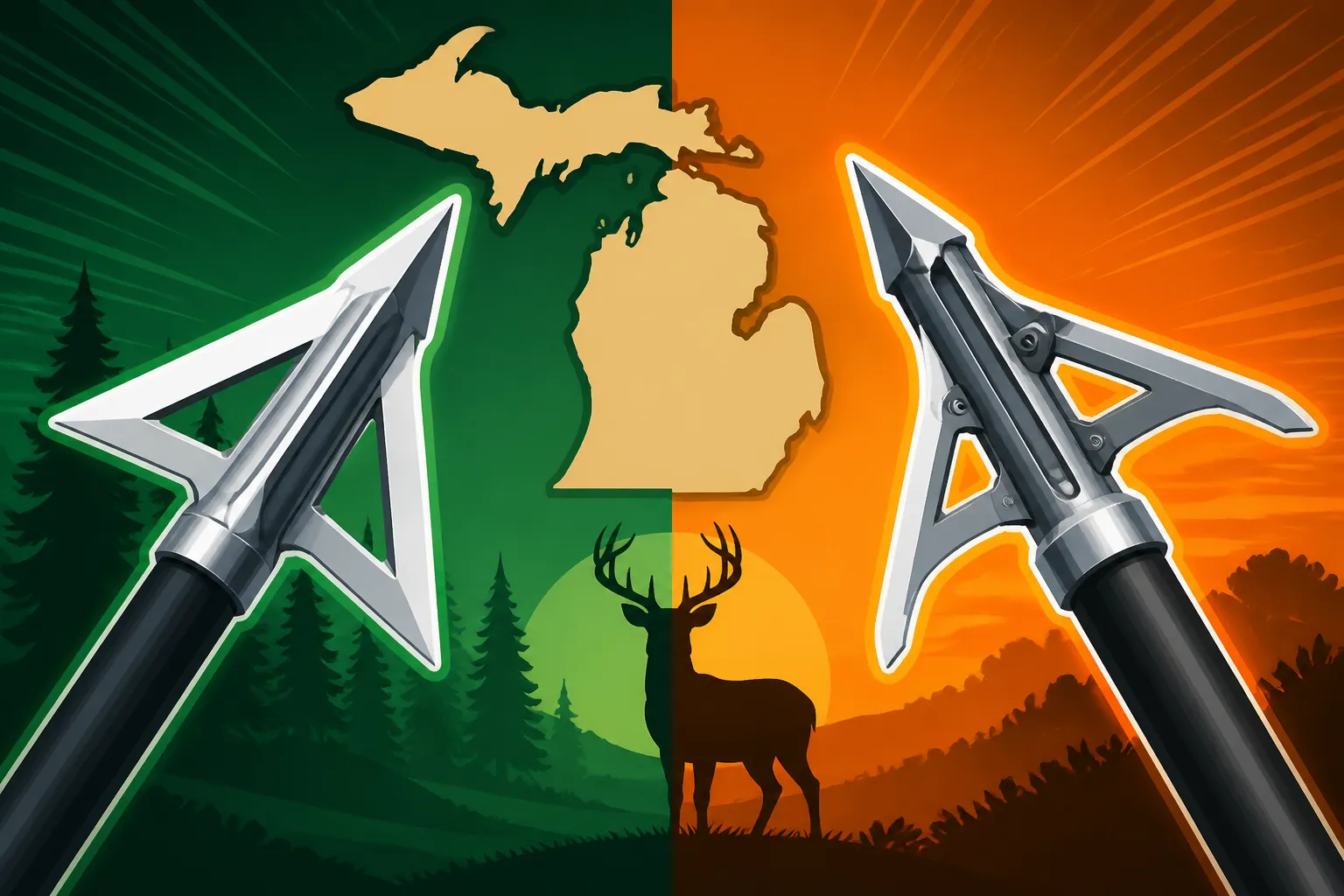
Fixed Versus Mechanical Broadheads
One of the biggest head-scratchers for any Michigan bowhunter, whether you're chasing whitetails in the Lower Peninsula hardwoods or venturing into the U.P. for a black bear, is which broadhead to screw onto your arrow. It's a choice that can feel overwhelming, with countless designs promising unmatched accuracy and devastating effectiveness. This guide aims to cut through the noise, helping you understand the real-world differences between fixed-blade and mechanical broadheads so you can make an informed decision for your next hunt.
Understanding the Core Differences: Fixed vs. Mechanical
The debate between fixed-blade and mechanical broadheads has been a campfire staple for decades, and for good reason. Each type has a distinct design philosophy and, consequently, different performance characteristics in the field. It’s not just about what looks cool; it’s about what will reliably perform when that moment of truth arrives, often in less-than-ideal conditions deep in Michigan's timber.
The Enduring Appeal of Fixed-Blade Broadheads
Fixed-blade broadheads are the veterans of the archery world, tried and true for generations. Their design is inherently simple: blades are rigidly attached to the ferrule, meaning they are always exposed and always ready. There are no moving parts to fail, no deployment mechanisms to worry about, and no O-rings or springs to maintain. This simplicity is often their greatest strength, providing a level of reliability that many hunters swear by, especially when chasing bigger game or hunting in remote, rugged areas where equipment failure is simply not an option.
When you launch a fixed-blade broadhead, what you see is what you get. The blades are already in their full cutting position, designed to start working the instant they make contact. This translates to excellent penetration, especially on bone. Imagine a Michigan whitetail quartering away, and your arrow clips the shoulder blade on its way through. A well-designed fixed-blade broadhead, with its stout construction and strong tip, is engineered to punch through or break bone, maximizing the chances of reaching vital organs. This robust nature also makes them incredibly durable; a fixed blade can often be resharpened or have its blades replaced, allowing for multiple uses if the ferrule remains intact after a clean pass-through. For hunters who prioritize maximum penetration and worry about anything that could go wrong with moving parts, fixed blades remain the gold standard.
The Evolution and Advantages of Mechanical Broadheads
Mechanical broadheads, also known as expandable broadheads, represent a more modern approach to archery hunting. Their defining feature is the blades that remain tucked away during flight and deploy upon impact. This design was born from a desire to achieve field-point accuracy—meaning the broadhead flies like your practice points—while still delivering a devastating wound channel. The tucked-in blades present a smaller profile during flight, reducing drag and making them less susceptible to wind planing, which can sometimes be an issue with larger, fixed-blade designs, especially at higher arrow speeds.
The primary allure of mechanical broadheads is their ability to create significantly larger cutting diameters than most fixed blades. Once deployed, these blades can expand to an inch and a half, two inches, or even more, creating a massive wound channel that leads to rapid blood loss and, ideally, a quicker, more ethical harvest. This larger cutting surface can be incredibly forgiving on marginal hits, increasing the chances of hitting a major artery or vein even if the shot isn't perfectly centered in the vitals. Picture a nervous whitetail ducking slightly at the sound of your shot, causing the arrow to strike a bit higher than intended. A mechanical broadhead with a wide cutting diameter might still clip the top of the lungs or sever a major vessel, leading to a much better outcome than a narrow fixed blade on the same shot. Many hunters find the confidence that comes with field-point accuracy and an expansive wound channel a game-changer, especially for those longer shots from a Treestand Setups in Michigan Hardwoods or for hunters looking to maximize their odds on a once-in-a-lifetime buck.
Performance in Real Michigan Hunting Scenarios
Michigan's diverse hunting landscape, from the dense cedar swamps of the Upper Peninsula to the sprawling agricultural fields of the southern Lower, presents a variety of challenges for any bowhunter. The performance of your broadhead isn't just theoretical; it's deeply practical, influenced by everything from the thickness of a deer's hide in November to the potential for hitting a rib.
Penetration and Durability in Tough Michigan Conditions
When you're talking about penetration in Michigan, you're really talking about what happens when your arrow meets resistance. Will it blow through a rib, or will it deflect? Will it get stuck in the shoulder, or will it punch through to the vitals? This is where the core design differences between fixed and mechanical broadheads really come into play.
Fixed-blade broadheads, with their robust construction and often solid tips, excel in situations where heavy resistance is expected. Their blades are rigid and supported, meaning they maintain their structural integrity even when encountering bone. If you hit a deer's shoulder blade or a heavy rib cage, a strong fixed blade is more likely to drive through, maintaining a straight path to the vitals. This can be critical when hunting larger game like a Michigan black bear, or a big U.P. buck that's put on a lot of fat and muscle by late fall. The thick hide, dense muscle, and strong bone structure of these animals demand a broadhead that won't buckle or lose energy upon impact. For example, if you're targeting a mature buck from a Hunting the Pre-Rut in Late October stand and your shot angle means there's a good chance of hitting the off-side shoulder, a fixed blade might offer you greater peace of mind regarding pass-through potential.
Mechanical broadheads, while delivering massive cutting diameters, can sometimes face challenges with extreme penetration and durability. The deployment mechanism, while designed to be robust, can introduce points of potential weakness under severe stress. If a mechanical broadhead hits a heavy bone directly, the blades might not fully deploy, or they could bend or break, reducing penetration and wound channel effectiveness. This isn't to say mechanicals can't penetrate; many modern designs are incredibly tough and perform exceptionally well. However, when comparing apples to apples, a simple, strong fixed blade often has an edge in bone-shattering penetration. Furthermore, in really cold Michigan weather, say during the late archery season, some mechanical mechanisms might be slightly stiffer or collect ice, potentially affecting deployment, though this is rare with quality modern designs. Consider your Bow Draw Weight for Michigan Whitetails and Arrow Weight for Short Shots too, as these factors significantly influence penetration regardless of broadhead type.
Accuracy and Flight Characteristics
Accuracy is paramount in bowhunting. It doesn't matter how big the wound channel is if you don't hit your target cleanly. This is where mechanical broadheads truly shine for many archers. Because their blades are tucked away during flight, they mimic the aerodynamic profile of a field point. This means that an arrow tipped with a mechanical broadhead often flies very similarly to one tipped with a practice point, requiring minimal to no tuning adjustments to achieve perfect flight. This "field-point accuracy" is a huge advantage for hunters, especially those who struggle with tuning or who want the simplest path to consistent groupings. This can make preparation for Bowhunting Michigan's Split Archery Season much simpler.
Fixed-blade broadheads, on the other hand, can be more sensitive to tuning issues. Their exposed blades create more drag and can catch the wind, causing the arrow to plane or steer off course, especially at higher arrow speeds or over longer distances. Achieving perfect flight with fixed blades often requires meticulous bow tuning—paper tuning, walk-back tuning, and ensuring your arrows are perfectly spined for your setup. It's a skill that takes practice and patience. However, once tuned, a well-flying fixed blade is incredibly consistent and predictable. Hunters who spend the time to perfectly tune their bow and arrows can achieve excellent accuracy with fixed blades, and they appreciate that there's no question about blade deployment once the arrow leaves the string. For those who hunt dense Michigan timber where shots are often short and precise, the absolute reliability of a tuned fixed blade is hard to beat, assuming the hunter has mastered their bow setup.
Making Your Choice: Matching Broadhead to Hunter and Game
Deciding between fixed and mechanical isn't about one being inherently "better" than the other. It's about finding the right tool for your specific hunting style, your equipment, and the game you're pursuing in Michigan. It's a personal journey that involves understanding your own strengths and limitations as a shooter.
Factors for Michigan Hunters to Consider
Michigan hunters face a diverse set of conditions and game species, all of which should factor into your broadhead choice. First, consider your archery setup. If you're shooting a traditional bow with lower Minimum Draw Weight for Michigan Deer, a fixed blade might be a better choice to maximize penetration, as mechanicals typically require a certain amount of kinetic energy to ensure full deployment. Faster, heavier compound bows can generate enough energy for almost any mechanical broadhead. Your typical shot distance is also crucial. If you primarily hunt from a ground blind or a ladder stand in thick cover where shots are almost always under 30 yards, the slight aerodynamic advantages of mechanicals might be less critical than the raw penetration of a fixed blade. Conversely, if you hunt open field edges or aspire to take slightly longer shots, the field-point accuracy of a mechanical might instill more confidence.
Another significant factor is the game animal itself. For Michigan whitetails, both broadhead types are highly effective when properly placed. However, if you're lucky enough to draw a Michigan bear tag, or if you plan to hunt anything with thicker hide and heavier bone than a deer, the robust construction and deep penetrating capabilities of a quality fixed blade might give you an edge. Many hunters choose to use a specific fixed blade for bear and then switch to mechanicals for deer. Finally, consider your personal confidence. If you consistently struggle to get fixed blades to fly true from your bow, switching to a mechanical that flies like a field point will undoubtedly improve your accuracy and, consequently, your ethical harvest rate. Confidence in your equipment translates directly to better shooting.
Testing and Tuning for Optimal Performance
Regardless of which broadhead style you choose, the absolute most critical step is rigorous testing and tuning. You can read every review and listen to every opinion, but nothing replaces putting arrows downrange with your specific bow, your arrows, and your chosen broadheads. Start by ensuring your bow is perfectly tuned with field points. This means checking cam timing, arrow rest alignment, and nock point. Once your field points are flying perfectly, then—and only then—introduce your broadheads.
For fixed blades, this is where the real work begins. You'll likely need to make small adjustments to your arrow rest, or perhaps even experiment with different fletching configurations, to get those fixed blades to group with your field points. It can be a frustrating process, but the reward is a system you can trust implicitly. For mechanical broadheads, the tuning process should theoretically be simpler. If your bow is well-tuned with field points, many mechanicals will hit the exact same spot. However, you must verify this. Shoot several broadheads at various distances, checking for consistent flight and grouping. You also need to confirm that your mechanical broadheads are deploying consistently and correctly upon impact into a target. This ensures the blades aren't sticking or deploying mid-flight. Resources like GoHunt can provide comparison data and user reviews that might help narrow down choices, but always remember to do your own in-person testing. Don't wait until the opening day of Michigan's archery season to find out your broadheads aren't flying true! Broadheads for Timber Shots need to be tested just as much as those for longer shots.
| Feature | Fixed-Blade Broadheads | Mechanical Broadheads |
|---|---|---|
| Blade Design | Blades are rigid and exposed during flight. | Blades retract during flight, deploy on impact. |
| Flight Accuracy | Can be more sensitive to tuning; may plane in wind. | Generally offers "field-point accuracy"; less drag. |
| Penetration | Excellent, especially on bone; robust construction. | Good, but can be compromised by heavy bone hits. |
| Wound Channel | Typically narrower, clean cuts. | Can create significantly wider wound channels. |
| Reliability | Very high; no moving parts to fail. | High, but relies on deployment mechanism. |
| Durability | Often reusable if ferrule is intact; blades can be resharpened. | May be single-use after impact; blades can bend/break. |
| Kinetic Energy Req. | Generally effective with lower draw weights. | Typically requires higher kinetic energy for full deployment. |
Ultimately, the best broadhead is the one you have the most confidence in and can shoot most accurately with your setup. Whether it's the tried-and-true reliability of a fixed blade or the impressive cutting diameter and accuracy of a mechanical, both are lethal tools in the hands of a responsible and well-practiced Michigan hunter. Spend time at the range, get to know your gear, and hunt ethically.
Disclaimer
This article is for general informational purposes only and does not constitute professional advice. Laws, prices and regulations vary by location and change over time. Consult a qualified professional for guidance on your specific situation.