Shotgun Slugs for Michigan Deer
The distinct crack of a rifle shot often signals deer season for many hunters, but if you've hunted in Michigan, especially south of the line, you know that sound is often replaced by the thump of a shotgun slug. It can be incredibly frustrating to feel like you're limited in your firearm choice, or to invest in a piece of equipment only to find its performance lacking or confusing. This guide is here to unravel the mysteries of shotgun slugs for Michigan deer hunters, helping you understand their role, capabilities, and how to get the most out of your setup in a state where they remain a crucial tool.
The Enduring Role of Shotgun Slugs in Michigan Deer Hunting
For generations of Michigan deer hunters, the shotgun has been the primary tool for putting venison in the freezer. It’s a tradition born out of necessity, a response to specific regulations designed to ensure safety in more densely populated areas. While some might view it as a limitation, the reality is that modern shotgun slug technology has transformed what was once a short-range, less precise option into a highly effective deer stopper.
Navigating Michigan's Limited Firearm Zone
If you’ve ever looked at a Michigan hunting map, you've seen that imaginary line cutting across the Lower Peninsula, delineating what we affectionately call the "shotgun zone" or, more formally, the "Limited Firearm Zone." This regulation was put in place decades ago to address concerns about public safety in areas with higher population densities, more roads, and smaller parcels of private land. The idea was that shotgun slugs, with their generally shorter effective range compared to high-powered rifle cartridges, would reduce the risk of stray bullets traveling long distances and posing a threat to non-hunters or homes.
This geographical restriction often leads to a unique set of challenges and frustrations for hunters. For those who hunt both north and south of the line, it means owning and maintaining different firearms for essentially the same pursuit. It can feel like an unfair burden, especially for new hunters trying to get into the sport without breaking the bank. Understanding Where Michigan Limits Rifles for Deer is the first step, and it really sets the stage for why shotgun slugs aren't just an option, but a requirement for many. The good news is that advancements have made this requirement less of a handicap and more of a specialized skill.
Modern Slug Technology: Not Your Grandpa's Shotgun
Forget the image of your grandpa's old single-shot, bead-sighted slug gun that you could only hope would hit a pie plate at 50 yards. While those guns certainly put meat on the table, modern slug technology has advanced by leaps and bounds. Today's slug guns, particularly those with dedicated rifled barrels, can achieve accuracy comparable to many rifles out to 150 yards, and even beyond in some specialized setups. This isn't just about the slugs themselves; it's about the entire system.
The biggest game-changer has been the widespread adoption of rifled barrels, which spin the slug just like a rifle bullet, vastly improving stability and accuracy. Coupled with advanced sabot slugs, which we'll dive into shortly, these setups can be incredibly precise. Hunters are now routinely mounting high-quality optics, often 1-4x or 2-7x scopes, on their slug guns, further enhancing their ability to make ethical, precise shots at extended ranges. This evolution means that hunting in the limited firearm zone no longer means sacrificing significant range or accuracy; it just means a different kind of precision.
Understanding Slug Types and Their Performance
When you walk into a sporting goods store, the variety of shotgun slugs on the shelf can be dizzying. Different manufacturers, different weights, different designs—it’s enough to make your head spin. But at their core, shotgun slugs generally fall into two main categories, each designed to work best with a specific barrel type, and understanding this distinction is crucial for maximizing your setup's performance.
Rifled Slugs vs. Sabot Slugs: Making the Right Choice
This is where the rubber meets the road for slug gun accuracy. The two primary types of slugs you'll encounter are rifled slugs (often called Foster or Brenneke slugs) and sabot slugs. They are fundamentally different in their design and how they interact with your shotgun barrel.
-
Rifled Slugs: These are the classic, older-style slugs. They are typically made of solid lead and have slanted "rifling" grooves on their exterior. Ironically, these grooves aren't meant to spin the slug (they're not deep enough to engage with a smoothbore barrel for rotational stability). Instead, they're designed to allow the slug to compress and safely pass through a constricted shotgun choke without damaging the barrel. Rifled slugs perform best in smoothbore barrels, which are standard shotgun barrels without any rifling. They achieve some stability from their nose-heavy design, like a shuttlecock, but generally offer limited accuracy beyond 75-100 yards. They're excellent for close-range work, especially in thick Michigan cover where shots are often 50 yards or less, and they tend to be more affordable.
-
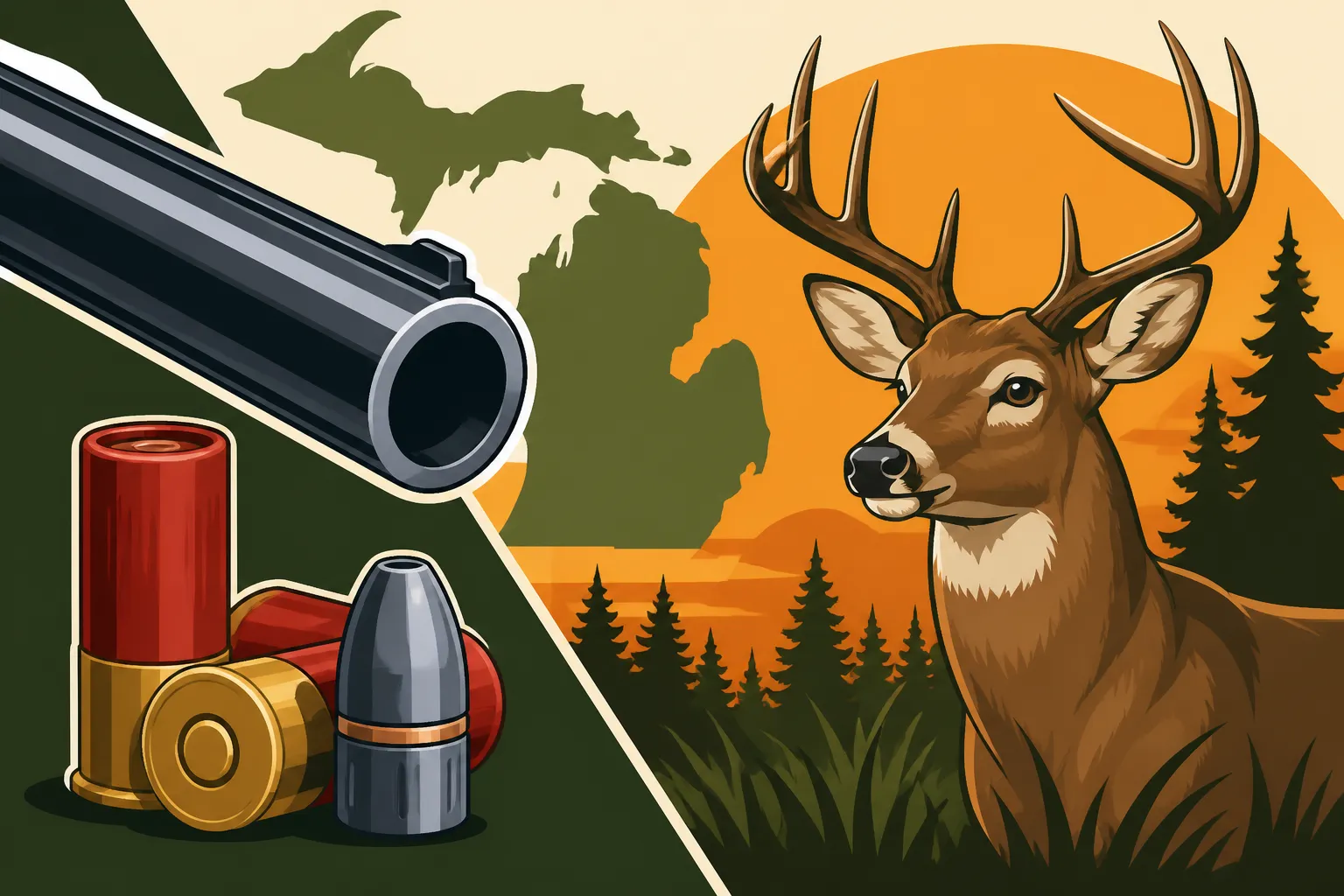
Sabot Slugs: These are the modern marvels. A sabot slug consists of a smaller, rifle-like bullet (often copper, lead, or a combination) encased in a plastic sleeve, or "sabot." When fired, the sabot engages with the rifling in a rifled shotgun barrel, spinning the bullet. Once the slug leaves the muzzle, the sabot falls away, and the now-spinning bullet continues on a much flatter, more accurate trajectory. Sabot slugs are designed only for rifled barrels. If you shoot a sabot slug through a smoothbore barrel, it won't spin, and its accuracy will be abysmal, often worse than a rifled slug. They are generally more expensive but offer significantly improved accuracy and range, often extending ethical shot distances well beyond 100 yards, making them ideal for hunters needing more reach in areas where rifles aren't allowed. Zeroing at 100 Yards for Woods Hunting becomes a much more achievable and practical goal with a quality sabot slug setup.
Here's a quick comparison of the two:
| Feature | Rifled Slugs (Foster/Brenneke) | Sabot Slugs |
|---|---|---|
| Barrel Type | Smoothbore (unrifled) | Rifled (dedicated slug barrel) |
| Accuracy | Good out to 75-100 yards | Excellent, 150+ yards with good setup |
| Range | Shorter, best for close quarters | Longer, flatter trajectory |
| Projectile | Solid lead, external "rifling" | Rifle-like bullet in a plastic sabot |
| Cost | Generally less expensive | Generally more expensive |
| Purpose | Traditional, dense cover, brush | Modern, open areas, longer shots |
| Recoil | Can be stout due to heavier lead slug | Varies, often less perceived due to design |
Straight-Wall Cartridges and the "Shotgun Zone" Evolution
Michigan's Limited Firearm Zone has seen an evolution in recent years, which has brought another option to the table for hunters: straight-wall rifle cartridges. Recognizing the advancements in firearm technology and the desire for hunters to have more versatile and accurate options, the state began allowing certain straight-wall rifle cartridges in the previously "shotgun-only" zone. These cartridges, like the .450 Bushmaster or .350 Legend, are designed to mimic the ballistic characteristics (specifically, the limited range potential) of shotgun slugs, while offering rifle-like accuracy and feel.
This change has been a huge relief for many hunters who prefer the ergonomics and precision of a rifle over a shotgun. It offers a flatter trajectory and often less recoil than many heavy slug loads, making it easier for some hunters to shoot accurately. However, it's not a blanket replacement; understanding Straight-Wall Cartridges Legal in Michigan is vital, as only specific calibers are permitted. For those dedicated to their shotguns, or those not wanting to invest in a new rifle, shotgun slugs remain an incredibly effective and legal option, especially with modern sabot technology. Whether you choose a shotgun slug or a straight-wall cartridge, the key is knowing your equipment and practicing with it.
Optimizing Your Slug Gun Setup for Michigan Deer
Getting the most out of your shotgun for deer hunting, especially with slugs, isn't just about loading a shell and pulling the trigger. It's about building a system. Just like a rifle hunter carefully matches their caliber to their intended game and range, a slug gun hunter needs to consider their barrel, optics, and ammunition to create an accurate and ethical hunting tool.
Barrels and Optics: Key to Accuracy
The foundation of any accurate slug gun is its barrel. If you're using a smoothbore barrel, you'll be limited to rifled slugs and generally shorter ranges. While perfectly effective in dense cover, for instance, when Hunting Michigan Swamp Edges for Deer, where shots are often up close, it won't give you the reach of a rifled barrel. For maximum accuracy and range with sabot slugs, a dedicated rifled slug barrel is almost a necessity. These barrels have helical grooves that spin the sabot, imparting stability to the projectile, much like a rifle. Many shotgun manufacturers offer interchangeable rifled barrels for their popular models, allowing you to convert your bird gun into a deer gun with a simple swap.
Once you have an appropriate barrel, good optics are paramount. Trying to shoot slugs precisely with just a bead sight or even basic open sights is challenging, especially beyond 50 yards or in low light. A low-power variable scope, such as a 1-4x or 2-7x, is ideal. These scopes offer enough magnification for precise shots at typical slug ranges but also provide a wide field of view for quick target acquisition in thick cover. Look for scopes with good Low-Light Performance in a Scope, as many Michigan deer are taken at dawn or dusk. Mounting your scope correctly with sturdy rings is crucial, as shotgun recoil can be stout and will test the integrity of your setup. Platforms like GoHunt can sometimes offer insights into popular gear choices or setup recommendations from other hunters, giving you a good starting point for your own research.
Ammunition Selection and Patterning Your Gun
This is perhaps the most critical, and often most overlooked, aspect of slug gun accuracy. Unlike rifles, where many different brands of ammunition in the same caliber will often shoot similarly, shotgun slugs are notoriously finicky. What shoots like a dream in one slug gun might group horribly in another identical model. You absolutely must test different brands and types of sabot slugs through your specific barrel.
Purchase a few different boxes of sabot slugs from various manufacturers—Hornady, Federal, Winchester, Remington, etc.—and head to the range. Shoot at 50 yards initially, then extend to 100 yards if your groups are good. You are looking for consistent groups of 3 inches or less at 100 yards for ethical deer hunting. This process is often called "patterning" your slug gun, though it's more akin to rifle group testing than birdshot patterning. Take detailed notes, and don't be discouraged if your gun "hates" a particular slug; it's just telling you to try another. Once you find the slug your gun prefers, buy several boxes of that same lot number if possible, as even slight variations between production runs can sometimes affect accuracy.
Practical Considerations and Field Tactics
So, you've got your optimized slug gun, you've patterned it meticulously, and you're ready for Hunting Michigan's November Firearm Deer Season. Now it's time to think about how this specialized tool performs in the real world and how to use it effectively to fill your tag.
Range Limitations and Ethical Shots
Even with modern sabot slugs and a rifled barrel, it's important to be realistic about the practical and ethical range limitations of a shotgun. While some hunters claim impressive groups at 200 yards, for the vast majority, 150 yards is generally considered the maximum ethical range for deer with a slug gun setup. Beyond that, energy retention drops significantly, and trajectory becomes much more rainbow-like, making precise shot placement challenging, especially if the deer takes a step. Your goal is always a clean, humane kill, and that means knowing your maximum effective range with your specific gun and ammunition.
Practice at various distances, including those closer "chip shots" that are common in Michigan's dense woods. A deer might pop out at 30 yards just as easily as 100. Understanding the trajectory of your chosen slug is critical. Does it drop 6 inches at 150 yards? Knowing this allows you to hold over appropriately and make an ethical shot. When using platforms like GoHunt for scouting, you can even mark potential stand locations and estimate shot distances, helping you visualize your ethical range limits in specific hunting scenarios.
Hunting Scenarios Where Slugs Shine
Shotgun slugs excel in many typical Michigan hunting scenarios, particularly where dense cover and shorter sight lines are the norm.
-
Thick Brush and Swamps: In areas like cedar swamps or heavy thickets, deer often won't present long shots. The heavy hitting power of a slug at close to medium range is devastating. Whether you're still-hunting through a pine plantation or set up on a deer trail along a marsh edge, a slug gun is right at home. Consider using a compact treestand or ground blind, especially in areas like the southern Michigan farm country, where visibility can be limited by standing crops or brush. Treestand Setups in Michigan Hardwoods can be adapted for slug guns, focusing on maximizing visibility at the ranges you know you can shoot accurately.
-
Deer Drives: For many Michigan hunters, especially those in the firearm season, deer drives are a time-honored tradition. In these situations, shots are often fast and at relatively close range as deer are pushed through cover. A slug gun's ability to put a large, heavy projectile on target quickly and with tremendous knockdown power makes it very effective. For safety, always be aware of your surroundings, your shooting lanes, and the location of other hunters during a drive.
-
Small Woodlots and Farm Edges: In agricultural areas, deer often spend their days bedded in small woodlots or creek bottoms, venturing out to crop fields at dawn and dusk. Setting up a ground blind or a strategically placed stand on a field edge or pinch point can offer excellent opportunities. A well-placed slug gun can handle these scenarios with ease, ensuring a quick harvest without the worry of a high-velocity rifle round traveling across open farmland. Remember to always be mindful of Michigan Safety Zone Rules around occupied buildings when hunting near farms.
Ultimately, while the shotgun zone may feel restrictive, the capabilities of modern slug guns mean you're far from under-gunned. With the right setup, thorough practice, and an understanding of your equipment's limitations, your slug gun will be a reliable, ethical, and effective tool for chasing Michigan whitetails.
Disclaimer
This article is for general informational purposes only and does not constitute professional advice. Laws, prices and regulations vary by location and change over time. Consult a qualified professional for guidance on your specific situation.