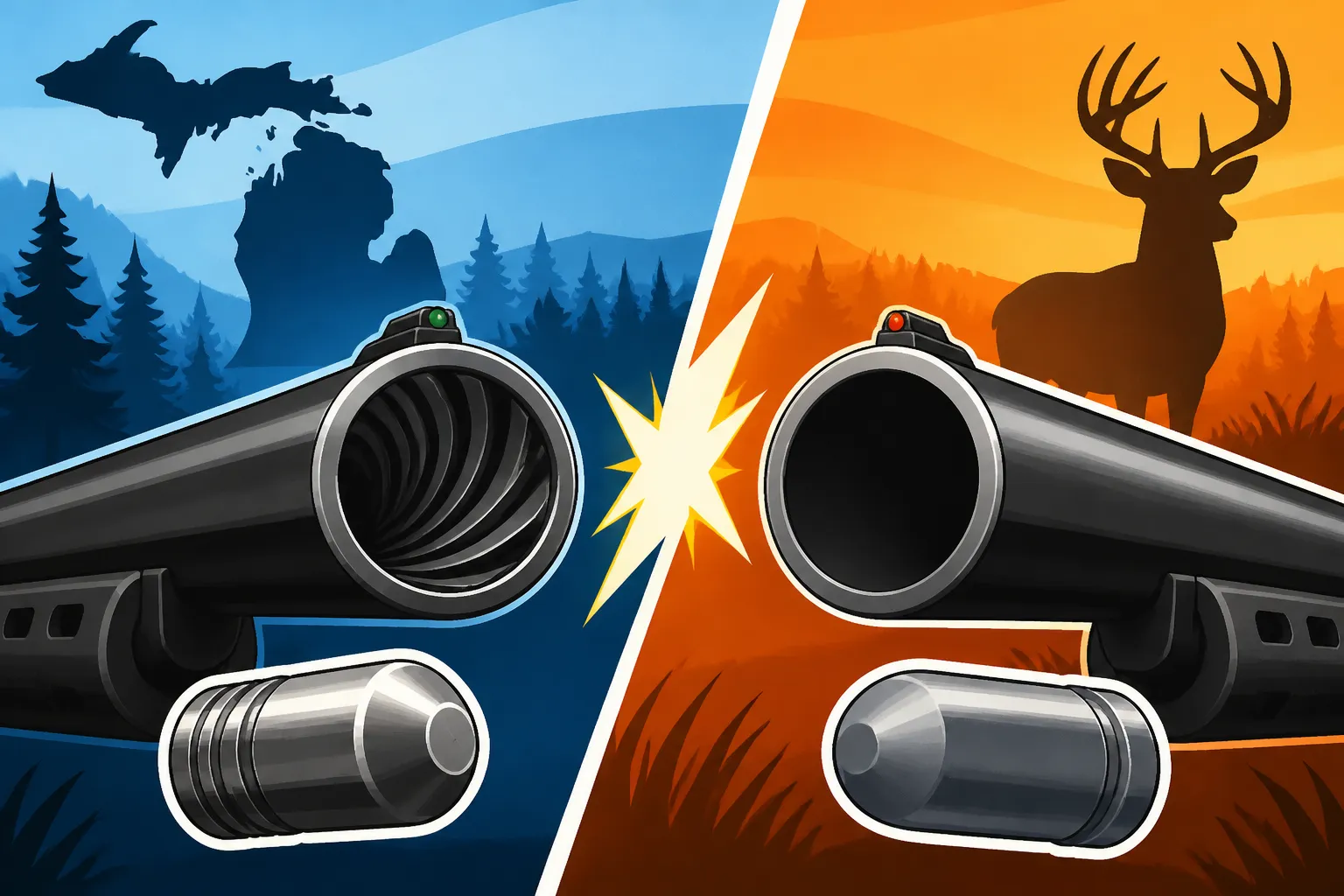
Rifled Versus Smoothbore Slug Barrels
There’s a common dilemma many Michigan deer hunters face, especially if you hunt in the southern Lower Peninsula: how do you get rifle-like accuracy when you're restricted to shotguns? The choice between a rifled slug barrel and a traditional smoothbore can feel overwhelming, with countless opinions flying around deer camp. This guide is here to cut through the noise, demystify both barrel types, and help you understand which one truly fits your Michigan hunting style and the terrain you’ll be covering.
Understanding the Fundamental Differences
When you're gearing up for deer season in Michigan, especially in the "Limited Firearm Zone" where traditional rifle cartridges are restricted, your shotgun becomes your primary tool. This means delving into the nuances of shotgun barrels is absolutely essential. It’s not just about pulling a trigger; it’s about understanding how your barrel interacts with your ammunition, and that critical interaction is what determines your accuracy and effective range in the field.
The Classic Smoothbore Barrel
Let's start with the familiar. A smoothbore barrel is exactly what it sounds like: the interior is perfectly smooth, without any grooves or spiraling cuts. This design is what makes a shotgun so incredibly versatile, allowing it to efficiently launch everything from fine birdshot for pheasants, to heavy buckshot for coyotes, and of course, slugs for deer. When hunting deer with a smoothbore, you'll typically be using "Foster" or "Brenneke" style slugs. These slugs are designed to be weight-forward, sometimes with external fins, to create some aerodynamic stability as they fly. However, they don't spin. Think of it like throwing a dart versus spinning a football. While these slugs can deliver substantial knockdown power at close range, their lack of stabilizing spin means their accuracy often diminishes quite rapidly beyond 50 to 75 yards. Many Michigan hunters have a smoothbore that pulls double or triple duty, and for those close-range encounters in thick cover, it’s a perfectly capable and proven setup.
The Modern Rifled Slug Barrel
Now, envision taking the precision engineering of a rifle barrel and applying it to a shotgun platform. That's essentially what a rifled slug barrel achieves. These barrels feature distinct helical grooves cut into the interior, just like a rifle. Their specific purpose is to impart a rapid spin on a specialized projectile: the sabot slug. A sabot slug is typically a smaller, rifle-like bullet encased within a plastic sleeve (the sabot). As the slug travels down the barrel, the rifling engages the plastic sabot, forcing the entire assembly to spin. Once it exits the muzzle, the plastic sabot separates and falls away, leaving the spinning bullet to continue on a much straighter, more stable trajectory. This technological advancement effectively transforms a standard shotgun receiver into a precision deer hunting instrument, allowing for significantly greater accuracy and extended effective ranges compared to any smoothbore setup. This distinction is particularly important for hunters operating in the What the Michigan Limited Firearm Zone Means, seeking performance that bridges the gap between traditional slug guns and true rifles.
Smoothbore Shotguns: When They Shine (and When They Don't)
For generations, the smoothbore shotgun was the quintessential deer gun for many Michigan families, particularly in regions where rifle hunting wasn't permitted. It was, and still is, a reliable workhorse. However, understanding its strengths and weaknesses is paramount to maximizing your success in the varied Michigan landscape.
The Practical Advantages for Michigan Hunters
One of the biggest upsides of a smoothbore shotgun is its incredible versatility and often lower entry cost. If you're a hunter who enjoys pursuing multiple game species throughout the year, a single shotgun with a smoothbore barrel can truly be your do-it-all firearm. From chasing pheasants to calling in turkeys, and then switching to deer slugs, it handles it all. For many Michigan deer hunters, particularly those navigating dense forests, thick brush, or swampy river bottoms, shot opportunities often present themselves at very close distances – 50 yards or less. In these scenarios, a smoothbore firing traditional slugs, like a Federal Power-Shok or a Winchester Super-X, delivers ample power and more than enough accuracy for a clean, ethical kill. There's less concern about hyper-precision at 100+ yards when your typical visibility is limited to a mere fraction of that. If your hunting grounds consist mainly of small woodlots or heavily wooded public land, the practicality and effectiveness of a smoothbore make it an excellent, uncomplicated choice. It’s a classic for a reason, getting the job done without requiring specialized gear.
The Inherent Limitations to Consider
While smoothbores are fantastic at close range, their primary limitation becomes glaringly obvious when you try to extend your shot distances. Beyond that 75-yard mark, and sometimes even closer, the accuracy of a smoothbore with traditional slugs can become inconsistent. Without the gyroscopic stability imparted by rifling, slugs are prone to wobbling or tumbling in flight, making them highly susceptible to wind and greatly decreasing the likelihood of precise shot placement. This can lead to the heartbreaking frustration of a missed shot on a great Michigan buck, or worse, a wounded animal. I've heard countless stories around camp of hunters being within what felt like a reasonable range, only for the slug to fly wide. Furthermore, these slugs typically have a much more pronounced arcing trajectory compared to sabot slugs, demanding greater attention to range estimation and hold-over at various distances. If your hunting plans involve open fields or situations where 100-yard shots are a real possibility, you'll definitely need to spend extensive time patterning various brands of Slug Guns and Michigan Shotgun Loads to understand your firearm's absolute limits. For hunters who demand maximum precision or anticipate longer shots, these limitations often push them towards a more specialized setup.
Rifled Barrels: Unlocking Precision and Range
The development of the rifled slug barrel, especially when combined with advanced sabot slugs, revolutionized deer hunting for those operating under shotgun-only or limited firearm restrictions. It truly brings rifle-like performance to a shotgun platform, dramatically expanding ethical shot opportunities.
The Performance Edge for Deer
The most significant advantage of a rifled slug barrel is the incredible boost in accuracy and effective range. When you send a quality sabot slug down a rifled barrel, that slug is spinning at high RPMs, much like a conventional rifle bullet. This spin stabilizes the projectile, resulting in a flatter trajectory and significantly tighter groups at extended distances. We're talking about hunters consistently achieving sub-4-inch groups at 100 yards, and with practice and premium ammunition, even pushing reliable, ethical kills out to 150 yards and beyond. This level of precision opens up a whole new world of hunting possibilities. Imagine hunting vast agricultural fields in Hunting Southern Michigan Farm Country, where deer often present themselves at distances well over 75 yards, or navigating the larger clearings and open timber of the Hunting the Northern Lower Peninsula. With a rifled barrel, you can confidently take those longer shots that would be irresponsible or impossible with a smoothbore. This extended effective range isn't just about shooting further; it's about increasing your confidence and ethical reach, ensuring a clean kill during Michigan Firearm Deer Season Structure.
The Trade-offs and Considerations
While the accuracy and range of rifled barrels are undeniable assets, they do come with specific trade-offs. The most prominent is the loss of versatility. A rifled slug barrel is purpose-built for sabot slugs. Shooting birdshot or buckshot through a rifled barrel is generally not advised, as it can damage the rifling or negatively impact the barrel's accuracy with slugs over time. This means if you want to hunt other game with that same shotgun, you'll need to swap barrels or own a completely separate smoothbore firearm. Another factor to consider is cost. Rifled barrels themselves are typically more expensive than smoothbore barrels, and sabot slugs are significantly pricier than traditional Foster slugs. This can quickly add up, especially if you're like me and spend a lot of time at the range patterning different loads. Recoil is also a factor; many high-performance sabot slugs generate substantial recoil, sometimes even more than traditional slugs, which can be a consideration for shooter comfort and follow-up shots. Finally, meticulous cleaning is crucial for rifled barrels. Plastic and lead fouling can build up in the grooves, degrading accuracy, so dedicated cleaning to remove all traces of sabot material is a must to maintain peak performance.
Making Your Choice for Your Michigan Hunt
Ultimately, the decision between a rifled and smoothbore slug barrel isn't about which one is inherently "better," but rather which one is "better for you." It hinges on a thoughtful evaluation of your personal hunting style, the specific environments you hunt, and your budget.
Matching Your Gear to Your Terrain and Style
Before you invest in a new barrel or even a new shotgun, take a realistic assessment of your typical hunting scenarios. Are you slipping through dense woods, still-hunting through thick undergrowth where shots are almost always under 50 yards? In such tight conditions, a smoothbore with a simple bead sight or a red dot might be perfectly adequate and even preferable for quick target acquisition. Conversely, if you find yourself overlooking cut agricultural fields, expansive clearings, or power line easements where deer might appear at 100-150 yards, the precision and extended range of a rifled barrel become invaluable. Consider your preferred method of hunting: do you sit in a Treestand Setups in Michigan Hardwoods overlooking a small feeding plot, or do you prefer to stalk through more open timber? Tools like GoHunt can be incredibly useful here, allowing you to scout aerial imagery and topo maps to understand the lay of the land, identify potential shot distances, and match your equipment's capabilities to the demands of that particular parcel. This forethought ensures your gear is a true asset, not a hindrance, to your success.
The Importance of Ammunition and Practice
Regardless of whether you choose a smoothbore or a rifled barrel, two factors will always be more critical than the barrel itself: your ammunition choice and your commitment to practice. Shotguns, more so than many rifles, are notoriously finicky about what ammunition they "like." A particular brand or grain weight of slug can shoot exceptionally well in one barrel, while another, seemingly identical slug, can spray wildly. For either barrel type, you must dedicate time at the shooting range. For smoothbores, try different brands of traditional slugs. For rifled barrels, experiment with various sabot slugs from different manufacturers. Buy several boxes, set up a sturdy shooting rest, and meticulously pattern each type at various distances. This is how you'll unlock your shotgun's true potential and discover its "sweet spot." For those with rifled barrels, sighting in at 100 yards is a common baseline, but knowing your bullet drop at 50, 75, and 125 yards is equally crucial, especially given the Practical Range in Michigan Timber. This deep understanding of your firearm's ballistics is what transforms a good setup into a consistently effective one. Remember, a well-practiced hunter with a modest setup will almost always outperform a novice with top-of-the-line gear. This diligent approach is vital for Zeroing at 100 Yards for Woods Hunting and for building the confidence needed for a successful hunt.
| Feature | Smoothbore Barrel | Rifled Barrel |
|---|---|---|
| Primary Ammo | Foster, Brenneke (non-saboted) slugs, birdshot, buckshot | Sabot slugs (jacketed, bullet-shaped, in plastic carrier) |
| Accuracy | Good up to 75 yards, rapidly decreases beyond | Excellent up to 150+ yards, comparable to a rifle |
| Trajectory | More arching, significant drop at distance | Flatter trajectory, less drop for given range |
| Versatility | High (can shoot all shotgun ammo types) | Low (primarily for sabot slugs; not recommended for shot) |
| Cost (Barrel) | Generally lower | Generally higher |
| Cost (Ammunition) | Lower (traditional slugs) | Higher (sabot slugs) |
| Recoil | Moderate to heavy, depending on slug type | Often heavy due to powerful sabot loads |
| Cleaning | Easier, less critical for accuracy | More critical to remove plastic/lead fouling for accuracy |
| Best Use Case | Dense woods, close-range shots, multi-purpose gun | Open fields, longer shots, dedicated deer hunting |
Tips for Optimizing Your Slug Gun Setup
After you've made the crucial decision between a smoothbore and a rifled barrel, there are still several ways to refine your slug gun setup to ensure maximum effectiveness for Michigan deer season. It’s a holistic approach, encompassing not just the barrel but also your choice of optics, the specific ammunition you use, and, crucially, your dedication to practice.
Finding the Right Ammo
I can’t stress this enough: your slug gun will perform best with the right ammunition. This isn't just a suggestion; it's a golden rule for slug hunters. Every single shotgun, even two identical models, can have a distinct preference for a particular brand, weight, or type of slug. For smoothbore users, this means experimenting with various Foster or Brenneke-style slugs from different manufacturers. Some barrels might prefer a heavier slug, while others perform better with a lighter option. For rifled barrel enthusiasts, the world of sabot slugs offers a dizzying array of choices from companies like Hornady, Federal, Winchester, and Remington. These are designed to perform like rifle bullets, but you still need to find the one your gun "likes." The best approach is to purchase a few different types, head to the range with a solid shooting rest, and systematically test each one. Shoot groups of three at your anticipated hunting distances and see what patterns consistently. The results can be dramatically different, and that perfect match will make all the difference in the woods.
Optics for Slug Guns
While some hunters prefer the simplicity of open sights, adding an optic to your slug gun can significantly enhance your accuracy and confidence in the field. For smoothbore shotguns, particularly those used in thick cover where shots are within 75 yards, a non-magnified red dot sight is an outstanding choice. These optics are fast, intuitive, allow for both-eyes-open shooting, and excel in low-light conditions often encountered during Michigan's hunting hours. They can handle the substantial recoil of slugs and greatly improve target acquisition. For those running rifled barrels and pushing their effective range out to 100-150 yards, a low-power variable scope is the way to go. Something in the 1-4x, 2-7x, or 3-9x range is ideal. You don't need excessive magnification, which can actually make it harder to find your target quickly in dense timber. Look for scopes with good light transmission for those critical dawn and dusk periods, and ensure they are rugged enough to withstand repeated slug recoil. A quality scope, properly mounted and zeroed, combined with a precise sabot slug, transforms your shotgun into a potent deer hunting machine, much like putting a good optic on a Rifle Setups for Michigan Deer. If you've used a Red Dots on a Turkey Shotgun, you already know the speed benefit.
Practice, Practice, Practice
This is arguably the most important tip of all. Possessing the best barrel and the finest optic means little if you're not proficient with your setup. Slugs, especially the powerful sabot loads, have a distinct recoil impulse that differs from rifle cartridges, and mastering this requires dedicated time at the range. Don't be a hunter who only fires a couple of rounds before opening day! Get comfortable with the recoil, develop consistent shooting form, and practice from various field positions – offhand, kneeling, and from a rest. If you hunt from a tree stand, try to simulate elevated shooting positions. Understanding your slug's trajectory at different ranges is paramount, so practice shooting at 50, 75, 100, and 125 yards to know exactly where your slug will impact. This will build your confidence and ensure that when a Michigan whitetail steps out during Michigan's November Firearm Deer Season, you're ready to make an ethical, clean shot. Consistent practice will make you a more effective and responsible hunter, regardless of your chosen equipment.
In the ever-evolving world of Michigan deer hunting, the choice between a smoothbore and a rifled slug barrel is a personal one, deeply tied to your hunting grounds and preferences. Both can be highly effective tools for putting venison in the freezer, but understanding their individual strengths and weaknesses is the first step toward making an informed decision and building a setup you can trust in the field.
Disclaimer
This article is for general informational purposes only and does not constitute professional advice. Laws, prices and regulations vary by location and change over time. Consult a qualified professional for guidance on your specific situation.