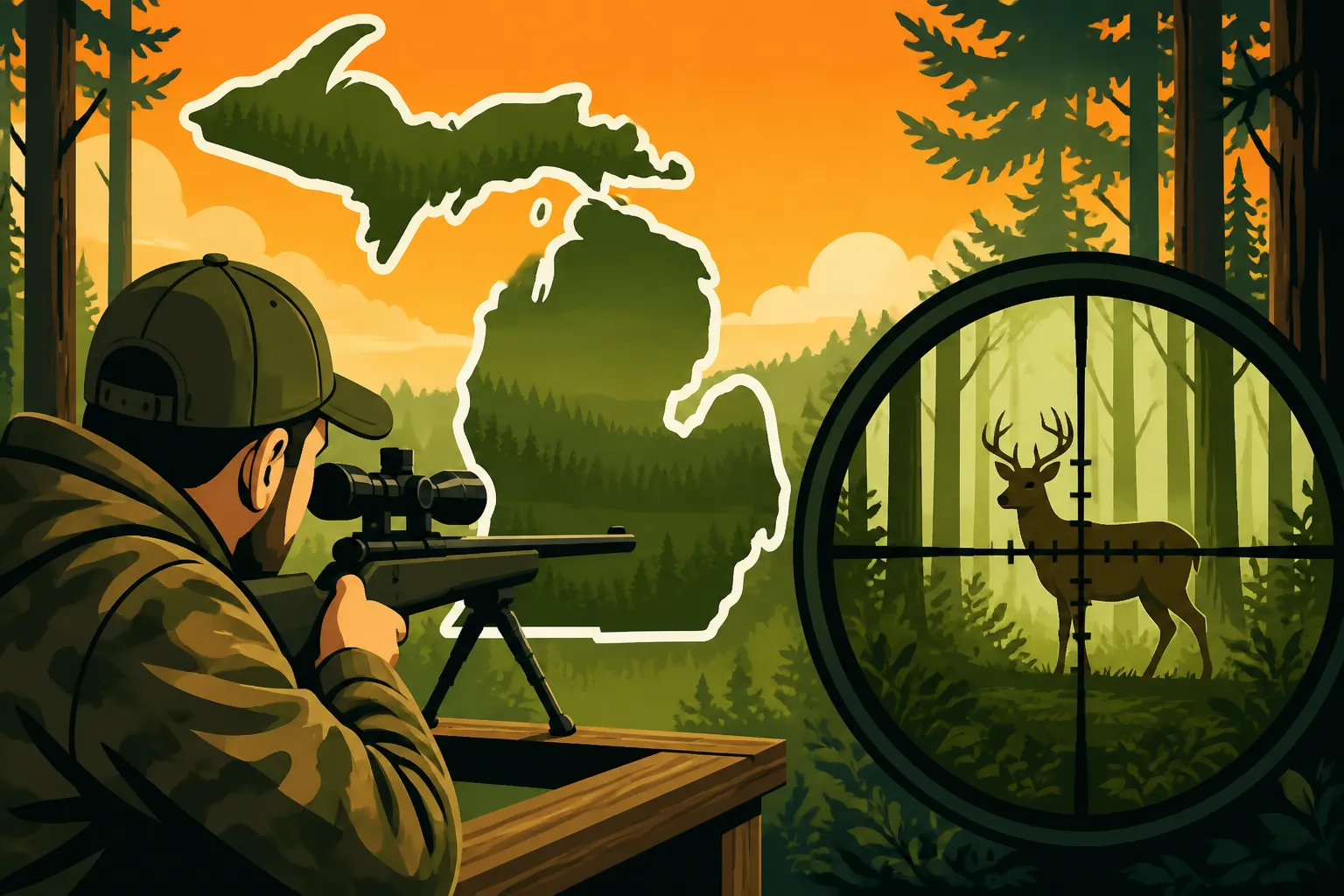
Rifle Ranges Realistic in Michigan Timber
One of the biggest struggles Michigan hunters face, especially those used to open country or dreaming of long-range shots, is coming to terms with the reality of our timbered landscapes. You might have a rifle capable of incredible distances, but when you're staring into a dense cedar swamp or a thick oak flat, that theoretical range quickly shrinks to a fraction of what you imagined. This guide is all about helping you understand and prepare for the realistic rifle ranges you'll encounter when hunting deer in Michigan's diverse forests, ensuring you're ready for the shot that actually presents itself.
The Reality of Michigan's Timbered Terrain
Michigan's hunting landscape is incredibly varied, but for much of our deer country, especially up north and in many state game areas, dense timber, thick swamps, and rolling hardwoods are the norm. This isn't the wide-open West where you can spot a deer a quarter-mile away and have time to set up for a long shot. Here, the challenge isn't usually about range, but about quick target acquisition and navigating obstacles.
Dense Cover and Reduced Visibility
Think about standing in a typical Michigan hardwood forest, especially after the leaves have fallen but before heavy snow. You've got trunks, branches, saplings, and maybe some underbrush. How far can you actually see a deer clearly, not just a flash of movement? For most of us, it's rarely more than 75 to 100 yards. In really thick stuff – like a tag alder swamp or a dense pine plantation – that number can drop to 20 or 30 yards. This is why many experienced hunters here carry a shotgun with slugs or a straight-wall cartridge rifle even in areas where traditional rifles are legal; the vast majority of shots are up close and personal.
The constant obstructions mean you're often looking through small windows. A deer might step into a shooting lane for mere seconds before disappearing behind another tree. This demands a different kind of preparation than long-range shooting. You need to be fast, precise, and keenly aware of your surroundings, not just your ballistic dope.
Fleeting Opportunities in Close Quarters
Deer in Michigan's timber are masters of using cover. They don't typically stand out in the open for long, especially if there's hunting pressure. They dart from thicket to thicket, often only giving you a small window of opportunity. This means you need to be constantly scanning, identifying potential shooting lanes, and being ready to shoulder your rifle quickly and quietly.
It’s a different game than hunting a food plot from a box blind where you might have minutes to range, steady, and shoot. In the woods, that deer might be gone before you can even bring your scope to your eye if you're not mentally prepared for close-range, quick-reaction shots. Understanding that most of your shots will be inside 100 yards, often much closer, changes how you approach your setup and your readiness.
Factors Influencing Realistic Shooting Range
Many factors contribute to what constitutes a truly "realistic" and ethical shooting range in Michigan's timber, beyond just the capabilities of your rifle. Ignoring these can lead to missed shots, wounded game, and frustration.
Terrain and Vegetation Density
The type of terrain you're hunting in fundamentally dictates your maximum effective range. Are you in open hardwoods with sparse undergrowth? Or are you in a classic Michigan cedar swamp, where visibility is measured in feet, not yards? What about an aspen clearcut that's been growing for 5-10 years? Each presents a vastly different shooting scenario.
For example, when Hunting Michigan Swamp Edges for Deer, your shot is likely to be very close as deer filter in and out of the thick cover. Conversely, if you're sitting on the edge of a mature oak ridge overlooking a slightly more open flat, you might get a 100-yard shot. Being able to read the land and understand the natural sightlines is crucial. Many hunters use mapping tools like those found in the GoHunt app to scout these areas virtually, helping them understand terrain features and vegetation density before setting foot in the woods.
Light Conditions and Weather
Michigan weather is notoriously unpredictable, and light conditions can change rapidly. Early morning and late evening, when deer are most active, often present the lowest light. A heavy overcast sky, fog, or a light snowfall can further reduce visibility, making it difficult to pick out details even at relatively short distances.
What might be a clear 75-yard shot on a sunny afternoon could become a questionable 40-yard shot in the gloom of a November morning. Rain, snow, and even high winds can make it harder to hold steady and can impact bullet flight, especially for lighter projectiles at the edge of your comfort zone. Always consider the current conditions when assessing if a shot is truly "on."
Shooter Skill and Animal Movement
This is perhaps the most critical factor. Your ability to make a clean, ethical shot is paramount. This isn't just about marksmanship on a bench rest, but about your ability to shoot accurately from field positions – standing, kneeling, off-hand – often under pressure and quickly. If a deer is moving, even slowly, that drastically reduces your realistic ethical range. A broadside shot on a stationary deer at 100 yards is one thing; a quartering-away shot on a walking deer at 75 yards through sparse brush is another entirely.
Be honest with yourself about your own capabilities. It's better to pass on a shot that feels marginal than to take a chance and wound an animal. Ethical hunting demands that we only take shots we are confident we can make clean and quick. This often means dialing back that "max effective range" significantly in a real-world hunting scenario.
Optimal Shot Distances for Common Calibers
While many modern rifle cartridges are capable of reaching out to several hundred yards, in Michigan's timber, those capabilities are rarely, if ever, utilized. Instead, focus on maximizing accuracy and energy transfer at closer ranges.
The 100-Yard Sweet Spot
For the vast majority of Michigan timber hunting, whether you're carrying a .30-06, a .270, a .308, or a .450 Bushmaster, your most common shot will be well within 100 yards. Many veteran hunters will tell you that if they get a clear shot at 75 yards, they feel lucky. This is why Zeroing a Rifle for Woods Distances is so important; focus on being dead-on at 50-75 yards, knowing that a 100-yard shot will still be well within your kill zone, and anything closer is easily handled.
The sweet spot for most timber hunting is indeed under 100 yards. This range allows for minimal bullet drop, maximum energy, and less impact from wind or small deflections from brush. It also provides a larger margin for error if your shooting position isn't perfect or if the deer takes a sudden step.
Straight-Wall Cartridges and Slug Guns
In Michigan, we have the "limited firearm zone" (formerly the shotgun zone) where traditional bottleneck rifle cartridges are restricted, requiring hunters to use shotguns with slugs or straight-wall rifle cartridges. This restriction reinforces the reality of close-range hunting in many parts of the state. Cartridges like the .450 Bushmaster, .350 Legend, or traditional slug guns are incredibly effective out to 150-200 yards, far exceeding the typical sightlines in the areas where they are mandated.
Even in areas where traditional rifles are legal, many hunters opt for these straight-wall options because they deliver immense knockdown power at the ranges most commonly encountered. They are essentially purpose-built for the very conditions we're discussing: short to medium-range shots in areas with limited visibility. For a more detailed look at the regulations, check out What the Michigan Limited Firearm Zone Means.
When Longer Shots Might Occur
Occasionally, you might find yourself in a situation that allows for a longer shot. Perhaps you're hunting an agricultural field edge adjacent to timber, or a very large clearcut where you can see across a wider expanse. In these specific scenarios, if you've practiced, are confident in your setup, and the deer is stationary, a shot out to 150 or even 200 yards might be realistic for some calibers and shooters.
However, these are the exception, not the rule. Never push your personal ethical limit just because your rifle can shoot that far. Your confidence, combined with the terrain and conditions, should always be the ultimate arbiter of what constitutes a "realistic" shot. For understanding the capabilities of your chosen firearm, you might review Rifle Setups for Michigan Deer.
Training for Timber Shots
Knowing your realistic range in Michigan timber means not just understanding the terrain but also training specifically for the types of shots you'll likely encounter. Bench shooting is great for accuracy, but it doesn't prepare you for real-world hunting scenarios.
Practice from Field Positions
Forget the bench for a while. Go to the range and practice shooting from standing, kneeling, sitting, and even prone (if you anticipate a chance for it). Practice using natural rests like trees or your pack. How quickly can you get on target? Can you hold steady for a few seconds if the deer hesitates? These are the skills that pay off in the woods.
Simulate real hunting conditions as much as possible. If you hunt from a treestand, try shooting from a simulated elevated position. Practice quick target acquisition and follow-through. Most importantly, practice with the ammunition you intend to hunt with, so you know exactly how it performs. For ideas on setups, consider Treestand Setups in Michigan Hardwoods.
Simulate Quick Shots and Obstacles
Set up targets at varying distances, emphasizing those under 100 yards. Practice bringing your rifle up quickly and making a clean shot. If allowed at your range, place small obstacles (like thin branches or cardboard cutouts) around your targets to simulate shooting lanes. This trains your eye to look for clear paths to the vitals and to assess what's in front of and behind your target.
Remember, a deflected bullet from even a small twig can cause a miss or, worse, a wounded animal. Always strive for a clear line of sight to the vitals. Your training should engrain the habit of only taking shots through truly clear lanes.
Know Your Maximum Ethical Range
Beyond just practicing, you need to establish your personal maximum ethical range. This is the distance at which, under less-than-ideal field conditions, you can consistently place a bullet into a vital zone. For many Michigan hunters, especially with dense cover, this is often closer to 100-125 yards, even with a capable rifle. For others, it might be 75 yards.
Shoot groups from field positions at increasing distances until you find the point where your accuracy begins to degrade. That's your honest maximum. It's not about what your rifle can do, but what you can do with it, consistently, ethically, and safely, under hunting pressure.
Gear That Helps with Range Assessment and Execution
While raw shooting skill is paramount, certain gear can significantly improve your ability to accurately assess range and make the most of those limited opportunities in Michigan's timber.
Rangefinders for Quick Distance Checks
A quality rangefinder is an invaluable tool, even for close-range hunting. While you might not range every single deer, knowing the exact distance to a few key landmarks or shooting lanes around your stand or still-hunting path can eliminate guesswork. "That tree is 60 yards, the edge of that swamp is 90." This pre-measured knowledge saves critical seconds when a deer appears.
In Michigan's dense timber, you'll often be using it for ranges well under 100 yards, so extreme long-range capability isn't as critical as speed and accuracy at closer distances. Make sure you pick one that's easy to use, even with gloves on, and can quickly give you an accurate reading on deer-sized targets. To delve deeper into this, consider Rangefinders in Thick Cover.
Optics Tuned for Low Light and Close Range
Your rifle scope needs to be an ally in low light and close quarters. While high magnification might seem appealing for spotting details, it can be a hindrance when a deer pops up quickly at 30 yards. A scope with a lower minimum magnification (e.g., 2-7x, 3-9x, or even a 1-4x or 1.5-6x) allows for a wider field of view, making it easier to acquire a fast-moving target up close.
Excellent light-gathering capability is also critical for those dawn and dusk encounters. Look for scopes with good objective lens size and quality glass. An illuminated reticle can also be a game-changer in deep shadows or against dark animal hides, helping you place your shot precisely without losing your crosshairs. For more on this, check out Rifle Scopes for Low-Light Swamps. Don't forget a good pair of Binocular Choice for Michigan Whitetails for scanning the woods before your shot opportunity.
Ammunition Designed for Close-Range Impact
While modern bullets perform well across a wide range of distances, for Michigan timber hunting, you want a bullet that expands reliably and retains energy even at relatively low velocities (which occur at shorter distances). Controlled expansion bullets are often a great choice, as they create significant wound channels without fragmenting excessively, ensuring deep penetration on broadside or slightly angled shots.
Avoid bullets designed primarily for extreme long-range performance, as they may not expand optimally at the higher impact velocities you'll experience on close-range shots. Match your ammunition to your likely shooting distances for the most effective and ethical results.
Here’s a quick overview of how common Michigan cover types impact realistic rifle ranges:
| Cover Type | Typical Visibility / Realistic Range | Considerations |
|---|---|---|
| Dense Cedar Swamp | 10-30 yards | Extremely thick, short shots, quick reactions, limited light. |
| Young Aspen Thicket (3-10 yrs) | 20-50 yards | Very dense, deer can be on you quickly, limited shooting lanes. |
| Mature Hardwoods (Open Understory) | 50-100 yards | Best visibility in timber, but still many obstructions, deer often moving. |
| Pine Plantation (Dense) | 20-40 yards | Dark, tight lanes, deer move quickly between rows. |
| Swamp Edge / Transition Zone | 30-75 yards | Deer entering/exiting thick cover, often moving, may pause briefly. |
| Field Edge (Adjacent to Timber) | 75-150 yards | Can offer longer shots, but deer often hesitant to enter open, watch for movement. |
| Mature Hardwoods (Thick Understory) | 40-70 yards | More challenging than open hardwoods, still requires careful shot placement. |
| River/Creek Bottoms | 25-60 yards | Often dense, wet, low light; deer follow natural travel corridors. |
This table illustrates that even in more open timber, a 100-yard shot is often pushing the upper limit of what's realistic for a clear, ethical opportunity.
Beyond the Range: Mindset and Ethics
Ultimately, understanding realistic rifle ranges in Michigan timber is about more than just bullet trajectories and gear; it’s about a hunter’s mindset and ethical responsibility.
Prioritizing Ethical Shots
The most powerful tool you have is your judgment. Always prioritize an ethical shot over a hero shot. If you have any doubt about clearing an obstruction, your ability to make a clean kill, or even identifying the deer's sex (especially important with antler point restrictions in some DMUs), then it's always best to pass. Another opportunity will often come, and preserving the integrity of the hunt and the welfare of the animal is paramount.
Michigan hunting is a privilege, and with that comes a responsibility to be a skilled and ethical hunter. This means knowing your limits, respecting the game, and only taking shots you are confident will result in a quick, humane harvest.
Adapting to the Environment
Instead of fighting against the limitations of Michigan's timber, embrace them. Our dense cover is precisely what makes our hunting so challenging and rewarding. It demands different skills: patience, woodsmanship, quiet movement, and a keen eye for subtle sign. It forces you to get closer to the deer, which is an experience in itself. Many find themselves Hunting the Pre-Rut in Late October and focusing on funnel areas to increase those close encounters.
Adapt your tactics. If you know you're in incredibly thick cover, consider still-hunting very slowly, focusing on small windows, or setting up a ground blind along a known travel corridor. Using platforms like GoHunt can help you identify these travel corridors and potential ambush points effectively. Your success won't come from pushing the limits of your rifle, but from understanding and working with the environment. Whether you're Hunting a Funnel Between Two Swamps or just trying to move quietly through heavy brush, knowing your realistic range allows you to focus on getting that close, clean shot.
Trusting Your Instincts
Experience teaches you to trust your gut. If a shot doesn't feel right, it probably isn't. This instinct is honed over years of hunting, spending time in the woods, and learning the nuances of deer behavior and terrain. Don't let buck fever or impatience override that inner voice telling you to wait or to pass.
Every hunt is a learning experience. Pay attention to how far your successful shots were, and critically, how far your missed shots were, or the shots you passed on. This self-assessment will refine your understanding of your own realistic rifle range in Michigan's challenging, yet incredibly rewarding, timber.
Disclaimer
This article is for general informational purposes only and does not constitute professional advice. Laws, prices and regulations vary by location and change over time. Consult a qualified professional for guidance on your specific situation.