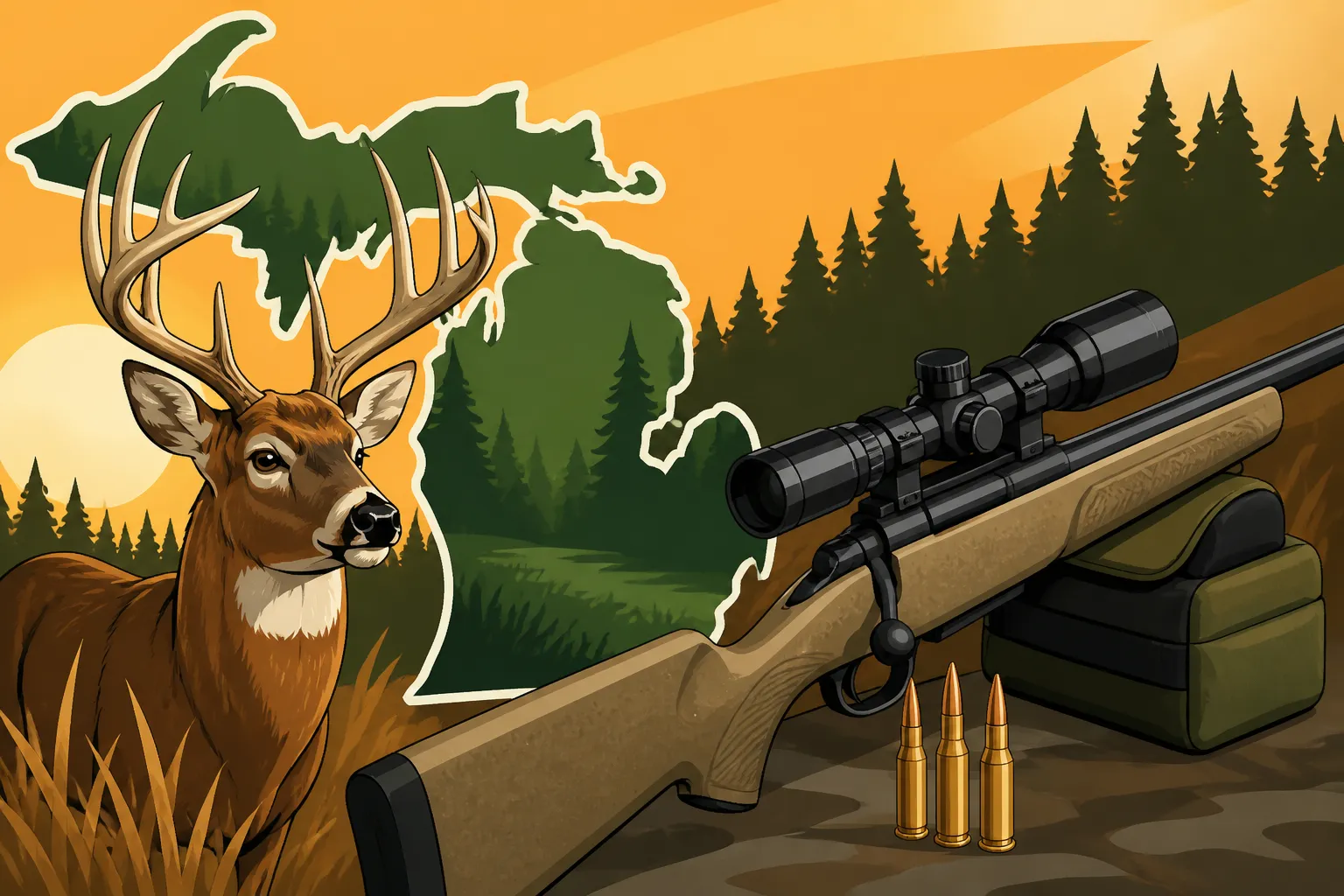
Rifle Setups for Michigan Deer
For many deer hunters in Michigan, the rifle is the ultimate tool for pursuing whitetails, but picking the right setup can feel like navigating a dense cedar swamp without a compass. With our state's diverse landscapes, from the thick timber of the Upper Peninsula to the sprawling farm fields of the Lower, and ever-evolving regulations, it's easy to get overwhelmed. This comprehensive guide will walk you through everything you need to know to assemble a rifle setup that is effective, legal, and perfectly suited for your Michigan deer hunting adventures.
Understanding Michigan's Rifle Regulations
Before you even start thinking about caliber or optics, you absolutely must understand Michigan's hunting regulations regarding firearms. Our state has a unique set of rules, particularly concerning rifles, that can trip up even experienced hunters if they're not careful. It’s not just about what you can use, but also where you can use it, and these rules are designed with hunter safety and population density in mind.
The Limited Firearm Zone Explained
One of the most significant regulations for rifle hunters in Michigan is the "Limited Firearm Deer Zone." This invisible line, roughly starting at Muskegon and sweeping across to Bay City, divides the Lower Peninsula. South of this line, traditional centerfire rifles using bottleneck cartridges were historically prohibited for deer hunting. The rationale behind this was public safety in more densely populated areas and regions with smaller, fragmented parcels of land. The concern was that a high-velocity rifle bullet could travel for miles, posing a significant risk in areas with homes, roads, and recreational trails.
This rule meant that hunters in the southern Lower Peninsula were largely restricted to shotguns loaded with slugs, muzzleloaders, or handguns, which generally have a shorter maximum effective range and less potential for over-travel compared to many rifle cartridges. This restriction shaped hunting culture and gear choices for generations of Michigan hunters. It forced innovation and a deeper understanding of the capabilities of these alternative firearms. Hunters often invested heavily in accurate slug guns, knowing it was their primary option. You can find out more about the geographical restrictions here: Where Michigan Restricts Rifles for Deer.
Straight-Wall Cartridges and Their Impact
The landscape changed considerably with the introduction of straight-wall cartridge regulations. Recognizing that many modern rifle cartridges designed with straight walls (like the .450 Bushmaster, .350 Legend, and .44 Magnum rifle cartridges) offered similar ballistic performance and range safety profiles to shotguns with slugs, the state decided to allow their use in the Limited Firearm Zone. This was a game-changer for many hunters who desired the ergonomics, familiar feel, and accuracy of a rifle platform, but were previously limited to shotguns. It essentially brought rifle hunting, in a modified form, to the entire Lower Peninsula.
The straight-wall cartridge rule allows these specific types of ammunition to be used for deer during the firearm season in areas where bottlenecked rifle cartridges are not permitted. This has led to a huge surge in popularity for calibers like the .450 Bushmaster, which delivers significant knockdown power and accuracy out to practical deer hunting distances in Michigan, typically 200 yards or less. Understanding the specifics of these regulations is crucial, as using an illegal cartridge can result in serious penalties. It's a prime example of how Michigan adapts its regulations to hunter feedback and advancements in firearm technology. Straight-Wall Cartridges Legal in Michigan offers further insight into this.
Legal Firearms and Ammunition Beyond Deer
While our focus here is on deer, it's worth noting that Michigan's regulations for other game species and hunting scenarios can differ. For instance, predator hunting, like coyote calling, often allows for a broader range of centerfire rifle cartridges across the entire state, outside of the specific deer firearm season restrictions. Similarly, specific seasons or management units might have unique requirements for certain firearms or ammunition types.
Always consult the current Michigan Hunting and Trapping Digest for the most up-to-date information on legal firearms and ammunition for the specific game you are pursuing and the zone you plan to hunt in. Rules can and do change, and it's your responsibility as a hunter to stay informed. Don't rely on old knowledge or campfire stories; verify every season. This diligence ensures not only your compliance but also the safety and ethical pursuit of game.
Choosing the Right Rifle Caliber for Michigan Whitetails
Selecting a rifle caliber for Michigan deer involves balancing several factors: the terrain you hunt, the typical shot distances, bullet performance, and, of course, legal restrictions. Michigan's diverse geography means a "one-size-fits-all" approach isn't always optimal, but there are certainly calibers that shine across much of the state.
Popular Calibers for Versatility in Michigan
For hunters operating in the Upper Peninsula or the northern Lower Peninsula, where traditional bottleneck rifle cartridges are permitted, several calibers consistently prove their worth. The venerable .30-06 Springfield and .308 Winchester remain incredibly popular, and for good reason. They offer an excellent balance of power, trajectory, and readily available ammunition. A .30-06, for example, can handle any deer in Michigan with authority, whether it's a close-range shot in thick timber or a longer poke across a clearing. The .308, known for its efficiency in a shorter action, offers similar performance with slightly less recoil, making it a favorite for many.
Other strong contenders include the .270 Winchester, which offers a flatter trajectory for open areas and is still more than adequate for deer, and the 6.5 Creedmoor, which has gained immense popularity for its accuracy and mild recoil, making it a pleasure to shoot and highly effective on deer. These calibers offer a broad spectrum of bullet weights and types, allowing hunters to fine-tune their ammunition choice for specific conditions. Many hunters find that for Michigan, having a versatile cartridge means they don't need a different rifle for every slight change in habitat. Best Rifle Caliber for Michigan Deer dives deeper into this topic.
For those hunting in the Limited Firearm Zone in the southern Lower Peninsula, the straight-wall options have become the new standard. The .450 Bushmaster exploded onto the scene and quickly became a dominant force. Its heavy, large-diameter bullet delivers significant energy upon impact, making it incredibly effective on whitetails, even at longer slug-gun distances. The .350 Legend, a newer entry, offers a lighter recoil option with excellent ballistics for deer, making it a great choice for hunters seeking a more manageable shooting experience. These calibers are truly tailored for the regulations and provide reliable performance where traditional rifles cannot be used.
Debating Energy and Trajectory for Woods Hunting
Michigan hunting, especially in the state's vast public lands, often involves dense cover, whether it's thick pine stands, sprawling cedar swamps, or young aspen clearcuts. In these environments, shot distances are frequently much shorter than those encountered out West, often within 100 yards, and rarely exceeding 200 yards. This reality shifts the focus from ultra-flat trajectories at extreme distances to adequate energy transfer and reliable bullet performance at moderate ranges.
For woods hunting, knockdown power is often prioritized. A bullet that expands reliably and dumps its energy quickly within the deer's vitals is key to a clean, ethical kill and a shorter blood trail. While a flat-shooting caliber is nice, it's less critical when you're anticipating shots that are closer to 50 or 75 yards. Instead, hunters should consider bullet construction that allows for good expansion even at lower velocities, which can occur after penetrating some brush or just at longer moderate ranges for certain calibers.
Specialty Calibers for Specific Michigan Scenarios
Beyond the mainstream choices, some hunters opt for specialty calibers for particular Michigan scenarios. For instance, the .44 Magnum or .357 Magnum in a lever-action rifle can be a fantastic, fast-handling choice for incredibly dense cover and short-range encounters, particularly in the Limited Firearm Zone. These traditional pistol calibers in a rifle offer an increase in velocity and energy compared to a handgun, making them surprisingly effective for deer at short to medium range.
Similarly, for black bear hunting in Michigan, which often occurs in equally thick cover, some hunters might choose calibers with even heavier bullet options, like a .338 Federal or a .300 Winchester Magnum, if legal in their hunting unit. While these are certainly overkill for most deer, they provide an extra margin of safety and stopping power for a larger, tougher animal. However, for the vast majority of Michigan deer hunting, the popular and straight-wall calibers mentioned earlier offer more than enough capability to get the job done ethically and effectively.
| Caliber | Type | Typical Michigan Use | Pros | Cons |
|---|---|---|---|---|
| .30-06 Springfield | Bottleneck Rifle | Upper/Northern LP deer, versatile | High power, wide ammo availability, effective range | Heavier recoil, not legal in Limited Firearm Zone |
| .308 Winchester | Bottleneck Rifle | Upper/Northern LP deer, versatile, compact | Good power, moderate recoil, efficient, accurate | Not legal in Limited Firearm Zone |
| .270 Winchester | Bottleneck Rifle | Upper/Northern LP deer, open terrain | Flat trajectory, good for longer shots, moderate recoil | Not legal in Limited Firearm Zone |
| 6.5 Creedmoor | Bottleneck Rifle | Upper/Northern LP deer, accuracy focus | Excellent accuracy, mild recoil, good for deer | Not legal in Limited Firearm Zone |
| .450 Bushmaster | Straight-Wall Rifle | All Michigan deer, especially Southern LP (Limited Firearm Zone) | High knockdown power, legal statewide, available ammo | Heavier recoil than some, limited long-range |
| .350 Legend | Straight-Wall Rifle | All Michigan deer, especially Southern LP (Limited Firearm Zone) | Very mild recoil, good accuracy, effective for deer | Less kinetic energy than .450 Bushmaster |
| .44 Magnum | Straight-Wall Rifle | All Michigan deer, close quarters (Limited Firearm Zone) | Very compact, fast handling, good for thick cover | Limited effective range, rainbow trajectory |
Rifle Optics: Clarity and Precision in Michigan Cover
Once you've settled on a rifle and caliber, the next critical component is your optic. In Michigan, where light conditions can vary dramatically from the dim light of a dense swamp at dawn to the bright sun on an open field, your scope choice can make or break a hunting opportunity. You need an optic that gathers light effectively, offers a clear sight picture, and is durable enough to withstand the elements.
Scope Magnification for Timber and Openings
The typical shot distances in Michigan dictate appropriate scope magnification. For the vast majority of our whitetail hunting, especially in timber, a scope with a lower maximum magnification is often preferred. Variables like 1-4x, 2-7x, or 3-9x are incredibly popular and highly versatile. At 1x or 2x, you get a wide field of view, which is crucial for quickly acquiring a deer that steps out unexpectedly at close range in thick woods. This low magnification also helps reduce "scope wobble" when trying to hold steady on an animal.
As you increase magnification, you lose some field of view but gain precision for longer shots. A 7x or 9x top end is usually more than enough for a 200-yard shot, which is pushing the practical limits for many Michigan hunting scenarios. Overly high magnification (e.g., 4-16x or higher) can actually be a hindrance in dense Michigan cover, making it harder to find your target quickly and creating a tunnel-vision effect. Remember, you're not usually shooting across vast plains, but rather through openings in the trees.
Low-Light Performance in Michigan's Early Mornings and Late Evenings
Michigan's legal hunting hours extend from 30 minutes before sunrise to 30 minutes after sunset. These are often the absolute best times for deer movement, making low-light performance in your optics paramount. A scope's ability to gather and transmit light is largely determined by the size of its objective lens (the front lens) and the quality of its glass and coatings. A larger objective lens, such as 40mm or 42mm, paired with high-quality, fully multi-coated glass, will provide a brighter image in those critical low-light conditions.
Don't just look at the objective lens size, though. A cheap scope with a large objective lens can still perform poorly. The clarity, contrast, and true color rendition of the glass, combined with effective anti-reflective coatings, are what truly make a difference. Investing in a good quality scope from a reputable manufacturer like Leupold, Vortex, or Nikon (mentioning generic brands as examples, not specific recommendations for purchase) will pay dividends when that big buck steps out in the last few minutes of shooting light. Rifle Scopes for Low-Light Swamps offers a more detailed look at this.
The Role of Illuminated Reticles and Fast Target Acquisition
For hunters who frequently find themselves in truly dim conditions or against dark backgrounds (like a deer standing in the shadows of a cedar swamp), an illuminated reticle can be a significant advantage. An illuminated dot or crosshair allows you to see your aiming point clearly without obscuring the target, even when the rest of the reticle fades into the background. This can be especially helpful on heavily forested public lands, where deep shadows persist even on sunny days.
However, an illuminated reticle is not a replacement for good glass; it enhances it. It's a feature that adds to versatility, allowing for quicker target acquisition in challenging light. When selecting an optic, consider features like wide fields of view at low magnification, generous eye relief (the distance your eye needs to be from the scope to see a full image), and a crisp, easily adjustable reticle. These features contribute to fast, decisive shot placement when a Michigan whitetail appears in your shooting lane.
Mounting and Zeroing Your Michigan Deer Rifle
Having a great rifle and a superb scope means nothing if they aren't properly united and calibrated. Proper mounting and precise zeroing are non-negotiable steps to ensure accuracy and reliability in the field, especially when the moment of truth arrives during a Michigan deer hunt.
Proper Scope Mounting Techniques for Reliability
Mounting a scope correctly is more than just tightening a few screws. It's about ensuring the scope is perfectly aligned, securely attached, and can withstand the recoil forces of your rifle without shifting. This process typically involves using quality bases and rings that are specifically designed for your rifle's action and scope tube diameter. Cheap rings or bases can easily flex, shift, or even break, leading to frustrating accuracy issues and missed opportunities.
A good mounting job includes leveling the reticle, so your vertical crosshair is truly vertical, which is crucial for consistent shots at varying distances. Torquing screws to the manufacturer's specifications (for both the bases and rings) is also vital, as overtightening can damage your scope or fasteners, while undertightening will lead to movement. Many hunters prefer to have a gunsmith perform this task, especially if they are new to it, to ensure absolute reliability. A scope that shifts even slightly after a few shots will cause endless frustration and doubt in the field.
Zeroing for Realistic Michigan Distances
Once your scope is mounted, the next step is zeroing your rifle. For Michigan deer hunting, a 100-yard zero is a fantastic starting point and often all you need. Given that many shots are well within 150 yards, a 100-yard zero ensures that your bullet will impact very close to your point of aim at most common woods-hunting distances. With a 100-yard zero, most common deer calibers will only be an inch or two high or low out to about 175-200 yards, which is well within the vital zone of a deer.
If you anticipate shots closer to 200 yards across larger clearings or open fields, some hunters prefer a "point blank range" zero, which might involve zeroing a couple of inches high at 100 yards, so the bullet never rises or falls more than a few inches out to around 200-225 yards. However, the exact distance will depend on your specific caliber and bullet. The key is to know your rifle's trajectory with your chosen ammunition and practice at those distances. Don't just zero at 50 yards and assume you're good; always verify at 100 yards. You can read more about it here: Zeroing at 100 Yards for Woods Hunting.
Understanding Ballistics in Michigan's Varied Terrain
Michigan's terrain isn't just about trees; it also includes subtle elevation changes, from rolling hills in the northern Lower Peninsula to gradual inclines in the Upper Peninsula. While not as dramatic as mountain hunting, these small elevation changes can subtly affect bullet trajectory, especially at longer ranges. Understanding basic ballistics for your chosen cartridge is important. This includes knowing your bullet's drop at various distances and how wind might affect it. Even a moderate crosswind in an open field can push a bullet off target.
Tools like ballistic calculators (available as apps or online, including on platforms like GoHunt that provide extensive data) can help you visualize your bullet's path. These tools allow you to input your specific ammunition, muzzle velocity, and environmental factors like temperature and altitude to get a precise understanding of your bullet's behavior. While you might not need to dial for elevation on every shot in Michigan, understanding your bullet's point of impact at different ranges removes guesswork and builds confidence, which is invaluable when hunting pressured deer.
Accessories for a Successful Michigan Rifle Hunt
A rifle setup isn't just the firearm and scope; it's a system. The right accessories can significantly enhance your comfort, stability, and overall success in the field, helping you maximize your efforts, especially when hunting some of Michigan's more challenging public lands.
Slings, Bipods, and Shooting Sticks for Stability
Michigan deer hunting often involves a fair amount of walking, especially if you're venturing deep into state land. A comfortable, durable sling is absolutely essential for carrying your rifle throughout the day, freeing up your hands for navigation, climbing into a stand, or carrying other gear. Look for a sling that distributes weight well and is made of weather-resistant material. A padded sling can make a huge difference in comfort on a long trek to your hunting spot.
For those moments when you need a stable shooting platform, especially if you're hunting from the ground or have longer shots, shooting sticks or a bipod can be invaluable. Bipods attach directly to your rifle and are great for prone or seated shots, offering maximum stability. Shooting sticks, on the other hand, are more versatile for standing or kneeling shots and can be quickly deployed. They're particularly useful when hunting field edges or open woods where an improvised rest might not be readily available. Choosing between them depends on your hunting style and how much mobility you need.
Ammunition Considerations: From Lead-Free to Bullet Construction
The ammunition you choose is just as important as the rifle itself. Beyond selecting the correct caliber, consider bullet construction. For deer, you generally want a bullet that expands reliably and retains enough weight to penetrate deeply into the vitals. Common choices include bonded core bullets, which maintain their integrity well, and controlled expansion bullets, which create a good wound channel without fragmenting excessively.
Additionally, Michigan hunters should be aware of any potential lead-free ammunition requirements or recommendations. While not widely mandated for deer in Michigan at the moment, some specific land parcels or future regulations might favor or require non-lead options. Copper bullets, for example, offer excellent terminal performance and are a great ethical choice. Always test your chosen ammunition at the range to ensure it groups well with your rifle. Different rifles can have strong preferences for certain brands or bullet weights, and a precise shooting rifle with poor-performing ammo is a wasted effort.
Cases and Cleaning for Michigan's Weather Conditions
Michigan weather is famously unpredictable. One day it can be crisp and sunny for opening day, the next can bring cold rain, sleet, or heavy snow. Protecting your rifle setup from the elements is crucial for its longevity and performance. A good quality, weather-resistant rifle case is important for transport, but also consider a soft, quick-access gun sock or cover for keeping your rifle dry and free of debris while in the field or in a blind.
After a wet or snowy hunt, prompt cleaning is essential to prevent rust and maintain accuracy. This involves not only cleaning the bore but also wiping down all external metal surfaces and ensuring the action is free of moisture. A light coat of rust preventative oil can go a long way in protecting your investment. Simple precautions can ensure your rifle is ready for every hunt, regardless of what the Michigan forecast throws at you. For more insights on public land hunting, check out Hunting Pressure on Michigan State Land.
Rifle Maintenance and Pre-Season Preparation
A reliable rifle is a well-maintained rifle. Especially in the often-damp and rugged conditions of Michigan, proper care and pre-season preparation are critical to ensure your firearm performs flawlessly when you need it most. This isn't just about cleaning; it's about building confidence in your gear.
Cleaning and Storing Your Rifle for Longevity
After every outing, especially if your rifle has been exposed to rain, snow, or even heavy condensation, a thorough cleaning is in order. This typically involves cleaning the bore with appropriate solvents and brushes to remove copper and powder fouling. Pay close attention to the chamber area, as fouling here can lead to feeding issues or decreased accuracy. The external surfaces of the rifle, particularly metal components, should be wiped down to remove moisture, dirt, and fingerprints, followed by a light application of rust-preventative oil. Don't forget to clean your optics with lens-specific cleaning solutions and cloths.
When storing your rifle for extended periods, ensure it's in a controlled environment, ideally in a humidity-controlled safe or cabinet. Avoid storing rifles in soft cases for long durations, as these can trap moisture and accelerate rust formation. Periodically inspecting your rifle, even during the off-season, for any signs of rust or wear will help catch small issues before they become major problems. A well-cared-for rifle will last a lifetime and maintain its accuracy.
Pre-Season Range Time and Practice Drills
Confidence with your rifle comes from familiarity and practice. Before hunting season begins, dedicated range time is paramount. This isn't just about confirming your zero; it's about practicing real-world shooting scenarios. Practice shooting from various positions you might encounter in the woods: offhand, kneeling, seated, and using improvised rests like a tree limb or your pack. These are far more common in Michigan than perfectly stable bench rest shots.
Practice quickly acquiring your target and making an ethical shot. Simulate the stress of a hunting situation by setting time limits or practicing with slightly elevated heart rates. Running drills where you have to find the target quickly, shoulder the rifle, and make a precise shot within a few seconds can significantly improve your readiness for the field. The goal isn't just to hit paper; it's to consistently hit a deer's vital zone under pressure.
Addressing Common Rifle Issues in the Field
Even with the best preparation, issues can arise in the field. Knowing how to troubleshoot common rifle problems can save a hunt. For instance, a common issue is a rifle that suddenly loses its zero. This can often be traced back to loose scope rings or bases, or sometimes even a loose action screw. Carrying a small multi-tool with appropriate bits can allow for quick retightening in the field if needed.
Another common problem can be feeding or extraction issues. This might be due to a dirty chamber, a damaged magazine, or simply trying to cycle the action too slowly. Understanding the mechanics of your specific rifle model can help diagnose and often rectify these issues. Always carry a few essential cleaning tools, like a bore snake and some oil, in your pack for quick field maintenance. Being prepared for small hiccups ensures you can keep hunting rather than having to call it a day prematurely.
Ethical Considerations and Safety with a Rifle in Michigan
Michigan hunting is a privilege, and with that privilege comes a significant responsibility for safety and ethical conduct, especially when using a powerful tool like a rifle. These principles are not just about following the law; they're about respecting the game, the land, and your fellow hunters.
Knowing Your Target and What's Beyond
This is perhaps the most fundamental rule of firearm safety and ethical hunting: always be absolutely certain of your target and what lies beyond it. In Michigan's diverse landscapes, this means being extra vigilant. A deer might be standing in front of a tree line, but what's behind that tree line? Is it another hunter? A road? A cabin? Never take a shot unless you have a clear, unobstructed view of your target and a safe backstop.
This principle is particularly crucial on Michigan's extensive public lands, where other hunters, hikers, and even mushroom foragers might be present. Be aware of your surroundings, use binoculars (like those offered by GoHunt, for example) to positively identify your target before raising your rifle, and always assume there are other people in the woods. The consequences of a moment's carelessness are devastating and irreversible. Ethical hunting means making responsible decisions, even if it means letting a deer walk away.
Safe Firearm Handling and Transport in Michigan
Michigan has clear regulations regarding safe firearm handling and transport, which every hunter must know and follow. Rifles must be unloaded in vehicles, and typically carried in a case or otherwise secured to prevent easy access. When hunting, always follow the four fundamental rules of firearm safety: treat every firearm as if it were loaded, always point the muzzle in a safe direction, keep your finger off the trigger until you are ready to shoot, and be sure of your target and what is beyond.
When navigating through thick cover or crossing obstacles, ensure your rifle's safety is engaged. Many experienced hunters choose to unload their rifle completely when crossing fences, climbing into treestands, or navigating particularly tricky terrain. It adds an extra layer of safety and peace of mind. Remember also Michigan's hunter orange requirements during firearm seasons, which mandate a certain percentage of your outer clothing be hunter orange. This is a critical safety measure, especially on busy public land. Michigan Hunter Orange Rules explains these in detail.
Respecting Property and Fellow Hunters
A significant portion of Michigan hunting occurs on public lands, which means you will likely encounter other users. Respecting fellow hunters and non-hunters is paramount to maintaining a positive image for our sport. This includes being mindful of noise, avoiding cutting off other hunters, and respecting established hunting areas or blinds. If you see another hunter, a friendly wave or quiet acknowledgment is usually sufficient.
Furthermore, always know property boundaries, whether you are hunting public or private land. Michigan law is clear on trespass. Even retrieving a downed animal from private property without permission can constitute trespass. Use mapping tools like those from GoHunt to clearly identify property lines before you hunt. Being a courteous and respectful hunter not only upholds the traditions of the sport but also helps ensure hunting remains a cherished activity for generations to come. Understanding Michigan Legal Shooting Hours is also essential for responsible hunting.
Disclaimer
This article is for general informational purposes only and does not constitute professional advice. Laws, prices and regulations vary by location and change over time. Consult a qualified professional for guidance on your specific situation.