Sleds and Drags for Snow Country
There's nothing quite like the exhilaration of taking a Michigan whitetail, especially when that chill is in the air, or the ground is blanketed in fresh snow. But let's be honest, that triumphant moment often quickly gives way to a daunting reality: getting that deer back to the truck. When snow is on the ground, what might be a manageable drag across bare earth can transform into an exhausting, back-breaking ordeal. This guide is here to walk you through the essential tools and tactics for making deer retrieval in Michigan's snow country not just possible, but a whole lot less painful.
Why Snow Makes Deer Retrieval So Challenging in Michigan
Anyone who's ever tried to pull a deer through even a few inches of Michigan snow knows it's a completely different beast than dragging across dry leaves. The romantic notion of a pristine winter hunt quickly fades when you're straining every muscle, slipping, and sinking with each step. It's a fundamental challenge that changes how you approach every aspect of your hunt, from shot placement to route planning.
The Sheer Exhaustion Factor
Imagine trying to drag a heavy sack of concrete across sandpaper, and you're getting close to what it feels like pulling a deer through deep, wet, or crusted snow. The friction is immense, and it saps your energy at an alarming rate. In the Upper Peninsula or the northern Lower, we often get snow that's heavy and wet, clinging to everything, or so deep and powdery that you're post-holing with every step. Then there's the dreaded crust, which can be sharp enough to cut and yet still breaks under the deer's weight, creating a constant struggle. Each step becomes a monumental effort, and you're fighting not just the weight of the deer, but the resistance of the snow itself. It’s not just about strength; it’s about endurance, and Michigan’s winter conditions are designed to test every ounce of it. This isn't a quick sprint; it's a marathon where every yard feels like a mile.
Beyond the snow itself, your body has to work harder to stay warm, burning more calories, and your muscles are constantly engaged to maintain balance on slippery surfaces. Trying to manage your own gear, stay upright, and still pull a deer that can easily weigh 150-200 pounds or more, sometimes through a foot or two of snow, is a recipe for quick fatigue. It's easy to get discouraged when you feel like you're barely moving, even when you're giving it your all. That feeling of hitting a wall, sometimes only a hundred yards in, is a common frustration for Michigan hunters.
Navigating Tricky Terrain Under Snow
Snow, while beautiful, is a master of disguise. What looks like a smooth, flat expanse can hide a multitude of treacherous obstacles beneath its innocent white blanket. Logs, stumps, ditches, rocks, and uneven ground all become invisible hazards when covered by snow. You might be pulling along, feeling like you're making progress, only for the deer or your sled to suddenly catch on a hidden stump, jerking you to a halt or even sending you tumbling. This isn't just frustrating; it can be dangerous, leading to pulled muscles, twisted ankles, or even cuts and scrapes.
Michigan's diverse terrain, from the rolling hardwoods of the Lower Peninsula to the dense cedar swamps of the Upper, presents unique challenges when concealed by snow. A seemingly minor dip in the ground becomes a mini-canyon when you're trying to drag a heavy deer through it. Creek beds, frozen over but with unstable edges, can collapse, sending you and your quarry into icy water. Thick cover, already tough to navigate in the best of conditions, becomes a tangled nightmare where every branch seems to grab at your rope or poke at the deer. This is where planning your exit route before you even climb into your stand really pays off. Using a mapping app, like those found on GoHunt, to scout for the path of least resistance before the shot can save you hours of struggle and a lot of heartache after the fact. Thinking ahead about your Entry Routes on Flat Michigan Ground is even more critical when snow is involved, as what looks good on paper might be a hidden minefield underfoot.
Understanding Different Retrieval Methods: Sleds, Drags, and Carts
When it comes to getting a deer out of the woods, especially in Michigan's varying winter conditions, there's no one-size-fits-all solution. Depending on the depth of the snow, the distance to your vehicle, and the terrain you're traversing, you'll want to employ different methods. Each has its pros and cons, and knowing when to use what can make a world of difference.
The Classic Deer Drag: Simple But Demanding
The most basic method, and probably the one every hunter starts with, is the classic deer drag. This usually involves a simple rope, either tied directly to the deer's antlers or head, or looped around its neck or chest. Many hunters just carry a length of sturdy rope, or a compact, pre-made drag strap that clips onto the deer. It's lightweight, easy to pack, and requires no assembly. For short distances or very light snow cover, a simple drag can be perfectly adequate. If you've just dropped a deer 50 yards from a two-track on a fresh dusting of snow, a rope might be all you need.
However, the simplicity comes at a cost, especially in deeper snow. A basic drag rope means all the friction is directly between the deer's body and the snow. This translates into maximum effort for you. Every bump, every patch of sticky snow, every slight incline will feel like pulling a refrigerator. Without a wider contact patch to distribute the weight, the deer's body will often plow into the snow, creating a furrow that increases resistance even further. This method is notoriously hard on your back and shoulders, even with a chest harness to distribute the load better. While a simple rope is a must-have for emergencies or quick retrieves, it's rarely the ideal solution for any significant distance or challenging snow conditions here in Michigan, especially if you're dealing with a large-bodied buck or a wet, heavy snow. You really don't want to be testing your physical limits unnecessarily after a long day of Still-Hunting After a Michigan Snow.
The Advantages of a Deer Sled in Snow Country
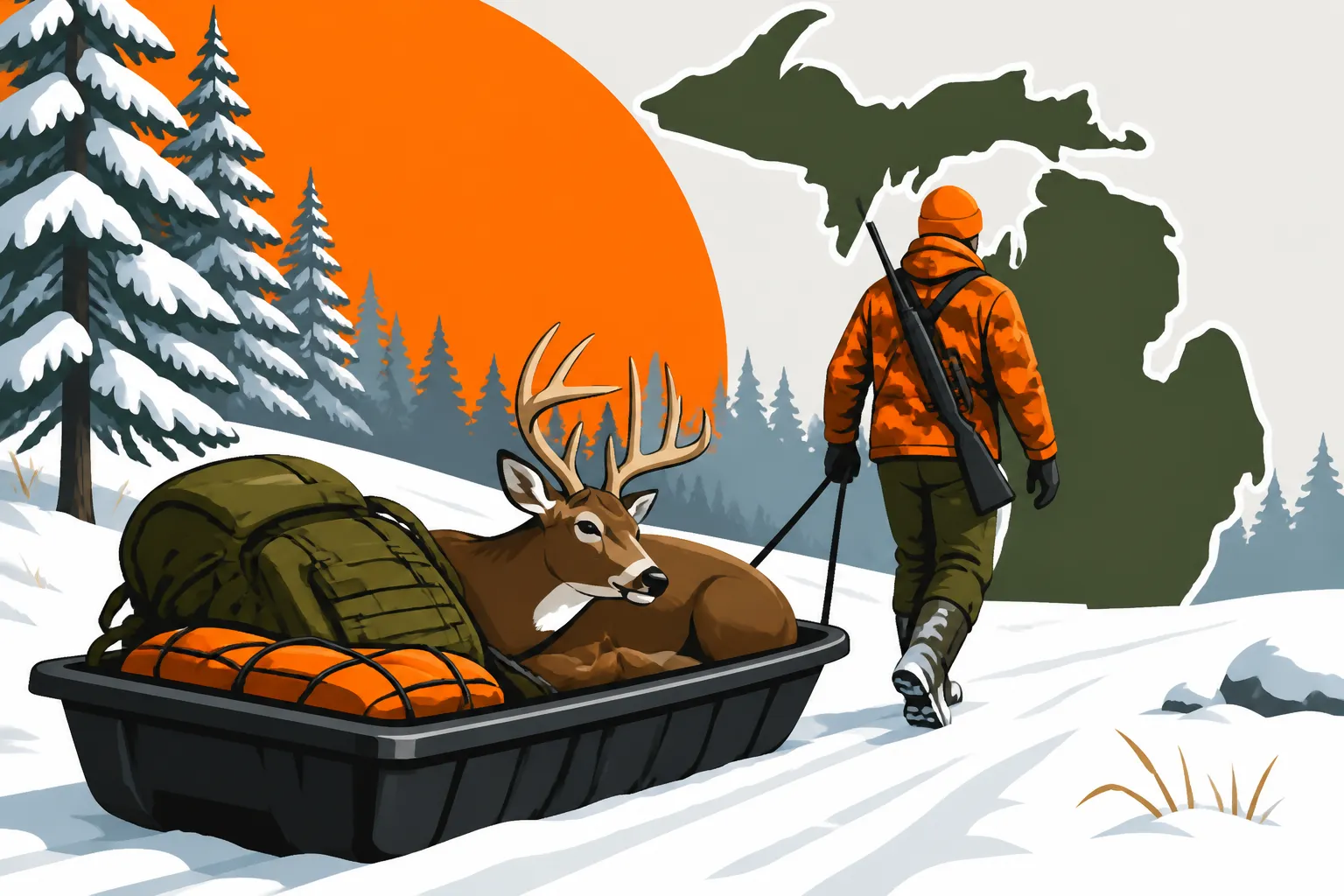
This is where deer sleds shine, and if you hunt Michigan''s late seasons or venture into the northern regions, a good sled is an absolute game-changer. The fundamental principle behind a deer sled is simple: reduce friction. By placing the deer on a smooth, wide surface, you distribute its weight and significantly cut down on the resistance as you pull. Instead of plowing, the deer glides. This alone can reduce the effort required by half or more, saving your energy and your back.
Deer sleds come in a variety of styles. You'll find rigid plastic sleds, often made of durable polyethylene, which are excellent for gliding over varied terrain, including thin ice or crusty snow. These are typically quite sturdy and can handle rough treatment, though they can be bulky to transport. Then there are flexible sleds, which are often made from a heavy-duty, pliable plastic sheet that you fold around the deer. These are lighter, can be rolled up and carried in a pack, and conform to the deer's shape, which can be advantageous in very tight cover. The choice between rigid and flexible often comes down to your primary hunting grounds. If you're often Hunting Deer in Deep Upper Peninsula Snow or pulling over long distances, a larger, rigid sled with good runners might be worth the investment for its sheer efficiency. For shorter drags out of dense, brushy areas, a flexible sled might offer more maneuverability. Many sleds also feature built-in edges or "runners" that help them track straighter through the snow, preventing the sled from veering wildly, which can be a real blessing when you're exhausted and trying to maintain a steady course.
Deer Carts: A Hybrid Solution and Their Limitations in Deep Snow
Deer carts are fantastic tools, no doubt about it. They typically feature two large wheels, a frame, and handles, allowing you to essentially wheel your deer out like a large wheelbarrow. On clear, relatively flat trails, frozen logging roads, or even short stretches of grass, a good deer cart makes retrieval almost effortless compared to dragging. If you're hunting private land with established trails or state land with well-maintained two-tracks, a cart can be your best friend. They keep the deer elevated, reducing contact with the ground, and the wheels bear the majority of the weight.
However, in the context of Michigan's snow country, deer carts quickly hit their limits. The moment the snow gets deep, soft, or particularly uneven, those wheels become a liability. They'll sink, get bogged down, and the entire cart will become a plow. You end up not just pulling the deer, but also lifting and dragging a heavy, often awkward cart. When the snow is deeper than the wheel's radius, you might as well be dragging the deer by hand, but with the added weight and bulk of the cart. While some carts have wider, pneumatic tires designed for rougher terrain, even these struggle in significant snowfall. They're also not ideal for navigating dense brush, fallen timber, or steep embankments, which are common features of Michigan's hunting landscapes. For the late Michigan Muzzleloader Season Tactics where significant snow is common, a cart is usually going to be less effective than a properly chosen sled or even a team of strong partners.
| Retrieval Method | Pros | Cons | Ideal Michigan Conditions |
|---|---|---|---|
| Simple Drag Rope | Lightweight, compact, inexpensive, easy to carry. | High friction, very physically demanding, hard on deer hide. | Light dusting of snow, very short distances, emergencies. |
| Flexible Deer Sled | Reduces friction, can be rolled/folded, good for tight spaces. | Less durable than rigid, can sometimes "plow" in very deep snow. | Moderate snow, mixed terrain, shorter to medium distances. |
| Rigid Deer Sled | Significantly reduces friction, very durable, tracks well. | Bulky to carry into the woods, can be noisy, requires more storage. | Deep snow, longer distances, relatively open cover. |
| Wheeled Deer Cart | Easiest on clear/frozen trails, keeps deer off ground. | Impractical in deep/soft snow, struggles with rough terrain, bulky. | Bare ground, frozen roads, well-maintained trails. |
Choosing the Right Sled or Drag for Michigan Conditions
Selecting the proper retrieval gear is like choosing the right camouflage pattern or caliber for your rifle – it all depends on the specific conditions you'll face. In Michigan, these conditions can vary wildly, even within a single season, let alone from the southern farmlands to the depths of the Upper Peninsula. Ignoring these variables can lead to a long, frustrating, and potentially unsafe recovery.
Factors to Consider: Snow Depth, Distance, and Terrain
Before you even think about buying a sled or a fancy drag harness, take a hard look at where and when you hunt in Michigan. Are you typically out during early archery season when a light dusting is all you might see, or are you a dedicated late-season hunter bracing for serious winter storms? The snow depth is paramount. A light, flexible sled might be fine for six inches of fluffy snow, but if you're slogging through two feet of heavy, wet stuff, you'll want something much more substantial, possibly with deeper runners. Similarly, if the snow is crusted over, you need a sled tough enough not to shatter or get hung up on the jagged edges.
Next, consider the distance. A hundred-yard drag to a nearby road is one thing; a half-mile trek back to your truck deep in the state forest is another. For longer distances, friction reduction becomes incredibly important, making a rigid sled with good runners almost a necessity. The more ground you have to cover, the more energy you'll save by having a superior sled. Then there's the terrain. Are you hunting relatively flat, open hardwoods where obstacles are visible and sparse? Or are you plunging into thick cedar swamps, battling through brush, over blowdowns, and navigating uneven ground? Hunting Michigan Swamp Edges for Deer can mean you're in a very challenging retrieval scenario. A bulky, rigid sled might be a hindrance in extremely dense cover where you need to weave around trees, but a flexible sled might get hung up more often. Conversely, in relatively open terrain with deep snow, a larger, rigid sled will glide much more efficiently. It's a balance of maneuverability versus efficiency, and understanding your typical hunting environment is key. This is where tools like GoHunt's mapping features can help you scout potential retrieval routes ahead of time, identifying open ridges versus dense lowland thickets.
Sled Materials and Durability
The material of your deer sled directly impacts its performance and longevity, especially in cold Michigan weather. Most quality deer sleds are made from some form of polyethylene plastic. This material is chosen for its inherent slickness, which reduces friction against snow and ice, and its durability. However, not all polyethylenes are created equal. High-density polyethylene (HDPE) is generally preferred for its strength, impact resistance, and ability to remain flexible in very cold temperatures. Cheap plastics can become brittle in sub-zero Michigan conditions, cracking or shattering if they hit a hidden rock or stump. You don't want your retrieval tool to fail halfway through a grueling drag.
Beyond the base material, look at the design of the sled's bottom. Many feature integrated runners – raised channels or ribs that run along the length of the sled. These runners are crucial for helping the sled track straight through the snow, preventing it from constantly veering off course. This is a huge advantage, especially when you're tired and trying to maintain a straight line through uneven terrain. Some sleds have deeper, more pronounced runners for superior tracking in deep snow, while others have shallower ones that offer a bit more maneuverability in brush. Consider also the thickness of the plastic; a thicker sled will generally be more durable and resist punctures from sharp sticks or frozen branches, which are abundant in Michigan's timber.
Handle and Harness Systems
Even the best sled in the world isn't much use if you can't comfortably and efficiently pull it. The handle and harness system is crucial for transferring your pulling power to the sled. A simple rope tied to the front of the sled is basic but can quickly lead to hand fatigue and rope burn. If you're using a rope, look for one that's thick enough to grip comfortably or wrap it with tape for a better hold. Better yet, consider a rigid pull handle. These are often made from PVC pipe or a similar material, providing a solid grip point that keeps your hands away from the snow and brush, and allows for a more even distribution of force.
For serious dragging, especially over longer distances or with heavier deer, a chest or shoulder harness is invaluable. These systems distribute the pulling load across your strongest muscle groups – your core and legs – rather than concentrating it on your hands, arms, and back. A well-designed harness will have padded straps and be adjustable to fit your body comfortably. Some harnesses are designed for a single person, while others are built for two or even three people to pull together, which can be an absolute lifesaver when you've got a big buck down a long way from the road, or are attempting to Recovering a Deer From a Swamp. Many Michigan hunters find that a sturdy rope with a rigid cross-bar handle, combined with a simple shoulder strap (even if it's just a looped piece of webbing) offers a good balance of efficiency and packability. Remember, you're not just pulling the deer, you're also walking, potentially uphill, and through tough cover, so any system that makes the pulling itself easier will pay dividends.
Practical Tips for Effective Snow Retrieval
Retrieving a deer in Michigan's snow isn't just about having the right gear; it's also about smart strategy and efficient execution. Even with the best sled, a poorly planned or executed retrieval can still turn into an epic struggle. These practical tips can help minimize the pain and maximize your chances of getting your deer out cleanly and safely.
Working with a Partner (or More!)
This might seem obvious, but the immense benefit of having an extra set of hands – or two, or three – cannot be overstated when faced with a snow-covered deer retrieval. The adage "many hands make light work" holds especially true here. One person pulling a heavy deer through deep snow is exhausting; two people can often make it feel like half the effort, and three or four can turn a nightmare into a manageable task. If you're hunting with a group, establish a plan for retrieval before the hunt even begins. Who's on point for bringing a sled? Who's got the strongest back? It’s part of the Michigan Deer Camp Traditions for a reason – everyone pitches in.
When working with partners, communication is key. Designate a leader who can call out directions, warn of obstacles, and set the pace. If using a sled, one person can pull from the front, while another pushes or steers from the rear, especially valuable when navigating tight turns or steep, short inclines. If a deer is particularly heavy or the snow is exceptionally deep, a second person pulling in tandem, perhaps with a second drag rope or harness attached to the sled, can provide significant additional horsepower. For strategies like Deer Drives With Three or Four Hunters, the sheer number of people often means retrieval is much less of an issue, as you’ve got a built-in crew. Having extra people also provides an opportunity for rotating who's doing the heaviest pulling, allowing everyone to take short breaks and conserve energy.
Preparing the Deer for Transport
Proper preparation of the deer itself can significantly impact the ease of retrieval. First and foremost, if you're taking a deer during the colder parts of Michigan's hunting seasons, Field Dressing a Deer in Cold Weather is crucial for meat quality. After field dressing, consider how the deer's body will lie on the sled or be dragged. If possible, remove all internal organs. Not only does this reduce the overall weight, but it also creates less bulk and a more streamlined profile for dragging, reducing the amount of snow it plows.
When placing the deer on a sled, try to position it to minimize drag. Antlers can be a major hang-up point. If you have a large-racked buck, consider tying the antlers back along the deer's body or removing them if regulations allow and you're keeping the skull. Secure the deer firmly to the sled with straps or ropes to prevent it from sliding off or shifting. A deer that constantly moves around on the sled will make pulling much more difficult and can cause imbalance, especially on uneven terrain. Make sure the head is facing forward, not sticking out sideways, as this can catch on brush or snowbanks. If dragging directly by rope without a sled, try to lift the head off the snow to prevent it from plowing. Sometimes, a simple loop around the neck with the legs tucked in can make for a more efficient drag, allowing the chest cavity to act as a natural runner.
Pacing and Route Planning
Once you've got your gear and your deer ready, the actual act of retrieval is all about smart pacing and route planning. Don't try to be a hero and sprint the whole way. Pacing yourself is critical to avoid burning out prematurely. Take frequent, short breaks. Even a minute or two can help your muscles recover and your breathing regulate. It's often more efficient to go slower and steadier than to sprint and then collapse, unable to move. Listen to your body and your partners. If someone is struggling, slow down. This isn't a race; it's a marathon.
Route planning is equally important. Before you even start pulling, take a moment to look at your surroundings. What's the easiest way back to your vehicle? Are there existing trails, old logging roads, or game trails that could reduce resistance? Using these can save immense effort compared to breaking fresh trail through deep snow. Avoid unnecessary climbs or descents. If there's a slightly longer, flatter route, it's almost always preferable to a shorter, steeper one, especially with a heavy load. If you use a mapping app like GoHunt, you can even mark your position and scout for the best path on the screen, looking for contours that minimize uphill travel or areas of denser cover. Remember to consider wind direction too; breaking trail into a strong headwind through falling snow can be brutal. Sometimes, it's better to circle around to use the wind to your advantage, or at least avoid fighting it directly. Planning your moves, whether it's through a Michigan Cedar Swamp for Deer or open hardwoods, is just as important after the shot as it is before it.
Maintenance and Storage of Your Retrieval Gear
After the grueling work of getting your deer out of Michigan's snow, the last thing you want to think about is cleaning and storing your gear. However, a little effort here goes a long way in ensuring your sleds and drags are ready for action next season. Neglecting maintenance can lead to degraded materials, rusty components, or even outright failure when you need them most.
Cleaning and Inspection
Once the deer is at the truck and you've handled the processing, take a few minutes to clean your retrieval tools. This might seem like a chore, but it's essential. Wash off any blood, dirt, mud, or bits of hair from your sleds, ropes, and harnesses. Blood, especially, can degrade certain materials over time and can attract pests if not thoroughly cleaned. A simple rinse with a hose and a scrub brush, maybe some mild soap, is usually all it takes. For ropes and harnesses, make sure they are completely dry before storing to prevent mildew and rot. This is particularly important for any fabric components or natural fiber ropes, which can break down quickly if stored wet.
After cleaning, take the time to inspect all components. Check ropes and straps for fraying, cuts, or weak spots. Look at the sled for any cracks, deep gouges, or signs of stress, especially around attachment points for handles or harnesses. If you find any damage, repair it now rather than waiting until the last minute before your next hunt. A worn rope or a cracked sled could mean a failed retrieval next time you're out. If your sled has any metal components, like buckles or attachment rings, check for rust and lubricate them if necessary. This routine inspection ensures that your gear remains reliable and safe, season after season, ready for that next Michigan Muzzleloader Season Tactics outing in the snow.
Proper Storage for Longevity
Where and how you store your deer retrieval gear can significantly impact its lifespan. For sleds, especially rigid plastic ones, avoid storing them in direct sunlight. UV rays can degrade plastic over time, making it brittle and prone to cracking, which is the last thing you want in freezing Michigan temperatures. A cool, dry, dark place like a garage, shed, or basement is ideal. If storing vertically, make sure it's not under stress or bent, as this can cause permanent deformation.
Ropes, harnesses, and any fabric components should be stored clean and dry to prevent mildew, rot, and pest damage. Hanging them up prevents kinks and tangles and allows air circulation. Keep them away from chemicals, oils, or fuels, which can weaken materials. If your gear includes any special straps or buckles, ensure they are clean and free of debris that could jam them. By taking these simple steps, you'll ensure that your sleds and drags are in prime condition, year after year, ready to tackle Michigan's snow-covered terrain. It's an investment in your future hunting comfort and success.
Disclaimer
This article is for general informational purposes only and does not constitute professional advice. Laws, prices and regulations vary by location and change over time. Consult a qualified professional for guidance on your specific situation.