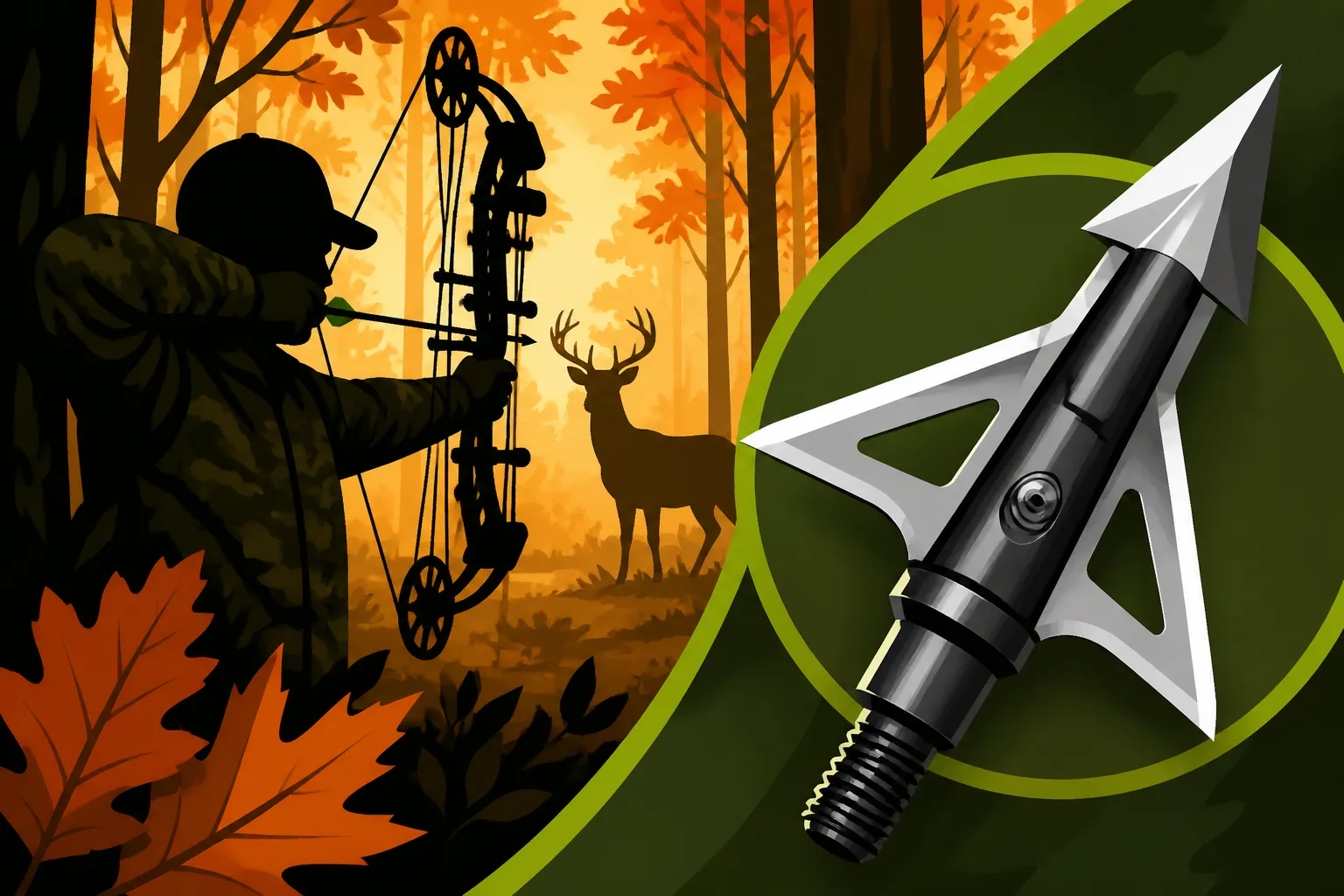
Broadheads for Timber Shots
A common frustration for Michigan bowhunters is sending an arrow through dense woods, only to wonder if it will hit its mark or glance off a twig. Those tight shooting lanes and unexpected deflections can make timber hunting feel like a gamble. This guide will walk you through everything you need to know about selecting and using broadheads specifically designed for effective, ethical shots in Michigan's thick timber and swampy cover.
Understanding the Challenges of Timber Shots in Michigan
Hunting in Michigan's diverse landscapes means often finding yourself deep within dense forests, whether you're stalking the big woods of the Upper Peninsula or nestled into a swamp edge in the Lower. These environments present unique challenges for bowhunters, demanding specific considerations for your equipment, especially broadheads.
The Reality of Dense Cover and Deflection
Michigan's state forests, particularly in the northern Lower Peninsula and Upper Peninsula, are often a maze of hardwoods, pines, and thick underbrush. Southern Michigan can be equally dense with swamp edges and woodlots choked with dogwood and tag alders. Hunters frequently find themselves with tight shooting lanes, often needing to thread an arrow through small gaps between branches or saplings. The primary concern here isn't just distance, but the myriad of obstacles that can deflect a broadhead, even slightly, sending it off course and potentially leading to a wounded animal. This is a frustrating reality for many of us who prefer to hunt deeper in the woods, far from open fields.
Unlike open field hunting where a clear shot might stretch out to 30 or 40 yards, timber shots are frequently closer, but far more cluttered. A seemingly clear path can have an unseen branch or a tiny, deflecting twig that spells disaster for accuracy. It's not just the main trunk of a tree; it's the smaller branches, the dense growth of young timber on a swamp edge, or the thick regeneration in a clearcut that creates a challenging environment. This environment demands broadheads that can maintain their flight path and integrity even if they encounter minor resistance. You need something that won't just crumple or veer off course at the slightest touch.
Ethical Considerations for Timber Hunting
When we hunt, our utmost responsibility is an ethical kill. A deflected arrow can lead to a wounded deer that's difficult to track and recover, causing unnecessary suffering. This is a nightmare scenario every bowhunter dreads. In Michigan, with our often-gnarly cover and fluctuating weather conditions, a poor blood trail from a poorly placed shot can mean losing an animal entirely. This concern drives the need for broadheads that maximize penetration and minimize deflection, ensuring that when we do get an opportunity, we make the most of it and fulfill our commitment to a humane harvest.
The short distances often encountered in timber might lull some into thinking any broadhead will do. However, the stakes are arguably higher. You have less time to react to a deer's jump, and the potential for a glancing blow is significant. Choosing a broadhead that is robust and flies true, even with imperfect release or a slight brush, contributes directly to our ethical obligations. It's about respecting the animal and the hunt, and ensuring you have the confidence to take the shot when it counts. This applies whether you're Still-Hunting Michigan Cedar Swamps or waiting patiently in a Treestand Setups in Michigan Hardwoods.
Understanding Broadhead Types and Their Performance in Timber
The market is flooded with broadhead options, and each type has its proponents and detractors. For timber hunting, however, some designs are inherently better suited to the unique challenges of dense cover. Let's break down the main categories.
Fixed-Blade Broadheads – The Workhorses
Fixed-blade broadheads are the traditional choice for a reason, and they truly shine in timber. They have blades that are rigidly attached to the ferrule, meaning they don't move upon impact. This design provides maximum durability and structural integrity. When you're talking about the potential for glancing blows off small twigs or branches, that unyielding design is a huge advantage. They are less prone to deflection and tend to maintain their flight path better through light obstructions, acting like a small chisel to cut through minor bits of cover rather than being pushed off course.
The downside for some is that fixed-blades can be more sensitive to bow tuning, and if your bow isn't perfectly dialed in, they might plane or fly differently than your field points. However, for a timber hunter, the confidence in their robustness often outweighs this tuning effort. Look for designs with a shorter, more compact profile as these tend to be more forgiving in flight and less susceptible to wind drift or minor contact. Brands like German Kinetic, GrizzlyStik, and even some Muzzy models offer extremely tough fixed-blade options that excel in these conditions. They are built for punching through, which is exactly what you need in Michigan's thick stuff. Make sure your Bow Draw Weight for Michigan Whitetails is sufficient for good penetration with these durable heads.
Mechanical Broadheads – The Expanding Controversy
Mechanical broadheads, also known as expandable broadheads, have blades that deploy upon impact. Their main selling point is that they fly like field points, making tuning easier for many hunters. They create larger cutting diameters, which can result in more devastating wound channels and better blood trails if they deploy correctly and fully penetrate. However, in dense timber, their reliability can be a significant concern. A mechanical broadhead relies on resistance to open its blades. If it hits a small branch before the animal, it might deploy prematurely or become damaged, leading to poor penetration or failure to open. This is a risk many timber hunters are unwilling to take.
While some modern mechanicals are designed to be more robust for timber, like those with bone-crushing tips or internal blade retention systems, the inherent design still presents a higher risk of failure or reduced penetration compared to a solid fixed-blade when encountering obstacles. The energy required to deploy the blades is energy not used for penetration, potentially reducing the overall pass-through capability. If you absolutely prefer mechanicals, choose those with a very strong ferrule, an over-the-top deployment, and a compact design that minimizes exposed blade surfaces during flight. Always test them extensively to ensure reliable deployment and flight, especially after any light contact. Compare them carefully, as the article Fixed Versus Mechanical Broadheads details.
Hybrid Broadheads – Bridging the Gap
Hybrid broadheads attempt to combine the best of both worlds: a small, fixed blade for initial cutting and structural integrity, paired with larger mechanical blades that deploy after entry. The idea is to get the dependable flight and preliminary cutting of a fixed blade, with the larger wound channel of a mechanical. For timber hunters, these can be a decent compromise. The fixed blades provide a leading edge that can help cut through minor obstructions without premature deployment, while the mechanical blades still offer a larger cut to maximize tissue damage once inside the animal.
However, hybrids still carry some of the risks of mechanicals. The deploying blades can still be compromised if the initial fixed blade encounters significant resistance or if the deployment mechanism itself is damaged. As with all mechanical designs, scrutinize the build quality and robustness of the moving parts. If you're going this route, rigorous testing is even more crucial to understand how they perform in various scenarios and to ensure consistent deployment. They are a relatively newer innovation, and while some hunters swear by them, a purely fixed blade still generally offers the highest confidence for navigating Michigan's thickest woods, where absolute reliability is often prioritized over maximum cutting diameter.
Key Features to Prioritize in a Timber Broadhead
When you’re staring down a tight shooting lane with a buck stepping into view, you want unwavering confidence in your broadhead. That confidence comes from choosing a broadhead with features specifically designed to handle the rigors of Michigan’s timber.
Durability and Construction Quality
This is paramount. A broadhead for timber needs to be built like a tank. You want a solid, one-piece ferrule construction or a design where the components are incredibly tightly integrated and robust. Cheap aluminum ferrules that bend on hard impacts are a no-go. Look for stainless steel, high-grade aluminum, or carbon steel construction that can withstand impact with bone, earth, or even the occasional small branch. The blades themselves should be thick and sharp, capable of holding an edge even after contacting dense hide or bone, let alone a small twig. Investing in quality here pays dividends in performance and confidence when you need it most.
Consider the tip design as well. A chisel tip or a cut-on-contact (COC) tip are generally preferred for timber. Chisel tips are incredibly strong and designed to smash through bone, which is a fantastic attribute if you hit a shoulder or encounter a twig. COC tips start cutting immediately, conserving energy for penetration, and their razor-sharp leading edge can slice through minor deflecting materials more cleanly than a blunt tip. Avoid broadheads with thin, flimsy blades or complex designs that have many moving parts or potential failure points, especially when browsing options on platforms like GoHunt. Simple, strong, and sharp are the keywords here for a broadhead that won't let you down.
Compact Design and Favorable Flight Characteristics
While a massive cutting diameter sounds appealing, for timber shots, a more compact, aerodynamic design is often better. Broadheads with a smaller profile and shorter blade length tend to fly more consistently and are less prone to wind drift or being caught by errant branches. They have less surface area to be affected by imperfections in your shot or light contact with vegetation. The goal isn't just a big cut, but a precise and deep cut delivered exactly where you aim.
The relationship between your broadhead and field point flight is also critical. Your broadheads must impact in the same spot as your field points at your typical hunting distances. This means meticulous bow tuning. Many fixed-blade broadheads, especially those with larger or less aerodynamic profiles, require more fine-tuning of your bow's rest and nocking point. Don't skip this step. A broadhead that flies true for 20 yards in the open might veer significantly if it's not tuned correctly, making a tight timber shot even more precarious. Spend time on the range, shooting through paper and at various distances, to ensure perfect flight. Your Bow Sights for Timber Shots are only as good as your broadhead flight.
Penetration Power
In timber, deer often move quickly, and quartering shots can be common as they react to movement or sound. You need a broadhead that maximizes penetration to ensure it reaches vital organs, even on less-than-ideal angles or after encountering bone. Factors contributing to penetration include blade angle, sharpness, and the overall mechanical advantage of the broadhead. A steep blade angle might be stronger, but a more acute angle generally penetrates better by reducing friction.
Focus on broadheads that are renowned for deep penetration. Cut-on-contact (COC) broadheads are excellent for this, as they start cutting immediately, saving energy for pushing through the animal. Two-blade fixed broadheads also tend to penetrate exceptionally well because they have fewer blades creating friction and a simpler path through tissue. While three or four-blade designs offer wider wound channels, they can sometimes sacrifice a little penetration, especially if they are not perfectly sharp or encounter dense bone. For timber, prioritize getting through the animal reliably over an excessively large cutting diameter. After all, a deer can run a long way in Getting a Deer Out of a Michigan Cedar Swamp if the penetration is poor. Consider your Arrow Weight for Short Shots in combination with your broadhead choice to optimize this.
Tuning and Practice for Timber Shot Success
Having the right broadhead is only half the battle. If your bow isn't tuned to shoot them perfectly, or if you haven't honed your shooting skills in realistic scenarios, even the toughest broadhead won't perform to its potential.
Broadhead Tuning Your Bow
This is the non-negotiable step for any serious timber hunter using fixed-blade broadheads. "Paper tuning" helps you identify inconsistencies in your arrow flight, showing if your arrow is coming off the string cleanly. But broadhead tuning takes it a step further. It involves shooting your broadheads alongside your field points and making micro-adjustments to your bow's rest, nocking point, and even cam timing until both hit the exact same spot at various distances. If your fixed blades are consistently hitting left or right of your field points, your bow is not tuned correctly, and you risk a bad shot.
Don't get frustrated; this process takes patience and precision. Small adjustments can make a huge difference. Sometimes, it's a matter of arrow spine or fletching choice. Heavier, stiffer arrows tend to be more forgiving for broadhead flight. A good archery pro shop can be invaluable here, helping you ensure your bow is perfectly cam-timed and spined for your arrows and broadheads. Remember, an untuned bow with fixed blades is a recipe for disaster in the woods, magnifying any slight deflection from a twig or branch. Tools and guides found on platforms like GoHunt can often assist with understanding and executing proper bow tuning, helping you achieve that critical field point accuracy with your broadheads.
Practicing in Realistic Timber Scenarios
Shooting at a flat target in an open field is great for form, but it doesn't prepare you for the reality of timber hunting. Set up targets in your yard or a safe area with natural obstacles like small branches, saplings, or brush. Practice shooting through narrow gaps, from awkward angles, or from a kneeling position, simulating real hunting conditions. This isn't about intentionally hitting obstacles, but about developing a keen eye for clear shooting lanes and understanding what constitutes a "good enough" shot in dense cover. It will train your brain to quickly identify safe shooting windows.
Pay close attention to your form when shooting from a treestand or ground blind in a tight spot, as these positions can affect your anchor point and release. Practice judging distances accurately in cluttered environments, as a small miscalculation can be amplified by obstacles. Even if you use a rangefinder, quickly identifying "shoot/no-shoot" windows and estimating distances with your eye is a crucial skill you'll need in the heat of the moment. Incorporate some dynamic shooting, drawing your bow quickly and getting on target, as deer in the timber don't usually stand perfectly still for long. This kind of practice builds muscle memory and decision-making skills that are vital when a buck steps out in Hunting a Funnel Between Two Swamps.
Strategic Shot Placement and Recovery in Michigan Timber
Even with the best broadhead and a perfectly tuned bow, shot placement remains the ultimate determinant of success. In the challenging environment of Michigan's timber, making wise decisions about when and where to shoot, and then diligently recovering your animal, becomes even more critical.
Prioritizing Ethical Shot Angles in Thick Cover
In Michigan's timber, a perfect broadside shot isn't always offered. Deer often present quartering-away or slightly quartering-to angles as they navigate dense undergrowth. With a robust timber broadhead, you can often take these shots if you understand anatomy and the likely path of your arrow. For a quartering-away shot, aim to send your arrow through the rib cage, angling forward to exit through the opposite shoulder or chest cavity. This maximizes internal damage, hitting both lungs and potentially the heart or liver. A quartering-to shot is riskier but can be taken if the angle allows you to hit the vitals without encountering the heavy shoulder bone directly.
The key is to be patient and disciplined. If the shot isn't clean, or if there's any doubt about a deflection, do not shoot. Waiting for a better angle, even if it means passing on a deer, is always the most ethical choice. Practice visualizing arrow paths through a deer's body from different angles. Use diagrams or a 3D target to confirm your understanding of organ placement and where your broadhead will travel. The tight quarters of timber can rush a hunter, creating a sense of urgency, but resisting that urge and waiting for a high-percentage shot is crucial, especially when you're relying on that broadhead to perform flawlessly on impact.
Maximizing Blood Trails and Recovery Efforts
Even with a perfectly placed shot and a top-notch broadhead, tracking a deer in Michigan's dense timber can be a challenge. The ground is often covered in leaves, thick brush, or mucky swamp water, making blood difficult to see, especially in low light. This is where your broadhead's performance becomes paramount. A broadhead that delivers a deep, clean cut and a good exit wound will significantly improve your chances of a robust blood trail, leaving a clear path to follow. Look for designs that prioritize both cutting diameter and penetration, as the combination often leads to more profuse bleeding and a better trail.
After the shot, give the deer time. A general rule of thumb is 30 minutes to an hour for a well-hit deer, and much longer (4-6 hours, or even overnight if conditions allow) for a suspected gut shot or marginal hit. Mark your exact shot location and the deer's last known direction of travel. Slowly and methodically follow the blood trail, looking for drops not just on the ground, but on brush and leaves at various heights. If the trail becomes sparse, expand your search in circles or grids around the last confirmed blood. In particularly dense areas, or when facing a meager trail, consider calling a tracking dog service; many professional trackers operate in Michigan and can be invaluable. This diligent approach, coupled with an effective broadhead, greatly increases your recovery odds in scenarios like Tracking a Deer in Michigan Snow.
Broadhead Maintenance, Preparation, and Ethical Considerations
Your commitment to effective timber hunting doesn't end with choosing and tuning your broadheads. Proper maintenance, thorough pre-season preparation, and an understanding of regulations are all part of the equation for success and ethical hunting.
Sharpening and Inspection
A sharp broadhead isn't just a suggestion; it's a requirement. Factory-sharp broadheads are often good, but taking the time to hone them to razor sharpness yourself can make a significant difference in penetration and cutting ability. Use a quality sharpening system that allows you to maintain the correct blade angle; a dull blade will "push" tissue rather than slice it, hindering penetration. After sharpening, carefully wipe down the blades and ferrule to prevent rust, especially if you're hunting in Michigan's notoriously damp or wet conditions, which are common throughout archery season.
Beyond sharpening, a thorough inspection of each broadhead is crucial before every hunt. Check for any nicks, bends, or burrs on the blades or ferrule that could affect flight or compromise integrity upon impact. Ensure all components are tight and secure, especially if they're interchangeable. Even a slight imperfection can lead to erratic flight or compromised performance. If you're reusing broadheads, always check them after retrieving from a target or previous kill. If any damage is found, replace the blades or the entire broadhead if the ferrule is compromised. A small investment in new blades is far better than a lost deer. Your kit should include Knives and Saws Worth Carrying for field dressing, but a dedicated broadhead sharpener is also essential.
Pre-Season Preparation and Ethical Storage
Don't wait until opening day to get your broadheads ready. Integrate broadhead tuning and practice into your off-season routine as soon as your bow is set up. Purchase new blades or broadheads well in advance to allow for sufficient practice and tuning time, avoiding the last-minute rush. Store your broadheads properly in a dedicated broadhead box or case to protect the blades from dulling or damage, and to prevent accidental injury to yourself or your gear. Keeping them organized and protected ensures they're in prime condition when you grab them for a morning sit in the timber.
When traveling to your hunting location, especially if you're on a multi-day trip to a deer camp in the Hunting the Michigan Upper Peninsula for Deer or planning a hunt in the Northern Lower Peninsula, ensure your broadheads are securely stored and separate from other gear to prevent any inadvertent damage or loss. This isn't just about safety, but about maintaining the integrity of your equipment. Ethical hunting begins long before the shot, and proper broadhead preparation is a fundamental part of that commitment. Platforms like GoHunt often feature discussions and guides on effective gear preparation, emphasizing the importance of this pre-season ritual.
Understanding Michigan's Regulations
Always, always, always be aware of Michigan's specific hunting regulations regarding broadheads. While most common broadheads are legal, it's your responsibility to know any restrictions on blade width, number of blades, or any prohibitions on certain types. For instance, broadheads with barbed blades that prevent withdrawal (often called "barbs") are typically illegal because they make field dressing and meat recovery more difficult, and can cause undue suffering. Ensure your broadheads meet any minimum cutting diameter requirements, if specified by current regulations.
Ignorance of the law is no excuse, and violating broadhead regulations can lead to fines and loss of hunting privileges. Consult the current Michigan DNR hunting digest or their website before each season, as regulations can change. These regulations are in place for ethical hunting and animal welfare, and they also contribute to a positive public image for hunters. Staying informed ensures you're not only prepared with the best gear for timber shots but also hunting legally and responsibly. Your Michigan Hunting Licences and What They Cost come with the responsibility of knowing and abiding by all hunting laws.
| Broadhead Type | Pros for Timber Shots | Cons for Timber Shots | Key Recommendation for Timber |
|---|---|---|---|
| Fixed-Blade | Max durability, structural integrity, less deflection, deep penetration. | Can require more precise bow tuning; some designs prone to planing. | Short, compact, robust designs (e.g., cut-on-contact or chisel tip). |
| Mechanical | Field-point flight, larger cutting diameter (if deployed). | Risk of premature deployment/damage from obstacles, reduced penetration if deployment fails. | Highly robust ferrule, over-the-top deployment, minimal exposed blades. |
| Hybrid | Combines fixed blade integrity with mechanical cutting diameter. | Still carries some mechanical risks; more complex design. | Thorough testing required; strong fixed blades for initial impact. |
Disclaimer
This article is for general informational purposes only and does not constitute professional advice. Laws, prices and regulations vary by location and change over time. Consult a qualified professional for guidance on your specific situation.