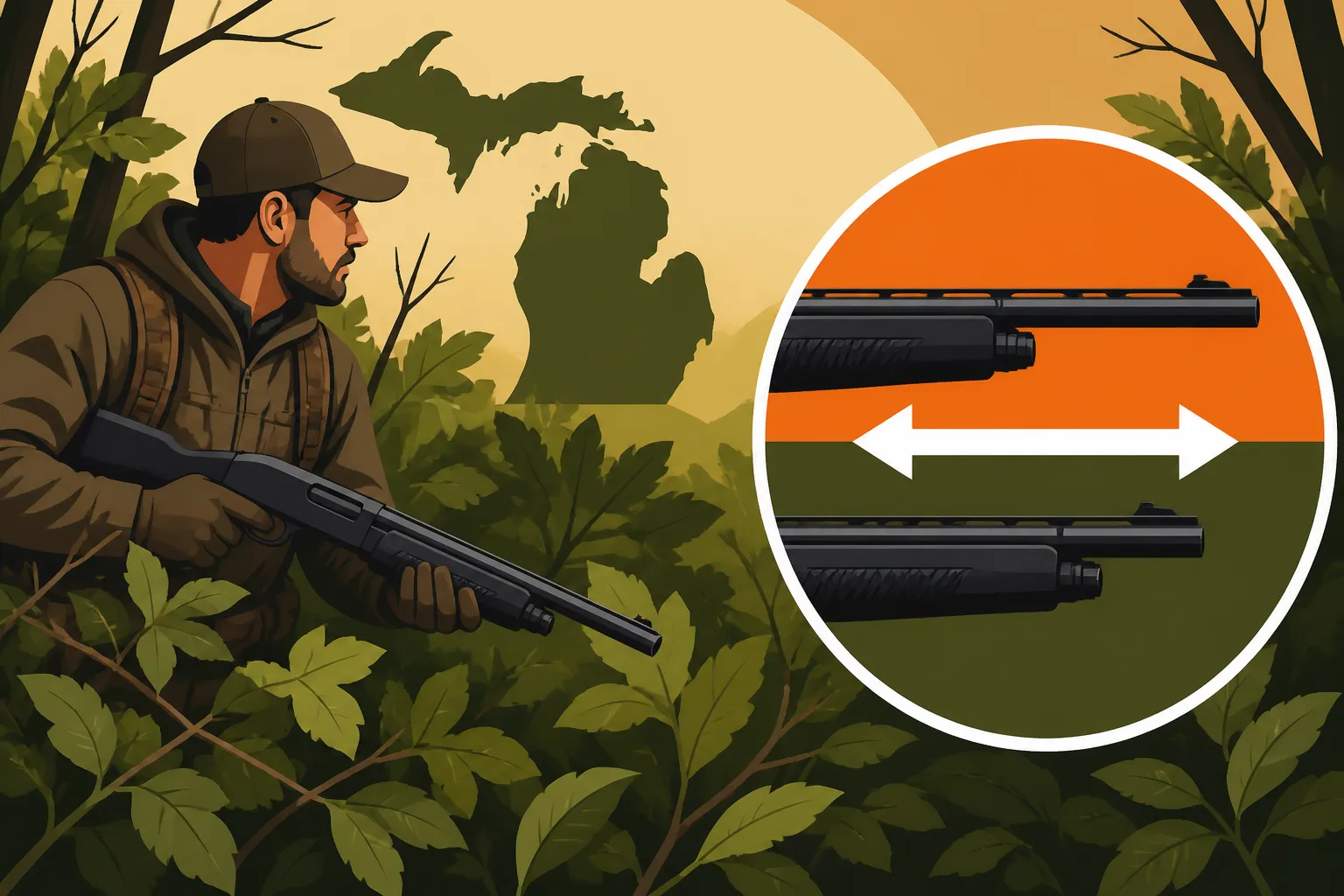
Barrel Length for Walking Thick Cover
It's a familiar dance for any hunter who's spent time in Michigan's woods: that frustrating moment when your rifle barrel snags on a stubborn branch, clattering against a tree, or catching on tangled undergrowth. This guide is all about tackling that common headache, helping you understand how your firearm's barrel length impacts your ability to move silently and effectively through our state's diverse, often incredibly dense, hunting cover.
The Constant Snag: Why Barrel Length Matters in Michigan's Thick Stuff
Michigan's landscape is a patchwork of hunting environments, from vast northern cedar swamps and dense aspen regeneration to overgrown clearcuts and thick farm country woodlots. Each offers its own unique challenges, but one constant remains: if you’re moving through it, rather than sitting high in a stand, your firearm’s length becomes a critical factor in both your comfort and your success. A long barrel might be a non-issue in an open prairie state, but here in Michigan, it can be a significant detriment.
The Frustration of Entanglement
There's nothing quite like trying to quietly slip through a thick stand of tag alders or push through a dense cedar swamp when your 24-inch barrel keeps getting hung up. Each snag creates noise, jars your aim, and often means you’re fighting your gear instead of focusing on the hunt. You might be still-hunting a transition zone where deer are likely to be bedded, or meticulously tracking a fresh sign line in heavy cover. A rifle that's constantly catching on brush turns a stealthy stalk into a noisy, clumsy ordeal. This isn't just about convenience; it's about minimizing disturbances and maximizing your chances of seeing game before it sees you. Every single time your barrel clangs against a branch, you're sending a subtle warning to every set of deer ears within earshot, and that can really dampen your spirits and your success rate.
The Quest for Nimble Handling
The drive to shorten barrel length, especially for hunting in thick cover, comes from a deeply practical place: the need for nimble handling. A shorter barrel allows for quicker target acquisition in tight spaces, easier maneuvering through dense brush, and less chance of bumping into obstacles. Imagine the difference when you're trying to pivot quickly for a fleeting shot at a grouse flushing from an aspen thicket, or when a buck steps out of a cedar swamp just 20 yards away, giving you only a narrow window of opportunity. A gun that handles like an extension of your body, rather than a cumbersome stick, is invaluable. This improved maneuverability means less noise, less effort, and ultimately, a more enjoyable and productive hunt, especially when you're deep in areas like those described in Hunting Michigan Cedar Swamps. Many hunters, after experiencing the struggle, actively seek firearms with shorter barrels, understanding that the benefit of easier navigation far outweighs minor theoretical ballistic differences at typical Michigan hunting ranges.
Finding the Sweet Spot: Balancing Maneuverability and Performance
Choosing the right barrel length isn't just about going as short as possible. There’s a balance to strike between ultimate maneuverability and maintaining effective ballistic performance. While a super-short barrel might be a dream to carry through the thickest stuff, you also need to ensure your cartridge still delivers adequate velocity and energy for a clean kill on your intended game. Thankfully, for most Michigan hunting scenarios, this "sweet spot" is often shorter than what many traditional hunting rifles offer.
Ballistic Considerations for Shorter Barrels
When you trim a barrel, you generally reduce the muzzle velocity of your bullet. This is simple physics: less time in the barrel means less expansion of propellant gases pushing the bullet. For cartridges like the popular .450 Bushmaster, often used in Michigan's limited firearm zone, a 16-inch barrel might see a slight velocity drop compared to a 20-inch barrel. However, for the typical hunting distances encountered in Michigan's thick cover—often under 100 yards, and frequently much closer—this velocity reduction is usually negligible in terms of terminal performance. Modern projectiles are designed to expand effectively over a wide range of velocities, meaning that even with a slightly reduced speed, your bullet will still perform as intended. The energy delivered will still be more than sufficient for deer, bear, or other game, as long as you're within reasonable ranges for that cartridge. For specific details on cartridge choices, you might find Straight-Wall Cartridges Legal in Michigan helpful.
It's about knowing your rifle, your ammunition, and your effective range. If you're confident in your ethical shot placement at 75 yards with a 16-inch barrel, that gun becomes a far more effective tool in dense cover than a 24-inch barrel you can't get into position. The real-world advantage of being able to get on target quickly and quietly often trumps a theoretical extra 50-100 feet per second of velocity that you wouldn't utilize anyway in the confines of a thick aspen stand or heavy pines.
Discipline-Specific Barrel Lengths
The "ideal" barrel length really depends on what you're hunting and where in Michigan you're doing it. There's no one-size-fits-all answer, but we can look at common choices for different hunting disciplines:
Deer Hunting in Thick Woods
For deer hunting, especially in the thickest parts of Michigan's Lower Peninsula or the expansive U.P. big woods, shorter barrels are a game-changer.
- Shotguns and Straight-Wall Rifles: In the Limited Firearm Deer Zone, where traditional rifles are restricted, hunters often use shotguns with slug barrels or rifles chambered in straight-wall cartridges like the .450 Bushmaster. Barrel lengths for these typically range from 18 to 22 inches. An 18-inch barrel on a slug gun or straight-wall rifle offers exceptional maneuverability, making it ideal for still-hunting thick brush or sitting in ground blinds tucked into dense cover. Anything longer can feel clumsy. For a deeper dive into slug options, check out Shotgun Slugs for Michigan Deer.
- Traditional Rifles: In the Upper Peninsula or the unrestricted northern Lower Peninsula, where bottle-necked cartridges are legal, hunters might opt for bolt-action or lever-action rifles. While 22-inch barrels are common, many savvy woods hunters choose 20-inch or even 18-inch barrels, especially if their primary hunting method involves extensive walking or Still-Hunting Michigan Cedar Swamps. These shorter barrels, particularly on cartridges like the .30-30 or even a .308, are more than capable of taking down a Michigan whitetail at the close-to-medium ranges typically encountered in timber.
Upland Bird Hunting in Brushy Cover
Upland hunting for grouse and woodcock in Michigan's aspen cuts and alder runs demands a shotgun that can be swung quickly and instinctively.
- Shotguns: Barrel lengths of 26 to 28 inches are common for general bird hunting, but for truly thick cover like that found in prime Grouse Hunting Michigan Aspen Cover areas, many hunters prefer 24-inch or even 22-inch barrels on their pump, semi-auto, or over/under shotguns. A shorter barrel reduces overall length and weight forward, making the gun feel faster and more responsive as a bird flushes. The open chokes often used for these fast-flying, close-range birds mean that the slight loss of velocity from a shorter barrel is irrelevant; pattern density at close range is key, and that's more about choke and shot size than barrel length. The balance of the gun is paramount here, allowing for those quick, fluid movements required to hit a bird darting through trees. More on this topic can be found in Upland Guns for Aspen and Alder.
Beyond the Barrel: Other Factors for Navigating Dense Cover
While barrel length is a significant piece of the puzzle, it's not the only factor determining how well your firearm handles in Michigan's thick cover. A combination of thoughtful gear choices and smart field techniques can dramatically improve your experience, even with a slightly longer barrel. Think holistically about your setup.
Gun Balance and Overall Weight
A firearm isn't just a length of metal; it's a system with a specific balance point and overall weight. A shorter barrel on a rifle might seem like the obvious choice for dense cover, but if that barrel is overly heavy, or if the rifle's stock is unbalanced, the whole gun can still feel cumbersome. A well-balanced firearm, even one with a slightly longer barrel, can often feel more nimble and less fatiguing to carry and point than a shorter, poorly balanced one. The "feel" of a gun in your hands is incredibly subjective, but critically important for comfortable all-day hunting.
Consider how the weight is distributed. A rifle that's too front-heavy will feel like it's constantly pulling you forward, making it harder to snap to attention quickly. Conversely, one that's too light in the front can feel whippy and harder to keep steady for a precise shot. It’s worth shouldering different firearms to see how they feel, rather than just looking at a spec sheet. A lighter overall weight, especially if you're covering miles of tough terrain, reduces fatigue and helps you remain focused. When you're spending hours pushing through tangles, like when you're Finding Ground Others Walk Past by working deep into difficult terrain, every ounce makes a difference.
Accessories That Add Length or Bulk
Modern hunting often involves various accessories, and it's easy to overlook how these additions can negate the benefits of a shorter barrel. Muzzle brakes, for instance, are fantastic for reducing recoil and muzzle rise, but they can add 2-4 inches to your barrel's effective length. Similarly, if you choose to hunt with a sound suppressor (which requires specific federal and state regulations), you’re adding significant length, often 6-8 inches or more, turning even a short-barreled rifle into a long, unwieldy package for thick woods.
Even simple additions like a large scope with a sunshade or an attached bipod can create snag points or add bulk that makes moving through brush more difficult. Think critically about what you truly need for your hunt. If you're hunting in dense cover where shots will be close, a massive high-magnification scope might be overkill and just another thing to catch on branches. Streamlining your setup—choosing a compact scope, perhaps omitting a bipod if you're not prone shooting—can make a big difference in the real world of Michigan hunting. When planning your route through dense pockets, tools like GoHunt can help you visualize the terrain and anticipate where these added lengths might become an issue.
Carry Methods and Field Techniques
Finally, how you carry and manipulate your firearm in the field plays a huge role in its perceived "length" and maneuverability. A hunter constantly carrying their rifle at port arms will inevitably experience more snags than one who employs smart carry techniques.
- Sling Use: A good sling is essential. Instead of just letting your rifle hang, adjust your sling so the rifle can be carried diagonally across your back, or vertically with the muzzle pointed up, secured by your arm. This keeps the barrel clear of most ground-level tangles and low-hanging branches. A strong, comfortable sling is not just for carrying, but for freeing up your hands for other tasks, like navigating difficult terrain or reaching for a rangefinder. You can explore more carry options in Sling for a Long Swamp Walk.
- "High Hold" or "Low Ready": When actively moving through dense cover and expecting a shot, rather than carrying the rifle horizontally, try a "high hold" with the muzzle pointed up and slightly forward, or a "low ready" with the muzzle angled down. This allows the barrel to slide past obstacles more easily. Keeping your hand on the forend helps you guide the barrel.
- Body Positioning: Use your body to break branches and push aside brush, creating a path for your firearm. Turn sideways to fit through tight spots, using your shoulders to clear a path. This mindful movement, coupled with a shorter, well-balanced firearm, drastically reduces noise and snagging, allowing you to move with the stealth needed to find wary Michigan game. Using aerial photos like those accessible through
GoHuntto identify the densest sections before you even step foot in the woods can help you plan your approach and prepare your gear accordingly, saving you frustration and lost opportunities.
Barrel Lengths for Michigan Hunting Scenarios
To help illustrate the choices, here's a table summarizing common barrel lengths and considerations for various Michigan hunting scenarios.
| Hunting Scenario | Typical Game | Recommended Barrel Lengths (Inches) | Key Considerations |
|---|---|---|---|
| Deer (Limited Firearm Zone) | Whitetail Deer | 18-22 (Shotgun/Straight-Wall) | Maneuverability, fast acquisition, effective at close range. |
| Deer (U.P. / Northern LP Rifle Zone) | Whitetail Deer, Bear | 18-22 (Rifle) | Balance, reduced snagging, sufficient ballistics for woods ranges. |
| Grouse/Woodcock | Ruffed Grouse, Woodcock | 22-26 (Shotgun) | Quick swing, light weight, balance for fast-flushing birds. |
| Small Game (Squirrel/Rabbit) | Squirrels, Rabbits | 16-20 (Rimfire/Shotgun) | Lightweight, easy to carry, minimal noise. |
| Predator Calling | Coyote, Fox | 16-22 (Rifle/Shotgun) | Compact for tight blinds/positions, quick transitions. |
This table is a general guide, and personal preference always plays a significant role. The most important thing is that you are comfortable and effective with your chosen setup.
Disclaimer
This article is for general informational purposes only and does not constitute professional advice. Laws, prices and regulations vary by location and change over time. Consult a qualified professional for guidance on your specific situation.