Rifle Scopes for Low-Light Swamps
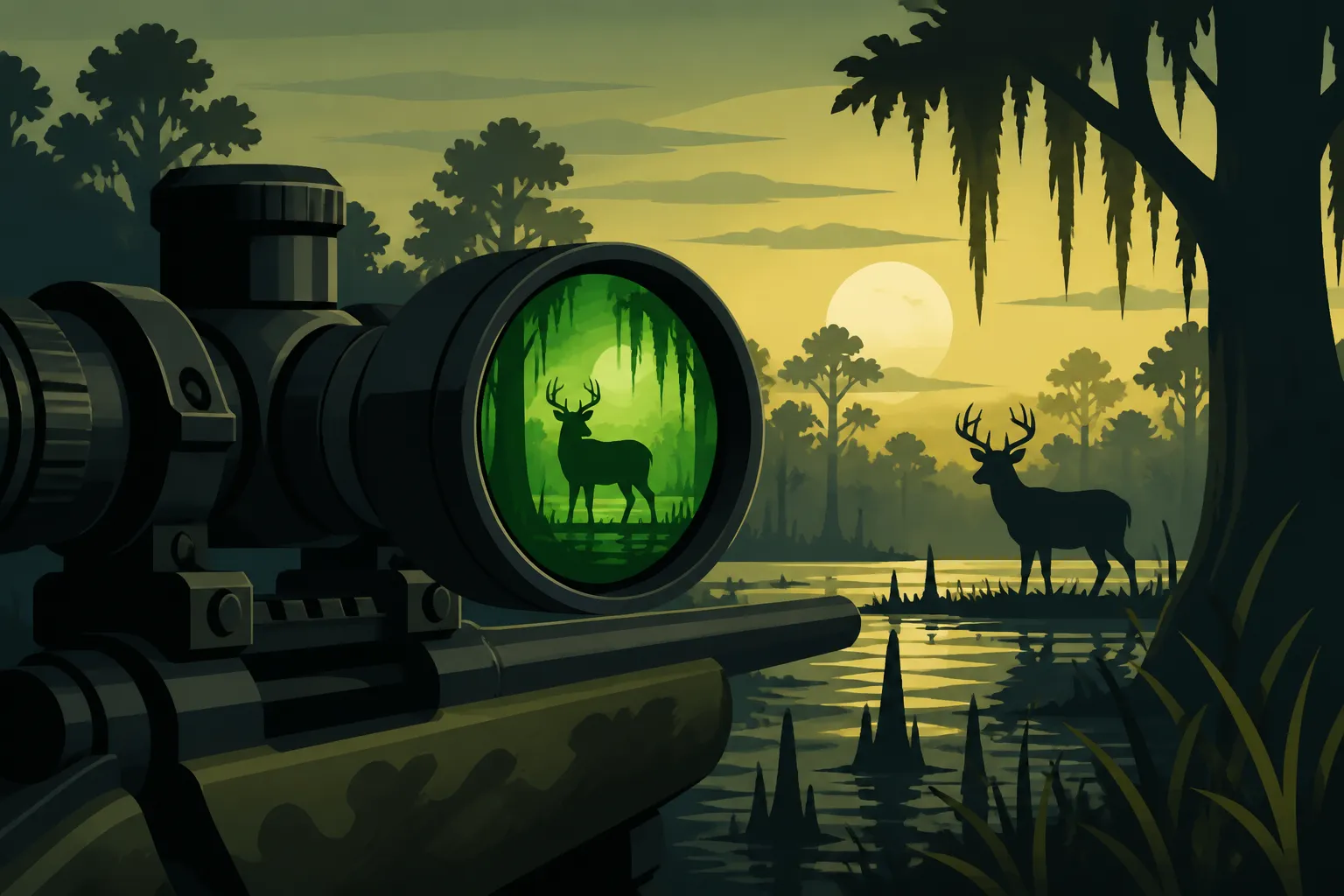
Michigan's dense forests and sprawling swamps present a unique challenge for deer hunters, especially when the light starts to fade in the early morning or late evening. That moment when a buck finally steps out from the impenetrable cedar thicket, just before legal shooting light ends, can be exhilarating, but it demands equipment that won't let you down. This guide will walk you through the critical features to look for in a rifle scope specifically designed to give you an edge in those notorious low-light swamp conditions, helping you make that shot when it counts.
Understanding the Low-Light Challenge in Michigan's Swamps
Anyone who's spent time in a Michigan cedar swamp or a thick aspen cut knows that "low light" here means something different than it does in open fields. The combination of dense canopy, thick underbrush, and persistent Michigan weather creates an environment where every photon counts.
The Dense Michigan Environment
Picture yourself sitting in a treestand along a black spruce edge, a classic spot for Hunting Michigan Swamp Edges for Deer, with a cedar swamp behind you and a barely visible trail leading to an oak ridge. It's 6:30 AM in mid-November, the sky is grey, a light drizzle is falling, and the fog is just starting to lift. Even though the sun might be "up" by the clock, the amount of usable light reaching your position is drastically reduced. The thick evergreen canopy overhead blocks much of the ambient light, creating perpetual twilight. This isn't just about dawn and dusk; on overcast days, especially deep in a swamp, it can feel like low light all day long. When you're Still-Hunting Michigan Cedar Swamps, trying to pick out a deer's leg through the tangled branches, a dim scope can make an ethical shot impossible.
The sheer density of the vegetation also means that any deer you encounter will likely be partially obscured, camouflaged against dark bark and shadows. Their dark coats blend seamlessly into the environment. You're not looking for an entire deer in the open; you're often trying to discern an antler tine, a shoulder, or the flicker of an ear through a small window in the brush. This demands not just light-gathering ability, but also exceptional clarity and contrast from your optic. The light transmission of your scope becomes paramount, not just to see something, but to see details.
Why Standard Scopes Fall Short
Many scopes, perfectly adequate for brighter conditions or open terrain, simply don't have the optical engineering required for Michigan's dark swamps. A basic hunting scope might gather enough light in a clear-cut or an open hardwood forest, but when you drop into a mature conifer swamp, the difference becomes stark. The image might appear dark, murky, and lack the contrast needed to distinguish a deer from the background. You might see a shape, but you can't be confident enough to place a shot accurately.
This isn't just frustrating; it's a safety and ethical concern. Taking a shot when you can't clearly identify your target or ensure an ethical hit is irresponsible. Standard scopes often use less sophisticated lens coatings, or fewer of them, leading to light loss and internal reflections. Their glass quality might not be optimized for maximum transmission, and their reticles might disappear against a dark background. You might find yourself having to strain your eyes, which only makes the problem worse and causes fatigue. For the dedicated Michigan hunter, a scope that shines in these demanding conditions isn't a luxury; it's a necessity, allowing you to confidently take advantage of those fleeting, precious moments.
Essential Optical Qualities for Swamp Scopes
When you're trying to pick out the subtle flick of a deer's ear in the deep shadows of a cedar swamp, the quality of your optics is everything. It's not just about the size of the objective lens; it's a complex interplay of glass, coatings, and design.
Light Transmission: More Than Just a Number
Light transmission refers to the percentage of light that passes through a scope's optical system and reaches your eye. In theory, a higher percentage means a brighter image. However, it's not always a straightforward number. Premium scopes can achieve light transmission rates in the high 90s, while budget scopes might be in the 80s or even lower. This difference might seem small on paper, but in the dim light of a Michigan swamp, it can be the deciding factor between a clear shot and a missed opportunity.
What truly matters is effective light transmission across the entire visible spectrum, and how that light is processed to create a clear, high-contrast image. The quality of the glass itself, how precisely it's ground and polished, and the consistency of the optical path are all crucial. Cheap glass introduces aberrations, scatters light, and dulls the image even if a high percentage of light technically gets through. For hunters, this means looking for scopes that boast ED (Extra-low Dispersion) or HD (High Definition) glass, which minimizes chromatic aberration and delivers truer colors and sharper details, making it easier to separate a deer from the dappled shadows. When you're trying to see into those dark pockets that GoHunt satellite imagery reveals as dense cover, superior light transmission makes all the difference.
The Role of Exit Pupil and Objective Lens
The objective lens is the front lens of your scope, the big one that faces your target. A larger objective lens can gather more light, but it's not the only piece of the puzzle. What many hunters don't fully understand is the "exit pupil." The exit pupil is the diameter of the light beam that leaves the eyepiece and enters your eye. It's calculated by dividing the objective lens diameter by the magnification. For example, a 40mm objective lens at 4x magnification has a 10mm exit pupil (40/4=10). At 10x magnification, it drops to 4mm (40/10=4).
Why does this matter? In low light, your eye's pupil dilates to let in more light. A young person's pupil can dilate up to 7mm in darkness, while an older hunter's might only reach 4-5mm. For optimal low-light viewing, you want the scope's exit pupil to be at least as large as your dilated eye pupil. If the scope's exit pupil is smaller than your eye's, you're not utilizing all the light your eye could take in. This is why a large objective lens with a relatively low magnification can be so effective in low light. It creates a larger exit pupil, giving your eye more light to work with and a more forgiving sight picture. This concept is vital for Low-Light Performance in a Scope. However, a huge objective lens also adds weight and requires higher scope rings, which can affect the rifle's balance and cheek weld. Finding the right balance for your hunting style is key.
Lens Coatings: Your Unsung Hero
Lens coatings are truly the unsung heroes of low-light performance. Every time light passes through an air-to-glass surface in a scope, a small percentage of it is reflected away. Without coatings, this reflection can add up to significant light loss and create distracting glare or flare. High-quality multi-coatings, often applied in multiple layers to all air-to-glass surfaces (fully multi-coated), dramatically reduce these reflections. This maximizes light transmission, but also improves contrast and color fidelity.
Beyond anti-reflective properties, some coatings also add durability, making the lenses more scratch-resistant, or repel water and oil, keeping your view clear even in a Michigan downpour. These hydrophobic coatings are invaluable when you're hunting in wet conditions common in swamps during late fall and winter. When comparing scopes, look for terms like "fully multi-coated" and inquire about any additional protective coatings. These treatments are expensive to apply correctly, which is why they are a good indicator of overall scope quality and a major factor in how well a scope performs when that trophy buck steps out of the shadows.
Magnification and Reticle Choices for Close Quarters
Choosing the right magnification range and reticle is crucial for navigating Michigan's tight, brushy terrain and the notoriously poor visibility of swamp edges. It's often counterintuitive to what many new hunters might think.
Finding the Right Magnification Range
When it comes to hunting in Michigan's dense cover, especially in those cedar swamps or thick aspen cuts where visibility might only extend 50-75 yards, less is often more. A scope with a wide magnification range, say 3-15x, might seem versatile, but the higher end of that range is rarely useful when you're trying to thread a bullet through a tight window in the brush. In fact, too much magnification can be detrimental. At 10x or 15x, your field of view (the width of the area you can see through the scope) shrinks dramatically, making it incredibly difficult to find a moving deer quickly, especially if it appears suddenly.
A lower magnification setting, typically 1x to 4x on the bottom end, is your friend here. It provides a much wider field of view, allowing for rapid target acquisition. When a deer busts out of a thicket at close range, you need to get on it fast. A scope that starts at 1.5x, 2x, or 3x and goes up to perhaps 7x or 9x offers the perfect balance for Michigan hunting. It gives you enough power for those slightly longer shots across a small clearing or a two-track, but most importantly, it excels in the close-quarters environment of the swamp. For more on this, check out Rifle Scope Magnification for Michigan Deer. Remember, it’s about making an ethical shot confidently, not necessarily about seeing the deer's eyelashes at 200 yards in the thick stuff.
Illuminated Reticles: A Game Changer
Imagine this scenario: you're set up for Hunting the Peak Rut Week in Michigan in a dark, shaded funnel leading to a bedding area. A magnificent buck steps out right at the edge of legal light, but its dark body blends perfectly with the dark background. Your traditional black reticle simply disappears. This is where an illuminated reticle becomes a true game changer for hunting in low-light swamps. An illuminated reticle has a central dot, crosshair, or portion of the reticle that glows, usually in red or green, powered by a small battery.
This illumination provides a stark contrast against a dark target or background, allowing you to clearly see your aiming point without obscuring the target itself. Modern illuminated reticles often have adjustable brightness settings, so you can dial it down to a subtle glow that doesn't wash out your vision, or brighten it for slightly less dim conditions. While it's another thing to turn on and potentially fail (always carry a spare battery!), the advantage it provides in those critical, fleeting low-light moments is undeniable. It ensures you have a precise aiming point when your traditional reticle would otherwise vanish. We delve deeper into this specific feature in Illuminated Reticles for Dark Swamps.
Simplicity in Reticle Design
While advanced reticles with multiple holdover points for long-range shooting are popular in open country, they can be a hindrance in the close, fast-paced environment of a Michigan swamp. Too many lines, dots, or hash marks can clutter your field of view, making it harder to quickly acquire your target and focus on the precise aiming point, especially under stress and in low light.
For swamp hunting, a simple duplex, German #4, or a similar uncluttered reticle is often the best choice. These designs typically feature bold outer posts that quickly draw your eye to the center, where a finer crosshair or dot allows for precise aiming. The goal is speed and clarity. You're generally not taking 300-yard shots in a Michigan swamp; most engagements will be well within 100 yards, often much closer. A reticle that allows you to quickly center on your target and place the crosshairs on the kill zone without distraction is invaluable. Even with an illuminated reticle, keeping the overall design simple ensures maximum efficiency when every second counts.
Durability and Reliability: Built for the Michigan Elements
Michigan hunting isn't always fair-weather strolls. From driving rain to heavy snow and unexpected tumbles, your gear needs to stand up to the elements. A rifle scope is an investment, and it needs to be as tough as the environment it's used in.
Waterproofing and Fog-Proofing: Non-Negotiable Standards
Michigan weather is notoriously unpredictable. One minute it's crisp and clear, the next a torrential downpour or a wet, heavy snow rolls in. If you're spending any time hunting the swamps, especially during Muzzleloader Tactics in December Cold, you're going to encounter moisture. A scope that isn't truly waterproof and fog-proof is a liability. Waterproofing means the scope is sealed with O-rings to prevent water from entering the housing, protecting the sensitive internal components. Look for ratings like IPX7 or better, indicating it can withstand immersion.
Fog-proofing goes hand-in-hand with waterproofing. It involves purging the air inside the scope and replacing it with an inert gas like nitrogen or argon. This dry gas prevents moisture from condensing on the internal lens surfaces when you move from a warm, humid environment (like your cabin) to a cold, damp one (like a Michigan swamp). There's nothing worse than raising your rifle for a shot only to find your reticle obscured by internal fog. Many modern scopes boast these features, but always verify. A fogged scope is as useless as no scope at all, and it's a common frustration for hunters in Michigan's wet environment.
Shock Resistance and Robust Construction
Hunting in Michigan, especially if you're venturing deep into state land or tackling rough terrain, means your rifle is going to take a few bumps and knocks. You might trip over a hidden root, slide on icy ground, or simply lean your rifle against a tree. Your scope needs to be built to withstand these impacts without losing its zero or suffering internal damage. This is where robust construction and quality materials come into play.
Look for scopes with a solid, one-piece main tube, typically machined from aircraft-grade aluminum. The internal components, particularly the erector system that houses the reticle and provides magnification changes, must be precisely engineered and securely mounted to handle recoil and external shocks. A scope that can't hold its zero after a fall or even after repeated recoil from your chosen Choosing a Rifle Caliber for Michigan Deer is worse than useless. It can lead to missed shots, wounded game, and a loss of confidence. Manufacturers often test their scopes vigorously for shock resistance, and it's a feature worth researching for any Michigan hunter who plans to put their gear through its paces.
Turrets and Adjustments for Real-World Hunting
In the thick cover of a Michigan swamp, you're usually not "dialing for elevation" on distant targets. Most shots are relatively close, requiring minimal, if any, adjustment once zeroed. However, the quality of your turrets and internal adjustments is still critical for setting and maintaining your zero. Turrets should offer crisp, tactile clicks that are easily felt even with gloved hands, allowing for precise adjustments during initial zeroing. More importantly, they should be reliable and repeatable, meaning a click moves the point of impact by the stated amount (e.g., 1/4 MOA or 0.1 MIL), and the scope returns to zero reliably after adjustments.
For swamp hunting, exposed target turrets that can be easily bumped or rotated inadvertently are often a liability. Capped turrets are generally preferred as they protect your zero from accidental changes while moving through brush. Some scopes offer zero-stop features, which allow you to return to your chosen zero quickly and positively after making temporary adjustments. While not as critical for close-range swamp hunting, precise and dependable adjustments are fundamental to the scope's overall accuracy and your confidence in its performance. When you're in the field, you want to trust that your scope is holding true, no matter the conditions or how much dense cover you've pushed through.
Practical Considerations Beyond the Glass
While optical quality and ruggedness are paramount, other practical aspects of a scope can significantly impact your hunting experience in Michigan's challenging swamp terrain.
Mounting, Rings, and Eye Relief
A top-tier scope is only as good as its weakest link, and that often comes down to the mounting system. High-quality rings and a sturdy base are essential to ensure the scope remains securely attached to your rifle, maintains its zero, and can withstand the rigors of hunting. For hunting in dense cover, where snags and bumps are common, robust, steel rings are often preferred over lighter aluminum options, especially if you're using a heavier rifle. Proper torque settings are also crucial—too loose, and the scope can shift; too tight, and you risk damaging the scope tube.
Eye relief is another critical factor, referring to the distance your eye needs to be from the eyepiece to see a full, clear image. Generous eye relief (typically 3.5 inches or more) is important for safety, preventing the scope from contacting your brow under recoil, especially with powerful cartridges. It also offers a more forgiving "eye box," making it quicker and easier to acquire a full sight picture when you bring the rifle to your shoulder, which is invaluable in fast-breaking swamp encounters. A scope with tight eye relief can be frustrating, forcing you to constantly reposition your head, losing precious seconds.
Weight and Balance: Carrying it Through the Thicket
Michigan swamp hunting often involves considerable walking, sometimes off-trail, through thick underbrush, over fallen logs, and across uneven ground. A heavy rifle setup can quickly become cumbersome and tiring. While a larger objective lens can aid in low-light performance, it also adds significant weight. This extra weight, particularly if it's forward-biased, can throw off the rifle's balance, making it harder to carry comfortably and swing smoothly.
Consider the overall weight of your chosen scope in relation to your rifle and personal strength. A lighter, more compact scope that still delivers excellent optical performance might be a better choice than the heaviest, largest objective model on the market. Manufacturers like GoHunt provide tools and resources to help hunters understand different gear choices, and they emphasize how individual components contribute to the overall field experience. A well-balanced rifle, even if it sacrifices a tiny bit of theoretical low-light capability, will be much more enjoyable to carry and quicker to shoulder and aim when that fleeting opportunity arises. Every ounce matters when you're dragging your feet through knee-deep muck for miles.
Understanding Your Budget and Value
Let's be realistic: high-quality optics are an investment. You generally get what you pay for when it comes to glass quality, coatings, and robust construction. However, that doesn't mean you need to mortgage the farm to get a capable swamp scope. There's a wide range of excellent optics available across various price points. Instead of focusing solely on the most expensive options, prioritize features that are truly essential for your specific hunting conditions.
For Michigan low-light swamp hunting, light transmission, a good exit pupil, multi-coated lenses, fog-proof and waterproof construction, generous eye relief, and a simple, illuminated reticle should be at the top of your list. You might find a scope from a reputable manufacturer that offers these core features exceptionally well, even if it lacks some of the bells and whistles (like advanced ballistic turrets) that you won't use in the swamp anyway. Read reviews, compare specifications, and consider the manufacturer's warranty. A solid warranty indicates confidence in their product's durability. Ultimately, the best scope is one you can afford, that performs reliably in the conditions you hunt, and that you have complete confidence in when the moment of truth arrives.
Comparing Scope Features for Michigan Swamp Hunting
Here's a quick comparison of key features you'll want to consider when selecting a rifle scope for those challenging Michigan low-light swamp conditions:
| Feature | Ideal for Michigan Swamps | Less Ideal / Trade-offs | Why it Matters |
|---|---|---|---|
| Magnification Range | Low variable power (e.g., 1.5-6x, 2-7x, 3-9x) | High fixed power (e.g., 10x) or wide ranges (4-20x) | Wide field of view, fast target acquisition in thick cover. |
| Objective Lens Diameter | 32mm – 44mm (balancing light gathering and weight) | Very small (20-24mm) or very large (50mm+) | Balances light collection with weight and mounting height. |
| Light Transmission | High (90%+) with ED/HD glass and fully multi-coated lenses | Lower (80%-) with basic coatings or standard glass | Determines brightness, clarity, and contrast in dim light. |
| Exit Pupil | 6mm – 8mm (at typical hunting magnification) | Less than 4mm (at typical hunting magnification) | More light to your eye, more forgiving sight picture in low light. |
| Reticle Type | Simple Duplex, German #4, or similar, with illumination | Complex ballistic reticles without illumination | Uncluttered view, clear aiming point against dark backgrounds. |
| Durability | Argon/Nitrogen purged, O-ring sealed (IPX7+), solid tube | Not fog-proof, susceptible to water ingress or shock | Withstands Michigan's wet, cold, and rugged environment. |
| Eye Relief | Generous (3.5+ inches) with a forgiving eye box | Tight eye relief (<3 inches) | Safety from recoil, quick sight picture acquisition. |
Ultimately, choosing the right rifle scope for Michigan's low-light swamps is about understanding the unique challenges of the environment and prioritizing the features that will help you overcome them. It's about confidence, ethical hunting, and making the most of those precious moments when a Michigan whitetail finally presents itself.
Disclaimer
This article is for general informational purposes only and does not constitute professional advice. Laws, prices and regulations vary by location and change over time. Consult a qualified professional for guidance on your specific situation.