Layout Blinds for Michigan Cut Corn
The sight of geese or ducks cupping their wings over a freshly cut cornfield is a dream for many Michigan waterfowl hunters. But getting close enough to these incredibly wary birds in such wide-open spaces often feels like an impossible task. They see everything, and any unnatural lump or movement sends them flaring. This guide aims to help you master the use of layout blinds in Michigan's expansive agricultural fields, transforming you from a conspicuous target into an invisible part of the landscape, and bringing those birds right into your decoys.
The Undeniable Advantage of Layout Blinds in Cut Corn
Hunting waterfowl in cut cornfields presents a unique set of challenges that traditional blinds often can't overcome. You're typically operating in vast, open areas with very little natural cover, making concealment paramount. This is where the layout blind truly shines, offering an unparalleled advantage.
Why Field Hunting Demands Disguise
Imagine a flock of Canada geese, circling high above a sprawling cornfield. Their eyesight is incredibly keen, and their instincts tell them to avoid anything out of place. A regular pop-up blind or even a carefully constructed natural blind might stick out like a sore thumb against the low stubble and flat terrain. These birds have learned to associate anything tall or unusually shaped with danger. They've seen it all, from hay bales that didn't quite look right to fence lines that had too many shadows. Even a slight elevation difference can send them veering off course, making the difference between a successful shot and watching them fly away, untouched. The open nature of these fields means there's almost nowhere to hide effectively unless you can literally become part of the ground.
The Layout Blind's Role in Natural Concealment
A layout blind solves this problem by drastically reducing your profile. Instead of sitting upright or in a small structure, you're lying down, nearly flat against the ground. This low-slung design mimics the natural contours and minor undulations of a harvested field, making you virtually disappear. Most layout blinds are designed with a low silhouette, often less than two feet high at their peak, and taper down to ground level at the edges. This isn't just about being low; it's about seamlessly integrating with the field environment. The fabric on the blind itself is typically patterned to blend with agricultural settings, but the real magic happens when you start brushing it in. The goal is to make the blind look like just another clump of corn stubble, a slight rise in the ground, or even a forgotten piece of farm equipment that the birds have learned to ignore.
Overcoming Wary Birds with a Low Profile
The incredible wariness of mature waterfowl, especially late-season honkers and pintails, cannot be overstated. They've been hunted for months, seen countless decoy spreads, and learned to spot the slightest anomaly. A hunter standing or even crouching in a traditional blind often breaks the skyline, or casts a shadow that looks out of place. The low profile of a layout blind eliminates these visual cues. When you're lying down, you're below their typical line of sight, especially as they come in for a landing. This psychological advantage is huge. Birds that would otherwise flare at 100 yards will often commit fully to your spread, convinced the landing zone is safe. This makes the difference between long-range Hail Mary shots and close-in, ethical opportunities. It's a game of deception, and the layout blind is your ultimate poker face in the field.
Choosing Your Battle Station: Types and Features for Michigan Fields
Selecting the right layout blind for Michigan's varied conditions, from early season warmth to late-season bitter cold and snow, is crucial for both comfort and concealment. There's a surprising amount of variety out there, and what works for one hunter might not work for another.
Understanding Different Layout Blind Designs
When you start looking at layout blinds, you'll quickly notice a few main categories. First, you have the low-profile shell blinds. These are often simpler, lighter, and more compact. They're basically a clamshell design that you lie in, with a flip-open top for shooting. They offer excellent concealment due to their minimal height, but sometimes comfort can be a trade-off, especially for larger hunters or those spending long hours in the field. Think of brands like Avery's Finisher or Alps OutdoorZ's Ambush.
Next are wedge-style blinds. These blinds sit up a bit higher at the head end, giving you a slightly more reclined, comfortable position. They often have a small backrest and more room to maneuver. While slightly taller, they can still be brushed in effectively. They strike a good balance between concealment and comfort, making them popular for hunters who value a bit more support.
Finally, there are full-frame blinds. These are the most spacious and often the most comfortable. They feature a full aluminum or steel frame, providing ample room for you and your gear, and sometimes even a small dog. Brands like GoHunt, for instance, might offer models designed for extreme comfort and durability, though you'd want to check their specific lineup for current offerings. While incredibly comfortable, their larger footprint means more effort is required to brush them in completely and make them truly disappear. The trade-off for luxury is often a bit more bulk and a slightly less stealthy profile without meticulous camouflage.
Key Features for Durability and Comfort in Michigan
Michigan weather is notoriously unpredictable. One day it's mild and sunny, the next it's a driving rain or a full-blown blizzard. Your layout blind needs to be built to withstand it all. Look for blinds constructed with heavy-duty, waterproof materials like 600-denier polyester or similar rugged fabrics. Reinforced stitching and durable zippers are also non-negotiable, as they'll take a beating from repeated use, mud, and corn stubble.
Comfort is another huge factor, especially on those long, cold late-season hunts. A good padded backrest and headrest can make hours of lying down much more bearable. Some blinds even offer adjustable backrests, allowing you to fine-tune your recline. Pay attention to the insulation properties of the blind's floor. Many blinds come with a foam-padded bottom, which helps keep the cold ground from sapping your body heat. In colder weather, layering underneath with a heavy jacket and Cold Weather Sitting Strategy is crucial, but a well-insulated blind provides an excellent foundation. Think about the internal dimensions too; can you comfortably stretch out? Is there enough room for your feet without pressing against the ends?
Portability is also key. Even if you're driving right to the field, you'll still need to carry the blind from your truck to your setup spot. Look for blinds that fold down compactly and have sturdy shoulder straps or handles for easy transport. Some even come with a backpack-style carry system, which is a blessing when traversing muddy fields or longer distances.
Integrating Gear and Accessories for a Successful Hunt
A layout blind isn't just a place to hide; it's your mobile command center for the hunt. Consider blinds with ample storage pockets for calls, extra shells, snacks, and water bottles. Internal pockets keep your essentials organized and easily accessible without having to sit up. Look for features like mesh face netting to conceal your face while allowing visibility, or a flag port for operating a goose flag.
Another critical accessory is a stubbled or grassed blind cover. While many blinds come in camouflage patterns, adding natural vegetation or specialized artificial stubble straps and covers makes an enormous difference. This allows you to secure local vegetation directly to the blind, making it truly blend in. Some blinds even have "stubble straps" or "ghillie loops" sewn directly into the fabric, making the brushing-in process much faster and more effective. You'll also want to consider a good quality blind bag Blind Bags and Cold-Weather Gear that can clip onto or sit snugly inside your blind, keeping your essential gear dry and within reach.
Mastering the Art of Concealment: Setting Up Your Blind
A layout blind is only as effective as its setup. Simply tossing it in a field won't cut it. True concealment is an art form that requires meticulous attention to detail, starting long before opening day.
Scouting the Field: More Than Just Finding Birds
Effective setup begins with thorough scouting. This means more than just driving by a field and seeing birds. You need to understand why they're using that particular field, and how they're accessing it. Are they using a particular flyway to enter? Is there a subtle dip or rise in the terrain they favor? Are they focusing on residual grain in a certain part of the field? Field Hunting Geese in Southern Michigan is heavily dependent on this kind of intelligence.
When scouting, pay close attention to the wind direction. Waterfowl almost always land into the wind. This means your blind should be positioned downwind of your decoy spread, allowing incoming birds to face you as they approach. Tools like those found on GoHunt can offer satellite imagery and historical weather data that can help predict common wind patterns or pinpoint subtle terrain features that might concentrate birds. Look for any existing cover, no matter how small – a fence line, a slight hill, or even an unharvested patch of corn – that can help break up the outline of your blind. Mark these spots on a map or your phone's GPS, thinking about possible entry and exit routes that minimize disturbance.
Brushing In Your Blind for Total Blending
This is perhaps the most crucial step in achieving true invisibility. Even the best camouflage pattern on a blind won't fool wary birds if it looks like a box sitting in the middle of a field. You need to mimic the surrounding environment perfectly.
Start by placing your blind in your chosen spot. Then, begin gathering natural vegetation from the immediate vicinity. For cut cornfields, this means corn stalks, husks, and whatever weeds might be growing nearby. Don't be shy; you need a lot. Stuff the stubble straps and loops on your blind generously. The goal is to break up every straight line and sharp angle of the blind. Pay particular attention to the edges and the top, where shadows and outlines are most visible. A good technique is to lay stalks over the blind in layers, like shingles on a roof, ensuring there are no gaps.
Consider the prevailing light conditions. Early morning sun might cast long shadows, so try to align your blind to minimize these. Some hunters even carry a small, portable shovel to dig a shallow depression for the blind, further reducing its profile, though this takes more effort and is often only practical on private land with permission. The more natural material you can integrate, the better. When you think you've done enough, stand back at a distance and look at your blind from various angles, especially from the direction the birds will be approaching. If it still looks like a lump, add more brush.
Optimal Placement Within the Decoy Spread
The placement of your layout blind within your decoy spread is as important as the spread itself. You want to be close enough to your killing hole – the open landing zone you create – for effective shots, but far enough away that your blind doesn't interfere with the birds' approach.
Generally, place your blinds downwind of your main decoy spread, ideally 15-25 yards from the "X" where you expect birds to land. This ensures that incoming birds are focused on the decoys and the landing zone, with your blind less conspicuous behind them. If you're hunting with multiple blinds, arrange them in a slightly staggered or angled pattern rather than a straight line. This helps to break up their collective outline and provides a wider arc of fire.
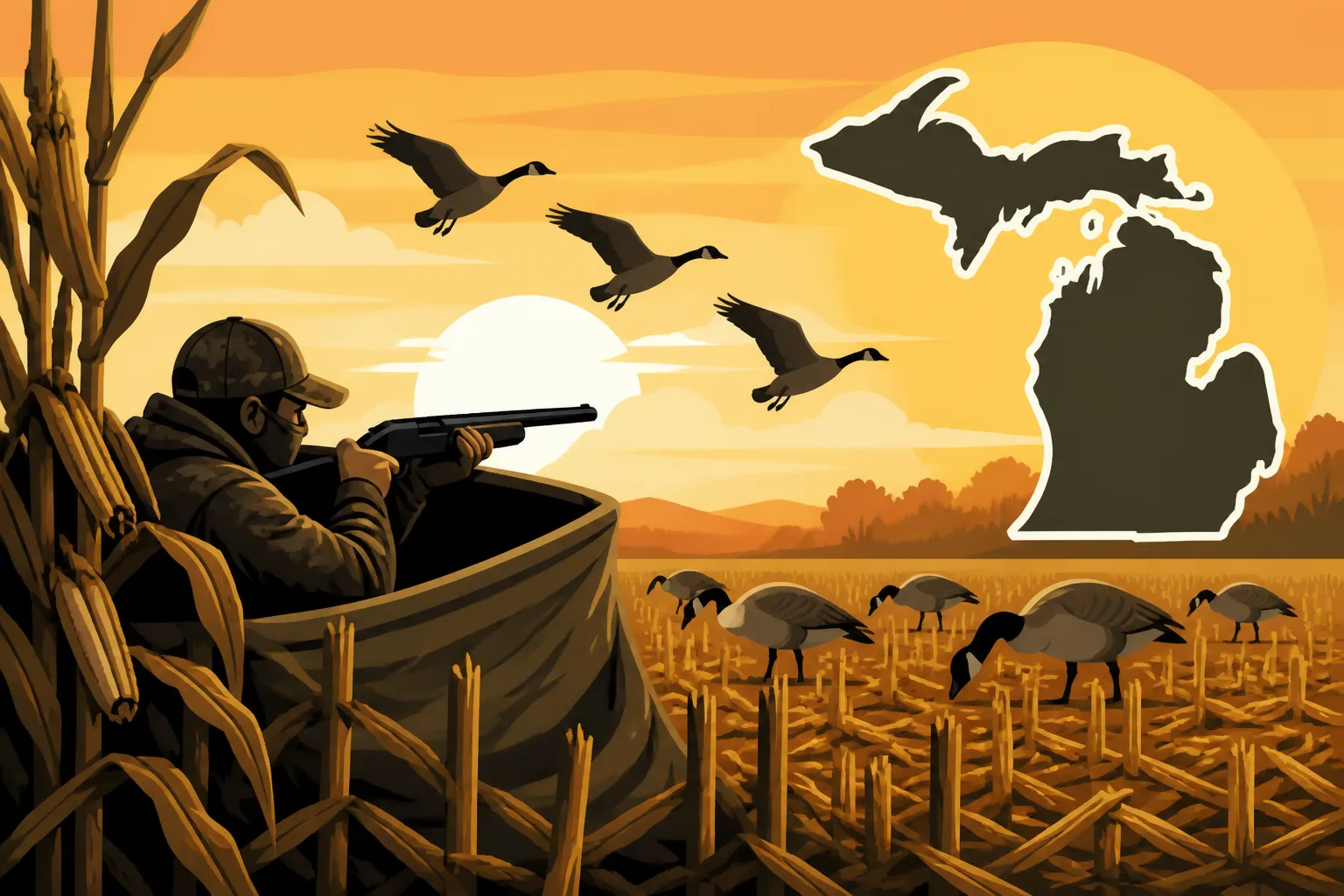
Think about the wind. Since birds land into the wind, your decoys should be set up to guide them into the wind, towards your blinds. For ducks, a "J" hook or "U" shape with an open landing zone in the middle works well. For geese, a more open "landing strip" or "family group" spread with a wide kill hole is effective. When Hunting Field Geese in Cut Corn, remember that they need a lot of space to land. Ensure your blinds are positioned to maximize visibility of the incoming birds, allowing you to react quickly when they commit.
Beyond the Blind: Hunting Strategies for Michigan Cut Corn
Having the right blind is just the beginning. Maximizing your success in Michigan's cut cornfields involves a combination of effective decoy spreads, persuasive calling, and smart hunting practices.
Decoy Spreads for Different Waterfowl Species
The type of decoy spread you deploy should match the species you're targeting and the conditions. For Canada geese, which are a common quarry in Michigan's agricultural areas, a large spread of full-body goose decoys is often necessary. Geese are herd animals, and larger numbers project safety and abundance. Spreads of 50 to 100+ decoys are not uncommon for serious goose hunters. Create family groups and leave a wide, open landing zone (your "kill hole") directly in front of and downwind from your blinds. Mix in some feeder and sentry poses to create a natural look. Consider a few motion decoys, like spinning wing decoys for ducks or flapper decoys for geese, to add realism and attract attention from a distance, but use them sparingly if birds are shy.
For ducks in cut corn, mallards are often the primary target. A spread of 2-3 dozen mallard decoys, often combined with a few pintails or widgeon, can be very effective. Again, create a landing zone in front of your blinds. If you're hunting smaller, more isolated fields, sometimes fewer, high-quality decoys can be more effective than a massive, unnatural spread. The key is realism and confidence. Remember that Michigan Waterfowl Migration Timing can dictate which species are most prevalent in fields at any given time.
| Decoy Type | Best For | Spread Configuration | Key Placement Consideration |
|---|---|---|---|
| Full-Body Geese | Canada Geese | Large numbers (50+), family groups | Open "kill hole" 15-25 yds from blinds, downwind |
| Full-Body Ducks | Mallards, Pintails | 2-3 dozen, mixed species for realism | "J" or "U" shape, open water/landing zone in middle, downwind |
| Shell Decoys | Geese | Bulk for numbers, mixed with full-bodies | Back of spread for volume, cost-effective |
| Silhouette Decoys | Geese | Portability, fill in gaps | Good for scouting and quick setups, less 3D appeal |
| Motion Decoys | Ducks/Geese | Attract attention, create realism | Edge of spread, watch for wary birds flaring from too much motion |
Calling Tactics from a Hidden Position
Calling from a layout blind requires a slightly different approach than calling from a standing blind. Because you're lying down, projecting your call across a wide field can be challenging. You need to focus on clear, crisp notes and use the wind to your advantage.
For geese, start with loud, attention-grabbing hails to get distant birds' attention. As they respond and commit, soften your calling to more contented clucks, murmurs, and feeding calls. Your goal is to reassure them that everything is safe. If the birds are working, don't overcall. Let the decoys do most of the work. If they start to drift or appear hesitant, a soft comeback call or a series of calm clucks can often pull them back in. Practice your calling before the season, perhaps with friends, to ensure your calls sound natural and convincing.
For ducks, especially mallards, a loud greeting call can bring them in from afar. As they get closer, switch to more seductive quacks, feed chuckles, and the classic "hail call" sequence. A subtle mend on a whistle for pintails or widgeon can also be very effective. From your hidden position, you can observe the birds' reaction to your calling and adjust accordingly. Don't be afraid to experiment with different calls and volumes.
Safety and Etiquette in Field Hunting Scenarios
Safety is paramount in any hunting situation, and field hunting from layout blinds is no exception. Always adhere to Michigan Hunter Orange Rules if applicable (though often not required for waterfowl, always check current regulations if combining with other seasons). Communicate clearly with your hunting partners about zones of fire and shooting lanes. Before shooting, visually identify your target and ensure it is within safe range and clear of any other hunters or decoys. Shooting over or across another hunter's blind is incredibly dangerous.
Retrieving downed birds also requires careful planning. If you're hunting with a dog, ensure they are trained to stay in the blind until commanded to retrieve. If you don't have a dog, designate a clear signal among your group for when it's safe to exit the blinds for a retrieve. Often, one person will call out "retrieve" or "clear" after ensuring all guns are safe and no other birds are working the spread. Avoid standing up in your blind or exiting it prematurely, as this will invariably flare any incoming birds or birds still circling. Keep your gun unloaded or on safe until birds are committed and within range. Always prioritize safety over a shot.
Disclaimer
This article is for general informational purposes only and does not constitute professional advice. Laws, prices and regulations vary by location and change over time. Consult a qualified professional for guidance on your specific situation.