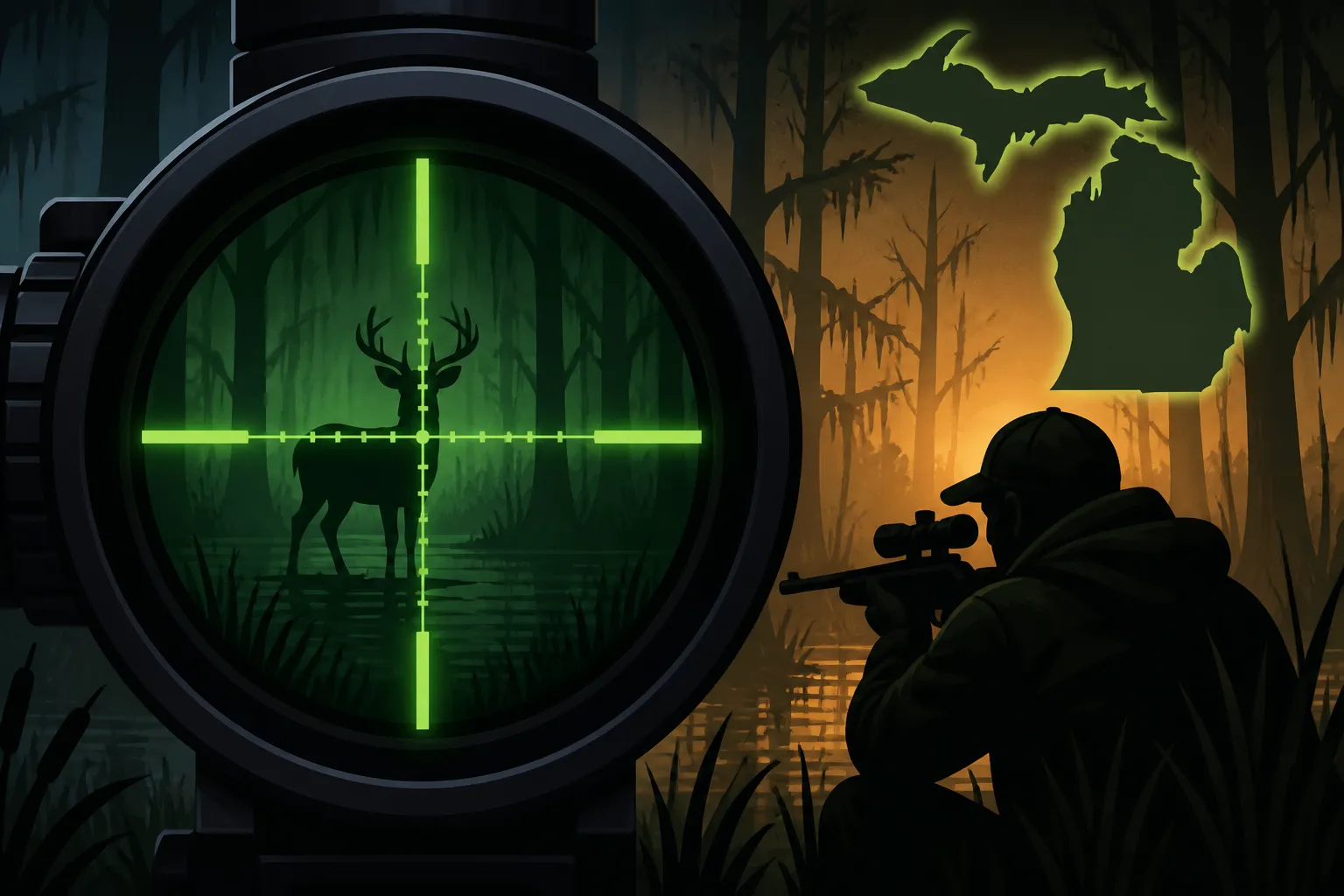
Illuminated Reticles for Dark Swamps
One of the most frustrating things about hunting in Michigan, especially as the seasons wear on and the days get shorter, is trying to make a confident shot in those notoriously dim, often thick, swampy environments. We've all been there: that trophy buck finally steps out during the last few minutes of legal shooting light, or maybe first thing in the frosty morning, and your crosshairs just disappear into the shadows. This guide is all about tackling that common problem head-on, exploring how illuminated reticles can be a game-changer for clarity and precision when light is at its absolute worst.
The Challenge of Low-Light Hunting in Michigan's Swamps
Michigan’s deer hunting often means facing dense cover, whether you're still-hunting through a vast cedar swamp in the Upper Peninsula or setting up on a scrape line bordering a thick, mucky marsh in the northern Lower. These environments, while fantastic for holding mature deer, are also notorious for gobbling up available light, making shot placement incredibly difficult during the crucial golden hours of dawn and dusk. It’s not just about seeing the deer; it’s about making sure you can see your reticle clearly against the animal's dark hide or the tangled brush behind it.
Imagine sitting in your treestand on a cold November evening, nestled deep in a tag alder swamp that funnels deer between two woodlots. The sun has dipped below the horizon, and the woods are quickly fading to shades of grey. A nice buck steps out at 50 yards, but as you shoulder your rifle, your traditional black crosshairs vanish into the buck's dark shoulder and the shadowy cedars beyond. You know it’s a legal buck because you can see his antlers, but can you really place that shot with absolute confidence when your aiming point is practically invisible? This is where many of us have had to let a deer walk, simply because we couldn't trust our optics. Hunting Michigan Swamp Edges for Deer can be incredibly productive, but the low light is a constant adversary.
Why Every Minute Counts in Michigan
Legal shooting hours in Michigan are tied directly to sunrise and sunset, giving us a precious half-hour before and after those official times. Often, the biggest bucks, the ones that have grown wise to hunter pressure, move most actively during these low-light periods. They understand that the cover of darkness offers them a safety net. For hunters, this means that maximizing visibility during those critical 30-minute windows can literally make or break a season. Losing even a few minutes of effective hunting time because your reticle is washed out is a huge disadvantage. Michigan Legal Shooting Hours are a hard deadline, and you want every second to count.
The frustration is real. You've spent countless hours scouting, set up your stand perfectly, endured cold temperatures, and finally, a quality animal presents itself. To have your opportunity thwarted by something as seemingly simple as not being able to see your aiming point feels like a punch to the gut. This isn't about pushing ethical boundaries; it's about ensuring that within the legal framework, you have the best possible chance to make a clean, humane shot. Having a clear, visible aiming point is paramount to ethical hunting, allowing for precise shot placement that leads to quick, clean harvests.
The Problem with Traditional Black Reticles
Traditional black reticles, while perfectly functional in good light, often struggle when ambient light levels drop. They rely on contrast against the background to be visible. In a dark swamp, against the deep browns and greens of dense cover, or the dark coat of a deer, that contrast can disappear entirely. It’s like trying to see a black thread on a black cloth. Your eye tries to pick out the fine lines of the crosshairs, but they blend in, making it incredibly difficult to pinpoint your exact aiming point. This can lead to hesitation, or worse, a rushed, imprecise shot.
When you're hunting in areas like the vast cedar swamps of the U.P., where sunlight barely penetrates even at midday, the problem is amplified. Even on a bright, overcast day, the understory can be surprisingly dark. During those early morning frost-covered stands or late evening sits as the cold creeps in, that black reticle can feel utterly useless. For hunters who spend time Still-Hunting Michigan Cedar Swamps or trying to make out antler points in dim light, the disappearing reticle is a common, and deeply frustrating, issue. Counting Antler Points From a Stand is hard enough in good light, let alone when your reticle is gone.
Understanding Illuminated Reticles: What They Are and How They Work
Illuminated reticles are a game-changer precisely because they don't rely on ambient light or contrast for visibility. Instead, a small internal light source, usually an LED, illuminates the reticle itself, or a portion of it. This makes your aiming point glow, providing a clear, sharp reference point regardless of how dark your target or the background might be. It’s a bit like having a tiny, glowing dot or crosshair projected onto the scene, ensuring you always know exactly where you’re aiming.
Most illuminated reticles feature a rheostat, which is a fancy word for a dial or button that allows you to adjust the brightness. This is incredibly important, as you don't want a blindingly bright reticle in truly low light, which can cause "flaring" and make it harder to see your target. Conversely, on a slightly brighter, overcast day, you might need to dial up the intensity a bit to ensure it still stands out effectively. The goal is always to have the reticle visible and sharp, but not so bright that it overwhelms your natural night vision or the image of the animal.
The Glow: Red Versus Green Reticles
When it comes to the color of the illumination, you'll typically find red or green. Both have their proponents, and personal preference plays a big role.
- Red Reticles: These are by far the most common. Many people find red to be less intrusive on their natural night vision, especially in extremely low-light conditions. It tends to be less jarring to the eye. For many years, military and tactical optics have favored red for this reason, as it helps maintain situational awareness in the dark. In Michigan's diverse landscapes, a red reticle often works well against various backgrounds, from dark timber to snow.
- Green Reticles: Some hunters swear by green, arguing that the human eye is more sensitive to green light, making it appear brighter and sharper to some individuals. In certain environments, like dense green foliage in late summer or early fall, a green reticle might offer a bit more contrast than a red one. However, some find green to be more disruptive to their night vision, causing their pupils to constrict more.
Ultimately, trying out both colors if possible, perhaps by looking through a friend's scope or visiting a well-stocked sporting goods store, is the best way to determine which works best for your eyes. What's crucial is that either color provides the necessary contrast that a traditional black reticle simply can't in truly challenging lighting.
Beyond the Dot: Different Illumination Patterns
Illuminated reticles aren't just a simple glowing dot. Many modern scopes offer a variety of illumination patterns, from a simple center dot to more complex ballistic reticles where only certain holdover points are illuminated.
- Illuminated Center Dot: This is arguably the most popular. The main crosshairs remain black, but a small, bright dot at the very center of the intersection glows. This gives you a precise aiming point without cluttering the rest of your field of view. It’s excellent for rapid target acquisition and precise placement.
- Partially Illuminated Reticle: Some scopes illuminate a larger portion of the reticle, such as the entire center cross, or perhaps only a section of a ballistic reticle. This can be beneficial for hunters who prefer a larger, more prominent aiming reference in extremely low light, or for those who use specific holdover points that they want illuminated.
- Full Reticle Illumination: Less common for hunting, but some optics illuminate the entire reticle pattern. While this provides maximum visibility of the reticle, it can also lead to more internal reflection and potentially distract from the target. For most Michigan deer hunting scenarios, a center dot or partially illuminated reticle offers the best balance of visibility and precision.
Here's a quick comparison of common illumination styles:
| Illumination Style | Description | Pros | Cons | Ideal Use Case |
|---|---|---|---|---|
| Illuminated Center Dot | Only the small dot at the crosshair intersection glows. | Precise, minimal distraction, quick target acquisition. | May not be enough for some hunters in extreme darkness. | Most deer hunting scenarios in varied light. |
| Partially Illuminated | Center crosshairs or a specific segment of the reticle glows. | Clear aiming point, good for ranging/holdover visibility. | Can be slightly more cluttered than a simple dot. | When some ballistic holdover points need visibility. |
| Red Dot (Non-Magnified) | Entire dot glows, typically in a non-magnifying sight. | Extremely fast, excellent for close range. | No magnification, less precise for longer shots. | Shotgun/muzzleloader hunting in thick cover, Hunting the Michigan Liberty Hunt Weekend. |
| Fiber Optic Illumination | Gathers ambient light, often for a bright aiming point without batteries. | Bright in good light, no battery dependence. | Dim or disappears in very low light (no internal light source). | Good daylight, brush hunting. |
Choosing the Right Illuminated Reticle for Michigan Hunting
Selecting the right illuminated reticle for your Michigan hunts isn't just about picking the first one you see. It involves considering the specific conditions you'll face, your hunting style, and what features will genuinely enhance your effectiveness in the field. This isn't just about fancy gadgets; it's about reliable performance when it matters most. Many Michigan hunters use resources like GoHunt to scope out gear reviews before making a purchase, noting how different optics perform in cold, wet conditions.
The first thing to look for is adjustable brightness settings. A high-quality illuminated reticle will have a wide range of intensity options, from barely perceptible to bright enough for a sunny day. You’ll want fine control, especially on the lower end, to prevent your reticle from flaring or washing out your target in deep twilight. Imagine hunting on a heavily overcast day in a deep valley, then the sun breaks through momentarily – you need to be able to adjust that reticle quickly without fumbling.
Battery Life and Cold Weather Performance
This is a huge factor for Michigan hunters. Our seasons can be long, and the weather can be brutal. You don't want your reticle to die on you during a crucial moment.
- Battery Type and Availability: Most illuminated reticles use common coin-style batteries (CR2032, CR2025, etc.). Always check the type and make sure they're readily available. Carrying spares is non-negotiable.
- Battery Life Claims: Manufacturers will often list battery life in hours. Take these figures with a grain of salt, as they are usually based on optimal conditions and mid-range brightness settings. Real-world usage, especially in cold weather, will often be less.
- Cold Weather Impact: Michigan winters can drain batteries faster. If you're planning on Muzzleloader Tactics in December Cold or hunting late-season archery in deep snow, expect your battery life to be reduced. Consider scopes that have features designed to combat this, such as automatic shut-off functions after a period of inactivity, which can significantly extend battery life. When researching options, a platform like GoHunt can be invaluable for looking up user reviews and specifications, helping you understand real-world battery performance.
Durability and Construction for the Michigan Woods
Our hunting environments are tough on gear. From scrambling through thick brush to climbing into treestands in sleet, your optics need to withstand a beating. Look for scopes with robust construction, often aircraft-grade aluminum.
- Waterproof and Fogproof: This is non-negotiable. Michigan weather is unpredictable. You need optics that are O-ring sealed and nitrogen or argon purged to prevent internal fogging and moisture ingress. A sudden rain shower, heavy fog rolling in off the Great Lakes, or just the humidity in a swamp can ruin a hunt if your scope isn't sealed properly.
- Shockproof: Your scope will get bumped, whether it's riding in a truck, getting snagged on a branch, or even just the recoil from your rifle. It needs to hold zero and continue functioning reliably.
- Ergonomics: Can you easily adjust the brightness with gloves on? Is the illumination control simple and intuitive? Fumbling with tiny buttons in the dark with cold fingers is a recipe for frustration.
Magnification and Objective Lens Size
While not directly about the reticle, these factors play a huge role in how much light your scope gathers and how clear your image is, which in turn affects how well you can use your illuminated reticle.
- Objective Lens Diameter: Generally, a larger objective lens (the front lens) gathers more light, resulting in a brighter image in low light. For example, a 50mm or 56mm objective will gather more light than a 40mm, but it also adds weight and bulk. For Optics for Michigan Timber and Swamp, balancing light gathering with manageability is key.
- Magnification Range: For most Michigan deer hunting in timber and swamps, extreme magnification isn't necessary. A 3-9x, 2-10x, or even a fixed 4x or 6x scope is often plenty. High magnification can actually make the image darker in low light, as it's spreading the gathered light over a larger area. Look for good Low-Light Performance in a Scope across the magnification range you'll actually use.
Practical Considerations and Best Practices
Having an illuminated reticle is a powerful tool, but like any tool, it needs to be used correctly and maintained diligently. It’s not a magic bullet, but it can give you a significant edge in those challenging Michigan hunting scenarios.
First and foremost, practice with your illuminated reticle. Don't wait for opening day to figure out the brightness settings. Take your rifle to the range and practice at varying light levels – early morning, late evening, even a cloudy day – to get a feel for what intensity works best for different conditions. This muscle memory will be invaluable when that buck finally steps out. You want to be able to make adjustments instinctively, without having to take your eye off the target.
When to Use and When to Conserve
An illuminated reticle is primarily designed for low-light conditions. In bright daylight, the illumination can actually be a hindrance, creating glare or simply not being necessary.
- Turn it On When Light Fades: As the sun begins to set or before it fully rises, activate your reticle. Start with the lowest comfortable setting and adjust up if needed.
- Conserve Battery Life: When you're packing your gear back to camp, or if you know you'll be sitting for hours in full daylight, turn the illumination off. Many hunters forget this, leading to dead batteries when they need them most. Developing the habit of turning it off when not actively using it is key.
- Redundancy is Key: While illuminated reticles are great, your scope should still have a functional, visible black reticle that you can use if the illumination fails (dead battery, electronic malfunction). Don't rely solely on the illumination. This is why a simple illuminated dot within a traditional duplex reticle is often a fantastic choice.
Battery Management and Spares
This cannot be stressed enough: always carry spare batteries. Keep them in a waterproof container in your pack, perhaps even taped to the inside of your scope cap, so they're always with your rifle.
- Check Batteries Regularly: Before each season, and perhaps even midway through, put in fresh batteries. Old batteries, even if they seem to be working, can lose power quickly in cold weather or during prolonged use.
- Cold Weather Protection: When hunting in truly cold conditions, consider keeping your spare batteries in an inside pocket, close to your body heat. This can help them maintain their charge better until needed. You wouldn't go Hunting the Michigan Upper Peninsula for Deer in January without extra layers, so don't go without extra power for your optics.
- Proper Storage: If you plan to store your rifle for an extended period (off-season), remove the battery from the scope. This prevents potential corrosion and slow drainage.
Pairing with Other Low-Light Gear
An illuminated reticle is part of a larger system. It works best when paired with other gear designed for low-light performance.
- Quality Glass: Even the best illuminated reticle won't help much if your scope's glass is blurry or poor quality. Invest in good quality objective and ocular lenses that transmit light efficiently.
- Binoculars and Rangefinders: Use your binoculars to spot and identify deer in low light before you even bring your rifle up. An illuminated reticle is for aiming, not for primary spotting. When scouting, tools like the Michigan Mi-HUNT Map can help you find areas where light might be an issue.
- Hunter Orange: While you're focused on seeing your target, remember that during firearm seasons, Michigan requires specific amounts of hunter orange to keep you visible to other hunters. How Much Hunter Orange Michigan Requires is an important safety consideration that doesn't conflict with your low-light optics.
By understanding how illuminated reticles work, choosing a model suited to Michigan's challenging conditions, and implementing smart field practices, you can significantly improve your chances of making confident, ethical shots during those prime low-light hours.
Disclaimer
This article is for general informational purposes only and does not constitute professional advice. Laws, prices and regulations vary by location and change over time. Consult a qualified professional for guidance on your specific situation.