.30-30 in Michigan Cedar Swamps
There's a special kind of challenge that Michigan's cedar swamps throw at deer hunters. It's not just the deep snow or the cold; it's the sheer impenetrable thickness of the cover, the way visibility shrinks to mere yards, and the feeling that every step is a wrestling match with tangled branches and hidden obstacles. You spend hours meticulously still-hunting, inching through the heavy scent of cedar, convinced a monster buck is bedded just out of sight. Then, in an instant, a flash of brown, a snort, and a crashing escape, often leaving you wondering if a fast-handling rifle might have made all the difference. This guide is for every hunter who's faced that frustration, looking to understand why the humble .30-30, in a lever-action rifle, remains a time-honored and incredibly effective choice for navigating and succeeding in these dense Michigan cedar swamps.
The Unique Challenges of Michigan Cedar Swamps for Hunters
Michigan's cedar swamps are truly a world unto themselves when it comes to deer hunting. They're not like the open hardwoods or sprawling agricultural fields. These aren't places where you set up a stand overlooking a vast food plot, hoping for a 200-yard shot. No, hunting here demands a different mindset, different gear, and a deep understanding of the environment. Many hunters, especially those new to the state or accustomed to more open country, find themselves utterly overwhelmed by the sheer density and difficulty of these habitats.
Dense Cover and Limited Visibility
Imagine stepping into a Michigan cedar swamp in late November. The snow might be a foot deep, and the air is biting cold. But what immediately strikes you is the wall of green. Towering white cedars grow in tight clusters, their branches interwoven, forming a canopy that blocks out the sky and creates a perpetual twilight on the forest floor. Beneath them, a thick understory of dogwood, tag alder, and various brush chokes any open lanes.
Visibility in these conditions is often measured in feet, not yards. A deer can be twenty yards away and completely invisible, only revealing itself as a blur as it slips through the thicket. This isn't conducive to high-magnification scopes or long-range cartridges. The frustration is real when you know a deer is there, you can hear it, but you just can't get a clean look, let alone a shot. For more insight into these unique environments, you might want to check out Reading a Michigan Cedar Swamp for Deer.
Short-Range Engagements and Quick Shots
Because of the extreme density, almost every shot opportunity in a cedar swamp will be a close-quarters affair. We're talking 50 yards or less, and often much, much closer. Deer often hold tight, only busting out when you're nearly on top of them. This means you need a rifle that can be brought to bear quickly, swung smoothly through brush, and deliver a knockout punch without needing a lengthy aiming process.
Trying to line up a precision shot with a high-powered, scoped rifle that's designed for open country feels cumbersome and slow in this environment. You're trying to thread a needle through a thicket, and the deer isn't waiting. The deer will often be moving, too, making a snap shot essential. This reality makes many hunters rethink their traditional deer rifle choices, searching for something more practical for such confined spaces.
Navigation and Movement in Difficult Terrain
Beyond the shooting challenges, simply moving through a cedar swamp is an Olympic feat. The ground is often uneven, riddled with hidden root balls, boggy spots, and fallen timber covered in snow. Your legs are constantly working overtime, lifting high over obstacles, breaking through crusty snow, or sinking into wet, mucky earth. Every step is an effort, and dragging a heavy, long rifle can quickly become exhausting.
The physical demands mean that a lightweight, compact rifle is a massive advantage. You need something that won't snag on every branch, something that can be carried comfortably for hours of slow, deliberate Still-Hunting Michigan Cedar Swamps. Many hunters find that the easier a rifle is to handle and carry, the more energy they have for the actual hunting and the less likely they are to get tangled up at a critical moment. You certainly don't want to be fighting your gear when a mature buck finally slips into view.
Why the .30-30 is a Classic Choice for Michigan Swamps
For generations of Michigan hunters, especially those who cut their teeth in the northern woods and swamps, the .30-30 Winchester cartridge and its associated lever-action rifles aren't just a classic; they're an institution. There's a reason this cartridge has endured, particularly in dense cover like our cedar swamps. It's a testament to its practical effectiveness in real-world hunting scenarios where speed and maneuverability trump raw power and long-range precision.
Ideal Ballistics for Close-Range Brush
Let's talk brass tacks about the .30-30's performance where it really counts: up close. While it might not win any awards for flat trajectory at 300 yards, the .30-30 shines in environments where shots are rarely beyond 75-100 yards. Its heavier, slower bullets, often flat-nosed or rounded soft points, are designed to deliver significant energy upon impact, even if they've clipped a twig or two. In a swamp, you're not usually worried about minute-of-angle accuracy at extreme distances; you're concerned with hitting a vital area on a deer that's likely moving and then ensuring that bullet performs reliably.
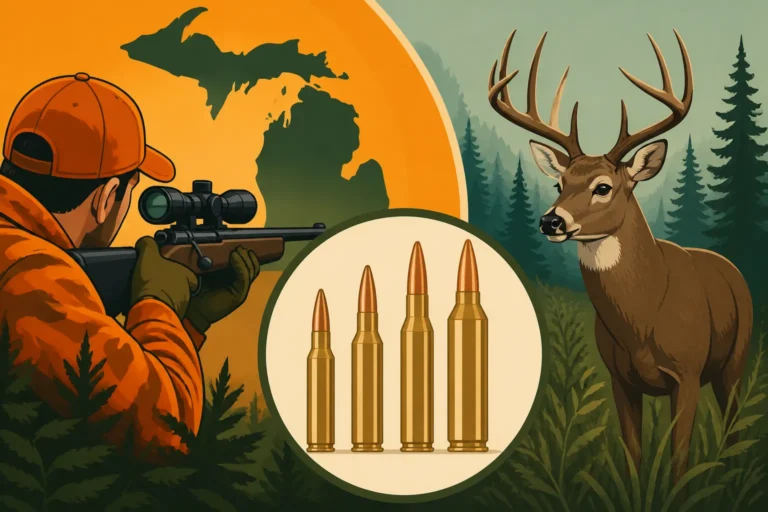
Modern ammunition, like those with Hornady's LEVERevolution FTX bullets, have further enhanced the .30-30's capabilities. These spitzer-pointed flex-tip bullets offer a slightly flatter trajectory and better aerodynamics than traditional flat-nose bullets, but crucially, they still expand reliably at .30-30 velocities, making them devastating on Michigan whitetails within the typical swamp ranges. While some might argue for faster calibers, the truth is, within 100 yards, a well-placed .30-30 bullet does exactly what it needs to do.
Compact Size and Maneuverability of Lever Actions
The spiritual home of the .30-30 is the lever-action rifle, and this platform is a perfect match for the tight confines of a cedar swamp. Lever-action rifles are typically shorter, lighter, and much more compact than many bolt-action or semi-automatic deer rifles. Their lack of a protruding magazine or bolt handle makes them less prone to snagging on branches as you push through heavy brush.
A short barrel, common on many lever guns, also allows for incredibly fast target acquisition and nimble handling. Imagine a deer bursting from cover at 30 yards; you can get that .30-30 to your shoulder, cycle the lever, and get a shot off much quicker than with a long, heavy bolt-action rifle equipped with a large scope. The balance of a good lever gun also aids in carrying it for miles on end, reducing fatigue during those long, deliberate still-hunting excursions. When planning your hunt, a tool like GoHunt can help you scout and visualize how this compact rifle fits into different types of terrain, from open ridge tops to the densest swamp edges.
Time-Tested Effectiveness on Michigan Whitetails
There's a reason why your grandpa, and maybe even his grandpa, swore by a .30-30 for deer hunting in Michigan. This cartridge has put countless deer in the freezer across the state for over a century. It's not a new, flashy caliber, but it's utterly dependable. Its moderate recoil makes it easy to shoot accurately, allowing hunters to place their shots precisely, which is always more important than raw bullet energy.
For the typical Michigan whitetail, which might range from 100 to 200 pounds, the .30-30 offers more than enough power. A properly constructed bullet from a .30-30 will penetrate vital organs and transfer significant energy, leading to quick, humane kills. Many of the biggest bucks in Michigan's record books were taken with cartridges like the .30-30, proving that shot placement and hunting skill far outweigh ballistic overkill. For understanding the deer herd you'll be hunting, refer to White-Tailed Deer Across Michigan.
Practical Considerations for Hunting with a .30-30 in Swamps
While the .30-30 is an excellent tool for Michigan's cedar swamps, maximizing its effectiveness involves more than just owning the rifle. It requires a thoughtful approach to ammunition, optics, and how you prepare for the unique challenges of the swamp environment. Thinking through these details beforehand can make a huge difference in your success and enjoyment.
Ammunition Selection for Cedar Swamps
When choosing ammunition for your .30-30 in a cedar swamp, you're looking for consistent expansion and reliable performance at moderate velocities, not necessarily maximum range. Traditional 150-grain or 170-grain soft point bullets have been the workhorses for decades, and for good reason. They are designed to expand well on deer at .30-30 speeds, creating a wide wound channel.
However, as mentioned, modern advancements like Hornady's LEVERevolution line with FTX bullets offer a slight edge. Their flexible polymer tip allows for a spitzer-like profile, which improves ballistic coefficient, but remains safe in tubular magazines. This means you get a bit flatter trajectory without sacrificing reliable expansion at close range. These bullets are engineered to perform reliably through brush, which is a major advantage in a swamp. While no bullet is truly "brush-proof," a heavier, slower bullet tends to deflect less dramatically than a lighter, faster, highly aerodynamic projectile. It's worth trying a few different brands and bullet weights to see what shoots best in your specific rifle.
Optic Choices for Low-Light, Close-Range Shots
This is where many hunters go wrong in thick cover. Putting a 3-9×40 or 4-12×40 scope, let alone something even higher power, on a .30-30 destined for the swamp is often counterproductive. In the low light of a cedar swamp, under a dense canopy, a high-magnification scope with a small objective lens will be dim and difficult to use. Furthermore, trying to find a deer at 25 yards on 9x magnification is like looking through a straw; you'll have an extremely narrow field of view, making it hard to acquire a moving target.
Instead, opt for low-power optics. A 1-4×20 or 2-7×33 scope is often ideal. Keep it on the lowest magnification (1x or 2x) while still-hunting, giving you a wide field of view that's almost like looking with both eyes open. When a deer appears, you can quickly acquire it. The larger exit pupil of a low-power scope also allows for better light gathering, which is crucial in the dim swamp. Some hunters even prefer a simple red dot sight for ultimate speed and target acquisition at very close ranges, though it offers no magnification. Remember, Low-Light Performance in a Scope is key in these areas.
Zeroing and Practice for Typical Swamp Distances
Zeroing your .30-30 for long-range precision is pointless for swamp hunting. Most shots will be inside 75 yards. A good rule of thumb is to zero your rifle at 50 or 75 yards. At these distances, your bullet will typically rise slightly and then fall, keeping you well within the vital zone of a deer out to 100-125 yards without needing to hold over or under significantly.
What's more important than a specific zero is consistent practice at these close, fast distances. Set up targets that simulate quick, snap-shot opportunities. Practice shouldering your rifle smoothly, acquiring the target, and firing quickly. If you have access to a range where you can simulate walking and shooting, even better. The goal is to make these movements fluid and natural, so when that buck explodes from a thicket, your muscle memory takes over. You might even use a platform like GoHunt to mark potential shooting lanes you'd encounter, helping you visualize these practice scenarios.
Field Tactics and Other Gear for Swamp Hunting with a .30-30
Having the right rifle is only part of the equation. To truly succeed with a .30-30 in Michigan's cedar swamps, you need to combine it with effective field tactics and a selection of supporting gear that can withstand the rigors of this demanding environment. A well-planned approach makes all the difference, both in finding deer and in successfully getting them out.
Still-Hunting and Tracking in Cedar
The .30-30 and a lever-action rifle are perfectly suited for still-hunting and tracking. Your goal is to move as slowly and quietly as possible, pausing frequently to observe and listen. In cedar swamps, this means taking literally one or two steps, then freezing for several minutes, scanning every shadow and clump of brush. Deer often bed incredibly tight in these areas, relying on the dense cover for concealment. They expect you to walk past them.
Pay close attention to subtle signs: a twitching ear, a horizontal line that doesn't quite look like a log, the glint of an eye. The compact nature of the .30-30 allows you to carry it comfortably in one hand, ready to bring it to your shoulder at a moment's notice. If you jump a deer, the fast cycling of a lever-action gives you a quick follow-up shot if the initial one wasn't clean. Learning to read the subtle nuances of these areas can be found in Reading a Michigan Cedar Swamp for Deer. If snow is on the ground, tracking can be highly effective, and the .30-30 is a great companion for a quiet, deliberate track.
Carrying and Protecting Your Rifle in Wet Conditions
Michigan cedar swamps are almost perpetually damp, if not outright wet, especially once snow starts to fall or during a thawing period. Keeping your .30-30 protected is essential. A good quality sling is a must, allowing you to carry the rifle securely while freeing your hands for navigating difficult terrain or carrying other gear. Look for a sling that won't slip on your shoulder and is durable.
Consider using a waterproof rifle case or a simple soft case that offers some protection from moisture and abrasions as you push through brush. Some hunters even carry a thin, waterproof cover or simply wrap the action in a plastic bag during heavy snow or rain. After a hunt, always wipe down your rifle thoroughly, especially the metal components, with a lightly oiled cloth to prevent rust. Even stainless steel benefits from this care.
Essential Gear for Swamp Navigation and Recovery
Beyond the rifle, other gear will make your swamp hunt more successful and safer. Good footwear is paramount; waterproof, insulated boots with excellent traction are non-negotiable. Think rubber boots or high-quality leather boots treated for waterproofing. You'll be crossing wet areas, and cold, wet feet will ruin a hunt faster than anything. Consult Boots for Michigan Swamps and Snow for more details.
A reliable GPS unit or a smartphone app like GoHunt (with downloaded maps for offline use) is critical for navigation. The dense canopy can make it difficult to get a good satellite signal, but having a way to mark your starting point and track your path is invaluable in a swamp where all directions can look the same. Remember, compass and map skills are a great backup!
Finally, retrieving a deer from a cedar swamp can be incredibly difficult. Consider a deer sled or a specialized game cart designed for rough terrain if you're hunting with a partner. Even a sturdy rope can be a lifesaver. Being prepared for the haul out is just as important as the shot itself. More tips on this can be found in Getting a Deer Out of a Michigan Cedar Swamp.
| Feature / Cartridge | .30-30 Winchester (170 gr) | .30-06 Springfield (180 gr) |
|---|---|---|
| Typical Range | 0-150 yards | 0-300+ yards |
| Velocity (Muzzle) | ~2200-2400 fps | ~2700-2800 fps |
| Energy (50 yards) | ~1500-1700 ft-lbs | ~2500-2800 ft-lbs |
| Recoil | Moderate | Significant |
| Rifle Type (Common) | Lever-action, compact | Bolt-action, longer |
| Visibility (Swamp) | Excellent, quick target acquisition | Can be cumbersome, narrow FOV |
| Brush Performance | Good, heavier bullets deflect less | Faster, lighter bullets can be more prone to deflection |
Disclaimer
This article is for general informational purposes only and does not constitute professional advice. Laws, prices and regulations vary by location and change over time. Consult a qualified professional for guidance on your specific situation.