Why Commercial Forest Land Is Open
For many Michigan hunters, especially those without private land access, the constant search for open ground can feel like a never-ending battle. It's frustrating to drive past vast timberlands, wondering if they're public or private, and whether you're even allowed to step foot on them. This guide will peel back the mystery surrounding Michigan's Commercial Forest Land (CFL), explaining precisely why these substantial tracts are open to you, the diligent hunter, and how you can take advantage of this unique opportunity.
The Quest for Hunting Land: A Common Frustration
Let's be honest, finding a place to hunt in Michigan that isn't already teeming with other hunters, or strictly private, can be a real headache. You scout all year, mark promising spots, only to find "No Trespassing" signs plastered everywhere or a parking lot full of trucks on opening day of firearm season. It's enough to make you feel like giving up on a prime piece of ground before you even get a chance to explore it. This scarcity of accessible land is a huge concern for many, making every acre that is open feel like a precious commodity.
The Ever-Shrinking Landscape of Opportunity
Michigan is blessed with a lot of public land, especially in the northern Lower Peninsula and the entire Upper Peninsula. But even with millions of acres of state and national forests, the sheer number of hunters means pressure can be intense in popular spots. Then there's the ever-encroaching development and the increasing trend of landowners locking up their property, making it feel like the available hunting opportunities are shrinking right before our eyes. It can be incredibly disheartening when you see prime habitat but have no legal way to access it, and it often leads hunters to stick to the same, often over-hunted, parcels year after year.
A Historical Agreement for Public Benefit
This is where the Michigan Commercial Forest Act (CFA) steps in, offering a refreshing counterpoint to the land access dilemma. Enacted decades ago, the CFA was a forward-thinking piece of legislation designed to achieve a dual purpose: encourage sustainable timber production and ensure public access to these privately-owned forest lands. It's a testament to the idea that economic activity and public recreational opportunities don't have to be mutually exclusive. Instead, Michigan found a way to create a symbiotic relationship, benefiting both the landowners who manage vast tracts of timber and the hunters, anglers, and trappers seeking open ground. Understanding this historical agreement is key to appreciating why these lands are open and how they fit into the broader landscape of Public Hunting Land in Michigan.
How the Commercial Forest Act Works
At its heart, the Commercial Forest Act is a straightforward trade-off: property tax breaks for public access. It incentivizes private landowners, often large timber companies or even individual citizens with significant acreage, to keep their forestland undeveloped and actively managed for timber production. In return for a reduced tax burden, these enrolled lands become open to the public for specific recreational uses.
Tax Incentives for Landowners
Imagine owning thousands of acres of forestland. The property taxes alone could be crippling, pushing landowners to sell off parcels for development or convert them to other uses. The CFA addresses this by offering a significant reduction in annual property taxes. Instead of paying the standard property tax rate, landowners enrolling their eligible forest property in the program pay a much lower specific tax rate per acre. This financial incentive makes it economically viable for them to retain large tracts of forest, manage them for long-term timber harvest, and resist the pressure to break them up or develop them. It's a win for the timber industry, promoting a stable supply of forest products, and a win for conservation, keeping these valuable ecosystems intact and working. The commitment isn't just about avoiding taxes, though; it also implies a commitment to sound forestry practices, often leading to a healthy, diverse forest that benefits wildlife.
The Public Access Mandate
Now, here's the crucial part for us hunters: in exchange for those juicy tax reductions, the land must be open to the public for hunting, fishing, and trapping. This isn't a suggestion; it's a non-negotiable condition of enrollment. A landowner cannot cherry-pick who gets access or restrict it in any way beyond general hunting regulations. This means that if you identify a parcel as Commercial Forest Act Land, you have a legal right to access it for hunting, just as you would state or federal land. There's no need to knock on doors, seek special permission, or worry about trespass. This is a vital distinction from regular private land, where Michigan Trespass and Permission Law dictates you absolutely need permission to enter. The public access mandate means a substantial amount of land, particularly in Michigan's forested regions, becomes available to hunters who might otherwise be shut out.
| Feature | Commercial Forest Land (CFL) | Michigan State Forest | Typical Private Land (Not CFA) |
|---|---|---|---|
| Ownership | Private (often timber companies) | Public (State of Michigan) | Private (individuals, corporations) |
| Primary Purpose | Timber production, sustainable forestry | Multiple use: timber, recreation, wildlife | Owner's discretion (residence, agriculture, hunting) |
| Tax Status | Reduced property tax incentive for landowner | Tax-exempt | Standard property tax rates |
| Public Hunting Access | REQUIRED by law (for enrolled parcels) | Generally open (with specific rules) | PERMISSION REQUIRED (verbal or written) |
| Management Focus | Heavily timber-driven, but still benefits wildlife | Balanced management for various resources | Varies wildly by owner's goals |
| Signs/Markings | Often minimal, may have small "CFL" signs or timber markings | Clearly marked with State Forest signs | "No Trespassing," boundary lines, private property signs |
| Roads/Access | Logging roads, often gated, may be unmaintained | Maintained forest roads, two-tracks, trails | Private drives, gated roads, no public access |
Navigating Commercial Forest Land for Hunting
Knowing that CFL exists and is open is one thing; actually finding and hunting it effectively is another. These lands aren't always signed as clearly as State Game Areas, and they often have unique characteristics due to their primary use.
Identifying CFL Parcels
The first step is knowing where these lands are. While driving around and looking for subtle signs is one approach, the most reliable method for Finding Commercial Forest Act Parcels is by using modern mapping technology. Tools like onX Hunt are invaluable here. Their robust map layers can specifically identify Commercial Forest Act lands, often clearly delineated with a distinct color or label. Similarly, other mapping apps or even the Michigan DNR's own mapping resources can help. These digital tools allow you to zoom in, see property lines, and understand the ownership status before you even leave your couch. Without these mapping solutions, finding CFL can be a frustrating guessing game, relying on outdated paper maps or blind luck. When you're physically on the ground, look for older, often faded, small green signs with "Commercial Forest Land" printed on them, though these are not always present or easily visible. Recognizing these parcels on your map allows you to plan your hunts strategically, whether you're looking for Hunting the Michigan Upper Peninsula or a hidden gem in the northern Lower Peninsula.
Rules and Etiquette for Hunting CFL
Just because CFL is open to hunting doesn't mean it's a free-for-all. It's crucial to remember that these are still privately owned working forests. While you have the right to hunt, fish, and trap, you do not have the right to damage property, litter, or interfere with logging operations. This means:
- Respect Private Property: Stay within the boundaries of the CFL parcel. Using mapping tools like GoHunt can help you pinpoint these lines exactly. Straying onto adjacent private land not enrolled in the CFA is trespassing.
- No Property Damage: Do not damage gates, signs, or logging equipment. This land is managed for timber, and a landowner's income depends on its integrity. If you encounter active logging, find another area to hunt that day.
- Leave No Trace: Pack out everything you pack in. Leaving trash or spent casings reflects poorly on all hunters and could jeopardize future access.
- Vehicle Access: Many logging roads on CFL are gated or not maintained for public vehicle traffic. Assume you'll be walking or using non-motorized methods unless clearly indicated otherwise. Obey all posted signs regarding vehicle use.
- General Hunting Regulations: All state hunting laws and regulations still apply. This includes specific seasons, bag limits, licensing requirements, and important safety considerations like Michigan Safety Zone Rules, which dictate how far you must be from buildings.
Adhering to good ethics and showing respect for the landowner's investment is paramount. Our continued access to these valuable lands depends on a positive relationship between hunters and landowners.
The Benefits and Challenges of CFL
Commercial Forest Land offers a unique blend of opportunities and considerations for Michigan hunters. It's a vast resource, but one that requires a slightly different approach than typical state land.
A Vast Resource for Hunters
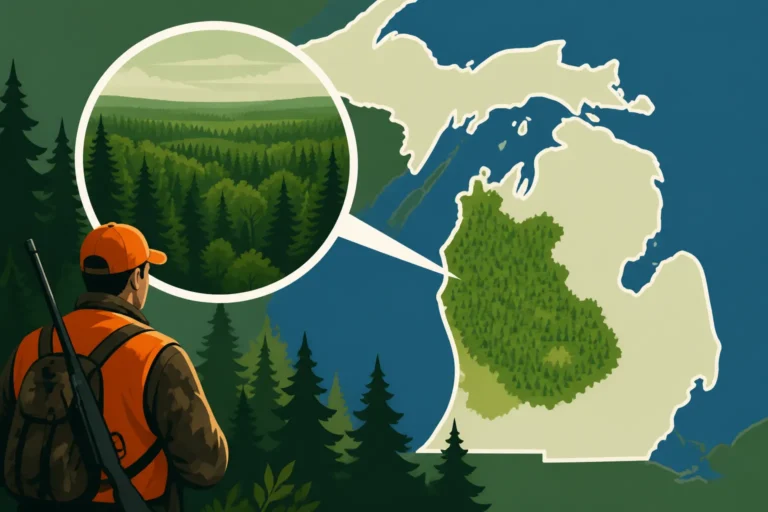
The sheer acreage enrolled in the Commercial Forest program adds significantly to Michigan's accessible hunting footprint. These aren't small, isolated parcels; they often connect with existing state land, creating expansive tracts of contiguous forest for deer, bear, grouse, and other game. This means more room to roam, less pressure in some areas, and the chance to find unpressured game that might otherwise be pushed onto private property. You'll find diverse habitats on CFL, from mature hardwoods to dense conifer swamps, and crucially, new timber cuts. These cuts, often targeting specific species or age classes of trees, can create fantastic early successional habitat that deer, grouse, and woodcock absolutely thrive in. Knowing how to hunt Hunting Michigan Clearcuts and Aspen Cuts can be extremely productive on these lands. The ongoing timber management means the habitat is constantly changing and evolving, often to the benefit of game species that prefer younger, thicker cover.
Unique Considerations for Hunters
While the benefits are clear, hunting CFL also comes with its own set of challenges. Unlike state or national forests where management goals often explicitly include wildlife habitat, CFL's primary driver is timber production. This means:
- Rapid Habitat Change: What was a thick, young stand one year could be a clearcut the next. What was a clearcut could be a dense, unhuntable jungle of regeneration a few years later. This requires consistent scouting and adaptability. Using satellite imagery on apps like onX Hunt to observe changes year-to-year can be very helpful for Scouting Michigan Public Land Before Season.
- Active Logging Operations: You might encounter heavy machinery, log trucks, and active work crews. For safety reasons, and out of respect for the loggers, you need to be prepared to alter your hunting plans if you stumble into an active cutting block.
- Access Challenges: While open, access can be difficult. Gated roads, muddy tracks, and lack of developed parking areas are common. This often means hoofing it further into the woods, which for some, is exactly what they're looking for when Finding Ground Others Walk Past.
- Lack of Amenities: Don't expect established trails, picnic tables, or designated campsites. These are working forests, not recreational parks. Be prepared to be self-sufficient and practice strict Leave No Trace principles.
- Boundary Awareness: Always be vigilant about property lines. Even with mapping apps, it's easy to get disoriented in dense timber. Understanding onX Layers for Michigan Land Status is crucial to avoid inadvertently trespassing onto adjacent private property.
- Deer Movement Post-Harvest: After a timber cut, deer patterns can shift dramatically. They'll gravitate towards the new browse and cover, but it might take some time for them to establish new travel corridors. Understanding Timber Cuts and Where Deer Move After is key to success.
By understanding why these lands are open and how they are managed, you can effectively incorporate Commercial Forest Land into your hunting strategy, opening up new possibilities and giving you more ground to explore in Michigan.
Disclaimer
This article is for general informational purposes only and does not constitute professional advice. Laws, prices and regulations vary by location and change over time. Consult a qualified professional for guidance on your specific situation.