Michigan Safety Zone Distance Rules
One of the biggest worries for Michigan hunters, especially those on the edge of development or near busy areas, is making sure their hunting activities are safe and legal for everyone. It's not just about ethics; specific laws dictate how close you can be to occupied buildings. This guide will fully explain Michigan's safety zone distance rules, helping you understand where you can and cannot discharge a firearm or bow, ensuring a safe and responsible hunting experience for all.
Understanding Michigan's Core Safety Zone Rules
At its heart, Michigan's safety zone rule is pretty straightforward, but the nuances can sometimes trip up even experienced hunters. The primary goal is to protect people and property from accidental discharge, providing a clear buffer between hunting activities and human habitation. This isn't just a suggestion; it's a critical part of Michigan Hunter Safety Requirement.
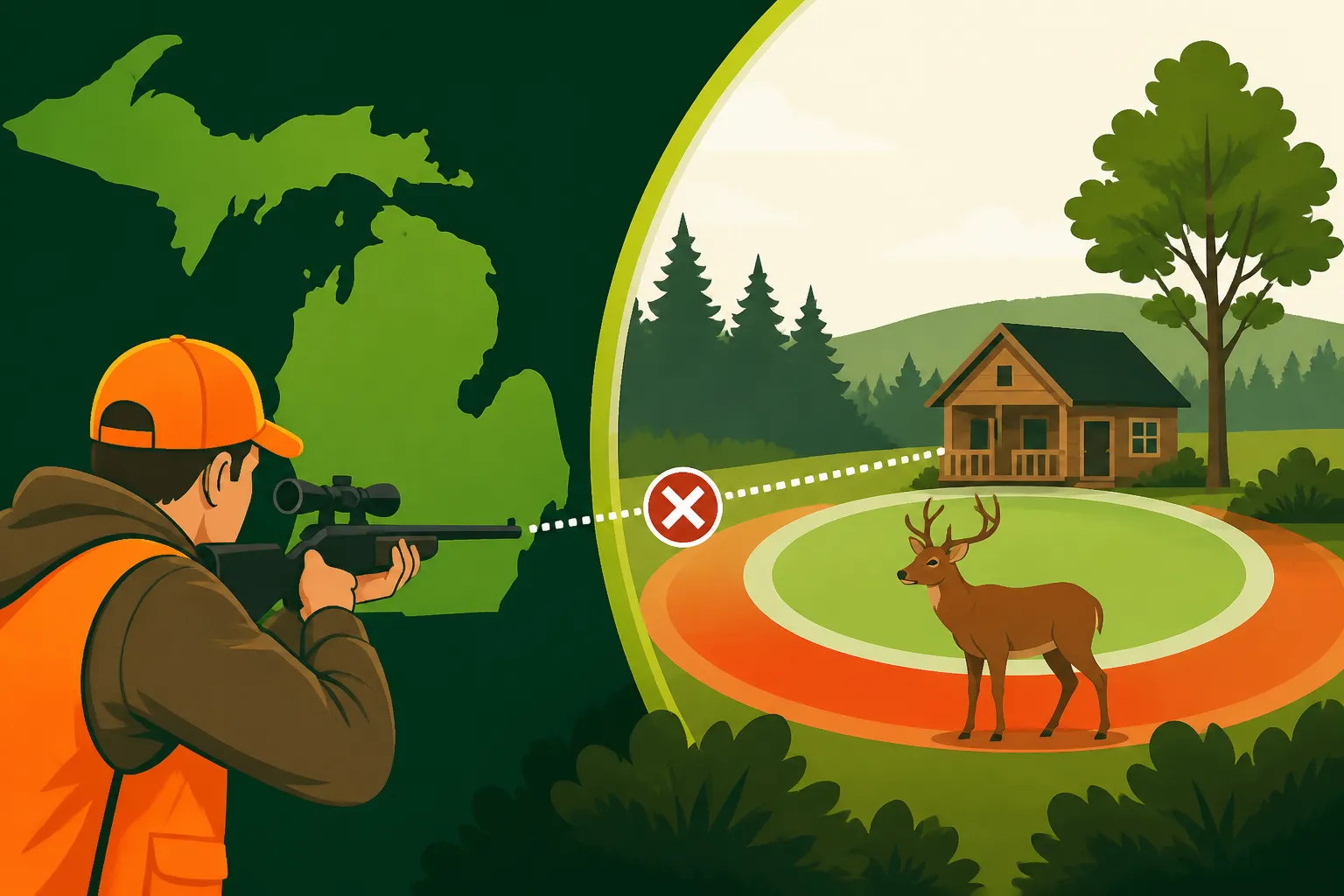
The rule states that it is unlawful to hunt with a firearm or bow within 150 yards of an occupied dwelling, house, lodge, or public shooting area, or any barn or other building used in connection with a farm operation, without obtaining the written permission of the owner or occupant. Let's break that down:
- 150 Yards: This isn't an arbitrary number. It's roughly the maximum effective range for many common hunting firearms, especially shotguns with slugs or straight-wall cartridges, which are prevalent in Michigan's Lower Peninsula. The idea is to create a zone where a stray bullet or arrow is highly unlikely to reach an inhabited structure, even if it misses its intended target. For context, 150 yards is about 1.5 football fields. It's a significant distance, and one that requires careful attention, especially in fragmented landscapes.
- Occupied Dwelling, House, Lodge, Public Shooting Area: This covers places where people live or gather regularly. It doesn't necessarily have to be someone's primary residence; a hunting lodge, a cabin that's used seasonally, or even a public shooting range all fall under this protection. The key is "occupied," meaning someone is residing or actively using it. A long-abandoned farmhouse might technically be exempt if it's truly empty and derelict, but it's always safer to assume it's "occupied" unless you know for a fact otherwise and have checked with local authorities.
- Barn or Other Building Used in Connection with a Farm Operation: This extends the protection to agricultural buildings, recognizing that farmers and their workers are often present in and around these structures. This isn't just about the main farmhouse; it includes barns, silos, equipment sheds, and even livestock enclosures if they're actively used for farming. This is particularly relevant when hunting in Southern Michigan Farm Country Deer Hunting.
- Written Permission: This is the golden ticket. If you want to hunt closer than 150 yards to one of these protected structures, you absolutely must have written permission from the owner or occupant. Verbal permission isn't enough to satisfy the law. This written permission should clearly state that you are allowed to hunt within the safety zone and ideally specify the dates or duration of that permission. This protects both you and the landowner.
Failing to adhere to these rules can result in significant penalties. It's not just about potential fines; it's about the erosion of public trust in hunters and the risk of injury. Every hunter carries a responsibility to know and follow these regulations to ensure hunting remains a safe and respected activity in Michigan.
Why Safety Zones Are Essential for Responsible Hunting
The Michigan safety zone rules aren't designed to make hunting harder; they're in place for very important reasons that benefit everyone involved. They are a cornerstone of responsible hunting, fostering safety, maintaining public perception, and preventing unnecessary conflicts.
Protecting People and Property
The most obvious reason for safety zones is, well, safety! A discharged firearm or arrow can travel a considerable distance, and even a small projectile can cause serious injury or property damage. Imagine the anxiety of a homeowner hearing shots fired incredibly close to their house, or worse, finding a bullet hole in their barn. These rules are designed to prevent those terrifying scenarios.
Consider a scenario where you're tracking a deer in thick cover, and the deer suddenly bolts toward an open field. Unbeknownst to you, there's a house just beyond the tree line, barely visible. Without the 150-yard buffer, an ethical shot at the deer could inadvertently put someone's home or even their family at risk. The safety zone provides that crucial margin for error, accounting for ricochets, missed shots, and the unpredictable movement of game animals. It demands that hunters be acutely aware of their surroundings, not just for game, but for human safety as well. This diligence is part of being a good steward of the land and a responsible hunter.
Maintaining Positive Public Perception
In an increasingly urbanized state like Michigan, the divide between hunters and non-hunters can sometimes feel wide. Incidents involving hunters too close to homes or private property only serve to fuel negative stereotypes and push for stricter regulations that could impact all hunters. Safety zones are a critical tool in demonstrating that hunters are responsible, considerate, and committed to public safety.
When hunters consistently respect safety zones, it builds trust within communities. It shows non-hunting landowners and residents that hunters understand and prioritize their safety and privacy. This positive perception is vital for preserving hunting access, especially on Hunting Small Private Tracts in Michigan or when trying to gain new permission. Conversely, just one or two instances of hunters violating these zones can quickly lead to public outcry, calls for more restrictive laws, and even outright bans in certain areas. It's a collective responsibility; every hunter's actions reflect on the entire hunting community.
Minimizing Conflicts and Trespassing Issues
Safety zones also play a huge role in preventing direct conflicts between hunters and landowners, and in reducing instances of perceived or actual trespassing. When property lines are unclear, or hunters are unaware of nearby structures, the safety zone acts as a clear, enforceable boundary. This is particularly helpful in areas with a patchwork of public and private land.
Think about using an app like onX Hunt or GoHunt; these tools are invaluable for identifying property boundaries. But even with a clear property line, the safety zone extends beyond that line if an occupied building is within 150 yards. So, even if you are legally on public land, you could still be in violation of the safety zone if you discharge a firearm too close to a private residence. This often means carefully planning your approach and hunting strategy, sometimes opting for a longer walk or choosing a different stand location to ensure you're outside that crucial 150-yard perimeter. It also helps clarify where Michigan Trespass and Permission Law intersects with hunting regulations, emphasizing that permission to be on land doesn't automatically grant permission to hunt within a safety zone.
Navigating Safety Zones on Public and Private Land
Understanding the 150-yard rule is one thing, but actually applying it in the field, whether you're on a sprawling state forest or a cozy private parcel, is where the rubber meets the road. It requires careful planning, keen observation, and sometimes, a good map.
Public Land Considerations
Hunting on public land in Michigan, whether it's Michigan State Forest Hunting or a State Game Area, often presents unique challenges regarding safety zones. Public land frequently borders private residences, farms, or even small towns. Just because you're on public property doesn't exempt you from the safety zone rule.
When Scouting Michigan Public Land Before Season, it's absolutely crucial to identify any occupied buildings near the property lines. I rely heavily on mapping applications like onX Hunt, which clearly show property boundaries and often display building structures. Zoom in on the edges of the public land you plan to hunt. Look for houses, barns, or any other structures within 150 yards of where you might set up a stand or still-hunt. Remember, this 150-yard buffer can extend well into the public land, creating a "no-shoot" zone even on property you have legal access to. If you're bowhunting, the rule applies, but your effective range might be much shorter, so the risk of an arrow reaching 150 yards unintentionally might be lower, but the law still stands.
Consider a popular state game area with scattered private in-holdings. You might find a perfect pinch point for deer movement, only to discover a small cabin just across the property line, 100 yards away. In this situation, even if you're standing on state land, you cannot discharge your firearm or bow unless you have written permission from that cabin owner. This scenario often forces hunters to adjust their plans, moving deeper into public land or finding alternative stand sites that are safely beyond the 150-yard mark. Understanding Hunting Pressure on Michigan State Land also means recognizing that popular spots might have more residences nearby, requiring extra vigilance.
Private Land Specifics and Written Permission
On private land, the safety zone rule takes on a slightly different flavor. If you're hunting your own property, or property where you have permission, you still need to be mindful of your neighbors. The 150-yard rule applies to all occupied dwellings or farm buildings, whether they belong to you or someone else.
For instance, if you own 40 acres but your neighbor's house is 100 yards from your property line, you still need their written permission to hunt within that 150-yard safety zone that extends onto your land. This is why cultivating good relationships with your neighbors is so important. A simple conversation, followed by a polite request for written permission, can prevent a lot of headaches. The written permission doesn't have to be a legal novel; a signed note stating "I, [Neighbor's Name], give [Hunter's Name] permission to hunt within 150 yards of my occupied dwelling at [Address] for the [Hunting Season/Dates]" is often sufficient. Always make sure to carry this with you.
| Aspect | Public Land | Private Land |
|---|---|---|
| Primary Rule | 150 yards from occupied buildings. | 150 yards from occupied buildings (including neighbors'). |
| Ownership | Buildings typically belong to adjacent landowners. | Buildings may be yours or neighbors'. |
| Permission | Requires written permission from adjacent owner. | Requires written permission from neighbor (if applicable). |
| Impact | Creates "no-shoot" zones within public boundaries. | May restrict hunting close to property lines. |
| Tools | onX Hunt, GoHunt for boundary/building intel. | Good neighbor relations, clear written agreements. |
When hunting private land, ensure you not only have general permission to hunt but also specific, written permission if your hunting activities will be within that 150-yard zone of an occupied structure, even if it's on your land and the structure is your neighbor's. It's the discharge of the weapon that triggers the rule, not just your presence. The detail of Do You Need Written Permission in Michigan? becomes especially relevant here, reinforcing the importance of documentation.
Common Mistakes and How to Avoid Them
Even with a clear understanding of the rules, it's surprisingly easy to make mistakes in the field when it comes to safety zones. The excitement of the moment, unfamiliar terrain, or simply misjudging distances can lead to unintended violations. Avoiding these pitfalls is key to a safe and lawful hunt.
Misjudging Distances
One of the most frequent errors hunters make is underestimating 150 yards. In dense woods, or when adrenaline is pumping, what looks like a safe distance can actually be much closer. We often overestimate distances when looking across open fields and underestimate them in thick timber.
How to avoid it:
- Use a Rangefinder: This is your best friend. Before you even set up your stand or choose a still-hunting path, use a rangefinder to ping known reference points, especially towards any visible or suspected structures. Get a reading on that distant tree, the edge of a field, or that ridge line. Modern rangefinders are incredibly accurate and take the guesswork out of it.
- Map Applications: Again, applications like onX Hunt or GoHunt have distance measuring tools. Before you leave home, or even while in the field, use the app to measure the distance from your planned hunting location to any identified structures. These digital tools can literally draw a 150-yard circle around buildings, giving you a clear visual boundary.
- Pacing or Landmarks: If you don't have a rangefinder or a reliable app, you can physically pace out 150 yards from a known structure. Find a landmark at that distance and make sure you stay beyond it. A standard football field is 100 yards; so, walk a field and then half again to get a feel for the distance.
Forgetting About Unseen Structures
Sometimes, the structures you need to avoid aren't immediately visible. A house might be tucked away behind a rise, or a barn might be obscured by a thick line of trees. Assuming "out of sight, out of mind" is a dangerous game to play.
How to avoid it:
- Thorough Scouting: Don't just scout for deer sign; scout for human sign too. Look for driveways, utility lines, fences, or even faint trails that might lead to a hidden dwelling. Pay close attention to the edges of fields and property lines.
- Aerial Maps: Before you ever step foot in the woods, spend significant time studying aerial imagery on your mapping app. Look for any clearings, roads, or isolated buildings that might be hidden from ground-level view. This is where onX Hunt truly shines, allowing you to layer property ownership with aerial photos.
- Talk to Landowners/Neighbors: If you have permission to hunt private land, talk to the landowner about all adjacent properties. They often know where every structure is and can give you invaluable guidance on where to avoid. If you are hunting public land, be aware that you might be unable to get this kind of advance information.
Neglecting Written Permission
As mentioned earlier, verbal permission is not enough. Relying on a casual conversation can put you in a bind if there's ever a question about your compliance with the safety zone rule.
How to avoid it:
- Always Get It In Writing: A simple, signed note is sufficient. Keep it concise, stating the hunter's name, the landowner's name, the date, and explicit permission to hunt within the 150-yard safety zone of their specific address or parcel number.
- Carry It With You: Always have that written permission slip with your hunting license and other identification. If a conservation officer or concerned citizen ever approaches you, you can immediately demonstrate your compliance. This also applies to general Michigan Hunting Licences and What They Cost.
- Review Regularly: If you have long-standing permission, make sure it's current. Property ownership can change, or a landowner's wishes might evolve. A quick check-in before each season is always a good idea.
Overlooking the "Occupied" Clause
The rule specifies an "occupied" dwelling. This doesn't just mean someone lives there full-time. A seasonal cabin that's only used for a few weekends a year is still considered occupied during those times. A public shooting range is, by its nature, "occupied" when in use.
How to avoid it:
- Err on the Side of Caution: Unless you have absolute certainty that a building is truly abandoned and derelict, assume it's occupied. It's always better to give a wider berth than to risk a violation.
- Observe and Inquire: If you're unsure about a seasonal cabin, look for signs of recent activity: a freshly mowed lawn, a parked car, lights on in the evening. If possible and appropriate, a polite inquiry with a neighbor might clarify the situation.
By being diligent with these practices, Michigan hunters can not only stay on the right side of the law but also reinforce their commitment to ethical, safe, and responsible hunting. It’s about more than just avoiding a fine; it’s about respecting the land, the wildlife, and especially, our fellow citizens.
Disclaimer
This article is for general informational purposes only and does not constitute professional advice. Laws, prices and regulations vary by location and change over time. Consult a qualified professional for guidance on your specific situation.