Where Michigan Limits Rifles for Deer
Navigating Michigan's deer hunting regulations can feel like trying to read a map drawn in the dark, especially when it comes to understanding where you can and can't use certain firearms. It's a common frustration for both new and seasoned hunters to feel unsure about what's legal in their favorite hunting spots. This comprehensive guide aims to shed light on Michigan's firearm restrictions for deer hunting, helping you confidently choose the right tool for the job, no matter where you plan to chase whitetails in our beautiful state.
Understanding Michigan's "Limited Firearm Deer Zone"
Michigan is a state of diverse landscapes, from the dense cedar swamps of the Upper Peninsula to the sprawling farm fields of the southern Lower Peninsula. This diversity, coupled with population centers, has led to a set of hunting regulations designed to balance hunter opportunity with public safety. The most significant of these for firearm users is the concept of the "Limited Firearm Deer Zone."
What is the Limited Firearm Zone?
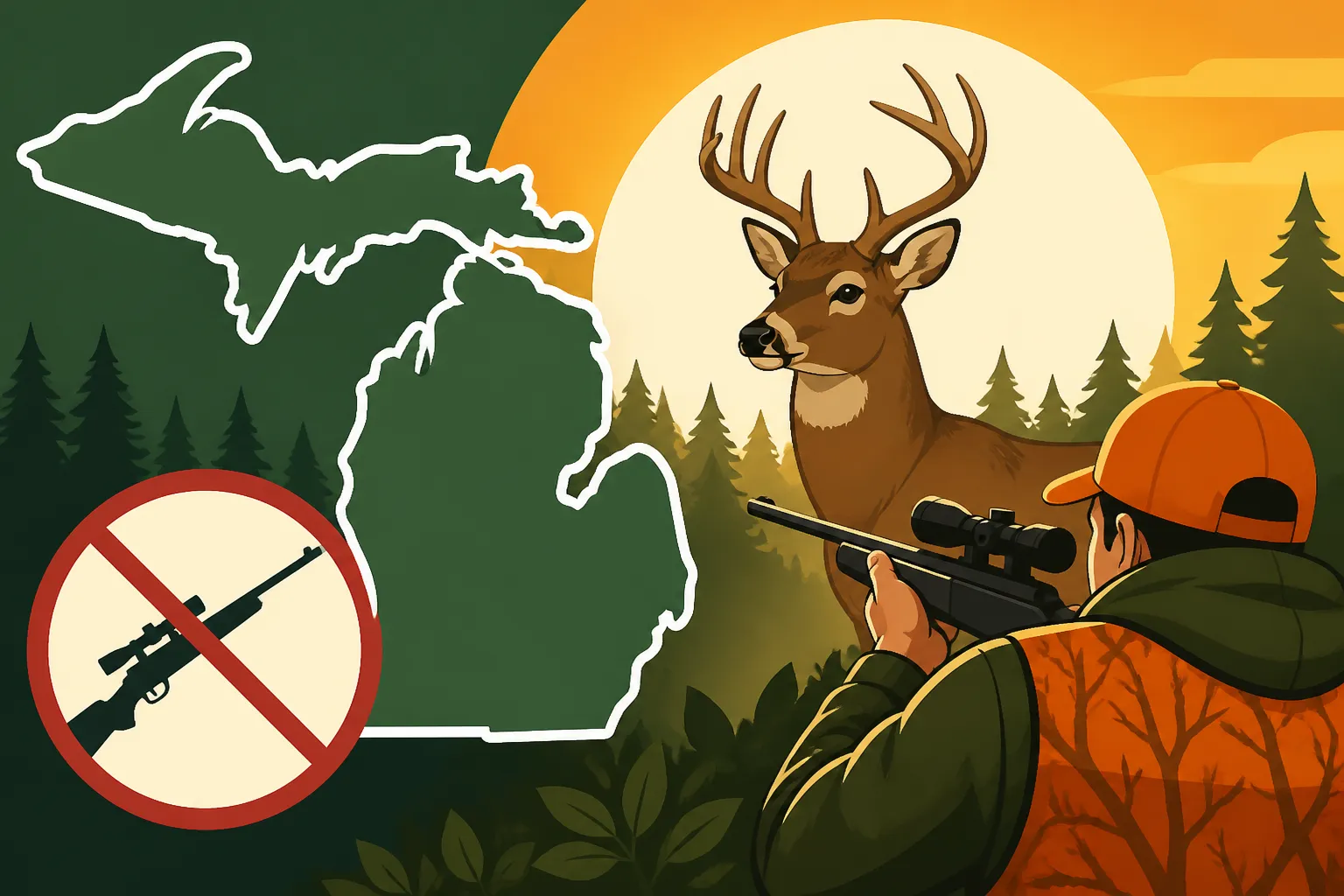
Imagine a line drawn across the Lower Peninsula, roughly from Muskegon on the west side to Bay City on the east. Everything south of that line, generally speaking, falls into what's known as the Limited Firearm Deer Zone. This designation isn't just a suggestion; it's a hard rule that dictates what types of firearms you can legally use during the firearm deer season. For generations, this zone has been the arena for shotgun hunters, often leading to a distinct hunting culture compared to areas where rifles are permitted.
Historically, this zone was established due to the higher population density and more agricultural landscapes found in the southern Lower Peninsula. The idea was to limit the effective range of hunting projectiles to enhance public safety in areas where homes, roads, and non-hunting activities were more prevalent. It’s a practical consideration when you think about the distances a rifle bullet can travel compared to a shotgun slug.
If you're new to hunting in Michigan, or perhaps visiting from out of state, identifying this zone is paramount before you even think about packing your gear. Many resources, including mapping applications, clearly delineate this boundary, which is crucial for compliance. We'll dive into those resources later, but for now, understand that if you're hunting in places like Lenawee, Jackson, or Kent counties, you're firmly within this restricted territory.
Why Does This Zone Exist?
The rationale behind the Limited Firearm Zone boils down to public safety and maintaining a positive perception of hunting in more populated areas. A high-powered rifle round can travel for miles, posing a significant risk if discharged in areas with houses, farms, or public trails. Shotgun slugs, while still potent and dangerous at close range, typically have a much shorter effective range and a more rapid drop in velocity, reducing the potential for unintended harm at greater distances.
For decades, the standard deer firearm in this zone was the smoothbore shotgun firing a rifled slug, or later, dedicated rifled slug guns. This tradition became deeply ingrained, and many hunters grew up learning to make precise shots within the limitations of these firearms. While technology has advanced dramatically, the core principle of safety remains. What the Michigan Limited Firearm Zone Means is really about creating a safer hunting environment without entirely closing off opportunities in densely populated regions.
It also speaks to the different types of terrain found across Michigan. Southern Michigan often features smaller woodlots, thickets, and agricultural fields where deer are frequently on the move between cover and food. Long-range rifle shots are less common and often unnecessary in such environments. Conversely, the vast, open forests of the north offer much more expansive opportunities for longer shots.
Legal Firearm Choices Within the Limited Firearm Zone
So, you're hunting south of that imaginary line. What can you actually carry into the woods? The rules here have evolved over the years, thankfully offering hunters more versatility than in decades past, but still retaining that focus on shorter-range projectiles.
Shotguns and Their Evolution
For many Michigan hunters, especially those of us who grew up in the southern half of the state, the shotgun is synonymous with deer season. Originally, we'd be slinging smoothbore shotguns, often with iron sights or a simple bead, firing what were essentially large lead projectiles – the classic "rifled slug." These were effective, but precision at longer ranges was always a challenge, making close encounters the name of the game.
The technology for slug hunting has come a long way since those days. Today, many hunters in the Limited Firearm Zone use dedicated slug guns with fully rifled barrels and sophisticated optics. These setups can deliver impressive accuracy out to 150 yards or even more with modern sabot slugs. The rifled barrel puts a spin on the projectile, much like a rifle, stabilizing it for better flight. This evolution means that while you're still using a "shotgun," the performance can be surprisingly close to a traditional rifle for deer hunting distances in dense cover. Shotguns and Slugs in Michigan's Restricted Zone are still incredibly popular, and for good reason—they get the job done efficiently and safely within the zone's intent.
The Rise of Straight-Wall Cartridges
Perhaps the biggest game-changer for southern Michigan deer hunters in recent memory has been the legalization of straight-wall cartridges. This was a direct response to hunters' desires for more rifle-like performance and accuracy, particularly for those who found traditional slug guns lacking. A straight-wall cartridge is exactly what it sounds like: a cartridge case where the walls are essentially straight from the base to the mouth, without the bottle-neck taper typical of many high-powered rifle rounds.
The key characteristic that makes them legal in the Limited Firearm Zone is that they are considered to have a more limited range than bottlenecked rifle cartridges, even though they can be very effective at typical deer hunting distances. Popular calibers like the .450 Bushmaster, .350 Legend, and .44 Magnum (when fired from a rifle, not just a handgun) have become incredibly popular. These cartridges offer significantly less recoil than many slug guns, often better accuracy, and a wider array of ammunition options. Many hunters feel this change truly leveled the playing field, allowing them to use firearms that are both powerful enough for deer and comply with the safety regulations. You can learn more about specific options in Straight-Wall Cartridges Legal in Michigan.
When considering a straight-wall cartridge, it’s worth noting that many traditional pistol calibers like .44 Magnum or .357 Magnum also qualify when chambered in a rifle. This gives hunters a lot of flexibility in choosing a firearm that suits their style and budget. The advent of these cartridges has meant a lot for Michigan hunters, giving us a modern option that performs well within the framework of the zone's restrictions.
Handguns and Their Specific Rules
Yes, handguns are also a legal option for deer hunting in Michigan, even within the Limited Firearm Zone, provided they meet certain criteria. This opens up another interesting facet of our hunting culture, from those who prefer the challenge of a handgun hunt to those carrying one as a secondary firearm. For deer, handguns must fire a minimum .35 caliber bullet, and the barrel must be at least 4 inches long. The ammunition must be a straight-walled cartridge, which ties directly into the rules we just discussed.
Many of the popular straight-wall rifle cartridges also have handgun counterparts, such as .44 Magnum or .357 Magnum, making them viable choices. However, hunting with a handgun is a different discipline entirely. It requires a significant amount of practice to achieve proficiency and ethical shot placement, especially given the typically shorter sight radius and different handling characteristics compared to a long gun.
Carrying a handgun for deer can be an incredibly rewarding experience, but it's not for the faint of heart. It demands excellent marksmanship and a commitment to close-range hunting. For those who embrace the challenge, it offers a unique way to pursue deer in Michigan. Always double-check your handgun's specific caliber and barrel length against the current Michigan DNR regulations to ensure it complies.
Hunting Outside the Limited Firearm Zone: "Unlimited" Rifle Territory
Once you cross that imaginary line heading north, or if you're hunting anywhere in our magnificent Upper Peninsula, the rules change considerably. Here, the vast expanses of forest and less dense population allow for the use of traditional bottlenecked rifle cartridges, which most hunters simply refer to as "rifles."
Exploring the Northern Lower Peninsula and Upper Peninsula
The Northern Lower Peninsula, roughly north of the Muskegon-Bay City line, and the entire Upper Peninsula are largely considered "unlimited" rifle territory. This means hunters can use a broader array of rifle calibers and types, giving them the flexibility to choose a firearm best suited for the terrain and anticipated shot distances. From the sprawling pine forests of the Huron-Manistee National Forest to the rugged wilderness of the Ottawa National Forest, a rifle hunter feels right at home.
This region is characterized by larger tracts of public land, denser forests, and generally lower human population density compared to the south. Opportunities for longer shots can arise, particularly along clear-cuts, pipeline clearings, or power line easements. The deer here often travel greater distances and the habitat can be more challenging to navigate, making the effective range and power of a rifle a significant advantage. Hunting the Michigan Upper Peninsula for Deer often involves long walks and variable conditions, where a reliable rifle is a trusted companion.
However, even in rifle country, common sense and ethical considerations always apply. Just because you can shoot further doesn't always mean you should. Understanding your effective range and the capabilities of your chosen cartridge remains paramount. Topography, vegetation, and ensuring a safe backstop are always considerations, no matter the firearm.
Rifle Calibers for Different Game and Terrain
The array of legal rifle calibers in the unlimited zone is extensive, offering options for everything from smaller deer to larger black bears. Common deer hunting calibers like the .30-06 Springfield, .270 Winchester, .308 Winchester, and newer cartridges like the 6.5 Creedmoor are all popular choices. These calibers offer excellent ballistic performance, flat trajectories, and sufficient energy for clean deer kills at a variety of ranges.
When choosing a rifle, consider the typical terrain you'll be hunting. In thick timber, shots are often close, and a rifle that handles well in tight quarters is valuable. For more open areas or scouting power lines, a rifle with a flatter trajectory might be preferred. Rifle Setups for Michigan Deer can vary widely based on personal preference and the specific hunting grounds. Some hunters prefer traditional bolt-action rifles for their accuracy and reliability, while others might opt for lever-action rifles in brushy country.
For larger game like Michigan black bears, which are also hunted in these northern zones, many of the same deer calibers are suitable, though some hunters prefer something with a bit more punch, such as a .300 Winchester Magnum. The key is choosing a caliber you can shoot accurately and confidently. Remember, shot placement is always more important than raw power.
Navigating the Rules: Tools and Resources for Michigan Hunters
Michigan's hunting regulations can be complex, and staying informed is a continuous process. Thankfully, there are several excellent resources available to help hunters understand and navigate these rules.
Using Maps and Digital Resources
In this digital age, we have incredible tools at our fingertips to help us understand land ownership, boundaries, and, critically, firearm regulations. The Michigan Department of Natural Resources (DNR) offers its own comprehensive mapping resource called Mi-HUNT. This online mapping application allows you to view public land boundaries, habitat types, and important regulations specific to certain areas. It's an invaluable tool for planning your hunt and confirming if you're in the Limited Firearm Zone.
Beyond the DNR's direct offerings, many hunters rely on third-party mapping applications that overlay land ownership, public/private distinctions, and even hunting zone boundaries right on their phone or GPS device. Companies like onX Hunt have become indispensable for countless hunters. For example, their app clearly marks the boundary of the Limited Firearm Zone, making it easy to see at a glance whether your chosen hunting spot requires a straight-wall cartridge or if your trusty rifle is good to go. This kind of visual aid is far more intuitive than trying to decipher a written description of a boundary line. It’s also where a resource like GoHunt can be incredibly useful, providing detailed mapping and regulatory information that you can access right from your phone in the field. Using Mi-HUNT on a Phone can genuinely save you headaches and ensure compliance.
Before heading afield, always take the time to consult these resources. Even if you've hunted an area for years, boundaries or regulations can sometimes shift, or you might find yourself exploring new territory. A quick check of a reliable mapping app can prevent potential legal issues and give you peace of mind.
Staying Up-to-Date on Regulations
The Michigan DNR publishes an annual Hunting and Trapping Digest, which is the official word on all hunting regulations. This digest is available online as a PDF and often in print at sporting goods stores and DNR offices. Reading it cover-to-cover, or at least the sections relevant to deer hunting, is a non-negotiable step for any responsible hunter. Ignorance of the law is never an excuse, and these regulations are put in place for safety and conservation.
It's also important to understand that regulations aren't static. They can change from year to year based on deer population dynamics, disease management (like Chronic Wasting Disease), public feedback, and legislative action. What was legal last season might have a slight modification this season. For example, the list of Legal Firearms for Michigan Deer sometimes sees updates to approved straight-wall cartridges or other specifics.
Beyond the annual digest, the DNR often publishes news releases or updates on its website throughout the year, especially concerning emergency closures, CWD regulations, or carcass movement restrictions. Subscribing to their email newsletters or following their official social media channels can be a good way to stay informed. Don't rely solely on word-of-mouth from a buddy or an old blog post; always go to the official source for the most current information.
Strategic Considerations for Rifle Hunters in Michigan
Beyond understanding the rules, applying them effectively to your hunting strategy can make all the difference. Knowing where you can use a rifle influences your gear choices and your approach to hunting.
Gear Considerations for Zone-Specific Hunting
Your firearm choice directly impacts your other gear selections. If you're hunting in the Limited Firearm Zone with a straight-wall cartridge rifle or a modern slug gun, your optics setup should reflect the typical shot distances. A low-power variable scope (e.g., 1-4x, 2-7x, or 3-9x) is often ideal, offering a wide field of view for quick target acquisition in thick cover while providing enough magnification for shots out to 100-150 yards. You don't necessarily need a high-magnification scope built for long-range precision if your effective range is capped.
Ammunition choice is also critical. For straight-wall cartridges, there's a wide variety of bullet weights and designs. Selecting a bullet designed for deer, with good expansion and penetration characteristics, is essential. For slug guns, modern sabot slugs perform far better than traditional rifled slugs, especially through a rifled barrel. Always pattern your shotgun or zero your rifle with the exact ammunition you plan to hunt with, as different loads can shoot very differently. Zeroing at 100 Yards for Woods Hunting is a great benchmark, even if you anticipate closer shots.
Conversely, if you're in the unlimited rifle zones of the U.P. or northern Lower Peninsula, your gear choices might shift. You might consider scopes with higher magnification for potential longer shots, or binoculars with better low-light performance for scanning vast timber tracts. A more powerful rifle caliber might also be chosen if bear or even elk are on your wish list. The key is aligning your gear with the regulations of your hunting area and the specific challenges of that terrain.
| Feature | Limited Firearm Zone (South) | Unlimited Firearm Zone (North) |
|---|---|---|
| Location | Southern Lower Peninsula (generally south of Muskegon-Bay City line) | Northern Lower Peninsula (north of line) & Entire Upper Peninsula |
| Primary Firearms | Shotguns (smoothbore & rifled), Straight-Wall Cartridge Rifles, Handguns | Traditional Rifles (bottleneck cartridges), Shotguns, Straight-Walls, Handguns |
| Cartridge Types | Straight-wall rifle cartridges (e.g., .450 Bushmaster, .350 Legend, .44 Mag Rifle), Shotgun slugs | Bottlenecked rifle cartridges (e.g., .30-06, .270, .308, 6.5 Creedmoor), all others legal in limited zone |
| Range Expectation | Shorter ranges (typically under 200 yards), dense cover, agricultural edges | Longer ranges possible (over 200 yards), vast forests, clear-cuts |
| Safety Rationale | Public safety due to higher population density and residential areas | Lower population density, more expansive wilderness, less risk to distant structures |
| Hunting Style | Often involves still-hunting, drives, stand hunting in smaller woodlots | Stand hunting, still-hunting, Deer Drives With Three or Four Hunters in larger timber |
| Mapping Tool Use | Critical for confirming zone boundaries and specific property lines | Useful for identifying public land, access points, and terrain features |
Adapting Tactics to Firearm Restrictions
Your hunting tactics should naturally adapt to the type of firearm you're using and the zone you're in. In the Limited Firearm Zone, where shot distances are generally shorter, focusing on close-range opportunities is paramount. This often means more attention to detail in stand placement, ensuring good cover, and understanding deer travel patterns through small woodlots or along field edges. Strategies like still-hunting through thickets or even small deer drives can be highly effective. Hunting a Standing Cornfield in the Thumb is a classic example of tactical adaptation in the southern zone.
For instance, when setting up a treestand in southern Michigan, you might prioritize a spot that offers a clear shot lane for 50-75 yards, rather than looking for a long-range vantage point. Understanding the movement patterns of deer between bedding areas in small swamps and feeding areas in nearby crop fields becomes crucial. You might focus more on scent control and quiet entry/exit to maximize your chances of a close encounter. Using resources like GoHunt to scout aerial maps for pinch points and funnels becomes even more valuable.
In the unlimited rifle zones of the north, while longer shots are possible, the core principles of deer hunting still apply. Many successful hunters in the U.P. still advocate for close-range tactics, as mature bucks often stay in the thickest cover. However, a rifle does offer the advantage of being able to reach out if a deer presents itself across a large opening or a valley. Your Scouting Michigan Public Land Before Season will dictate whether you prepare for a 20-yard shot or a 200-yard shot. Adapting to the specific conditions of your hunting area, rather than blindly relying on the maximum range of your firearm, is always the mark of a skilled hunter.
Remember, regardless of the zone, safety should always be your top priority. Know your target, what's beyond it, and your firearm's capabilities and limitations. Michigan offers incredible deer hunting opportunities across its diverse landscapes, and understanding these firearm restrictions ensures we can all enjoy them responsibly.
Disclaimer
This article is for general informational purposes only and does not constitute professional advice. Laws, prices and regulations vary by location and change over time. Consult a qualified professional for guidance on your specific situation.