Rabbit Hunting Thick Michigan Brush
There's nothing quite like the thrill of chasing cottontails through Michigan's dense cover, but let's be honest, it can also be a brutal experience. Getting tangled in briars, wading through knee-high tangles, and having rabbits seemingly vanish into thin air can be incredibly frustrating. This guide is here to walk you through the nitty-gritty of successfully hunting rabbits in Michigan's thickest brush, offering practical strategies, gear advice, and tips to make your hunt safer and more productive.
Understanding Michigan's Thick Brush and Rabbit Behavior
Hunting rabbits in Michigan isn't like strolling through a park. Our landscape, particularly in areas transitioning from agricultural fields to woods, or along river bottoms, is often characterized by incredibly dense vegetation. This isn't just a minor inconvenience; it's a primary factor in how rabbits survive and how hunters must adapt.
Identifying Prime Rabbit Habitat in Dense Cover
When we talk about "thick brush" in Michigan, we're thinking about a few key types of cover that cottontails absolutely adore. Think about those neglected corners of old farms where the field meets the forest edge, choked with multiflora rose, hawthorn, and tangled grapevines. These areas create an impenetrable fortress for rabbits, offering both food and protection from predators like coyotes, foxes, and hawks. You'll also find prime rabbit habitat along river and creek bottoms, where thickets of dogwood, willow, and even some young cedar swamps provide year-round refuge. In the northern parts of the Lower Peninsula and the Upper Peninsula, you might encounter rabbits in thick aspen regeneration or areas with heavy blow-downs that create a jumble of natural cover. Even suburban areas with unmanaged greenbelts or powerline cuts can hold surprisingly good numbers of rabbits, though hunting these spots comes with its own set of considerations regarding safety zones and local ordinances.
Understanding these specific types of cover is your first step. It's not just about finding "a brush pile," but recognizing the quality of that cover. Look for areas that offer a combination of dense overhead protection, tangled ground cover to hide in, and nearby food sources like clover, tender shoots, or even fallen apples. Often, these spots are literally right under our noses, overlooked by hunters focused on larger game.
How Rabbits Use Thick Brush for Survival
Rabbits are masters of evasion, and thick brush is their natural fort. They don't just "live" in it; they actively use it as their primary defense mechanism. When a predator approaches, a rabbit's first instinct is often to freeze, relying on its camouflage within the dense tangle. If that doesn't work, they burst out, darting into the nearest, densest cover available, often running in tight circles or figure-eights to confuse a pursuing predator or hunter. They know every tunnel, every escape route, and every hidey-hole in their small home range.
During winter, especially after a fresh snowfall, you might see their tracks leading into and out of these thickets. This is when the cover provides crucial thermal protection, insulating them from biting winds and heavy snow. The denser the cover, the warmer and safer they feel. This behavior also dictates how we hunt them. Trying to push through a massive, unbroken block of thick brush without a strategy is usually a recipe for frustration. You'll move too slowly, make too much noise, and the rabbits will be long gone before you ever get a shot. Instead, we need to think like a rabbit: where would I go if startled? Where is the safest, densest cover available? This mindset helps identify choke points, escape routes, and pockets of cover worth investigating thoroughly.
Essential Gear and Preparations for Thick Brush Hunting
Successfully navigating Michigan's gnarly rabbit cover demands specific gear. Forget your open-woods deer hunting attire; this is a different game entirely, one where durability and protection are paramount.
Clothing and Protection for Nasty Cover
When you're pushing through blackberry brambles, multiflora rose, and thorny hawthorn, your regular hunting pants will get shredded in a single outing. You need serious protection. The absolute workhorse here is a good pair of Brush Pants for Michigan Alder. These are typically made from tough, briar-resistant materials like waxed canvas, Cordura, or heavy-duty nylon, often with a waterproof lining. Look for pants with reinforced fronts and seats, as you'll be kneeling, sitting, and pushing through incredibly abrasive vegetation. Brands like Filson, Orvis, or even some of the more rugged workwear companies offer excellent options.
Your upper body needs protection too. A heavy canvas or waxed cotton jacket can offer some defense, but if you're working with dogs, a tough vest is often preferred to allow for more freedom of movement. Always wear long sleeves, even on mild days, to prevent scratches and scrapes. And don't forget the hands! Heavy-duty leather gloves or briar-proof gloves are non-negotiable. Your hands will take a beating, so choose gloves that allow for good dexterity but offer maximum protection.
Footwear is another critical component. You'll be walking through wet grass, soggy leaves, and potentially standing water. Waterproof boots with good ankle support are a must. Many hunters prefer rubber boots for their complete waterproofing and ease of cleaning, especially if you're sloshing through muddy creek beds. Others opt for sturdy leather or synthetic hiking boots with a waterproof membrane like Gore-Tex, ensuring they are well broken-in to prevent blisters. Consider a pair of Boots for Walking Michigan Aspen Cuts for the kind of support and protection needed in these environments. The key is comfort and dryness, because a cold, wet foot will cut your hunt short faster than anything.
Shotguns, Ammo, and Safely Navigating Brush
For rabbit hunting in thick cover, a fast-handling shotgun is king. Shots are often close, quick, and reactionary. A 12-gauge or 20-gauge pump-action or semi-automatic shotgun with an improved cylinder or modified choke is ideal. The open choke allows for a wider pattern at close range, increasing your chances of connecting with a fast-moving target in dense cover. Barrel length is also a consideration; shorter barrels (24-26 inches) are easier to maneuver through tangled brush without getting snagged.
As for ammunition, most rabbit hunters opt for lead shot in sizes #5, #6, or #7.5. These sizes provide a good balance of pattern density and knockdown power for rabbits without over-penetrating. Always confirm lead shot is legal in your specific hunting area; while generally allowed for small game, local ordinances or specific managed areas might have different rules. For example, some federal lands require non-toxic shot for all hunting.
Safety is paramount, especially when hunting in thick brush where visibility can be extremely limited. Always treat every firearm as if it's loaded, keep the muzzle pointed in a safe direction, and be absolutely certain of your target and what's beyond it. When moving through dense cover, carry your shotgun in a safe, ready position that allows for quick mounting but prevents accidental discharge if you trip or get snagged. Many hunters prefer to carry their gun "broken" if it's a break-action, or with the action open and safety on for other types, only loading and closing the action when they are in a prime spot to flush a rabbit.
When hunting with a group, communication is vital. Know where every hunter is at all times. Wearing hunter orange is not just a legal requirement during firearm deer season in Michigan, but it's also a smart safety practice for any hunting activity where visibility might be an issue. Even during small game seasons, a blaze orange hat or vest can make a huge difference in being seen by other hunters. Make sure you understand all Michigan Hunter Safety and Youth Licences requirements before heading out.
Effective Hunting Strategies for Michigan's Dense Rabbit Cover
Rabbit hunting in thick Michigan brush requires more than just wandering around. It calls for specific tactics to outwit these masters of camouflage and speed.
The Art of Still-Hunting and Flushing Rabbits
Still-hunting for rabbits in thick cover is a slow, deliberate process that rewards patience and keen observation. It's about moving stealthily, stopping frequently, and scanning every nook and cranny of the brush. You're not looking for the whole rabbit, but rather a flicker of an ear, an eye, or just an unnatural shape among the branches. Rabbits often sit incredibly tight, relying on their camouflage, and will only bolt when you're almost on top of them.
When still-hunting, make a few steps, then pause. Look ahead, but also behind you, as a rabbit might double back. Pay close attention to small pockets of slightly denser cover within the main thicket, or areas where the sun might be warming a brush pile. Sometimes, just kicking at a brush pile or shaking a low branch can convince a hiding rabbit to move. The key is to force the rabbit's hand, making it break cover for a shot.
This strategy works particularly well when hunting alone or with a partner. You cover ground slowly, systematically working through cover that might be too dense for a larger group to navigate efficiently. As you move, think about where a rabbit would likely run. If you jump one, try to anticipate its escape route. This is where a good mapping app like GoHunt can be invaluable. You can use it to pinpoint isolated clumps of cover, identify potential escape corridors, and even mark areas where you've previously jumped rabbits, helping you refine your approach on subsequent hunts.
Working with Beagles or Other Small Game Dogs
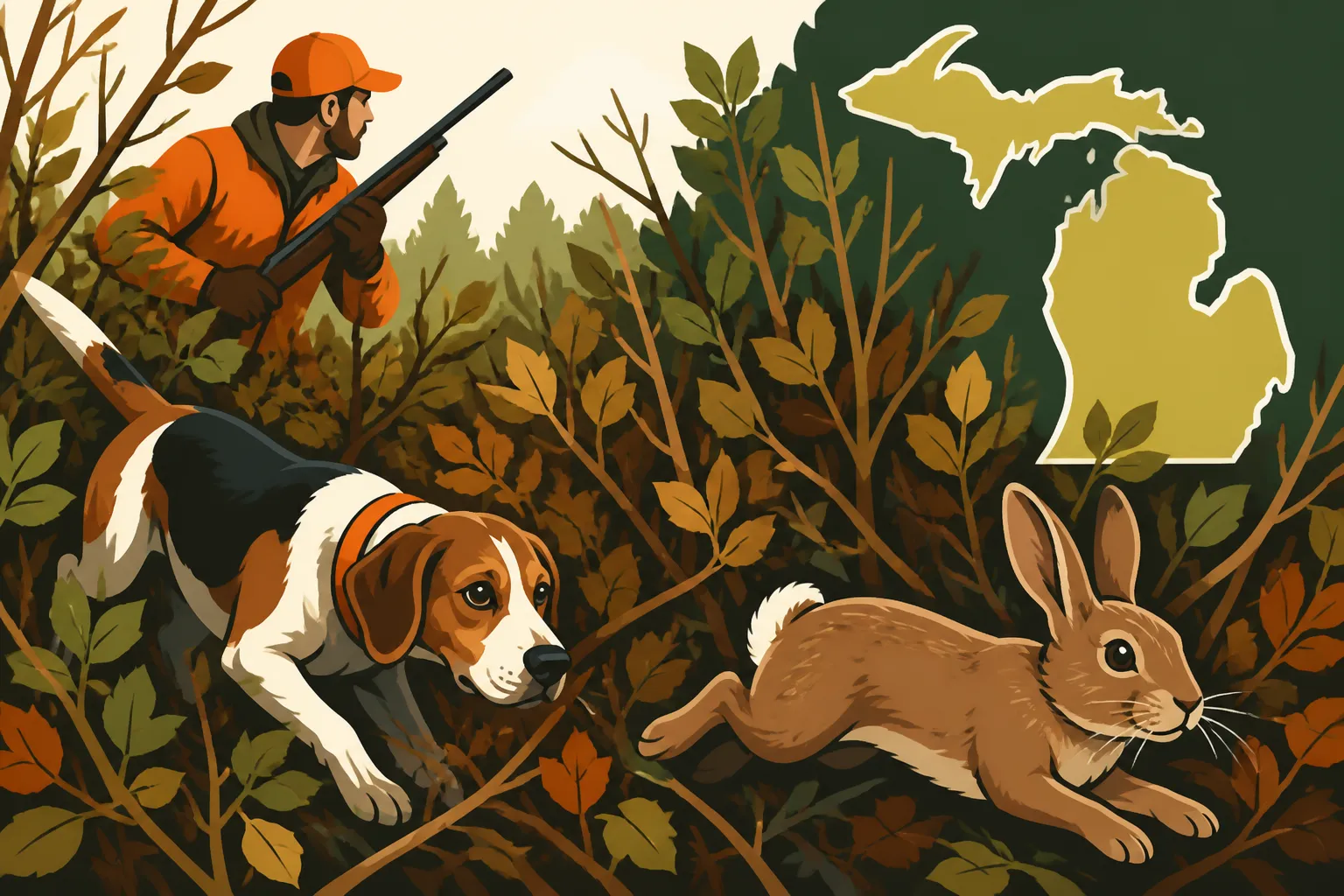
For many, rabbit hunting is hunting with dogs, and for good reason. Beagles, bassets, and other small game hounds are specifically bred for this task, with an incredible sense of smell and the perseverance to root out rabbits from the thickest of cover. If you have the opportunity, hunting with a pack of beagles is an exhilarating and often highly effective way to hunt Michigan rabbits. You can learn more about this exciting method in our guide on Rabbit Hunting With Beagles in Michigan.
The dogs work to find and flush rabbits, then relentlessly pursue them, typically driving them in a large circle back towards where they were originally jumped. This circling behavior is instinctive for rabbits and is what makes dog hunting so effective. Hunters position themselves strategically around the edge of the cover or along known rabbit runs, waiting for the dogs to bring the rabbit around. It’s a symphony of baying hounds and anticipation.
When hunting with dogs, it's crucial to trust your dogs and let them work. Don't crowd them. Give them space to sort out the track. And always, always identify your target before shooting. In the excitement of the chase, it's easy to get tunnel vision. Be absolutely sure it's a rabbit and that your shot is safe, especially with dogs in the area. Keeping track of your dogs with GPS collars can also be a huge help, especially in vast, thick areas. This technology, sometimes integrated with scouting platforms like GoHunt, allows you to monitor their location and movement even when they're out of sight and earshot.
Group Hunting and Driving Tactics
For larger patches of dense cover, a group of hunters can be very effective by employing driving tactics. This involves assigning "pushers" and "posters." Pushers walk through the thick cover, making noise, kicking brush, and actively trying to flush rabbits. Posters, also known as blockers, position themselves quietly at strategic points where rabbits are likely to exit the cover.
The key to a successful drive is communication and coordination. Before starting, everyone should know their role, the boundaries of the drive, and the location of fellow hunters. Safety is even more critical here due to multiple hunters moving through thick terrain. Define clear shooting lanes and angles, and ensure everyone understands that shots should only be taken at rabbits moving away from the pushers and towards the posters, or safely across a poster's field of view.
When setting up posters, think about natural pinch points: narrow strips of cover, field edges, or openings where rabbits will be funneled. Maps from services like GoHunt can help identify these topographical features and potential escape routes before the hunt begins, allowing you to set up the drive for maximum efficiency and safety. These group drives can be physically demanding for the pushers, but they can be incredibly productive, often flushing multiple rabbits from a single, dense thicket. It’s a bit like a scaled-down version of Deer Drives With Three or Four Hunters, just for much smaller game and with a different set of safety considerations.
Post-Hunt Considerations and Safety
A successful hunt doesn't end when the shot is fired. Proper game care and unwavering attention to safety are crucial, especially when operating in challenging environments like Michigan's thick brush.
Handling Your Harvest and Game Care
Once you've harvested a rabbit, proper field dressing is important to ensure the meat is good quality. In cooler weather, you have a bit more time, but if it's a mild Michigan day, especially during the early small game seasons, you'll want to get the internal organs out quickly. This helps the carcass cool down faster and prevents spoilage.
To field dress a rabbit:
- Gloves: Wear latex or nitrile gloves to protect yourself from any potential diseases.
- Incision: Make a shallow incision through the skin of the belly, from the sternum to the pelvis.
- Skinning: The skin of a rabbit is surprisingly loose. You can often pull the skin off like a sweater, starting from the back.
- Evisceration: Carefully sever the rectum and bladder, then remove all internal organs. Check for any abnormalities.
- Cooling: If possible, rinse the cavity with clean water (though often impractical in the field) and then let it cool. Many hunters carry game bags to protect the carcass from dirt and flies as they continue hunting or make their way back to the vehicle.
Once home, either skin and butcher the rabbit immediately or place it in a cooler with ice until you can process it. Rabbit meat is delicious and versatile, perfect for stews, frying, or even roasting. Remember to always be aware of Michigan's Michigan Small Game Seasons and Bag Limits and report your harvest if required, although rabbits typically don't require individual reporting.
Safety Reminders in Thick Michigan Cover
Hunting in thick brush naturally presents more challenges to safety than hunting in open terrain. Reduced visibility, uneven footing, and the close proximity of other hunters or dogs all demand heightened awareness.
Here's a quick table outlining key safety considerations:
| Safety Aspect | Best Practices in Thick Brush |
|---|---|
| Visibility | Always wear hunter orange, even if not legally required for the season. Ensure others in your party do too. Communicate frequently, verbally or with whistles, to maintain awareness of everyone's position. |
| Footing | Watch every step. Thick brush often conceals roots, rocks, holes, and slippery mud. Sturdy, ankle-supporting boots are crucial. A walking stick can help with balance and checking uncertain ground. |
| Firearm Handling | Keep your firearm pointed in a safe direction at all times, especially when moving through tangles. Engage the safety. Only load your firearm when actively hunting in a productive area, and unload it completely when crossing obstacles or taking a break. |
| Target ID | In limited visibility, 100% positive target identification is non-negotiable. Do not shoot at sound or movement. Ensure there are no hunters, dogs, or non-target animals in the line of fire. |
| Emergency Prep | Carry a small first-aid kit, a fully charged cell phone (with a power bank), and knowledge of your location (a GPS app like GoHunt is excellent for this). Let someone know where you're hunting and when you expect to return. Be prepared for minor injuries. |
| Communication | Agree on clear communication signals (e.g., specific calls, whistles) with your hunting partners. Maintain visual contact when possible, especially during drives. |
| Dog Safety | If hunting with dogs, ensure they are wearing bright collars and ideally GPS trackers. Keep them in mind for every shot, and never shoot low or at a running target if a dog could be in the line of fire. |
Remember, the Michigan wilderness can be unpredictable. Being prepared and prioritizing safety will ensure your rabbit hunting adventures in the thick stuff are memorable for all the right reasons. Always check the Michigan DNR website for the latest regulations on Michigan Rabbit and Hare Seasons before you head out.
Disclaimer
Please note: Hunting regulations and conditions can change. Always consult the latest Michigan Department of Natural Resources (DNR) hunting digests and regulations before embarking on any hunting trip. This guide is for informational purposes only and does not supersede official DNR rules.