The Three-Point Rule in Michigan
It can be incredibly frustrating to be out in the Michigan woods, heart pounding as a beautiful buck steps into view, only to be riddled with doubt: "Is he legal? Does he meet the point restrictions for this area?" This confusion is a common pain point for many hunters, especially with Michigan's varied regulations. This comprehensive guide is here to unravel the mystery of the "Three-Point Rule" in Michigan, explaining exactly what it means, where it applies, and how it impacts your hunting decisions.
Understanding the Michigan Three-Point Rule
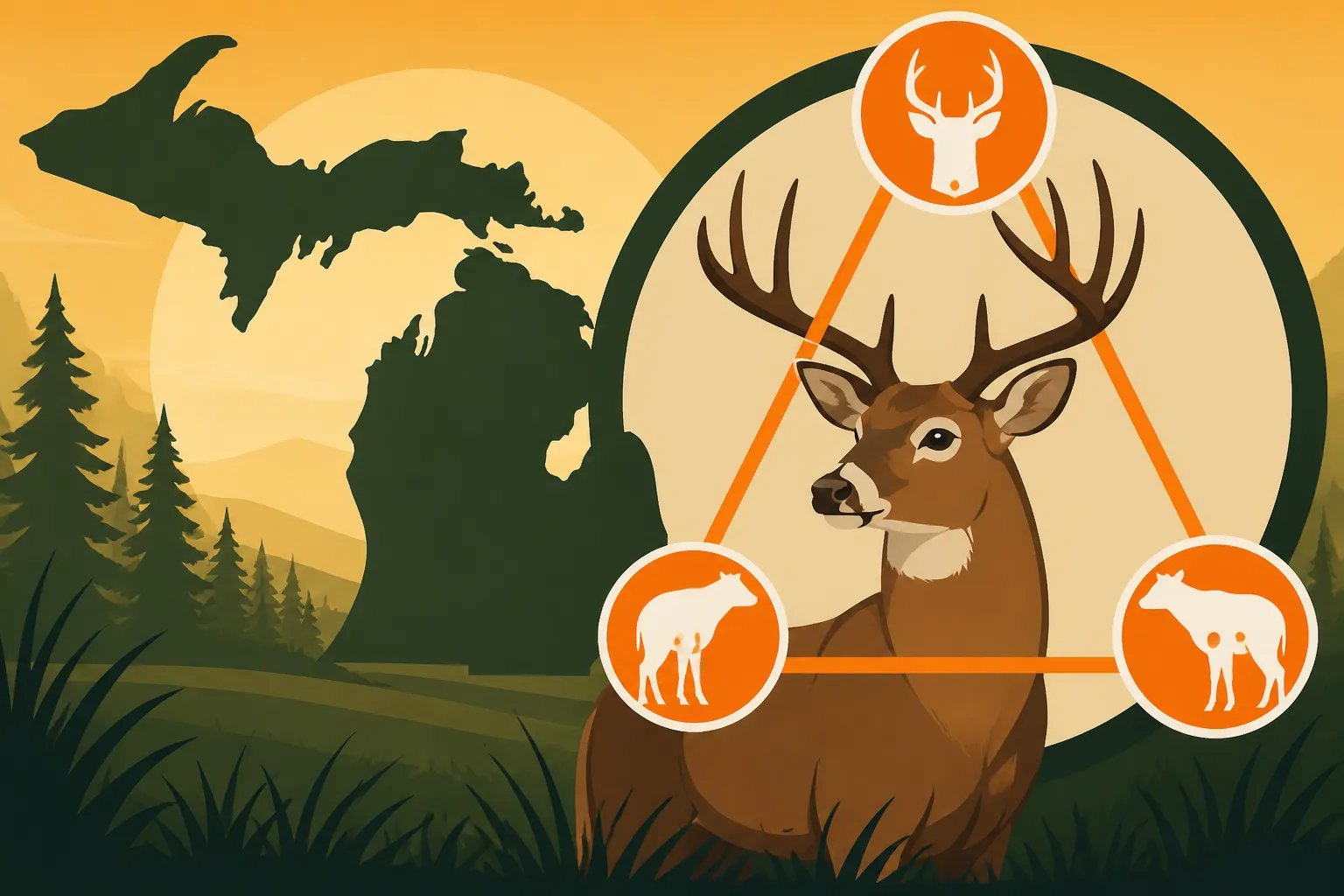
Michigan's deer hunting regulations are designed to manage the herd effectively, aiming for a healthy balance and quality hunting experiences. The three-point rule is one such regulation, and it often causes a bit of head-scratching. Simply put, this rule dictates that a deer is considered an antlered buck (and therefore legal to harvest with an antlered deer license) only if at least one of its antlers has a minimum of three points that are each at least one inch long. This isn't about the total number of points on both antlers, but specifically about one side meeting that minimum.
Defining a "Point" for the Rule
Let's get down to the nitty-gritty of what actually counts as a "point." The Michigan Department of Natural Resources (DNR) is quite clear: a point must be at least one inch long when measured from its base to its tip. It also needs to project from the main beam or another point. This means those tiny little bumps, often called "nubs" or "buttons," that aren't at least an inch long, do not count toward the three-point minimum.
Imagine you've got a young buck in your sights. You see a brow tine, a G2 (the first point off the main beam), and then what looks like another small projection. You'll need to quickly assess if that third projection truly measures an inch or more. If it's shorter, that side only has two legal points, and you'd need to check the other antler to see if it meets the criteria. This can be a challenge in low light, dense cover, or when a buck is on the move, which is why understanding the rule clearly beforehand is paramount.
It's also important to differentiate between typical and non-typical points. For the purpose of the three-point rule, any projection that meets the one-inch length requirement counts, regardless of whether it's part of a "typical" antler configuration or an abnormal point. So, that kicker or sticker point stemming off a main point can absolutely contribute to your count, as long as it's an inch or more.
One Side or Both? Clarifying the Rule
This is where some of the biggest misconceptions arise. Many hunters mistakenly believe that the three-point rule means the buck needs a total of three points on both antlers combined, or three points on each antler. Neither of these interpretations is correct. The rule states "at least three points on one antler that are each at least one inch long."
This means a buck with a spike on one side and a fully developed three-point antler on the other is a legal buck in a three-point restriction zone. Conversely, a buck with two points on one side and two points on the other (a 4-point total, often called a "basket rack" 4-point) would not be legal if the rule applied to both sides or the total. Because at least one antler has only two points, it wouldn't meet the "at least three points on one antler" requirement. It's a critical distinction that can save you from a potential violation or, just as importantly, letting a legal buck walk when you could have filled your tag.
This nuance highlights the importance of observing the buck carefully, even if only for a few seconds. Focus your attention on one antler at a time to determine if it independently meets the minimum of three one-inch points. Often, hunters will mentally "score" the more developed antler first, as it's more likely to meet the threshold.
Visual Cues for Quick Assessment in the Field
When a buck steps out, especially in thick timber or at dawn/dusk, you often don't have minutes to analyze its rack. You need to make a judgment call quickly. Developing a system for rapid assessment can be incredibly helpful. One common strategy is to first look for the main beam, then scan for the brow tine (G1), the G2, and then the G3. If you can quickly identify a G1, G2, and G3 on one side, and they all appear to be an inch or longer, you're likely looking at a legal buck.
Another tactic is to use anatomical benchmarks on the deer itself. For example, a point that extends past the ear or is clearly longer than the eye can often give you a quick visual cue for the one-inch length requirement, though this isn't foolproof. Practice in the off-season by looking at photos or mounts of bucks and quickly counting their points, paying attention to the one-inch rule. This mental exercise can significantly improve your field judgment. Many experienced hunters also rely on their binoculars or a spotting scope to make a definitive assessment before raising their firearm or drawing their bow, especially if they are hunting in an area with antler point restrictions.
Geographic Reach: Where You'll Encounter This Rule
The Michigan three-point rule isn't a statewide blanket regulation. Instead, it's applied selectively in specific Deer Management Units (DMUs) across the state. This localized approach is part of the DNR's adaptive management strategy, allowing them to tailor regulations to the unique needs and goals of different regions and deer populations. It means that while you might be hunting under a three-point rule in one county, you could cross into an adjacent county with different antler regulations, highlighting the importance of knowing your specific hunting location.
Navigating Michigan's Deer Management Units (DMUs)
Michigan is divided into various DMUs, each with its own set of regulations concerning antlerless permits, antler point restrictions (APRs), and sometimes even specific season dates. The three-point rule is a form of APR, and its application varies greatly from the Upper Peninsula down to the southern Lower Peninsula. For instance, many areas in the northern Lower Peninsula and portions of the Upper Peninsula have had some form of APRs for years, aimed at improving buck age structure.
Before you ever step foot in the woods, it is absolutely crucial to know which DMU you'll be hunting in and what the precise regulations are for that specific unit. The Michigan DNR website is the authoritative source for this information, providing detailed maps and regulation summaries. Many hunters also use mapping apps like GoHunt or The Michigan DNR Hunt Fish App which can overlay DMU boundaries onto public and private land maps, making it easier to verify current regulations. Checking the annual Michigan Hunting Digest is also a non-negotiable step to ensure you are compliant. For more on this, check out our guide on Michigan Antler Point Restrictions by DMU.
Northern Lower Peninsula and Upper Peninsula Nuances
Historically, many of Michigan's APRs, including variations of the three-point rule, have been concentrated in the northern Lower Peninsula (NLP) and certain parts of the Upper Peninsula (UP). These regions often feature larger tracts of public land and different deer population dynamics compared to the agricultural landscapes of Southern Michigan. In these areas, the goal of APRs is often to allow younger bucks a chance to mature, leading to an older age class of bucks in the herd.
For example, many DMUs in the NLP that are characterized by large state forests like the Huron-Manistee National Forest or the Au Sable State Forest have implemented APRs. This helps to reduce pressure on yearling bucks, theoretically allowing them to survive another year or two and develop larger racks. Hunters often find that in these areas, patience is rewarded, and passing up smaller bucks becomes a more common practice. The Upper Peninsula also has its own unique challenges, including harsh winters that can significantly impact deer numbers. While some areas in the UP have APRs, others might have different management strategies. Understanding Upper Peninsula Deer Yarding and Winter Movement can provide additional context for these regulations.
Impact on Local Hunting Pressure
The implementation of the three-point rule, or any antler point restriction, can subtly shift hunting pressure and hunter behavior. In DMUs where the rule is in effect, hunters are naturally more selective, meaning more young bucks (those with fewer than three points on an antler) are passed up. This can lead to different experiences for hunters compared to areas without such restrictions.
For one, it might mean more "legal" bucks are seen later in the season, as they've had less pressure early on. On the flip side, some hunters might find it more challenging to fill an antlered tag if they are accustomed to shooting any antlered buck. This can sometimes lead to localized shifts in hunting pressure, with some hunters choosing to avoid APR areas if they prioritize simply harvesting an antlered deer over targeting older age class bucks. However, for those looking for a different kind of hunting experience, one focused on herd management and potentially seeing more mature animals, these regulations can be a welcome change. It also encourages a deeper understanding of deer behavior and careful observation, as hunters must be more discerning.
The "Why" Behind the Rule: Management Objectives
The three-point rule, like other antler point restrictions in Michigan, isn't just about making hunting more challenging or arbitrary. It's a strategic tool employed by the Michigan DNR with clear management objectives in mind. These objectives are rooted in scientific deer management principles, aiming to foster a healthier, more balanced deer herd and, ultimately, enhance the quality of the hunting experience for everyone.
Promoting Buck Age Structure
One of the primary goals of the three-point rule is to protect younger bucks and allow them to survive to older age classes. In areas without antler restrictions, yearling bucks (1.5 years old) are often the most vulnerable to harvest because they are numerous and typically less wary than older bucks. By setting a minimum antler restriction, the DNR essentially provides a "pass" for many of these young bucks, giving them at least another year to grow.
This shift in harvest pressure means a greater proportion of bucks in the 2.5, 3.5, and even 4.5+ year old age classes. An older age structure within the buck population brings several benefits. Biologically, older bucks are crucial for maintaining genetic diversity. From a hunter's perspective, more mature bucks typically mean larger antlers, which many hunters find desirable. This directly contributes to the goal of improving the quality of the hunting experience, as hunters have a greater chance of encountering and harvesting a more mature animal. To learn more about this, explore Buck Age Structure Under Michigan APRs.
Improving Genetics and Herd Health
While the direct link between antler restrictions and "improving genetics" is a complex and often debated topic among wildlife biologists, the general principle is that allowing bucks to express their full antler potential can provide valuable data and potentially contribute to herd health. When bucks are harvested primarily as yearlings, it's harder to assess the genetic potential for antler growth within a population. By allowing them to mature, biologists can observe the natural antler development of bucks in different age classes.
Furthermore, a more balanced buck-to-doe ratio, which can be a secondary effect of protecting younger bucks, can lead to a more condensed and intense rut. In areas with heavily skewed buck-to-doe ratios (too many does per buck), the rut can be prolonged and less efficient, potentially leading to later fawn births and less healthy fawns. A more balanced ratio helps ensure that most does are bred during their first estrous cycle, resulting in fawns born earlier in the spring with a better chance of survival. This contributes to the overall health and vigor of the entire deer herd.
Hunter Satisfaction and Ethical Hunting
Beyond biological considerations, the three-point rule also aims to increase hunter satisfaction. Many hunters express a desire to see and harvest more mature bucks. Antler point restrictions are a direct response to this sentiment, providing a management strategy that aligns with hunter preferences for quality over quantity in terms of antlered deer. It fosters a different kind of hunting culture, one that often emphasizes patience, observation, and a deeper appreciation for deer behavior.
It also encourages a higher degree of ethical hunting. When hunters are required to identify specific antler characteristics, they are naturally forced to take more time to observe the animal before making a shot. This reduced "trigger-happiness" can lead to more deliberate and ethical shot placement, reducing the chances of wounding a deer. It cultivates a sense of stewardship among hunters, where they become active participants in the management of the deer resource, rather than just consumers. The decision to pass a buck you are unsure about, as explored in Passing a Buck You Cannot Count, is a testament to this ethical approach.
Real-World Hunting: Tactics and Challenges
Hunting in areas with the three-point rule presents unique tactical challenges and requires a bit more discipline than simply waiting for any antlered deer to walk by. From the adrenaline-fueled moments of a split-second decision to the meticulous planning of your scouting trips, the rule impacts nearly every aspect of your deer season. This isn't just about adhering to regulations; it's about adapting your entire approach to become a more effective and ethical hunter.
Split-Second Decisions: Counting Points Under Pressure
Imagine this: it's prime time in November, the air is crisp, and a buck, clearly not a spike, steps out of a thicket. Your heart rate skyrockets. You grab your rifle or draw your bow, but then the crucial question hits: "Does he have three points on one side?" This is the moment the rule truly comes into play. In the excitement, judging points can be incredibly difficult, especially if the buck is moving, at a distance, or in low light. The last thing you want is to make a mistake.
Many seasoned hunters will tell you that if there's any doubt, you should let the buck walk. It's far better to err on the side of caution than to face a violation or, worse, to harvest an illegal deer. Practice in the off-season, perhaps by viewing trail camera photos or videos and quickly trying to identify legal bucks under the three-point rule. This mental drill can significantly improve your ability to make those quick, high-pressure decisions when it matters most. Using a good set of binoculars, like the ones discussed in Binocular Choice for Michigan Whitetails, can also be crucial for point assessment.
Scouting for Legal Bucks
The three-point rule absolutely changes how you approach preseason scouting. Instead of just looking for "buck sign," you're now specifically looking for evidence of bucks that meet the legal criteria. This means paying closer attention to sheds you find (though sheds don't always reflect the full antler potential of a living buck) and, more importantly, using trail cameras effectively. Setting cameras up on scrapes, food plots, or travel corridors can help you inventory the bucks in your hunting area and identify which ones are legal.
Furthermore, understanding deer movement patterns becomes even more vital. If you know where mature bucks are typically bedding and feeding, you can focus your efforts on those areas. Utilize resources like Scouting Michigan Public Land Before Season to maximize your pre-season efforts. When analyzing trail camera photos, spend time counting points on various bucks. This can give you a better feel for the antler development in your specific DMU and help you confidently identify a legal buck once season opens. This meticulous scouting also helps you identify potential travel routes where legal bucks might be moving, allowing you to set up your stand accordingly.
Using Technology to Your Advantage
In today's hunting world, technology can be a huge asset in navigating complex regulations like the three-point rule. As mentioned, the Michigan DNR's Hunt Fish App provides a digital version of the hunting digest, often with interactive maps that show DMU boundaries and specific regulations. There are also private mapping services, like GoHunt, that offer detailed overlays showing public land, private property lines, and often include information on local hunting regulations and historical harvest data.
These apps allow you to verify your exact location within a DMU with GPS precision, ensuring you know whether the three-point rule is active in your specific hunting spot. They can also help you mark observations of legal bucks during scouting, track deer movement patterns, and even plan entry and exit routes to minimize disturbance. Having this information literally at your fingertips can significantly boost your confidence and reduce the anxiety associated with making a split-second decision in the field. Remember, knowing your hunting area and its rules, thanks to tools like GoHunt, is just as important as knowing your equipment.
The Ethical Dilemma of the "Borderline" Buck
Sometimes, a buck will step out, and you'll be on the fence. It might look like it has three points, but you can't be absolutely certain if that third point truly measures an inch. This "borderline" buck presents a significant ethical dilemma. As responsible hunters, our primary duty is to abide by the law and respect the resource. If you have any doubt whatsoever, the most ethical choice is to pass on the shot.
This decision can be tough, especially when you've put in countless hours and haven't seen much action. However, upholding the integrity of the hunt and respecting the regulations is paramount. The consequences of harvesting an illegal deer can range from significant fines to license revocation, not to mention the potential social stigma within the hunting community. Ultimately, the thrill of the hunt comes from a successful, legal, and ethical harvest. Taking the time to properly identify your target ensures you're doing your part for responsible wildlife management and maintaining the proud tradition of hunting in Michigan. For more on the specifics of reporting your harvest and adhering to the rules, consult What Michigan Requires After You Kill a Deer.
Summary of Antler Point Rule (APR) Scenarios
To help visualize how the three-point rule works in Michigan's specified DMUs, here's a quick table outlining common antler configurations and whether they would be legal under the "at least three points on one antler" rule.
| Antler Configuration (Points ≥ 1 inch) | Side A | Side B | Legal Under 3-Point Rule? | Explanation |
|---|---|---|---|---|
| Spike on both sides | 1 | 1 | No | Neither antler meets the 3-point minimum. |
| Spike on one, 2 on other | 1 | 2 | No | Neither antler meets the 3-point minimum. |
| 2 points on both sides | 2 | 2 | No | Neither antler meets the 3-point minimum. |
| Spike on one, 3 on other | 1 | 3 | Yes | Antler B has 3 points. |
| 2 points on one, 3 on other | 2 | 3 | Yes | Antler B has 3 points. |
| 3 points on both sides | 3 | 3 | Yes | Both antlers meet the 3-point minimum. |
| 3 points on one, 4 on other | 3 | 4 | Yes | Both antlers meet the 3-point minimum. |
| 4 points on both sides | 4 | 4 | Yes | Both antlers meet the 3-point minimum. |
This table clearly shows that as long as one side of the rack has at least three distinct points measuring one inch or more, the buck is legal to harvest in an area with the three-point rule.
Disclaimer
This guide is intended for informational purposes only and does not constitute legal advice. Hunting regulations in Michigan can change. Always consult the most current Michigan Hunting Digest published by the Michigan Department of Natural Resources (DNR) or visit their official website before heading into the field to ensure you are fully aware of and compliant with all applicable laws and regulations for your specific hunting unit and season.