Where Michigan Restricts Rifles for Deer
For many Michigan deer hunters, figuring out what firearm is legal where can feel like navigating a maze, especially with the ever-present question of where Michigan restricts rifles for deer. It's a common frustration, trying to keep up with the rules and ensure you're compliant while planning your hunt. This comprehensive guide is here to clear up that confusion, explaining Michigan's Limited Firearm Deer Zone, the types of firearms you can use, and how to stay on the right side of the regulations.
Understanding Michigan's Limited Firearm Deer Zone
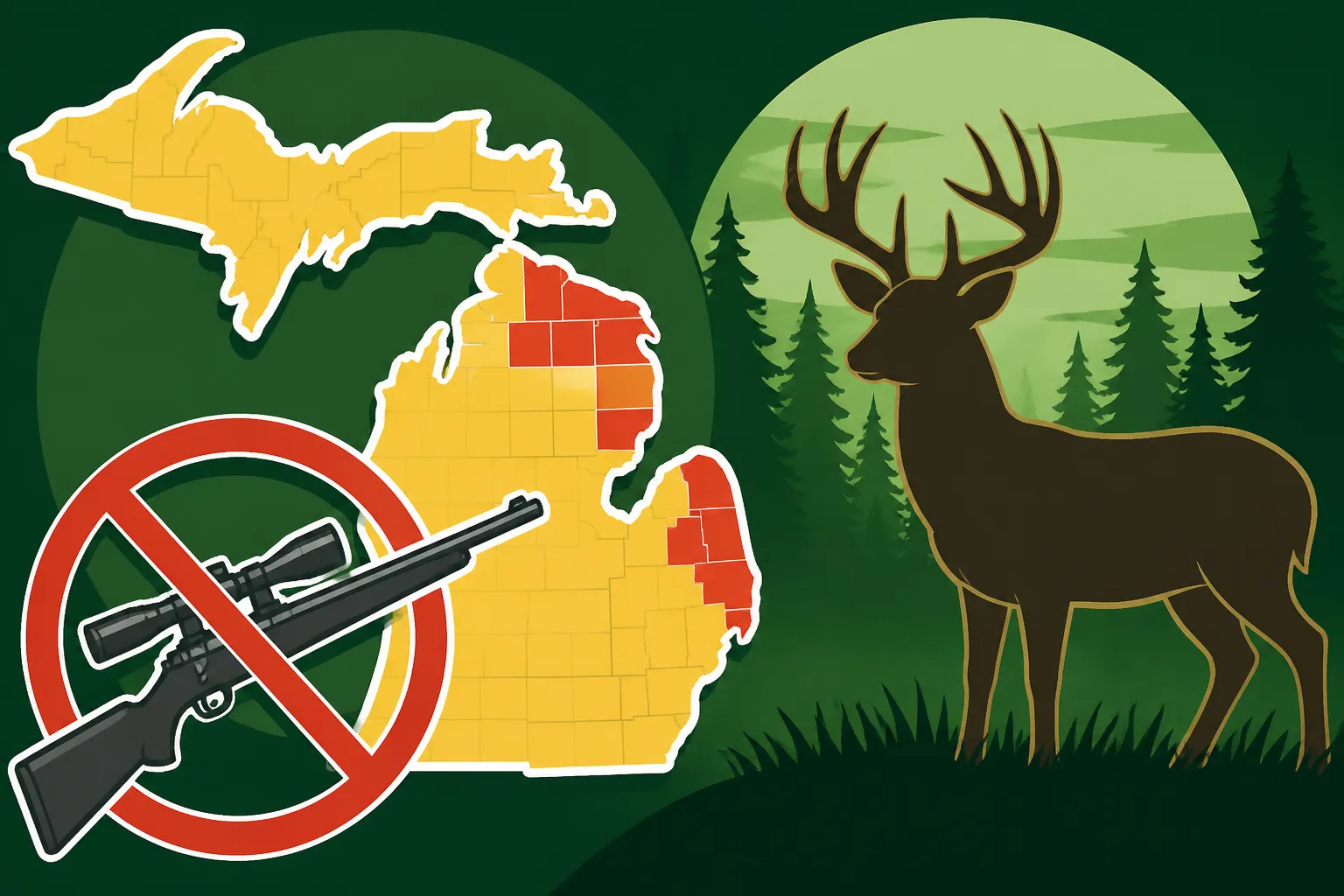
Michigan's deer hunting landscape is unique, particularly when it comes to the types of firearms allowed in different regions. The state is essentially divided into two primary zones for firearm deer hunting: the "Limited Firearm Deer Zone" (often still colloquially called the "Shotgun Zone") in the southern Lower Peninsula, and the unrestricted zone in the northern Lower Peninsula and the Upper Peninsula where traditional rifles are generally allowed. This division is a source of constant discussion and occasional confusion among hunters, both residents and those visiting our beautiful state.
What Defines the Limited Firearm Zone
The Limited Firearm Deer Zone encompasses the entire Lower Peninsula south of a specific line. This line typically runs across the state, generally from M-20 in Oceana County eastward to US-31, then south to M-82, east to M-66, north to M-20, east to US-127, north to M-46, then east to I-75, north to M-20, and finally east to Lake Huron. It's a bit of a winding path, but essentially, if you're hunting in the more densely populated, flatter, and agricultural southern half of the Lower Peninsula, you're likely in this restricted zone. The core reason behind this zone's existence, dating back decades, was public safety in areas with higher population density and less expansive wilderness compared to the northern reaches of the state. The idea was that projectiles from shotguns or straight-wall cartridges have a more limited range than typical rifle bullets, reducing the risk of stray rounds traveling significant distances into populated areas.
Historical Context and the "Shotgun Zone" Legacy
Before the advent of straight-wall rifle cartridges, this southern zone was strictly a "shotgun zone." Hunters relied on slug guns, often smoothbore shotguns, to harvest deer. These setups, while effective at closer ranges, typically offered less accuracy and range than a rifle. The frustration was real for many hunters who felt limited by the equipment. Over time, as ammunition technology advanced and discussions around hunter safety and opportunity evolved, the Michigan Department of Natural Resources (DNR) and the Natural Resources Commission (NRC) began to explore alternatives. This led to the expansion of legal firearms to include certain types of handguns and, significantly, straight-wall cartridges. This change aimed to provide hunters with more effective and accurate options while still adhering to the original safety intent of the zone. It was a huge relief for many, allowing for better accuracy and a more enjoyable hunting experience in an area historically known for its challenges.
Legal Firearms Beyond Traditional Rifles
So, if traditional bottlenecked rifle cartridges are out, what is allowed in the Limited Firearm Zone? The rules have evolved to include several categories of firearms, all designed to offer increased accuracy and power compared to traditional shotgun slugs, but with a similar safety profile regarding projectile range.
Here's a quick overview of what's legal for deer in the Limited Firearm Zone:
| Firearm Type | Cartridge/Gauge | Notes |
|---|---|---|
| Shotguns | 10-gauge to 28-gauge | Must be loaded with single projectile slugs. Buckshot is generally prohibited for deer. |
| Muzzleloading Rifles & Pistols | .44 caliber or larger | Must be loaded with a single projectile. |
| Handguns | .35 caliber or larger | Must use a straight-walled cartridge and be carried legally. |
| Rifles (Straight-Walled) | .35 caliber or larger | Must be loaded with a straight-walled cartridge, no bottlenecked rifle cartridges allowed in this zone. |
This table simplifies it, but each category has nuances. For example, when it comes to Muzzleloader Deer Hunting in Michigan, there are specific rules about loading and ignition types. It’s always best to consult the current Michigan Hunting and Trapping Digest to ensure full compliance, as rules can occasionally be updated.
Specific Restrictions and Acceptable Alternatives
The shift to allowing straight-wall cartridges in the Limited Firearm Zone was a game-changer. It acknowledged hunters' desires for more precise and powerful options while maintaining public safety. This category, along with modern slug guns and handguns, now forms the backbone of firearm deer hunting in the southern Lower Peninsula.
Straight-Wall Cartridges and Their Popularity
Straight-wall cartridges are exactly what they sound like: cartridges where the casing walls are straight from the base to the mouth, without the "neck" or bottleneck seen in traditional rifle cartridges like a .30-06 or .270. Their design means the bullet loses velocity more quickly than a bottlenecked cartridge, reducing the maximum range a projectile can travel and thus fitting the safety criteria for the Limited Firearm Zone.
The most popular straight-wall cartridge in Michigan is arguably the .450 Bushmaster, and it's truly become a star. It offers excellent ballistics for deer hunting, often rivaling traditional rifle calibers in terms of knock-down power within typical Michigan hunting distances. Many hunters have embraced it wholeheartedly, appreciating the significant upgrade in accuracy and terminal performance compared to older slug-gun setups. Other popular straight-wall options include the .350 Legend, .44 Magnum, .45 Colt, and even larger calibers like the .45-70 Government. The Straight-Wall Cartridges Legal in Michigan article goes into even greater detail on this topic, offering a deeper dive for those considering a new firearm.
The rise of these cartridges has led to a booming market for firearms chambered in them, from bolt-action rifles to lever-action models. This means hunters in the Limited Firearm Zone now have a wide array of reliable, accurate, and potent firearms at their disposal, making for a much more confident shot in the deer woods.
Handguns, Shotguns, and Muzzleloaders
While straight-wall rifles have gained immense popularity, the traditional options haven't disappeared. Handguns, provided they meet the .35 caliber or larger straight-walled cartridge requirement, remain a viable option for many. They offer a unique challenge and a very personal hunting experience, though their effective range is often more limited than a rifle. Many hunters who pursue deer with handguns find it an incredibly rewarding endeavor, testing their stalking and shooting skills to get close.
Shotguns loaded with slugs are still a perfectly legal and effective choice, particularly in dense cover where shots are almost always close-range. Modern slug guns, especially those with rifled barrels and paired with good optics, can be surprisingly accurate out to 100-150 yards, which is often more than enough for the thick woods and small parcels found in much of Southern Michigan Farm Country Deer Hunting. For more insights, check out Shotgun Slugs for Michigan Deer.
Muzzleloaders, too, hold a special place, especially during the dedicated late-season hunt. These firearms provide a unique historical connection to hunting and are incredibly effective. With modern inline muzzleloaders, hunters can achieve impressive accuracy and range, making them a formidable tool for deer across the state, including the Limited Firearm Zone. They require a bit more preparation and attention to detail, especially regarding powder and projectile choices, but the reward of harvesting a deer with a muzzleloader is truly unmatched.
Special Considerations for Archery and Crossbows
It’s important to remember that these firearm restrictions apply specifically to the firearm deer seasons. When it comes to archery, there are no restrictions on where you can hunt with a bow or crossbow in Michigan, beyond standard land access rules. The entire state is open to archers during the designated Michigan's Archery Split Works season, which is fantastic for hunters who prefer the silent pursuit of bowhunting. Whether you're in the deep woods of the Upper Peninsula or a small woodlot in southern Michigan, your bow or crossbow is good to go. This makes archery a consistently popular choice for many, especially those who hunt properties that might span the firearm zone boundary or prefer a single weapon system for all their deer hunting.
Navigating County Lines and Public vs. Private Land
Understanding where the Limited Firearm Zone begins and ends is crucial. Michigan's diverse landscape means you could literally cross a road and go from one zone to another, and this has significant implications for your hunt strategy.
Identifying the Boundary: North vs. South
The official boundary of the Limited Firearm Deer Zone is defined by specific roads and geographical features. For instance, counties like Mason, Lake, Osceola, Clare, Gladwin, Arenac, and Bay generally mark the transition from the unrestricted northern zone to the restricted southern zone. Some counties, like Muskegon or Newaygo, might be partially in both, adding another layer of complexity. This means if you're planning to hunt near these transitional areas, you must know exactly where you are on the map.
Imagine you're hunting in Newaygo County. Depending on which side of M-20 you're on, your legal firearm options could be completely different. Hunter education and vigilance are key here. This is not a situation where "close enough" is acceptable. Carrying an illegal firearm for the zone you're in, even by accident, can lead to serious consequences.
Using Mapping Tools to Confirm Your Location
Fortunately, modern technology has made identifying these boundaries much easier. Gone are the days of relying solely on paper maps and hoping you didn't misread a county line. Today, several excellent mapping apps and online resources can pinpoint your exact location and overlay the Michigan DNR's hunting zones.
One fantastic tool is the Michigan DNR's Mi-HUNT map, which provides detailed land ownership, habitat, and regulatory information. Another incredibly useful platform for hunters is GoHunt. With its detailed mapping layers, you can easily see parcel boundaries, public land access, and, most importantly for this discussion, the specific firearm zones. Many hunters swear by these digital tools because they offer real-time GPS tracking, allowing you to confirm your location with accuracy, even if you're deep in the woods or navigating unfamiliar territory. Before heading out, always take the time to mark your intended hunting area on one of these apps and double-check the firearm zone. This simple step can save you a lot of headache and keep you hunting legally and responsibly. Understanding Using the Michigan Mi-HUNT Map can dramatically improve your preparation.
Impact on Hunting Strategy and Gear Choices
The firearm restrictions fundamentally shape how you approach deer hunting in different parts of Michigan. In the Northern Lower Peninsula and the Upper Peninsula, where traditional rifles are permitted, hunters often think about longer shots, open timber, and vast wilderness. This influences caliber choice, optic selection, and even how far they might be willing to track a deer. The article Rifle Setups for Michigan Deer gives a great overview of popular choices.
Conversely, in the Limited Firearm Zone, the focus shifts. Shots are typically closer, often within 150 yards, and the terrain might involve more dense thickets, swamp edges, and smaller woodlots surrounded by agricultural fields. This environment makes the inherent trajectory and energy limitations of straight-wall cartridges less of a hindrance and more of a practical consideration. Hunters in this zone might prioritize quick-handling firearms, optics with a wider field of view for close-range target acquisition, and even the ability to make follow-up shots quickly in thick cover. Choosing the right gear for Michigan's November Firearm Deer Season can make all the difference, especially when balancing power and practicality within the zone's rules. This often means focusing on shot placement and understanding your firearm's effective range with your chosen ammunition.
The Future of Rifle Restrictions in Michigan
Michigan's hunting regulations are not static; they evolve based on conservation goals, scientific research, hunter feedback, and public safety considerations. The discussions around firearm restrictions are ongoing, reflecting a dynamic balance between tradition, safety, and hunter opportunity.
Ongoing Discussions and Potential Changes
There's a recurring debate among Michigan hunters and lawmakers about the future of the Limited Firearm Zone. Some hunters advocate for expanding the use of traditional bottlenecked rifles statewide, arguing that modern ammunition technology, improved hunter education, and responsible hunting practices make the distinction unnecessary. They point to other states with similar population densities that allow rifles across the board. Others maintain that the current restrictions are vital for public safety in densely populated areas and that straight-wall cartridges already offer a good balance.
These discussions are complex and involve numerous stakeholders, from the DNR to local communities and hunting organizations. It's not uncommon for legislation or proposals to emerge that seek to modify the current rules. For example, there have been recent efforts and discussions regarding the overall Michigan Baiting and Feeding Rules, which also highlight the constant reevaluation of regulations.
How Hunters Can Stay Informed
For Michigan hunters, staying informed about potential changes is crucial. The best resources for up-to-date information are the official Michigan DNR website and their annual Hunting and Trapping Digest. The DNR often holds public meetings or solicits feedback on proposed regulation changes, providing avenues for hunters to voice their opinions. Subscribing to DNR newsletters, following their social media channels, and participating in hunter-advocacy groups can also help keep you in the loop. Websites like GoHunt often compile regulatory updates and discussions, making it easier for hunters to access aggregated information. It's our responsibility as ethical hunters to know and follow the rules, and that includes keeping an eye on how those rules might change in the future.
Disclaimer
The information provided in this guide is for general informational purposes only and is not intended as legal advice. Hunting regulations can change, and interpretations may vary. Always consult the most current Michigan Hunting and Trapping Digest published by the Michigan Department of Natural Resources (DNR) or contact the DNR directly for the most accurate and up-to-date regulations before heading afield. Following all local, state, and federal laws is the responsibility of each individual hunter.