How Deer Starve in a Bad Michigan Winter
Anyone who's spent enough time in Michigan's woods knows that winter can be a brutal season, not just for us humans, but especially for our deer herd. There's a particular kind of heartbreak that comes from finding winter-killed deer, or seeing bucks in spring with antlers that just aren't what they should be. A bad Michigan winter can decimate local deer populations, and it often comes down to one tragic reality: starvation. This guide aims to shed light on how these harsh conditions lead to deer starvation, impacting both the animals and the hunting experience for years to come.
Deer's Natural Winter Survival Strategies
Michigan deer are incredible creatures, equipped with a suite of natural adaptations that allow them to endure the cold and scarcity that comes with our winters. Understanding these strategies helps us appreciate just how severe a "bad" winter has to be to truly push them past their limits. They're not just waiting for spring; they're actively fighting for survival.
Fat Reserves and Metabolism
As autumn progresses into late fall, Michigan whitetails are in a race against the clock. Their primary strategy for winter survival is to pack on as much fat as possible. This means constantly foraging, converting carbohydrates and proteins from acorns, corn, and browse into thick layers of subcutaneous and visceral fat. These fat reserves act as their personal energy battery, slowly draining throughout the lean months. A deer that goes into winter well-fed and healthy has a much better chance of making it through to spring. It’s like us stocking the pantry for a blizzard, but their pantry is literally under their skin.
Beyond simply storing fat, deer also have remarkable metabolic adaptations. Their metabolism slows down significantly during winter, requiring less energy to maintain body temperature and basic bodily functions. This is why you often see deer seemingly lethargic in deep winter; they're conserving every calorie. They also develop a thicker winter coat, growing longer, hollow guard hairs that trap air and provide incredible insulation, making them much more resistant to the biting cold than you might think.
Habitat and Winter Cover
The right habitat is absolutely crucial for deer trying to survive a Michigan winter. Just as important as food, if not more so, is thermal cover. Thick stands of conifers, especially cedar swamps, pine plantations, or dense hemlock groves, are invaluable. These areas act like giant natural blankets, blocking wind, holding snow off the forest floor, and radiating a bit of heat that keeps temperatures several degrees warmer than in open hardwoods. These sheltered spots, often referred to as deer yards, are where deer try to congregate. You can learn a lot about their winter behavior by looking into topics like Upper Peninsula Deer Yarding and Winter Movement.
Within these sheltered areas, deer will create intricate trail systems, compacting the snow and making it easier to move between browse sources without expending excessive energy. They'll also find micro-habitats, like the lee side of a ridge or a south-facing slope that catches more sunlight, to bed down and conserve warmth. A diverse landscape with plenty of mature conifer cover interspersed with younger browse areas provides the best chance for deer to weather the storm.
Behavioral Adaptations
Deer also exhibit significant behavioral changes to cope with winter. Their activity levels drop dramatically. They move less, browse less frequently, and spend more time bedded down. This reduced movement is a direct energy-saving tactic; every step in deep snow costs valuable calories. They also become much more gregarious, often forming larger herds in deer yards, which can offer some safety in numbers and communal trail-breaking.
Their diet shifts too. While acorns and agricultural crops are king in fall, winter forces them to rely on less nutritious but available woody browse. This includes twigs and buds from aspen, maple, dogwood, and cedar. It's not ideal, but it's calories. Hunters who spend time in the late season often focus on Late-Season Food Sources for Whitetails precisely because these become critical for deer survival. Understanding these behavioral shifts is key to understanding how deer attempt to outlast the cold.
Defining a "Bad" Michigan Winter for Deer
Not all Michigan winters are created equal. Some are mild, with sporadic snow and brief cold snaps, allowing deer to cruise through relatively easily. Others, however, are relentless, pushing deer to their absolute physiological limits. When we talk about a "bad" winter for deer, we're really talking about a perfect storm of environmental factors that conspire against their survival.
The Impact of Deep Snow Accumulation
Snow is arguably the biggest villain in a severe Michigan winter for deer. It's not just the amount of snow, but its depth and duration. When snow levels consistently exceed 18-24 inches, it becomes extremely difficult for deer to move, especially fawns, whose shorter legs sink deep into the powder. This drastically increases their energy expenditure just to get from point A to point B, burning through those precious fat reserves at an alarming rate. Imagine trying to run through waist-deep water all day long – that's what a deer faces in deep snow.
Deep snow also effectively "buries" vital food sources. Even if browse is present, if it's under two feet of snow, deer can't reach it. This cuts off access to crucial sustenance. Moreover, crusting snow, where a layer of ice forms on top of softer snow, can be even worse. A deer will break through the crust, cutting its legs and expending even more energy, sometimes leading to debilitating injuries or making them incredibly vulnerable to predators like coyotes. The legendary article about The 111 Days of Deep Snow in the U.P. perfectly illustrates this.
Persistent Extreme Cold
While deer are built for cold, persistent extreme temperatures still take a toll. When air temperatures consistently drop into the single digits or below zero, especially when combined with wind, their bodies have to work overtime to maintain core temperature. Even with their thick coats and reduced metabolism, there's a limit to how much heat their bodies can generate when the outside world is trying to freeze them solid. This forces them to burn fat reserves even faster.
The combination of deep snow and extreme cold is particularly deadly. They can't move to find food, and the cold is relentlessly draining their energy. This leads to a vicious cycle where a deer becomes weaker, making it less able to move and find food, further accelerating its decline. It's a cruel feedback loop that many simply cannot escape.
Duration of Harsh Conditions
Perhaps the most critical factor in a "bad" winter is its duration. A week or two of deep snow and extreme cold is tough, but deer can often bounce back. When those conditions stretch for weeks, or even months, that's when starvation really sets in. Biologists often track something called the Winter Severity Index and What It Means, which combines snow depth and temperatures over time to gauge the impact on deer. A prolonged period of severe conditions means deer are burning more calories than they can possibly take in for an extended period.
A long winter also means a delayed spring green-up, further extending the period of food scarcity. Just when deer are at their weakest, expecting new growth, a late thaw can push them to the brink. This extended period of negative energy balance is what truly defines a "bad" winter and explains How Many Deer the Upper Peninsula Lost in historically severe years. Hunters often use tools like GoHunt to understand historical weather patterns and forecast how different areas might be impacted by winter, which can inform their expectations for the following season.
The Process of Starvation: When Strategies Fail
When Michigan's winter conditions become too severe, even the best natural adaptations and survival strategies eventually falter. The process of starvation in deer is a grim, relentless march as their bodies exhaust every available resource.
Depletion of Energy Reserves
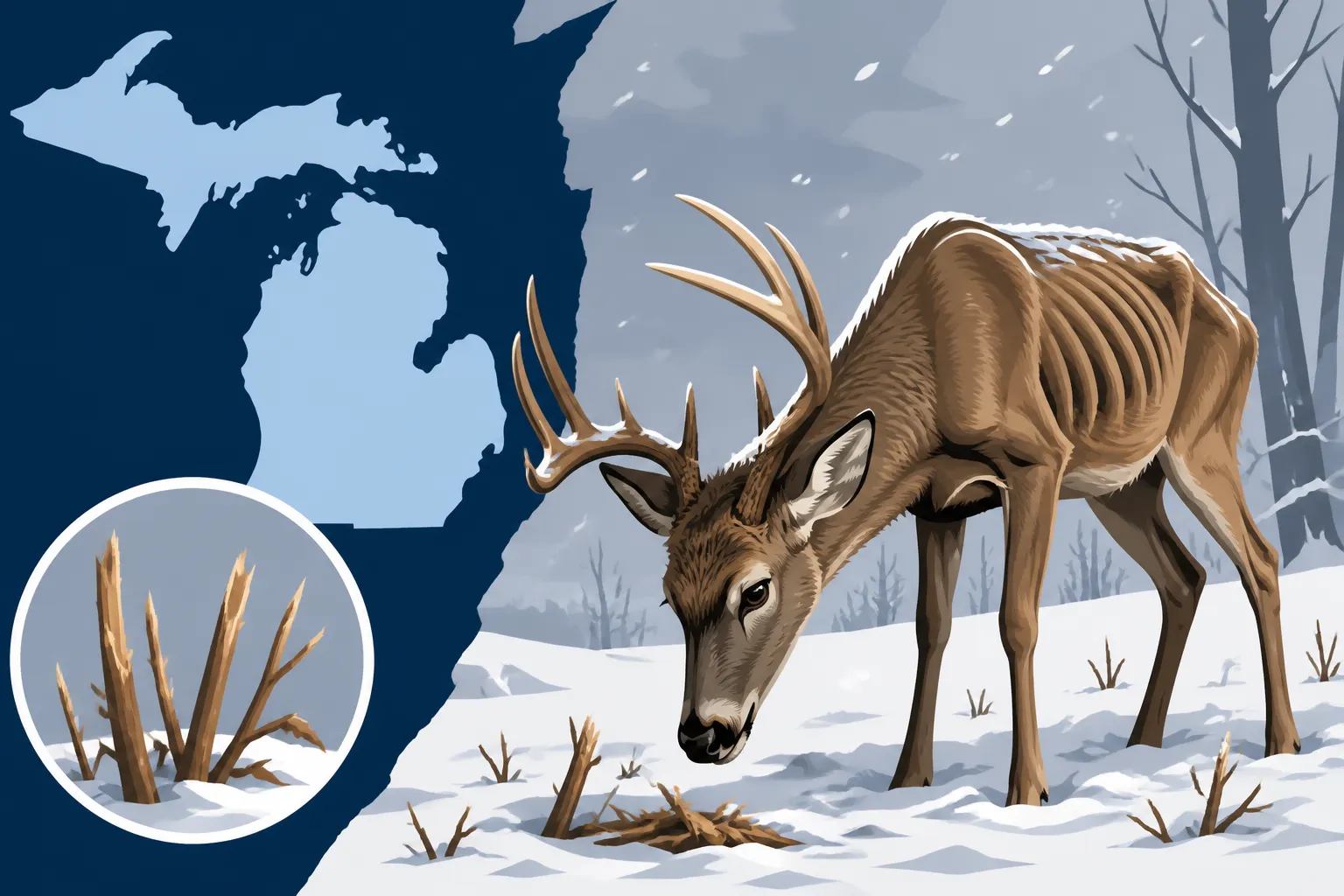
The first step in starvation is the complete depletion of those crucial fat reserves. A healthy deer might have a thick layer of fat around its internal organs and under its skin, especially near the tail base and brisket. As winter wears on, this fat is metabolized, shrinking away until the deer becomes gaunt. You can often tell a struggling deer by its sunken flanks and visible ribs, even under its thick winter coat.
Once the fat is gone, the deer's body turns to muscle tissue for energy. This is a critical point; muscle loss means a further reduction in strength and mobility, making it even harder to move through snow or evade predators. It also impacts vital organ function. This phase is typically irreversible, even if food suddenly becomes available, as the deer is too weak to properly digest and recover. It's a downhill slide from which few return.
Reduced Foraging Ability
As a deer weakens from lack of energy, its ability to forage effectively drops. Moving through snow, even in broken trails, becomes an immense effort. A deer that might normally browse for several hours a day may only be able to stand for short periods or access only the easiest-to-reach browse, which is often the least nutritious. This creates a feedback loop: less food leads to less energy, which leads to less foraging, and so on.
The quality of browse also plays a role. In a desperate attempt to get any calories, deer will eat less palatable and less digestible woody stems, sometimes stripping bark off trees. Their rumens, the first stomach compartment, are designed to efficiently process specific types of forage. A sudden shift to highly fibrous, low-nutrient food when already weakened can further compromise their digestive system, making it harder to extract what little energy is available.
Increased Vulnerability to Predators and Disease
A starving deer is a walking target. Its weakened state makes it slow, less alert, and utterly unable to escape predators like coyotes, wolves, or even domestic dogs. What might be a relatively easy meal for a healthy deer to escape becomes a death sentence for a deer in the throes of starvation. Predators actively seek out these vulnerable individuals, acting as a natural culling mechanism that targets the weakest animals.
Furthermore, starvation severely compromises a deer's immune system. Their body is so focused on survival that it diverts resources away from fighting off pathogens. This makes them highly susceptible to diseases that a healthy deer might easily shrug off. Parasitic loads, which are always present, can become overwhelming in a weakened animal. It's a tragic irony that the very act of trying to survive winter often leaves them susceptible to other forms of mortality.
Long-Term Effects on Michigan's Deer Herd
A single bad winter doesn't just impact the deer that die during that season; it sends ripples through the herd that can be felt for years, affecting everything from population numbers to antler quality. This is why Michigan's DNR closely monitors the health of the herd and environmental factors.
Impact on Fawn Survival and Recruitment
The most immediate and significant long-term impact of a severe winter is on fawn survival and recruitment. Does that barely survive a harsh winter often emerge in poor physical condition. This directly impacts their ability to successfully carry fawns to term, or to nurse them adequately after birth. Weakened does may abort fawns, give birth to smaller, weaker fawns, or produce less milk, leading to higher fawn mortality rates.
Even fawns born to healthy does in a post-severe winter year can struggle. If the spring green-up is delayed or habitat has been stressed, there might be less high-quality forage available for rapid growth. This means fewer fawns survive to adulthood, drastically reducing the number of young deer entering the population. Hunters looking at Michigan Deer Harvest Trends years after a brutal winter will often see a noticeable dip directly attributable to these lost fawn crops. It takes years for a deer herd to recover from such a setback, which is why topics like How Long a Deer Herd Takes to Recover are so important for management.
Antler Development and Overall Health
Another noticeable long-term effect, especially for hunters, is on antler development. Antler growth is directly tied to a buck's overall health and nutritional status. A buck that expends most of its energy simply surviving winter will have very little left to allocate to growing impressive antlers in the spring. You'll often see smaller racks, or even spikes on older bucks, in the years following a severe winter. Their bodies simply prioritize survival over bone growth.
This also impacts the overall health and age structure of the herd. Older, less robust deer are often the first to succumb to starvation, which can temporarily reduce the number of mature animals. The remaining deer, even if they survived, may have lingering health issues that affect their reproductive success and longevity. For a hunter using tools like GoHunt to analyze herd health, understanding past winter severity is a crucial piece of the puzzle.
Recovery of the Herd Post-Winter
The recovery of Michigan's deer herd after a bad winter is a slow process, contingent on several factors. Favorable, mild winters and abundant food sources in subsequent years are essential for the herd to rebuild its numbers and regain its health. Good habitat management, including proper timber harvests to create young browse, can also accelerate this process.
However, even with ideal conditions, it typically takes several years for a population to fully rebound. The loss of fawns means a gap in the age structure of the herd, which won't be filled for a few seasons. Hunters may notice fewer deer overall and a decline in antler quality for a while. While heartbreaking, it’s a natural, albeit brutal, part of the cycle of life in Michigan's wild lands. Understanding this helps us appreciate the resilience of these animals and the complex factors that influence our hunting opportunities.
| Winter Severity Level | Snow Depth Impact | Cold Impact | Deer Condition | Recovery Time |
|---|---|---|---|---|
| Mild | Minimal | Brief/Moderate | Good | Immediate |
| Moderate | Consistent <18" | Occasional Extreme | Fair to Good | 1-2 Years |
| Severe | Consistent >18" | Persistent Extreme | Poor, Starvation | 3-5+ Years |
| Exceptional | >24" for Extended Periods | Relentless Extreme | Very Poor, Mass Starvation | 5+ Years |
Disclaimer
This article is for general informational purposes only and does not constitute professional advice. Laws, prices and regulations vary by location and change over time. Consult a qualified professional for guidance on your specific situation.