Still-Hunting Michigan Cedar Swamps
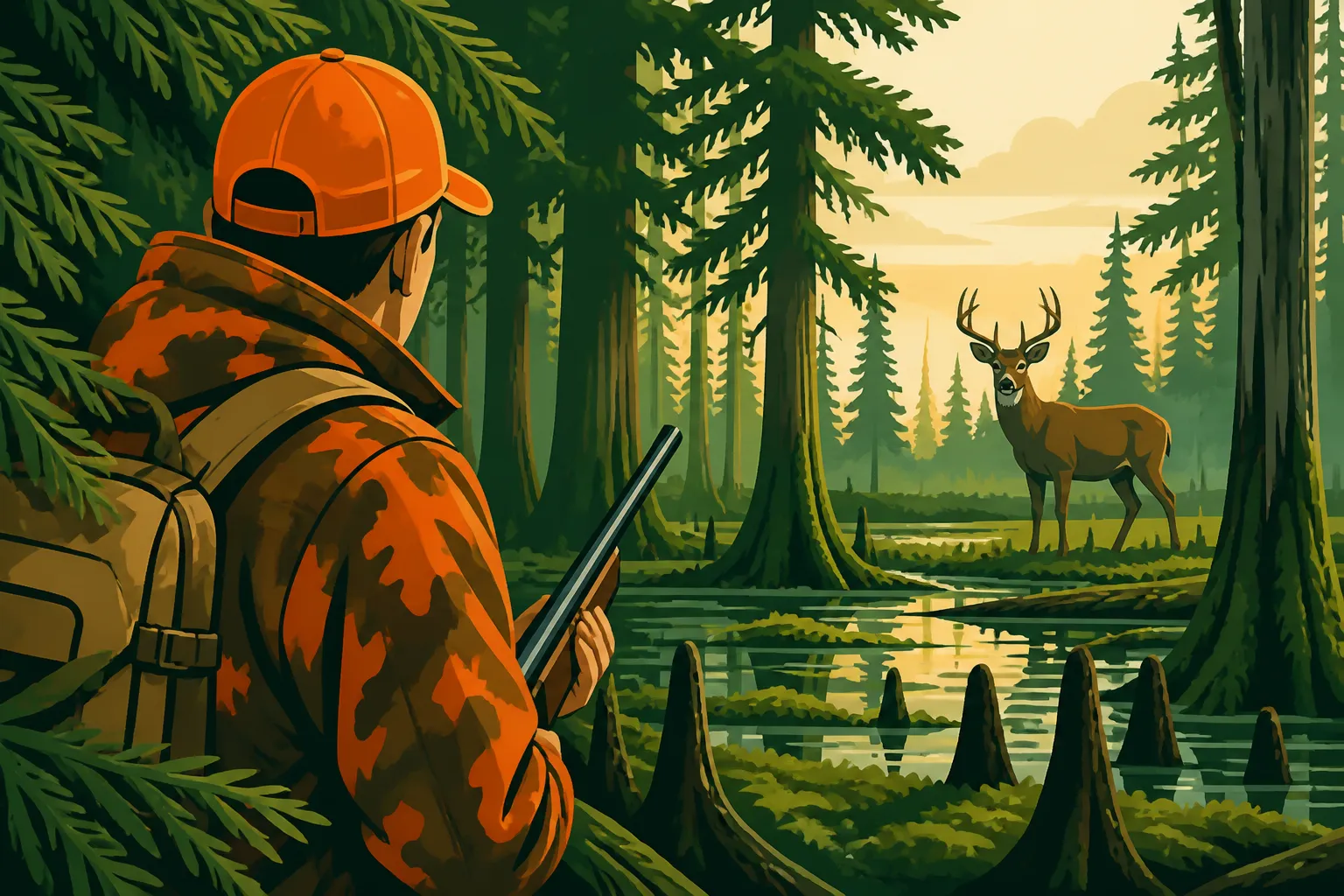
For many Michigan deer hunters, the dense, almost impenetrable cedar swamps can feel like a forbidden zone, a place where big bucks vanish and hunters get hopelessly turned around. It's frustrating to know those mature whitetails are using these sanctuaries, but feel ill-equipped to pursue them effectively. This comprehensive guide will equip you with the knowledge and tactics to confidently still-hunt Michigan's challenging cedar swamps, transforming them from impenetrable fortresses into prime hunting grounds.
Understanding Michigan's Cedar Swamps
Michigan's cedar swamps are unique ecosystems, distinct from the sprawling hardwoods or pine plantations. To successfully hunt them, you first need to understand why deer choose these places and how to decipher their intricate terrain.
Why Deer Love Cedar Swamps
Imagine a cold, blustery November day with biting winds and a dusting of snow. Where would you go if you were a deer? Not the open hardwoods! Cedar swamps offer an unparalleled combination of thermal cover, dense bedding, and a surprising array of food sources that make them whitetail magnets, especially when the weather turns nasty. The thick, interlocking branches of cedar trees create a canopy that traps heat, making the interior of a swamp noticeably warmer than the surrounding areas. This insulating quality provides crucial protection from harsh winter winds and heavy snow, allowing deer to conserve energy.
Beyond just thermal cover, cedar swamps also provide exceptional security. The dense undergrowth and low visibility within these areas make it incredibly difficult for predators, including human hunters, to move silently or see far. This provides a sense of safety for deer, especially mature bucks who are constantly seeking refuge from pressure. Within the swamp, deer find various browse options, from cedar tips (though less palatable, they are eaten when other food sources are scarce) to dogwood, wintergreen, and various aquatic plants that might grow in drier pockets or along edges. These areas are truly the deer's bedroom and fortress, especially after the leaves drop and other cover diminishes.
Reading the Terrain and Cover
Before you even step foot into a cedar swamp, you need to develop an eye for reading its nuances. This isn't like walking an oak ridge; the subtle changes in elevation, water flow, and tree species can tell a whole story about deer movement. Start by studying aerial maps – tools like the Michigan DNR’s Mi-HUNT map or GoHunt can be invaluable here, offering detailed satellite imagery and topographical overlays. Look for slight changes in color that might indicate drier ground, or subtle rises that could be "islands" within the swamp. These elevated pockets, even if only a few feet higher than the surrounding muck, are often prime bedding areas where deer can stay dry and have a vantage point.
Pay close attention to how water flows through the swamp. Deer will almost always follow the path of least resistance, which often means sticking to the driest ground or navigating along the edges of small streams or drainages. Look for natural funnels where two drier sections narrow, or where a band of cedars meets a different timber type. These transition zones are high-traffic areas. Remember to consult our detailed guide on Reading a Michigan Cedar Swamp for Deer to fine-tune your mapping skills and learn what specific features to look for on the ground. Understanding these subtle shifts is key to predicting where deer will move and bed within what appears to be a uniform sea of green.
Essential Gear and Preparation for Still-Hunting
Still-hunting a Michigan cedar swamp isn't a casual stroll. It demands meticulous preparation and specialized gear to ensure you stay comfortable, safe, and effective in what can be a truly unforgiving environment.
Clothing and Footwear for Wet, Cold Environments
Staying warm and dry is paramount when you're moving slowly through a cold, wet cedar swamp. Cotton is your enemy; once it's wet, it loses all insulating properties and will quickly make you miserable and susceptible to hypothermia. Instead, focus on a layering system using synthetic materials or, ideally, wool. A good base layer wicks moisture away from your skin, while a mid-layer provides insulation. Your outer layer needs to be completely waterproof and, crucially, quiet. The dense branches of cedar and thick underbrush will snag and rustle against noisy fabrics, alerting deer long before you see them. Brands like Sitka or First Lite offer excellent waterproof yet quiet options, often using GORE-TEX or similar high-performance membranes.
Footwear is arguably the most critical component. You will encounter water, mud, and possibly even thin ice. High-quality, insulated rubber boots are a non-negotiable item. Look for boots with aggressive tread for traction on slippery logs and muddy bottoms, and enough shaft height to keep water out when you step into an unexpected bog. Muck Boot Company or LaCrosse Alpha series are popular choices for their durability and warmth. Investing in a good pair of boots designed for these conditions, as discussed in Boots for Michigan Swamps and Snow, will make or break your hunt, allowing you to focus on the deer instead of your freezing, wet feet. Don't forget wool socks – bring an extra pair in your pack.
Optics and Navigation Tools
In the low-light conditions of a cedar swamp, good optics can be a game-changer. The dense canopy often creates perpetual twilight, making it hard to pick out deer movement or subtle features. A compact, high-quality pair of binoculars, perhaps 8×42 or 10×42, will gather enough light to help you discern deer in the shadows. You're not glassing vast distances, so clarity and low-light performance are more important than high magnification. Use them frequently, especially when you stop, to scan ahead and dissect potential cover.
Navigation in a swamp is notoriously tricky. The dense, uniform nature of the trees can quickly disorient you, and a compass alone might not be enough. A reliable GPS unit or a smartphone with a robust hunting app like GoHunt is essential. Download offline maps of your hunting area before you go, as cell service will likely be non-existent deep in the swamp. Use the app to track your path, mark waypoints, and confirm your location constantly. GoHunt offers excellent satellite imagery and topo maps that can reveal subtle features you might miss on the ground. Before you head out, read up on Using Mi-HUNT on a Phone and consider the pros and cons of dedicated GPS Units Versus Phone Apps for your primary navigation. Always carry a physical compass and a printed map as a backup, just in case technology fails.
Mastering the Art of Still-Hunting in Cedar
Still-hunting is less about charging through the woods and more about becoming part of the landscape, moving with the stealth and patience of a predator. In a cedar swamp, where visibility is limited and sounds carry differently, this art becomes even more critical.
The Slow Pace and Observational Skills
The most crucial rule of still-hunting, especially in thick cover like a cedar swamp, is to slow down. Way down. Think "10 steps and stop." Even that might be too fast. You should spend far more time observing than moving. Every few steps, pause completely. Scan every cedar trunk, every clump of brush, every shadow. Look for the horizontal line of a deer's back or belly amidst the vertical lines of the trees. Look for an ear twitch, a flick of a tail, or the dark patch of an eye. Our brains are wired to identify patterns, and deer know how to break that pattern by remaining motionless. By stopping frequently, you give your eyes time to process, and you give any deer in the vicinity time to relax if they've caught a glimpse of movement.
Engage all your senses. Listen intently for the rustle of leaves that isn't wind, the snap of a twig, or the subtle sound of hooves displacing mud. The acoustics in a dense swamp can be tricky; sounds may be muffled or distorted, so learn to interpret them. Pay attention to the air – a sudden waft of musky deer scent can tell you you're close, even if you can't see them. This isn't a race; it's a patient, deliberate chess match where observation is your greatest weapon. Practice this deliberate pace even when scouting off-season; the more you train your eyes and ears, the more successful you'll be when a tag is on the line.
Wind, Thermals, and Scent Control
Understanding and playing the wind is always important in deer hunting, but it takes on a particularly complex dimension in the dense, often humid environment of a cedar swamp. While thermals generally dictate air movement in hilly terrain, as covered in Wind and Thermals on Michigan Ridges, a swamp's flat topography and dense canopy can create swirling, unpredictable currents. Always favor an approach that keeps the wind in your face or quartering to you, but be prepared for it to shift unexpectedly due to localized air currents or topographical depressions. A small bottle of milkweed seeds or a powder puffer is invaluable for constantly checking the wind direction, even in seemingly still air.
Scent control becomes even more critical in such close quarters. Deer in a swamp are often bedded tight, with very limited escape routes, meaning they rely heavily on their nose to detect intruders. Shower with scent-eliminating soap, wear clean hunting clothes, and use scent-eliminating sprays. Store your hunting clothes in airtight containers or bags to prevent them from picking up household odors. While total scent elimination is impossible, minimizing your scent footprint drastically increases your chances of getting close to a deer before it detects you. Combine meticulous scent control with a slow, careful approach, and you'll significantly increase your odds.
Interpreting Deer Sign and Movement Patterns
Cedar swamps are often riddled with deer sign, but knowing what's fresh, what's historical, and what truly indicates a deer's current presence is key. Look for fresh tracks in soft mud or snow – the sharper the edges, the more recent the travel. Pay attention to the direction of travel and if multiple tracks indicate a well-used trail. In cedar swamps, deer often use well-worn trails that weave through the densest cover, following the driest ground. These trails are like highways for deer.
Rubs and scrapes can also be found, though perhaps not as conspicuously as in open hardwoods. Look for small, fresh rubs on cedar saplings or dogwood stems, indicating a buck has been moving through. Scrapes might be smaller and less numerous, often found on slightly drier edges or small islands. Most importantly, look for browse lines – where deer have consistently nipped off vegetation at a certain height. This indicates a consistent food source and heavy deer use. During winter, look for bark peeled from cedars, a sign of severe winter conditions or heavy deer populations relying on the less palatable cedar as a food source. Our guide on Still-Hunting After a Michigan Snow can provide excellent tips on how to interpret fresh tracks and trails when the snow helps reveal deer movement patterns. Focus on the freshest sign to confirm recent activity and increase your chances of an encounter.
Tactical Approaches to Still-Hunting Swamps
Still-hunting a cedar swamp requires a flexible and adaptable approach. You might start on an edge, venture deep into the heart of it, and always be prepared for the unexpected shot opportunity that demands quick thinking.
Hunting Edges and Transition Zones
The edges of cedar swamps are often the most productive places to start your still-hunt. These are the transition zones where the dense, dark cedars meet hardwoods, pine stands, old clearcuts, or even agricultural fields. Deer frequently stage in the security of the swamp before moving out into more open areas to feed, and they return to the swamp for bedding after a night of grazing. These edges offer a fascinating mix of cover and food, making them high-traffic corridors. Look for signs of heavy use, such as worn trails, abundant tracks, and fresh rubs and scrapes where bucks are marking their territory as they move between cover and food.
Focus your attention on subtle points or fingers of timber that extend out from the main swamp body, or small drainages that connect two larger blocks of cover. These natural funnels concentrate deer movement and provide excellent ambush points. While still-hunting along these edges, use the denser swamp cover as your concealment, moving slowly along the tree line while keeping an eye on the more open areas. Our guide on Hunting Michigan Swamp Edges for Deer provides further in-depth strategies for these high-value areas, and if you prefer a more static approach, knowing how to master Hanging a Stand on a Swamp Edge can complement your still-hunting efforts.
Penetrating the Heart of the Swamp
While edges are productive, some of the biggest, most reclusive bucks rarely leave the deepest, thickest parts of the swamp. Penetrating the heart of the cedar swamp is a high-risk, high-reward strategy that demands extreme patience and stealth. You'll need to move even slower than on the edges, often taking just a step or two before pausing for several minutes to scan. Look for "islands" of slightly higher, drier ground within the swamp – these are prime bedding areas. A mature buck will often bed with his back to the densest cover, facing out into a slightly more open area, allowing him to see danger approaching.
When you're deep in the swamp, every noise you make is amplified. Avoid breaking twigs underfoot by carefully picking up your feet and placing them down, testing the ground for stability before committing your weight. Use the dense cedar branches to break up your silhouette as you move. Don't be afraid to crawl or crouch to get a better view or to move through particularly dense spots. The goal isn't to cover ground, but to meticulously dissect the cover, inch by painstaking inch, until you spot a deer before it spots you. This is where your GoHunt map will be invaluable, helping you navigate the labyrinthine interior without getting lost.
Post-Shot Strategy and Recovery
Shooting a deer in a cedar swamp presents its own unique set of challenges, and recovery can be exceptionally difficult if not approached correctly. After the shot, mark the exact spot where the deer was standing, and where it was last seen. Use flagging tape, a prominent tree, or your GPS to waypoint both locations. This is crucial because visibility is so poor; without a reference, you can easily lose your bearings. Give the deer plenty of time – at least an hour for a well-hit deer, and much longer (4-6 hours, or even overnight) if you have any doubt about the shot placement.
Once you begin tracking, move slowly and deliberately. Look for blood on cedars, low branches, or disturbed ground. If the blood trail peters out, expand your search in ever-widening circles from the last confirmed blood. Remember that deer often seek the densest cover when wounded, and a cedar swamp offers plenty of that. Recovering a deer from these areas can be back-breaking work. Be prepared to bring a deer sled, rope, and perhaps a partner or two, especially for larger bucks. Check out our guides on Recovering a Deer From a Swamp and Getting a Deer Out of a Michigan Cedar Swamp for detailed strategies on navigating this arduous but essential part of the hunt.
Common Challenges and Solutions
Cedar swamps test a hunter's resolve, but with foresight and the right strategies, you can overcome their inherent difficulties.
Dealing with Thick Cover and Limited Visibility
The sheer density of Michigan's cedar swamps means your effective visibility range is drastically reduced, often to just a few yards. This can be incredibly frustrating, making you feel like you're constantly walking blind. The solution, however, isn't to try and force visibility; it's to adapt to the limitations. Slow down even further. Focus on detecting parts of a deer – an ear, a patch of hide, a flicker of movement – rather than expecting to see an entire animal. Your eyes should be constantly scanning, not just ahead, but to the sides, behind, and even slightly above where a deer might be bedded on a slightly elevated hummock.
Utilize natural openings, however small, to your advantage. A narrow game trail, a downed log, or a patch of thinner growth can provide momentary windows. When you pause, which should be often, spend those moments methodically glassing these small corridors. Listen intently; in thick cover, you'll often hear a deer before you see it. The snap of a twig, the rustle of leaves, or the soft blowing of a deer can be your first clue. Rather than fighting the cover, use it. Blend into the dense background, break up your silhouette, and move with such deliberate stealth that you might appear to be just another part of the swamp until you're ready to make your move.
Battling Michigan's Weather Elements
Michigan weather, particularly during the late archery and firearm seasons, can be brutal, and a cedar swamp only amplifies the challenge. Cold, wet conditions are the norm, and sitting still for extended periods, even when still-hunting, can lead to dangerous drops in body temperature if you're not prepared. Layering is your best friend here, as discussed earlier. Start with a moisture-wicking base layer, add insulating layers like fleece or wool, and top it off with waterproof, windproof outer shells. Pay special attention to extremities: high-quality insulated gloves or mittens, a warm hat, and the best rubber boots you can afford are crucial for keeping your core temperature up.
Be prepared for rain, freezing rain, and snow. A light, packable rain suit (again, silent fabric is key) can be slipped over your outer layers in a downpour. If snow starts falling, it can actually be a huge benefit for still-hunting, muffling your footsteps and making deer more visible against the white backdrop. However, also be aware of how falling snow can reduce visibility and make navigation even harder. Always carry a small pack with emergency supplies: extra dry socks, a lighter or waterproof matches, a small first-aid kit, and high-energy snacks. Staying physically comfortable allows you to stay mentally focused on the hunt.
Navigating and Avoiding Getting Lost
Getting turned around in a dense Michigan cedar swamp is not just a fear; it's a very real possibility, even for experienced woodsmen. The uniformity of the trees, the lack of prominent landmarks, and the often overcast skies can quickly disorient you. Your primary tool for avoiding this nightmare is your GPS device or hunting app. Whether it's a dedicated unit or an app like GoHunt on your phone, ensure it's fully charged, has offline maps downloaded, and you know how to use it proficiently before you enter the swamp.
Don't just rely on technology, though. Practice "breadcrumb" navigation by making mental or physical notes of your path. Look for unique trees, rock formations, or even downed logs that can serve as temporary landmarks. Every time you stop, take a moment to look back the way you came; this helps you recognize the return path later. Using a compass regularly to confirm your general direction of travel is also a smart habit. If you do start to feel disoriented, stop immediately. Don't panic. Consult your map and GPS, and if necessary, sit down, have a snack, and reorient yourself. It's always better to take a few extra minutes to confirm your location than to wander deeper into trouble.
| Still-Hunting Element | Hardwood/Open Woods | Cedar Swamp |
|---|---|---|
| Pace | Slow, deliberate | Extremely slow, stop often |
| Visibility | Moderate to good | Very limited, only short range |
| Footwear | Insulated hiking boots | High-top, insulated rubber boots (essential) |
| Navigation | Map/GPS, identifiable landmarks | GPS/GoHunt (critical), compass, breadcrumbing |
| Wind & Scent | Consistent wind patterns, scent control | Swirling, unpredictable thermals, extreme scent control |
| Key Sign | Rubs, scrapes, widespread tracks | Tracks on trails, browse lines, dense bedding pockets |
| Cover Use | Blend with trees/brush, use terrain | Blend with extreme density, use micro-openings |
| Recovery | Often straightforward, good blood trail | Extremely difficult, requires patience & gear |
Disclaimer
Please remember that hunting regulations, seasons, and licensing requirements can change. Always consult the latest Michigan Department of Natural Resources (DNR) regulations and local ordinances before heading out on your hunt. This guide is for informational purposes only and should not replace official safety courses or legal consultation.