Wind and Thermals on Michigan Ridges
Hunting Michigan's diverse terrain often means navigating subtle, invisible forces that can make or break a hunt. One of the biggest frustrations hunters face, especially when trying to pinpoint whitetails on a ridge, is the unpredictable nature of wind and thermals. You might think you have the wind in your favor, only for a sudden shift or thermal current to betray your presence to a wary buck. This guide is dedicated to demystifying wind and thermals on Michigan ridges, helping you understand these critical air movements so you can use them to your advantage, not against you.
Understanding the Invisible Dance of Air Currents
It's easy to dismiss wind as just "wind," but on Michigan's rolling ridge country, especially in the northern Lower Peninsula or parts of the Upper Peninsula, air movement is a complex interaction of large-scale weather patterns and localized environmental factors. A seasoned hunter knows that understanding this invisible dance is paramount to consistent success.
Differentiating Prevailing Wind and Thermals
First off, let's clear up the main distinction: prevailing wind versus thermals. The prevailing wind is what you see on the weather app on your phone. It's the broad, large-scale air movement driven by pressure systems. This is the wind that's generally consistent over a wider area, influencing everything from bird migrations to how quickly your scent travels down a deer trail. You might have a west wind blowing at 10 mph, and that's the general direction of the air mass.
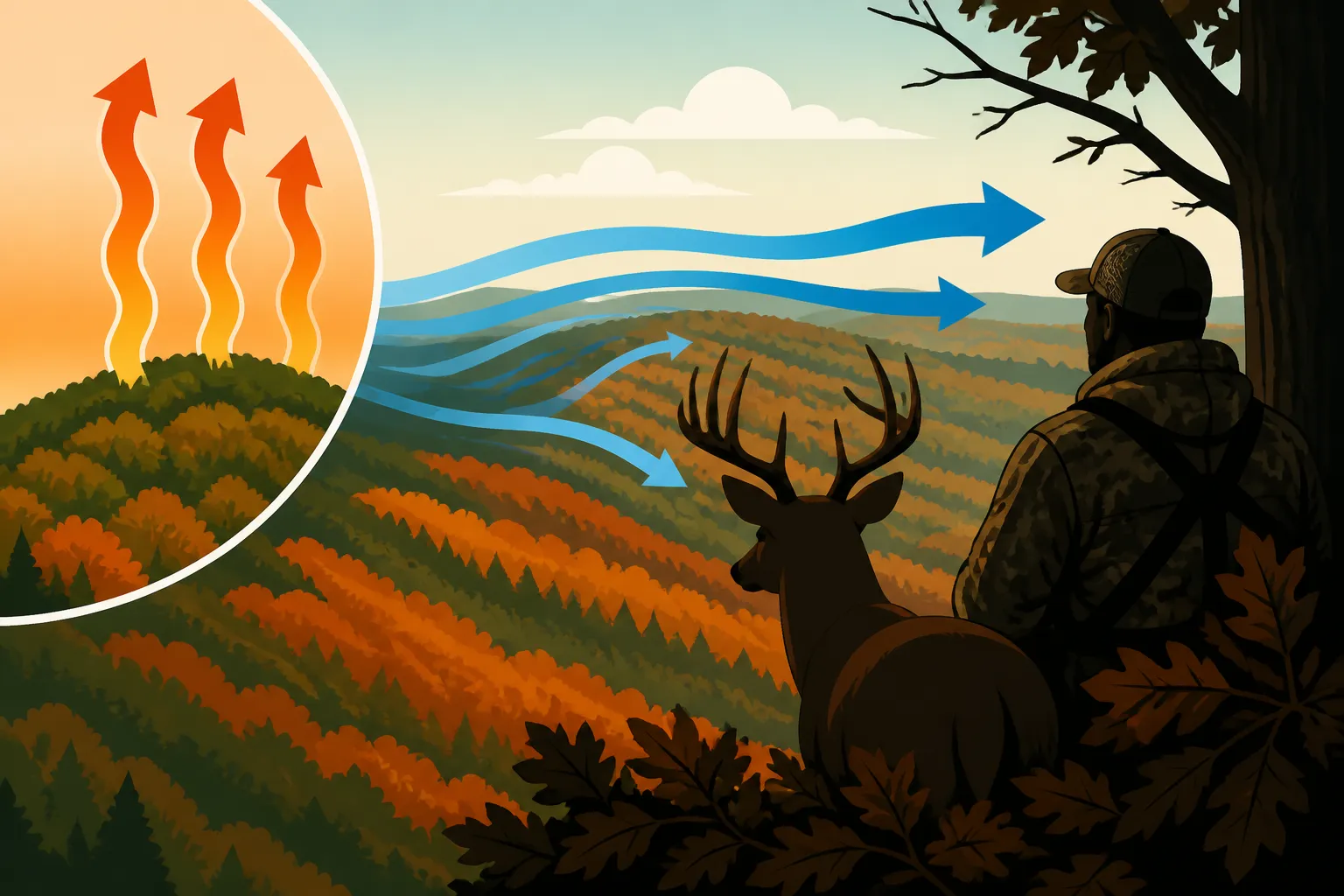
However, once you step into the woods, especially on broken terrain like ridges, you encounter thermals. Thermals are localized air currents created by temperature differences. Think of them as the microclimates within the larger weather system. They're driven by the sun warming up different slopes, shaded areas staying cool, or the ground radiating heat. While the prevailing wind might be from the west, a thermal could be pulling your scent straight up a steep ridge face in the morning, or dumping it down into a valley in the evening. Ignoring these localized thermals is like trying to navigate a swift river by only looking at the clouds – you'll quickly be off course. They're particularly potent in areas with significant elevation changes, even modest ones like the glacial moraines found in many parts of Michigan.
The Science Behind Thermal Movement
The basic principle behind thermals is simple: warm air rises, and cool air sinks. How this plays out on a ridge is fascinating and vital for hunters. In the morning, as the sun begins to hit the eastern slopes of a ridge, the ground warms up. This warm ground heats the air directly above it, causing that air to become lighter and rise. This rising air creates an updraft, a thermal current that flows up the slope. So, if you're set up on the eastern face, any scent you emit will be carried upwards, potentially alerting deer above you on the ridge crest or the opposite slope. The opposite happens in the evening. As the sun dips below the western horizon, the western slopes rapidly begin to cool. The air over these cooling slopes becomes denser and heavier, causing it to sink. This creates a downdraft, a thermal current that flows down the slope into the low-lying areas. Knowing this, you wouldn't want to approach a bedding area from below on a western slope as the sun sets, as your scent would be carried directly to any deer bedded there.
These thermal movements are also influenced by factors like cloud cover. On a heavily overcast day, the sun's heating and cooling effects are minimized, making thermals less pronounced, and the prevailing wind tends to dominate more. But on a clear, crisp Michigan day, especially during the deer seasons, thermals are incredibly strong and predictable. Draws, ravines, and hollows often act as funnels, intensifying these thermal currents as air is channeled through them. It's a constant, subtle ballet of air that's always in motion, demanding your attention.
Reading Michigan's Ridge Topography for Advantage
Michigan might not have towering mountains, but its "big woods" regions in the northern Lower Peninsula and the Upper Peninsula feature significant rolling terrain and distinct ridges that greatly influence deer movement and, by extension, air currents. Learning to read these topographical nuances is a skill that separates successful hunters from those who consistently struggle with detection.
Identifying Key Features on a Ridge
When you look at a topo map or use a hunting app like GoHunt, you'll see a lot more than just contour lines. You'll notice spurs, which are smaller ridges branching off a main ridge; saddles, which are low points or depressions along a ridge line, often natural crossing points for deer; benches, which are flat or gently sloping areas on the side of a ridge; and draws or ravines, which are low areas or valleys cutting into a ridge. Each of these features interacts with wind and thermals in unique ways.
For instance, a saddle acts as a funnel not just for deer, but also for wind. A prevailing wind blowing across a ridge will often be compressed and intensified as it squeezes through a saddle, creating a stronger, more consistent air current. However, thermals can also be tricky in saddles; rising air from one side might meet sinking air from another, leading to swirling conditions. Benches are often prime spots for deer to feed or bed, especially if they offer good cover and a vantage point. The thermal effect on a bench can be more subtle than on a steep slope, but it's still present. Deer often use these benches as travel corridors, moving just off the ridge crest to avoid being silhouetted, making them excellent places to set up. A tool like GoHunt or even the Michigan Mi-HUNT Map can be invaluable for identifying these subtle features before you ever step foot in the woods, giving you a serious edge in planning your approach and stand locations.
Vegetation's Role in Air Movement
Beyond the raw topography, the type and density of vegetation on Michigan's ridges play a huge role in how air moves. Think about the dense conifer stands – whether it's a tight cedar swamp nestled in a draw or a thick pine plantation on a ridge face. These dense trees act like physical barriers, effectively breaking up the wind and creating pockets of calm air or, conversely, channeling air into narrow lanes. A thick stand of pines on a ridge can create a leeward side that offers protection from the prevailing wind, making it an attractive bedding area for deer. However, these same dense stands can also trap cool air, acting as thermal sinks that influence downdrafts.
In contrast, open hardwoods – common in much of Michigan's prime deer habitat – allow for more consistent airflow. Here, the prevailing wind has a more direct influence, and thermals tend to be broader, less funneled than in dense cover. The transition zones, or edge effects, where different cover types meet, are especially critical. Imagine a ridge where a dense cedar swamp gives way to an open oak-hickory forest. The wind and thermals will behave very differently at this interface. Deer frequently use these edges for travel and bedding, offering hunters opportunities to intercept them, but only if they understand how their scent will behave where these airflows collide. This knowledge of how both contour and cover influence air is a fundamental component of effective Scouting Michigan Public Land Before Season.
Practical Hunting Strategies for Ridge Lines
Knowing how wind and thermals work is one thing; applying that knowledge to your hunting strategy in Michigan's ridge country is where the rubber meets the road. It means being deliberate about every aspect of your hunt, from where you hang your stand to how you walk in and out.
Strategic Treestand and Ground Blind Placement
When it comes to placing a treestand or setting up a ground blind on a Michigan ridge, your primary goal is to ensure your scent plume is never drifting into known or suspected deer travel routes or bedding areas. This often means positioning yourself so your scent is carried away from these zones by the prevailing wind and the anticipated thermal shifts. For example, if you anticipate deer moving along a bench on the western side of a ridge in the evening, you'd want to be set up slightly below that bench, with a prevailing west wind, so your scent blows harmlessly down into the valley. However, as the evening progresses and thermals begin to drop, that low-to-high approach is critical.
Some hunters even try to find locations that offer favorable wind conditions for multiple prevailing directions, though this can be challenging on a ridge. A common strategy for ridge hunting is to try and get below the thermal line in the morning or early afternoon, meaning your scent rises above deer moving on the slopes below you. Conversely, in the evening, you might want to be higher up, allowing your scent to be carried down and away by the falling thermals. It's a delicate balance, and using quality apps like GoHunt that provide hourly wind forecasts can give you a significant advantage in planning your sit. For detailed guidance on general stand placement, you might want to review Treestand Setups in Michigan Hardwoods. Remember, even with the best plan, you might need to adjust on the fly.
Entry and Exit Routes with Air in Mind
One of the most common ways hunters blow a hunt before it even begins is by having a poorly planned entry or exit. When hunting ridges, this risk is magnified due to thermals. Your ideal approach should always be from a direction that keeps your scent out of the primary hunting area and potential bedding sites. This often means approaching from downwind and accounting for thermal rise or fall. In the morning, you might need to approach from a higher point on the ridge, letting your scent rise and dissipate over the valley, or stick to the very bottom of a draw until you are below your setup, allowing thermals to pull your scent up and away behind you.
As for exit, the rules often reverse. After an evening hunt, as thermals are falling, you want to ensure your path out doesn't carry your scent into freshly active feeding or bedding areas. This might mean sticking to parallel ridges or using draw bottoms to keep your scent contained. For example, if Where Big Woods Bucks Bed in Michigan is often along a specific ridge, you must ensure your entry and exit routes never cross these critical zones with an unfavorable wind. The principles of minimizing disturbance, much like those discussed in Entry Routes on Flat Michigan Ground, are even more crucial when elevation is a factor. Your goal is to be a ghost, and the wind and thermals are either your cloak or your betrayer.
Still-Hunting and Stalking with the Wind
Still-hunting on a Michigan ridge is an art form that absolutely demands you understand air currents. It's not just about moving slowly and quietly; it's about moving in a way that constantly keeps the wind and thermals in your favor. This means you should primarily be moving into the wind or crosswind, never directly downwind, especially if you're stalking.
When working a ridge, you can use the terrain to your advantage. For instance, if you're still-hunting up a slope in the morning, you'll benefit from the rising thermals carrying your scent upwards, allowing you to move through the lower parts of a potential bedding area more undetected. Conversely, still-hunting down a slope in the evening can be risky due to falling thermals. You'll want to adjust your line of travel to stay on the leeward side of the ridge, using benches and slight depressions to keep your scent out of the main deer travel corridors. Using calls like Grunt Calls in Mature Timber can be effective, but remember that wind also carries sound, so gauge your calling volume accordingly.
A very effective tactic when still-hunting is to make short movements, then stop and carefully observe, paying attention to any subtle changes in wind direction using a wind checker or even by tossing a bit of milkweed fluff. This meticulous approach is key to success, drawing parallels to careful tactics like Still-Hunting Michigan Cedar Swamps, where every breath of wind can make a difference. The GoHunt app can provide real-time wind and thermal forecasts, allowing you to constantly adjust your strategy, but always confirm with local indicators.
Adapting to Changing Conditions and Unpredictable Michigan Weather
One of the most challenging aspects of hunting in Michigan is its famously fickle weather. A clear, calm morning can quickly turn into a blustery, snowy afternoon. Being able to adapt your understanding of wind and thermals to these changes is what elevates a good hunter to a great one.
Morning vs. Evening Shifts
As we've discussed, the thermal dance is most pronounced during the transition periods of morning and evening. In the morning, as the sun rises, usually hitting the eastern slopes first, the air starts to warm and lift. This means thermals will typically be moving uphill. So, if you're trying to sneak into a stand on the backside (western side) of a ridge overlooking a feeding area, you'll want to be careful of your scent being pulled up and over the ridge where deer might be. The opposite happens in the evening. As the sun sets, typically leaving the western slopes in shadow first, the air cools and descends. Thermals will then be moving downhill. If you're hunting a food plot in a valley adjacent to a bedding ridge, you'll want to ensure your scent is being carried down and away from the ridge as deer move out.
It's a critical dance that dictates approach, stand placement, and even when you decide to pack up your Packs for a Day on State Land and call it a hunt. Always try to move when the thermal current is either taking your scent away from where you expect deer to be or when it's rising above them. Being prepared for these temperature drops, especially as fall transitions into winter, is also part of a solid Cold Weather Sitting Strategy. The following table offers a quick guide to thermal behavior on clear days:
| Condition | Time of Day | Thermal Movement | Ideal Stand/Approach Direction (relative to deer) | Notes |
|---|---|---|---|---|
| Clear Sky | Morning | Air rises up slopes | Approach from high to low, or below rising thermal | Sun warms eastern slopes first, scent goes up |
| Clear Sky | Evening | Air sinks down slopes | Approach from low to high, or above falling thermal | Western slopes cool fastest, air "falls" |
| Cloudy/Overcast | All Day | Less pronounced | Prevailing wind more dominant | Thermals still present but weaker |
| Steep Ridge | All Day | Stronger effect | More critical to play thermals | Exaggerated rise/fall of air |
| Gentle Ridge | All Day | Weaker effect | Prevailing wind has more sway | More subtle air currents |
Dealing with Fronts and Swirling Winds
Michigan's weather systems are often dynamic. Pre-frontal systems can bring stable, consistent winds, which are often excellent for hunting as deer tend to move more before a weather change. However, as a front passes, especially a cold front, post-frontal conditions often bring high pressure and highly unstable, swirling winds. These are the days that can drive hunters absolutely mad, where your wind checker is constantly spinning. On these days, it's often best to stick to low-lying areas, thick cover, or deep draws where the wind might be more buffered, or to hunt very small pockets of timber. You can also hunt tighter to bedding areas if you are extremely confident in your approach, but generally, swirling winds make it tough.
Rain and snow can also impact air movement. A steady rain or light snow can actually help stabilize thermals, as the temperature difference between slopes becomes less pronounced. It also dampens scent molecules, though it doesn't eliminate them. What it does do is quiet your approach, making it an excellent time for still-hunting. Just be mindful of how your Michigan State Forest Hunting Rules might be affected by specific weather, especially during winter. The peak of Hunting the Michigan Rut in November often coincides with some of the most unpredictable weather of the year, demanding an extra layer of vigilance and adaptability from hunters.
Using Technology and Constant Vigilance
In today's hunting world, we have incredible tools at our disposal. Apps like GoHunt provide incredibly detailed wind forecasts, often broken down by hour and elevation, which can be invaluable when planning a hunt on ridgeline terrain. However, technology is only a guide. Nothing replaces constant vigilance in the field. Carry a wind checker – whether it's a small squeeze bottle with powder or a pouch of milkweed fluff – and use it constantly. Check the wind before you step into the woods, every 15-20 minutes while on stand, and especially before moving.
Watch how trees sway, how leaves fall, and even how your own breath vaporizes in the cold air. These are all indicators of local air currents. During your Scouting Michigan Public Land Before Season, identify areas prone to swirling winds or strong thermals. Note them down and build them into your mental map for when the season arrives. And finally, be prepared to adjust. Sometimes, the wind simply isn't right for your planned spot, and the best decision is to either move to an alternative location or abort the hunt altogether. It's frustrating, but it's far better than blowing out a prime area and educating a big buck by ignoring the invisible forces all around you. Understanding how wind and thermals work isn't just a suggestion; it's a fundamental requirement for consistent success on Michigan's challenging ridge country.
Disclaimer
Hunting involves inherent risks. Always follow all local, state, and federal hunting regulations. Ensure you have proper licenses and permits, and prioritize safety above all else. This guide provides general information and recommendations, but individual hunting situations can vary. It is your responsibility to understand and comply with all applicable laws and to hunt ethically and safely.