Layout Boats for Great Lakes Divers
The vast, often unforgiving waters of the Great Lakes are home to some of the most exciting and challenging duck hunting Michigan has to offer, but hunting divers in these immense expanses requires a specialized approach. Standard shore blinds or even small marsh boats simply won't cut it when you're targeting birds far from land. This guide is all about understanding why layout boats are the ultimate tool for pursuing diver ducks on Michigan's big water and how to maximize your success and safety.
The Unique Challenge of Great Lakes Diver Hunting
Hunting diver ducks on the Great Lakes is a completely different ballgame than dabbler hunting in a cattail marsh or puddle jumping a small river. The sheer scale of the water, the unpredictable weather, and the specific habits of birds like bluebills, redheads, canvasbacks, and goldeneyes demand specialized gear and tactics. Many hunters get discouraged trying to hunt the big water with conventional methods, finding themselves frustrated by the birds flaring far out or simply never seeing them close to shore.
Why Traditional Methods Fall Short on Big Water
Imagine setting up a typical blind on a Great Lakes shoreline. You might get some passing shots, but diver ducks, especially, prefer open water and often raft up miles from shore. They feed in deeper areas, diving for vegetation and invertebrates, and they generally aren't looking to swing over a cattail edge or a flooded timber hole. They're built for open water, and that's where they feel safest. Your traditional blind, designed for concealment against a bank or in vegetation, becomes a beacon on a vast, flat expanse of water.
Furthermore, the weather on the Great Lakes is a force to be reckoned with. A beautiful, calm morning can turn into a white-capping gale in a matter of hours. Small boats are quickly overwhelmed, making long runs to offshore feeding grounds risky, if not impossible. Decoy spreads, which are critical for attracting divers, need to be massive and spread out, a logistical nightmare to set and retrieve from a standard boat. The very nature of the environment dictates a specialized approach, and that's precisely where layout boats shine. They are designed to blend seamlessly into the water, right where the divers want to be.
The Role of Layout Boats in Diver Hunting
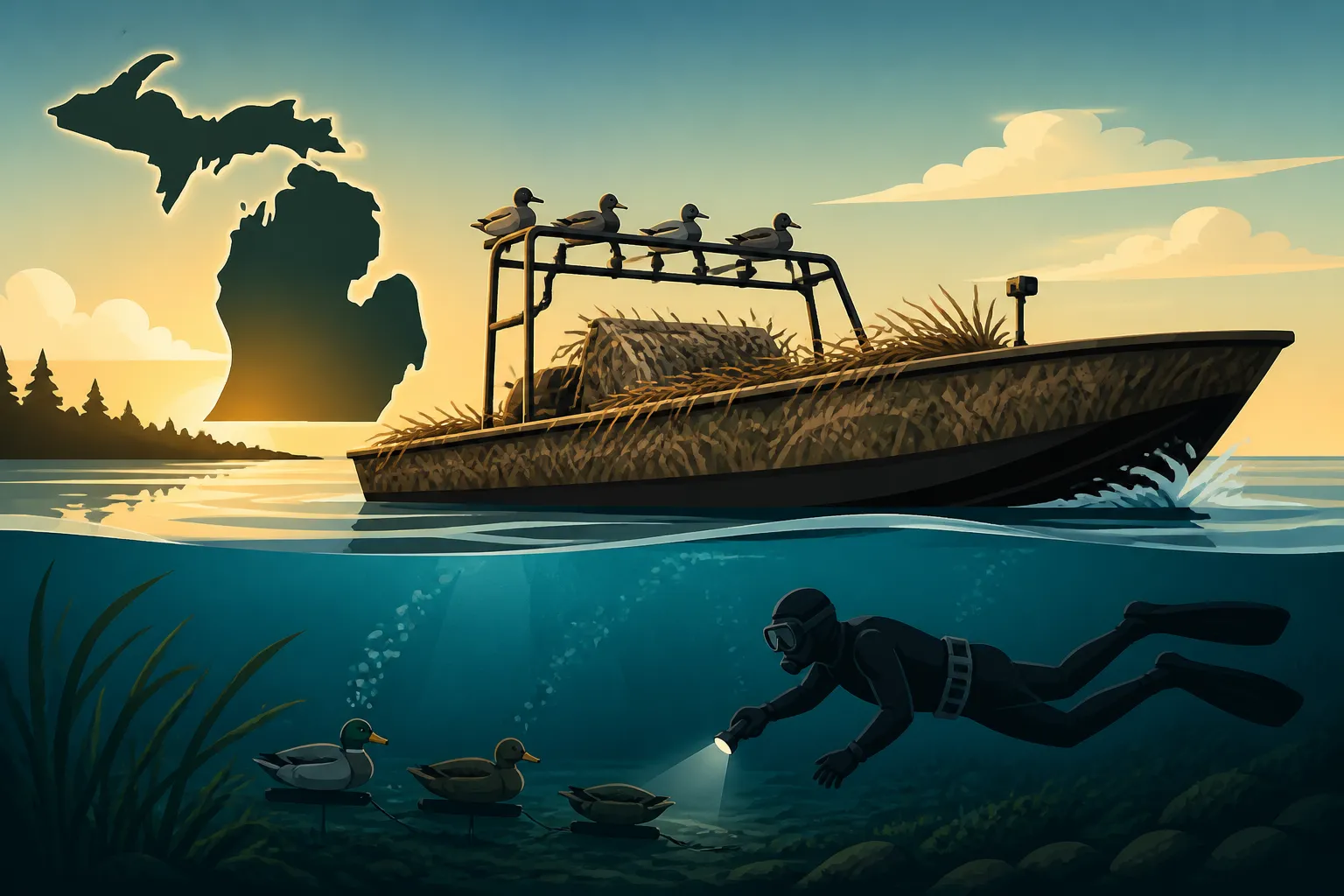
Layout boats are essentially low-profile, coffin-like boats designed for ultimate concealment on open water. Instead of hiding behind something, you're hiding in something that floats among your decoys. This places you directly in the kill hole, offering incredibly realistic decoying scenarios for wary diver ducks. These boats typically lie very low in the water, often with the hunter lying down inside, minimizing their profile to passing birds.
The primary advantage is simple: superior concealment. Divers see your spread, feel safe, and commit. You're not trying to draw them to shore; you're bringing the hunt to their preferred habitat. Beyond concealment, layout boats are often surprisingly stable for their size, capable of handling choppy conditions when deployed correctly from a larger tender boat. They allow hunters to strategically place themselves within expansive decoy spreads, creating the most natural-looking scenario possible. It's a method that truly gets you eye-level with the birds, immersed in their world, rather than observing from a distance.
Key Features to Look for in a Great Lakes Layout Boat
When you're ready to invest in a layout boat for Michigan's big water, you'll quickly realize there's a spectrum of options. Choosing the right one isn't just about price; it's about matching the boat to your hunting style, the conditions you anticipate, and, most importantly, safety on the vast Great Lakes.
Size and Capacity for Stability
Great Lakes diver hunting often means big water, which means waves. Stability is paramount. A good layout boat will strike a balance between being low-profile and having enough beam and freeboard to handle chop. While smaller, single-person boats are easier to maneuver and hide, a slightly larger, wider boat will offer more stability in rougher conditions and potentially more room for gear.
Consider the typical conditions you'll face. Are you mostly hunting protected bays like Saginaw Bay, or are you venturing into the more exposed areas of Lake Huron or Lake Michigan? While no layout boat is designed for extreme seas, some are certainly more robust than others. It's often a trade-off between ultimate concealment (smaller, lower profile) and enhanced stability (slightly larger, wider, more freeboard). Always remember that these boats are deployed from a larger "tender" boat, and the layout boat itself is meant to be part of the decoy spread, not your primary mode of transportation across open water. You'll also want to consider your own size and the amount of gear you typically bring. Some boats can feel quite cramped, especially during long waits in cold weather, which can be a real factor when you're out there for hours on end, waiting for the Duck Migration Timing Through Michigan to bring birds through.
Material and Construction for Durability
Layout boats are built to take a beating. They're constantly being loaded, unloaded, dragged, and exposed to harsh elements. Most are made from fiberglass, roto-molded plastic, or aluminum. Each has its pros and cons.
- Fiberglass: Offers excellent rigidity, can be easily repaired, and allows for very specific hull designs optimized for stability and low profile. However, it can be heavy and prone to gel coat damage if dragged over rocks.
- Roto-molded plastic: Extremely durable and impact-resistant, often lighter than fiberglass, and generally maintenance-free. It can be harder to repair if severely damaged, but it's tough.
- Aluminum: Lightweight, very durable, and highly resistant to punctures. It can be noisy if gear is dropped, and complex hull shapes can be more expensive to produce.
No matter the material, look for solid construction. Check seams, rivets, and any attachment points. The boat should feel stout and well-built, capable of withstanding years of abuse in demanding environments. Many manufacturers focus on durability, knowing their products will be put through the wringer. Brands like GoHunt often feature reviews of gear, including layout boats, so you can see what real hunters think about their longevity.
Essential Safety Features
Safety is non-negotiable on the Great Lakes. A layout boat, by design, places you in a vulnerable position, low in the water, often miles from shore.
- Positive Flotation: This is critical. Even if the boat fills with water, it should remain afloat and support the hunter. Foam flotation built into the hull is essential.
- Grab Handles and Tie-Off Points: Multiple, robust grab handles are important for getting in and out of the boat, especially in choppy water. Strong tie-off points are crucial for anchoring the boat in your spread and securing it to your tender boat.
- Drainage System: A reliable bilge pump (manual or electric, or both) is a must. Layout boats inevitably take on some water, whether from waves or rain, and you need to be able to clear it out quickly.
- High-Visibility Flag: While a layout boat's purpose is concealment, a high-visibility flag on a flexible pole is essential for safety, especially if other boats are in the area or if you need to signal your tender boat. This flag is typically deployed when not actively hunting or when moving. Remember that Life Jackets for Layout Hunting are not just recommended, they are legally required and absolutely essential. Always wear one, even if you think you're a strong swimmer.
Essential Gear for Layout Boat Hunting
A layout boat is just one piece of the puzzle. To successfully and safely hunt diver ducks on the Great Lakes, you'll need an array of other specialized equipment. This isn't a minimalist endeavor; it's a systems approach.
The Tender Boat and Its Role
The tender boat is arguably as important as the layout boat itself. This is your mother ship, your transport, and your safe haven. It's what gets you and your gear to the hunting grounds, deploys and retrieves the layout boats, and serves as a command center and safety platform.
A good tender boat for Great Lakes diver hunting should be:
- Large enough: To safely carry multiple layout boats, a massive decoy spread, all hunters, and gear, even in choppy water. An 18-20+ foot sturdy jon boat or a V-hull aluminum boat is often preferred.
- Powered appropriately: With an outboard motor powerful enough to get you to your spot efficiently and, more importantly, get you back safely if conditions change rapidly. Reliability is key.
- Equipped for safety: With all required safety gear, navigation lights, GPS, marine radio, extra fuel, and emergency supplies. You're often a long way from help.
- Capable of hauling: Strong anchor points, ample deck space, and a well-thought-out system for loading and unloading layout boats and decoys.
Many hunters use a combination of technologies for navigation and scouting, like the GoHunt app or specialized marine GPS units, to mark prime feeding areas for Diver Ducks on the Great Lakes and navigate safely to them. The tender boat also becomes a crucial spot for storing extra layers of clothing, hot coffee, and emergency gear for when the weather inevitably shifts.
Decoy Spreads for Big Water
Diver ducks respond to large, realistic decoy spreads. Forget your dozen mallard decoys; we're talking dozens, often hundreds, of diver decoys, mimicking a raft of feeding birds.
- Quantity: Aim for at least 50-100 diver decoys, and more is often better. Canvasbacks, redheads, bluebills, and goldeneyes should be represented.
- Rigging: Long-lines are the standard. This involves a heavy main line (often thick rope or cable) with multiple decoy drops (snoods) coming off it. This allows you to set and retrieve many decoys quickly and keeps them spread out naturally. Look for quality line, heavy weights, and durable swivels.
- Placement: Decoys are typically set in a "J" or "V" shape, with the open end downwind, leading birds toward the layout boat positioned at the bend or inside the "J". The layout boat becomes just another lump in the mass of decoys. Understanding the wind and currents is paramount for proper Decoy Spreads for Great Lakes Divers.
- Motion Decoys: While traditional motion decoys like spinning wing models aren't always effective for divers, simple jerk strings or current-activated motion decoys can add realism and attract attention from a distance.
Communication and Navigation
On the Great Lakes, communication is vital, and knowing where you are and where you're going is a matter of safety.
- Marine Radio (VHF): Essential for communicating with your tender boat, other vessels, and emergency services. Cell phone coverage can be spotty far from shore.
- GPS/Chartplotter: For accurate navigation, marking your hunting spot, and finding your way back to the launch in fog or low light. Handheld GPS units or marine chartplotters are both good options. Consider a robust, waterproof model.
- Whistle/Horn: A basic safety tool for signaling.
- Flares/Strobe Light: For emergency signaling, especially in low visibility.
Before every hunt, ensure all communication and navigation devices are charged, tested, and stored in waterproof bags. Going over the plan with your hunting partners, including potential emergency scenarios, is part of safe big-water hunting.
Safety Considerations on the Great Lakes
Hunting on Michigan's Great Lakes demands an elevated level of safety awareness. The conditions can be incredibly unforgiving, and help can be a long way off. Rushing or being unprepared can lead to serious trouble.
Understanding Great Lakes Weather and Conditions
The Great Lakes are famous for their unpredictable weather. A forecast that looks calm in the morning can quickly deteriorate. Winds can shift, waves can build rapidly, and fog can roll in with little warning.
- Check Multiple Forecasts: Don't rely on a single source. Check marine forecasts, local forecasts, and use weather apps with real-time radar. Look specifically for wind speed and direction, wave height, and predicted changes throughout your hunt.
- Monitor Conditions Constantly: Once on the water, keep an eye on the sky, listen to marine radio weather updates, and observe changes in wave patterns. Don't hesitate to pull out if conditions start to look sketchy. It’s always better to pack up early and hunt another day than to push your luck. Many experienced diver hunters will use services like GoHunt to scout areas and check historical weather patterns to better predict conditions.
- Know Your Limits: Both yours and your boat's. If the waves are too high or the wind too strong, stay home. No duck is worth risking your life. This is especially true when you're considering Big Water Safety in a Layout Boat.
Essential Safety Gear Checklist
Beyond the boat itself, there's a list of gear you absolutely must have when venturing out on the Great Lakes. This table outlines critical safety items:
| Item | Description | Why it's Essential |
|---|---|---|
| Personal Flotation Device (PFD) | USCG-approved life jacket, worn at all times. | Mandated by law, crucial for survival in cold water. |
| VHF Marine Radio | Waterproof, charged, programmed with local channels. | Primary communication in an emergency, often beyond cell range. |
| GPS Unit/Chartplotter | Waterproof, charged, with updated maps. | Navigation in fog or darkness, marking hazards/locations. |
| Flares/Strobe Light | Visual distress signals. | Attract attention if stranded or in distress. |
| Whistle/Air Horn | Audible distress signal. | Signal tender boat or other vessels in low visibility. |
| First Aid Kit | Comprehensive kit for injuries, seasickness meds. | Treat minor injuries or stabilize more serious ones. |
| Spare Engine/Motor | Small kicker motor or trolling motor with extra battery. | Backup propulsion if primary engine fails. |
| Extra Fuel | Ample supply in approved containers. | Avoid running out of gas miles from shore. |
| Anchors & Rope | Heavy anchors for tender, lines for layout boats, anchor retriever. | Hold position, prevent drifting, secure vessels. |
| Warm, Dry Clothing | Multiple layers, waterproof outer shells, spare set in dry bag. | Prevent hypothermia in cold, wet conditions. |
| Emergency Blanket | Thermal blanket for hypothermia prevention. | Crucial for warmth in emergencies. |
| Knife | Easily accessible, sharp, rust-resistant blade. | Cutting lines, disentangling, general utility. |
| Bailer/Bilge Pump | Manual bailer, powerful electric bilge pump. | Remove water from tender or layout boat. |
| Paddle/Oars | Backup propulsion if engines fail. | Get back to tender or shore if stranded. |
Never cut corners on safety gear. These items aren't optional; they're your lifeline on Michigan's vast waterways. Always tell someone your float plan before you go out: where you're hunting, who's with you, when you expect to be back.
Cold Water Shock and Hypothermia Prevention
The Great Lakes are cold, even in early fall. Water temperatures can be lethal year-round. Falling overboard can quickly lead to cold water shock and then hypothermia.
- Dress in Layers: Wear non-cotton base layers, insulating mid-layers, and a waterproof, windproof outer shell. Wool and synthetics are far superior to cotton for retaining warmth when wet.
- Wear a PFD: Always, without exception, wear a properly fitting USCG-approved PFD. It keeps your head above water, provides some insulation, and makes it easier for rescuers to spot and retrieve you.
- Avoid Overexertion: Especially when setting decoys or handling boats. Sweating can lead to rapid heat loss once you stop moving.
- Stay Hydrated and Fuelled: Bring warm drinks in a thermos and high-energy snacks. Maintaining your core temperature starts from within.
- Know the Signs: Be aware of the signs of hypothermia in yourself and your hunting partners: shivering, confusion, slurred speech, clumsy movements. Act quickly if you suspect it.
- Have a Plan: In case of an accidental capsize or fall overboard, know how you will get back into the boat, or onto the tender, and how you will warm up. Carrying a spare set of dry clothes in a waterproof bag is a smart move. When hunting the late season, remember Cold Weather Sitting Strategy is key not only for success but also for your well-being.
Operating and Hiding Your Layout Boat Effectively
The art of layout boat hunting lies not just in owning the right gear, but in understanding how to deploy, conceal, and retrieve it effectively, making you virtually invisible to incoming diver flocks.
Deployment and Anchoring Strategies
Getting your layout boat set up properly is a coordinated effort, usually involving two or more hunters in the tender boat.
- Scouting is Key: Before you even launch, use your GoHunt maps, depth finders, and observations to identify prime feeding flats, drop-offs, or migratory pathways for Layout Hunting Saginaw Bay or other bodies of water. Look for current breaks or areas where divers tend to raft.
- Anchor the Tender: The tender boat is usually anchored some distance away, often upwind or upcurrent, allowing the layout boat to be deployed and retrieved without spooking birds. A strong, heavy anchor is essential for the tender boat.
- Setting the Spread: The tender boat is used to strategically place the large decoy spread. Once the main spread is out, the layout boat is carefully pushed or towed into position.
- Layout Boat Anchoring: The layout boat itself is typically anchored with one or two smaller, lighter anchors that blend in with the bottom, or by tying off to a long-line of decoys. It needs to be securely held in place but still easy to retrieve quickly if conditions change. Ensure lines are clear and won't foul.
- Orientation: Position your layout boat to take advantage of the prevailing wind and sun, offering you the best shooting angles and concealment. Ideally, the boat faces into the wind for optimal bird approach, with the sun at your back if possible.
Concealment and Blending In
The whole point of a layout boat is to disappear. Achieving this requires attention to detail.
- Boat Camouflage: Most layout boats come in drab, neutral colors or patterns designed to blend with water. You can further enhance this with natural vegetation (grass mats, corn stalks) secured to the boat's edges, or even specialized covers. The key is to break up the boat's outline.
- Hunter Concealment: Your clothing must match the environment. Dark, dull colors are best. Avoid anything shiny or reflective. Many layout boats have a small cockpit opening or blind doors that close over you, further reducing your profile. Only your head might be visible, often covered with a face mask or hood.
- Motion Discipline: This is perhaps the hardest part. You must remain absolutely still until the birds are in the kill hole. Any sudden movement, even a subtle head turn, can flare wary divers. Practice smooth, slow movements when it's time to sit up and shoot.
- Minimal Gear Exposure: Keep all your gear, including your shotgun, tucked away until the last moment. Shiny gun barrels or calls glinting in the sun will give you away in an instant. This also includes knowing Waterfowl Loads for Michigan Divers and ensuring they are ready to go, but not exposed.
Retrieval and Cleanup
When the hunt is over, or conditions demand it, retrieving your layout boat and spread must be efficient and safe.
- Communication: Clearly communicate with your tender boat operator. Use hand signals or a marine radio to coordinate the pickup.
- Orderly Decoy Retrieval: The tender boat systematically picks up the decoy spread. This is where well-rigged long-lines save immense amounts of time and effort.
- Layout Boat Pickup: Once the bulk of the decoys are retrieved, the tender boat approaches the layout boat. This can be tricky in choppy water, requiring careful boat handling to avoid collision. The layout boat is typically brought alongside, secured, and then lifted or slid aboard the tender.
- Gear Management: Before heading back, secure all gear in both the layout and tender boats. Loose items can fly out in rough water. Drain any water from the layout boat.
- Post-Hunt Care: Once back at the launch, rinse your boats and decoys thoroughly with fresh water to remove salt or grit, preventing corrosion and prolonging their life. Store your gear properly, ready for the next adventure chasing divers on Michigan's incredible Great Lakes. It's a lot of work, but the reward of a committed flock of bluebills dropping into your spread is worth every bit of it.
Disclaimer
This article is for general informational purposes only and does not constitute professional advice. Laws, prices and regulations vary by location and change over time. Consult a qualified professional for guidance on your specific situation.