Are Cheap Binoculars Good Enough?
We've all been there: standing in the hunting aisle, staring at a wall of binoculars, from the 'too good to be true' value pair to the 'I need to sell a kidney' premium optics. The question isn't just about the price tag, but about value and real-world performance. Can those budget binoculars actually hold their own in the dense Michigan woods, or are you just wasting your hard-earned money? This guide is here to help you navigate that often-frustrating decision, looking specifically at whether those cheaper binoculars are truly 'good enough' for your Michigan hunting adventures.
The Undeniable Value of Optics, Regardless of Price Tag
Even if you're not planning to drop a month's mortgage payment on binoculars, having some form of optic is incredibly valuable. It’s not just about seeing things far away; it’s about seeing things better, confirming details, and making smarter moves in the woods. Many hunters view binoculars as a luxury, but I see them as an essential tool in almost any Michigan hunting scenario.
More Than Just Magnification: Why You Need Them
Think about a crisp autumn morning in a southern Michigan woodlot. You hear a rustle, or maybe catch a flicker of movement just out of your naked eye's reach. Instead of slowly inching closer and risking bumping whatever's there, a good pair of binoculars allows you to sit tight and observe. You can check out that patch of thick brush on state land without spooking anything, confirming if that dark lump is a stump or the shoulder of a bedded deer. This passive scouting is crucial, letting you gather information without giving away your presence.
Beyond just identifying game, binoculars help you understand your hunting environment better. You can pick apart distant tree lines, identify potential funnels, or spot subtle changes in terrain that indicate deer movement, all while staying hidden. This kind of observation is fundamental to effective hunting, saving you countless steps and reducing your impact on the deer you're pursuing. It’s an extension of your natural senses, giving you an edge.
Safety First: Identifying Your Target
In Michigan, especially with our various antler point restrictions and ever-present concerns about chronic wasting disease (CWD), positive target identification isn't just a good idea—it's often a legal requirement and a critical safety measure. You need to be absolutely certain of what you're shooting at. Imagine you're hunting in a DMU with strict antler point restrictions. That quick glance might tell you "buck," but are you sure it has the required number of points on one side?
Binoculars allow you to count points through thick Michigan timber before drawing a bow or raising a firearm. You can differentiate between a branch and an antler, or a legal buck and an unfortunate fork horn. In low light, or in dense cover like a cedar swamp, this positive identification is paramount. It ensures you adhere to regulations, avoid mistakenly shooting a non-target animal, and confirm a safe shot placement. This responsible approach to hunting is something every Michigan hunter should embrace, and binoculars are a key part of it. Counting Antler Points From a Stand requires more than just a quick look.
Extending Your Time in the Woods
Those critical first and last minutes of legal shooting light are often when deer are most active. Unfortunately, these are also the times when visibility is at its worst for the human eye. This is where binoculars really shine. Even a decent budget pair can help you glean details in those crucial low-light hours of dawn and dusk, effectively extending your effective hunting window.
By gathering what little light is available and magnifying it, binoculars help you discern shapes, colors, and movements that would otherwise remain hidden in the shadows. This means you can spot that big buck slipping along a field edge at dawn, or pick out a turkey silently roosting in a distant tree before you even get out of the truck. This extended vision translates directly into more opportunities and a greater understanding of game movement patterns, making your time in the woods more productive.
Deconstructing "Cheap" vs. "Expensive" Binoculars: What's the Real Difference?
The vast price range in the binocular market can be incredibly confusing. It's easy to assume that all binoculars pretty much do the same thing, but there are tangible differences that account for the varying costs. Understanding these differences can help you decide where to compromise and where to invest, especially for the unique challenges of Michigan hunting.
The Optics Behind the Dollar Signs: Glass and Coatings
At the heart of any binocular is its glass. Expensive binoculars typically use higher-quality glass, often referred to as "ED" (Extra-low Dispersion) or "HD" (High Definition) glass. This specialized glass helps to reduce chromatic aberration, which is essentially the color fringing you see around objects in cheaper optics. The result is a sharper, clearer image with truer colors, especially at the edges of the field of view. Imagine trying to pick out a turkey's beard in a dimly lit cedar swamp; that clarity makes all the difference.
Beyond the glass itself, the coatings applied to the lenses are critical. Premium binoculars feature multiple layers of anti-reflective coatings on all air-to-glass surfaces (fully multi-coated). These coatings dramatically increase light transmission, allowing more light to reach your eyes. This is why expensive binoculars perform so much better in low-light conditions. Cheaper binoculars might have fewer coatings or only coat certain surfaces, leading to a dimmer, less vibrant image, especially as light fades.
Build Quality and Durability for Michigan's Elements
Michigan weather is notoriously unpredictable. One minute it's a calm, crisp morning, the next you're caught in a driving rain or a sudden snow squall. This is where the build quality of your binoculars really matters. More expensive optics are typically built with robust, lightweight materials like magnesium alloys, which offer superior strength without adding excessive bulk. They are also meticulously sealed and purged with inert gas (like argon or nitrogen) to prevent internal fogging and ensure they are genuinely waterproof.
Cheaper binoculars often use more plastic in their construction, which can be less durable. While many budget models claim to be waterproof and fog-proof, the seals might not be as robust, leading to potential issues over time. A small leak can cause internal fogging that ruins your hunt, or even permanent damage if water gets inside. When you're out Keeping a Muzzleloader Dry in Wet Snow or hunkering down during a Michigan downpour, you need optics that can withstand the elements without failing you. The rubber armor on higher-end binoculars is also usually thicker and more resilient, providing better grip and shock absorption against inevitable bumps and drops.
Ergonomics and User Experience
While not directly impacting optical performance, the ergonomics and overall user experience contribute significantly to how effective and enjoyable your binoculars are to use. Premium binoculars often feature smoother, more precise focus wheels that allow for fine-tuning even with gloves on. The diopter adjustment (for balancing focus between your eyes) is typically more secure and less prone to accidental bumps.
Eye relief—the distance your eye can be from the eyepiece and still see the full field of view—is also often more generous and consistent in higher-end models, which is a huge benefit for hunters who wear glasses. The overall balance and weight distribution are usually better engineered, making them more comfortable to hold and glass with for extended periods. While a budget pair might show you the deer, a premium pair makes the process of finding and observing that deer much more comfortable and less fatiguing, allowing you to stay focused for longer.
When Budget Binoculars Can Be Your Hunting Buddy in Michigan
It’s easy to get caught up in the "you get what you pay for" mindset, and while there's truth to that, it doesn't mean budget binoculars are useless. For many Michigan hunting situations, a more affordable pair can absolutely get the job done, especially if you understand their strengths and limitations.
Close-Quarters Hunting and Dense Cover
If your hunting style primarily involves still-hunting dense Michigan cover, like a cedar swamp or thick aspen regeneration, or setting up in tight quarters, such as a ground blind overlooking a small food plot, your need for extreme optical clarity at long distances diminishes significantly. In these environments, shots are typically close, and the main goal of your binoculars is often just confirming what you already suspect is there.
For example, when Still-Hunting Michigan Cedar Swamps or Grouse Hunting Michigan Aspen Cover, you're often looking for movement within 50 yards or less. A basic 8x or 10x binocular with decent light transmission will allow you to pick apart shadows, identify game animals, and make positive identification without needing the nuanced detail of a high-end optic. The limited range and heavy cover mean that the subtle differences in glass quality become far less critical. In these scenarios, the ability to quickly bring them to your eyes and get a clear enough picture is more important than edge-to-edge sharpness across a wide-open field. Using a mapping tool like GoHunt to identify these small, dense cover pockets where long-range glassing isn't critical can pair perfectly with a reliable, budget binocular for quick checks.
"Secondary" Optics or Backup Pairs
Many hunters already own a primary optic, such as a high-magnification rifle scope, which handles their long-range viewing needs. In such cases, a budget pair of binoculars can serve as an excellent "secondary" optic. Maybe you keep them in the truck for quick roadside scouting, or have them hanging in camp for general observation. They might even be a backup pair in your pack in case your primary binos get lost, broken, or simply forgotten.
Think of it as having a spare tire – you hope you don't need it, but you're glad it's there. A more affordable pair might also be perfect for a new hunter, a youth hunter, or a guest you bring along, allowing them to participate in glassing without needing a significant investment in top-tier gear. They can learn the ropes, understand the value of optics, and appreciate their role in scouting and hunting without the pressure of handling expensive equipment.
Casual Scouting and General Observation
Not every trip to the woods is a full-blown hunting expedition. Sometimes you're just out for a hike, shed hunting in late winter, or simply enjoying nature. For these casual observation tasks, a budget binocular is perfectly adequate. You can spot birds, watch squirrels, or confirm deer tracks from a distance before committing to a long walk. Finding Sign in Big Timber often involves a lot of looking around, and a basic binocular can help you cover more ground visually.
Even when actively scouting before a season, if your scouting focuses on broader landscapes and identifying large features like clearcuts, ridge lines, or distant water sources, a mid-range binocular will typically provide enough clarity. You're looking for general patterns and major game trails, not counting the hairs on a deer's ear. For many, the cost-to-benefit ratio of a budget binocular for these less demanding tasks makes perfect sense, leaving more of your budget for other essential gear.
When "Good Enough" Isn't Good Enough: Limitations of Cheaper Optics
While budget binoculars have their place, there are definite scenarios where their limitations become painfully obvious, potentially hindering your success or even putting you at a disadvantage in the demanding Michigan hunting environment. These are the situations where investing a bit more in your optics truly pays off.
Low Light Performance: The Dawn and Dusk Challenge
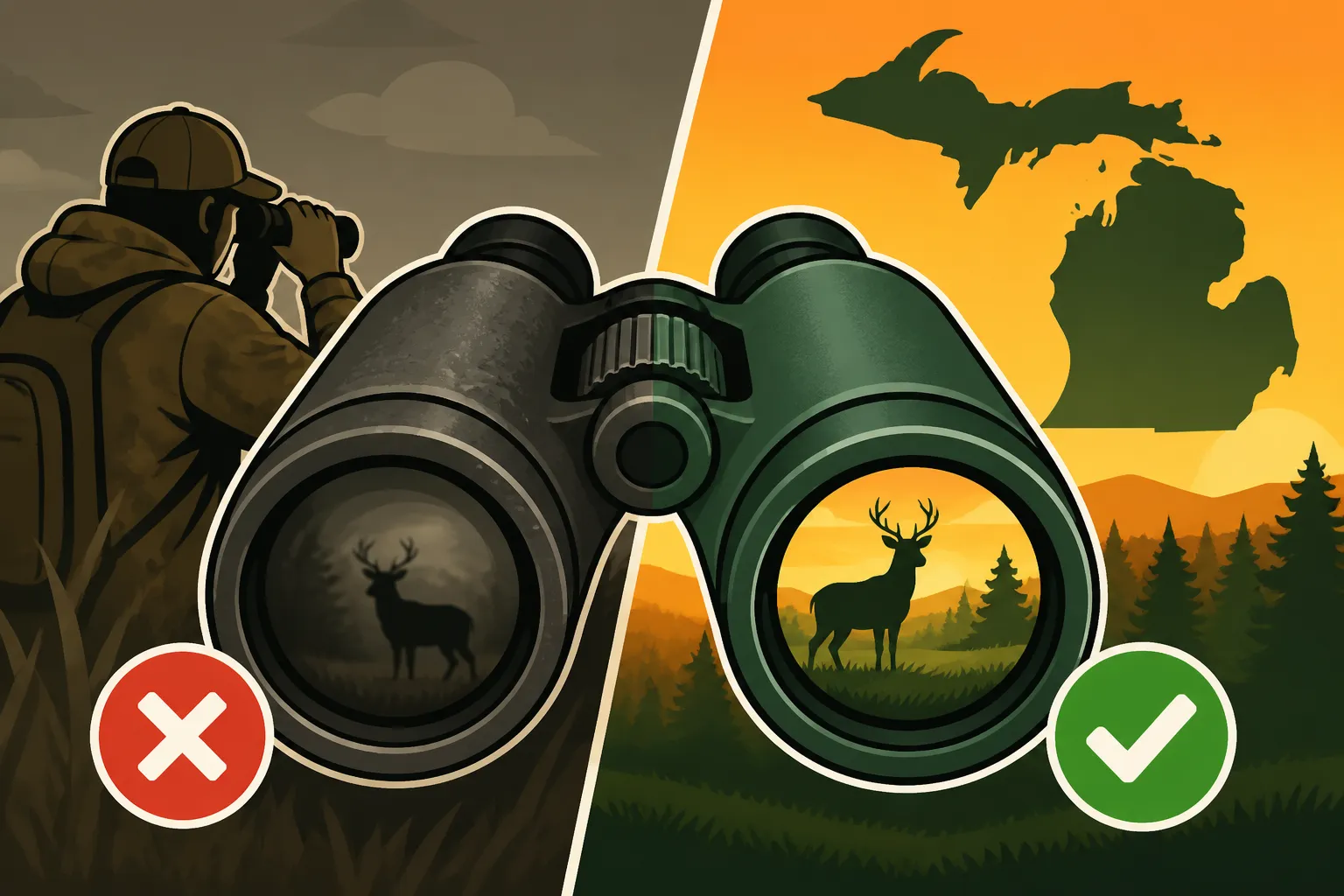
This is perhaps the biggest differentiator between cheap and expensive binoculars. Michigan hunters know that deer, bears, and even turkeys are most active during the low-light periods of dawn and dusk. These are often the golden hours for spotting game. Unfortunately, this is precisely when budget binoculars struggle the most. Their inferior glass and less sophisticated coatings simply cannot gather and transmit enough light to provide a bright, clear image in dim conditions.
You might be able to see a vague shape, but discerning critical details like antler points, an ear flick, or the actual species of animal becomes incredibly difficult, or even impossible. This limitation means you're effectively losing valuable hunting time—those precious first and last minutes of legal shooting light when a trophy animal might step out. Trying to resolve a deer in a shadowed river bottom at last light with cheap optics is a recipe for frustration and missed opportunities. Rifle Scopes for Low-Light Swamps face similar challenges, and the principles of light gathering apply directly to binoculars as well.
Long-Range Detail and Clarity
Michigan offers a variety of hunting landscapes, and sometimes you're glassing vast distances. Whether it's picking apart a distant hillside in the Upper Peninsula, scanning a sprawling agriculture field in the Thumb, or trying to identify movement across a large marsh, cheap binoculars often fall short when precise detail is needed at range. The image might appear blurry, lack contrast, or show significant chromatic aberration (color fringing), making it hard to make out subtle features.
Imagine trying to identify if that small dot on a distant cutover is a black bear or a stump, or if a deer in a far-off CRP field is a doe or a spike buck. With budget optics, the fine details that confirm identity or indicate a legal animal simply won't resolve. This lack of clarity can lead to wasted time, unnecessary stalks, or worse, passing on an animal because you couldn't confidently identify it. When you use tools like GoHunt to plan hunts over large, open areas or distant clearings, you need clear binoculars to effectively scout them from afar, confirming what the maps suggest.
Extreme Weather Conditions
As mentioned earlier, Michigan's weather can be brutal. From driving rain to heavy snow and sudden temperature swings, your gear needs to stand up to the test. While many budget binoculars claim to be waterproof and fog-proof, the quality of their seals and gas purging can be inconsistent. Over time, or under sustained exposure to moisture and temperature fluctuations, these seals can fail.
Internal fogging is a common issue with cheaper optics, rendering them useless at the worst possible moment. A sudden downpour or a shift from warm air to freezing temperatures can quickly fog up the internal lenses, leaving you blind. Furthermore, cheaper construction materials might not withstand accidental impacts as well, leading to misalignment or damage that compromises their performance. When you're facing harsh Michigan conditions, you don't want your optics to be your weak link.
Maximizing the Performance of Your Budget Binoculars
If a high-end binocular isn't in the cards right now, don't despair! You can still get significant value and performance out of a more budget-friendly pair by understanding what the numbers mean, practicing proper technique, and taking good care of your investment.
Understanding Magnification and Objective Lens Size
The numbers on your binoculars, like "8×42" or "10×42," tell you a lot about their potential performance. The first number (8x or 10x) is the magnification—how many times closer an object appears. The second number (42 in this example) is the diameter of the objective lens (the front lens) in millimeters. A larger objective lens generally means more light-gathering capability, which is crucial for low-light conditions.
For most Michigan hunting, an 8x or 10x magnification is ideal. 8x offers a wider field of view and is easier to hold steady, making it great for dense woods where quick target acquisition is key. 10x provides more detail at longer ranges but has a narrower field of view and is harder to keep steady. As for the objective lens, 42mm is a versatile choice, offering a good balance of light gathering and portability. For example, Binocular Power for Timber Hunting often favors less magnification and a wider field of view. Understanding these numbers helps you choose the best "cheap" binocular for your specific needs, rather than just grabbing the cheapest option.
Proper Use and Technique
Even the most expensive binoculars will perform poorly if you don't use them correctly. The biggest enemy of clear viewing is instability. Always try to steady your binoculars against something solid, like a tree trunk, a fence post, or even your knee if sitting. If standing, tuck your elbows against your body to create a more stable platform. Learning to control your breathing can also reduce shake, especially during intense moments.
For prolonged glassing sessions, especially if you opt for a 10x magnification or higher, consider investing in a simple binocular tripod adapter. These inexpensive accessories allow you to mount your binoculars to a standard photography tripod, providing rock-solid stability that reveals details you'd never see freehand. This technique drastically improves the clarity and usability of any binocular, making even a budget pair punch above its weight class.
Care and Maintenance
No matter the price tag, proper care and maintenance will significantly extend the life and performance of your binoculars. Always keep the lens caps on when not actively using them to protect against scratches and dust. Invest in a good quality lens cleaning kit—never use your shirt or a rough cloth, as this can scratch the delicate lens coatings. A soft brush, a can of compressed air, and a micro-fiber cloth with a specialized lens cleaning solution are your best friends.
Store your binoculars in a protective case, especially during transport, to prevent bumps and drops. If they get wet, wipe them down thoroughly, but never submerge a non-waterproof pair. If they claim to be waterproof, ensure the seals are intact. Proper storage in a dry place will prevent mildew or other issues. A well-cared-for budget binocular can outperform a neglected premium pair, so treat your optics with respect.
Key Features to Prioritize in Any Michigan Hunting Binocular
When you're sifting through options, even on a budget, there are certain features that are non-negotiable for Michigan hunting. Prioritizing these will ensure you get the most functional tool for your money, rather than a frustrating piece of gear that hinders your success.
Waterproofing and Fogproofing
This is, without a doubt, the most important feature for any Michigan hunting optic. Our state's weather can be incredibly wet and humid, with sudden downpours, misty mornings, and heavy snow. If your binoculars aren't sealed against moisture, they will fog internally at the worst possible moment, rendering them useless. Worse, moisture can lead to mold and permanent damage.
Look for binoculars explicitly labeled as "waterproof" and "fog-proof," ideally with nitrogen or argon purging. While cheaper models might cut corners here, a decent mid-range budget option will have reliable sealing. This feature alone can save your hunt and your investment. Don't compromise on this, regardless of how tight your budget is.
Comfortable Eye Relief and Field of View
Eye relief refers to the distance your eye can be from the eyepiece and still see the full, unvignetted image. If you wear glasses, generous eye relief (typically 15mm or more) is absolutely critical. Without it, you'll constantly be removing your glasses or struggling to see the entire field of view, which is incredibly frustrating in the field. Test binoculars with your glasses on if possible.
Field of view (FOV) is the width of the area you can see through the binoculars at a certain distance (e.g., 350 feet at 1,000 yards). A wider FOV (often found in 8x magnification models) makes it easier to scan large areas, track moving animals, and locate game quickly in dense cover. While a tighter budget might mean compromises on edge-to-edge clarity, a respectable FOV is still achievable and highly beneficial for most Michigan hunting scenarios.
A Reputable, Even If Budget-Friendly, Brand
In the world of optics, brand reputation often correlates with quality control and customer service, even at the entry-level. While you might not be able to afford the top-tier offerings from elite brands, many well-known optics companies offer solid budget-friendly lines. These brands often leverage their experience and technology to produce reliable, if basic, binoculars that still meet acceptable performance standards.
Choosing a brand with some history or positive reviews for their more affordable offerings can provide peace of mind. They are more likely to have consistent manufacturing processes, better quality glass (even if not ED), and often a customer service department that will stand behind their product if an issue arises. This is a much safer bet than an obscure, no-name brand that offers suspiciously low prices, where the quality can be a complete gamble. As you progress in your hunting journey and use resources like GoHunt to plan more complex hunts, you'll find that a reliable piece of gear, even if budget-conscious, is always better than an unreliable one.
Binocular Performance vs. Michigan Hunting Scenarios
Let's break down how different binocular tiers might stack up for common Michigan hunting situations.
| Price Tier | Key Features | Best Use Case in Michigan | Limitations |
|---|---|---|---|
| Budget (< $150) | Basic glass, often roof prism, some coatings. | Dense timber, thick brush, close-quarters deer/grouse. | Poor low-light, limited clarity at range, questionable durability. |
| Mid-Range ($150-$400) | Better glass, fully multi-coated, waterproof, fog-proof. | Versatile for woods/field edges, general deer/turkey. | Still lags in extreme low-light, might lack premium clarity. |
| High-End (>$400) | ED/HD glass, advanced coatings, robust construction. | Long-range glassing, critical low-light, open fields, bear. | Price point is a significant barrier for many hunters. |
The Upgrade Path: When to Consider Stepping Up
There often comes a point in a hunter's journey when the limitations of budget gear become apparent, and the desire for better performance outweighs the initial cost savings. Recognizing this moment is key to making a smart investment.
Investing in Your Passion
For many Michigan hunters, hunting isn't just a hobby; it's a deep-seated passion, a way of life. As you spend more time in the woods, learn new tactics, and push your skills, you'll naturally start to notice where your equipment is holding you back. Maybe it's that critical half-hour of legal light when you just can't make out antlers, or the frustration of a blurry image across a field. When you start to realize these limitations are hindering your success or enjoyment, it's a clear sign that an upgrade is worthwhile.
Investing in better optics is investing in your hunting experience. It's about gaining confidence in your ability to identify game, making more ethical shots, and simply enjoying the beauty of the Michigan wilderness with greater clarity. It's not about being a gear snob, but about acquiring tools that truly enhance your time afield and help you achieve your goals.
Exploring Other Optic Types
As you consider stepping up your optics game, you might also explore different types of viewing equipment. While binoculars are versatile, other specialized optics can fill specific niches. Monoculars, for instance, are incredibly lightweight and compact, perfect for ultralight scouting or quick checks when space is at a premium. They offer a single-eye view but can be less fatiguing than continually raising binoculars if you just need a quick look.
Rangefinding binoculars combine the best of both worlds, offering excellent optical performance with an integrated laser rangefinder. This eliminates the need to carry two separate devices and allows for seamless target acquisition and distance measurement, which is invaluable for making accurate shots, especially in varying Michigan terrain. If you're currently carrying a separate rangefinder, upgrading to a rangefinding binocular could be a game-changer. Rangefinders in Thick Cover can be difficult to use alone, but integrated into binoculars, they become much more efficient. As you get more serious and use advanced planning tools like GoHunt to dissect your hunting areas, having precise rangefinding capabilities integrated into your primary optic becomes a huge advantage.
Ultimately, the decision of whether "cheap binoculars are good enough" depends entirely on your specific hunting style, the terrain you hunt, and your personal expectations. For many casual hunters or those in dense cover, a budget-friendly pair will serve them well. But for those who demand clarity in low light, precision at long range, and unwavering durability in Michigan's challenging conditions, investing in higher-quality optics will always be a worthwhile upgrade. Start where you can, but don't be afraid to elevate your view as your passion grows.
Disclaimer
This article is for general informational purposes only and does not constitute professional advice. Laws, prices and regulations vary by location and change over time. Consult a qualified professional for guidance on your specific situation.