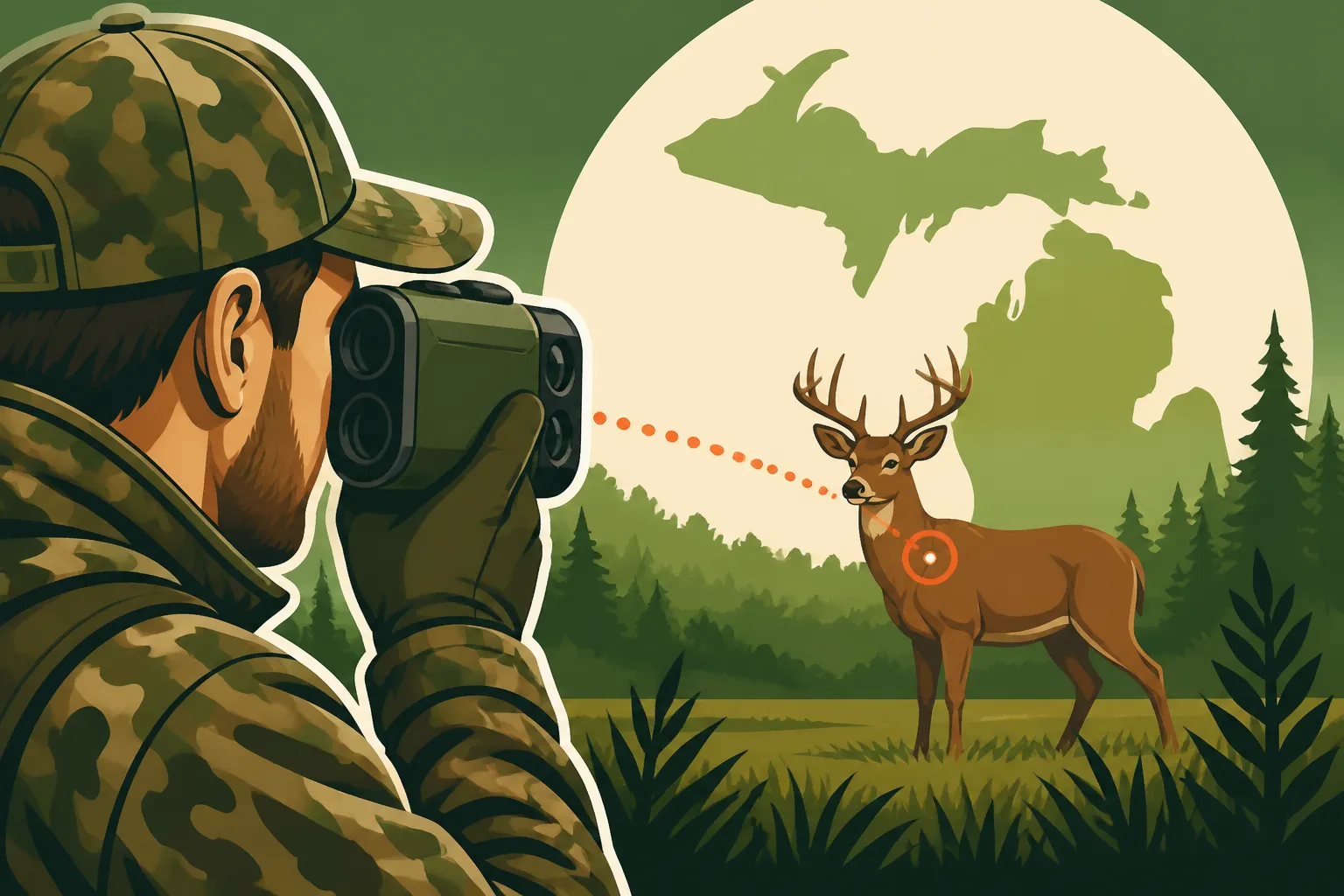
Rangefinders Under 100 Yards
Guessing distances in Michigan's thick woods, especially for those critical close-range shots, can lead to missed opportunities or, worse, unethical outcomes. Many hunters mistakenly believe rangefinders are only for long-distance open country. But for bowhunters in dense timber or shotgun hunters in the restricted zone, precise yardage under 100 yards is absolutely vital. This guide will walk you through finding and effectively using rangefinders specifically for these crucial close-quarters scenarios.
Why Precise Rangefinding Matters Even Under 100 Yards in Michigan
It's a common misconception that if your shot is "short," you don't really need a rangefinder. After all, how much can a deer move between 20 and 30 yards, right? The truth is, especially for archers and even for firearm hunters in certain Michigan zones, those seemingly small differences in yardage can have a huge impact on shot placement and, ultimately, a successful, ethical harvest. Don't let anyone tell you that ranging is only for wide-open fields; Michigan's woods demand precision.
The Criticality for Bowhunters
For those of us who prefer the silent hunt of archery season, precise yardage is the absolute bedrock of ethical shooting. Unlike a rifle, an arrow's trajectory drops significantly even at short distances. A deer at 25 yards versus 30 yards is a world of difference when you're aiming for a tiny kill zone with a fixed pin or even a slider sight. Misjudging by just five yards can mean the difference between a clean pass-through and a gut shot.
Imagine you're tucked into your treestand, maybe a favorite spot where you've hung it after scouting the sign, perhaps using an app like GoHunt to mark key rub lines and scrapes. You spot a nice buck sneaking through a thick cedar swamp. It pauses, broadside, but there's a small opening in the brush. Is it 20, 25, or 30 yards? Without ranging, you're guessing, and that guess, even if it feels close, could be off enough to wound the animal. Every single yard counts when you're slinging an arrow, especially when you consider how quickly deer can react to the sound of a bowstring. Bow Setups for Michigan Whitetails is a great resource to ensure your equipment is dialed in, but even the best bow won't compensate for a bad range.
Importance in Michigan's Limited Firearm Zones
While rifles offer a flatter trajectory, many areas of Michigan are still "limited firearm zones" where you're restricted to shotguns with slugs, muzzleloaders, or specific straight-wall cartridge firearms. These weapons, while capable, often have much more pronounced bullet drop than a high-powered rifle, even at distances under 100 yards. A slug can drop several inches between 50 and 75 yards, for example.
Consider hunting a field edge in southern Michigan, where the rules often necessitate a shotgun or straight-wall cartridge. You've got a deer moving along the tree line. You estimate 70 yards, but it's actually 85. That slight miscalculation could result in your slug hitting significantly lower than intended, hitting a leg or just brushing the brisket instead of putting the deer down quickly. Even with modern slug guns and straight-wall cartridges like the .450 Bushmaster, understanding your exact holdover or zero is crucial, and that requires knowing the precise distance. A rangefinder ensures you're applying the right aiming point every time. Shotguns and Slugs in Michigan's Restricted Zone delves deeper into these specific firearm regulations.
Key Features for Under $100 Rangefinders in Close-Range Hunting
When you're looking for a rangefinder that won't break the bank but still performs reliably under 100 yards, you're looking for a specific set of features. You don't need all the bells and whistles of a long-range unit, but you absolutely need consistent accuracy, speed, and usability in Michigan's varied terrain. Don't get caught up in marketing hype for features you won't use; focus on what truly matters for close-in work.
Accuracy and Speed in Dense Cover
The primary job of any rangefinder is to give you an accurate distance. For close-range hunting, "accurate" means within a yard or two, consistently. Many budget rangefinders perform admirably at these shorter distances. The challenge, especially in Michigan's woods, comes from the dense foliage – the leaves, branches, and undergrowth that can confuse a laser. Look for models that boast good target acquisition, meaning they can "see" through light brush to your target without picking up the intervening branches.
Speed is also crucial. When a deer steps out, you often have a very narrow window to range and shoot. A slow rangefinder, one that takes several seconds to give you a reading, could mean the difference between getting a shot off and watching the deer disappear. Modern budget models have improved drastically in this regard, offering near-instantaneous readings. Test them if you can, or read reviews specifically noting their performance in cluttered environments. You want a unit that locks onto the deer, not the tree five yards in front of it.
Usability and Ergonomics for Michigan Hunters
A rangefinder, no matter how accurate, is useless if it's a pain to use in the field. Think about the conditions you'll be hunting in: cold mornings with gloves on, wet days, or trying to silently range a deer from a precarious treestand position. You need a unit that fits comfortably in your hand, has buttons that are easy to press even with light gloves, and a display that's clear and easy to read in varying light conditions.
Consider the size and weight. A compact, lightweight rangefinder is much more likely to be carried consistently than a bulky one. Many hunters clip them to their bino harness or keep them in a readily accessible pocket. Also, pay attention to the display. While some expensive models offer fancy colored displays, a simple, clear black reticle and yardage reading is often perfectly adequate for close-range work, and often performs better in low-light conditions found in Rifle Scopes for Low-Light Swamps or just an hour before dark. A simple battery indicator is also a huge plus, so you're not caught off guard deep in the woods.
| Feature | Why It Matters for Under $100 & 100 Yards | What to Look For |
|---|---|---|
| Accuracy | Essential for ethical shots; small errors are critical in archery. | +/- 1 yard accuracy; consistent readings. |
| Speed | Quick shots are often necessary; deer don't wait. | Sub-second readings; quick target acquisition. |
| Target Acquisition | Avoid ranging brush instead of the deer itself. | Good performance in light cover; "scan" mode helpful. |
| Ergonomics | Easy to use with gloves, quiet operation. | Compact, lightweight, comfortable grip; easy-to-press buttons. |
| Display Clarity | Read numbers quickly in low light or bright sun. | Clear, uncluttered display; simple reticle; often black for budget. |
| Durability | Withstands Michigan weather and bumps. | Water-resistant or waterproof; rubberized armor; solid build. |
Practical Application: Using Your Rangefinder in Michigan's Woods
Having a rangefinder is one thing; effectively integrating it into your hunting routine is another. It's not just about ranging a deer when it appears; it's about preparation, practice, and smart deployment. Learning to use it instinctively will reduce movement and noise, giving you a greater edge in the challenging environments of Michigan. This often means ranging before a deer even steps out, a strategy that saves crucial seconds.
Pre-Ranging Your Shooting Lanes and Landmarks
This is arguably the most important rangefinder tactic for close-range hunting. Before a deer even shows up, take the time to range key points around your stand or blind. If you're hunting a funnel between two swamps, for example, range the base of a specific tree at 25 yards, a stump at 35, and the edge of a thicket at 40. Write these down or commit them to memory. When a deer appears, you don't need to range the deer itself; you just need to identify which pre-ranged landmark it's closest to.
This technique is invaluable in Michigan's dense forests. It minimizes movement and the time spent fiddling with your rangefinder when a buck is in sight. You're already set. This is especially true when still-hunting a Michigan cedar swamp, where visibility is limited and every yard feels like a guess. Think about your entry routes on flat Michigan ground or where you've brushed in a blind on a field edge – all prime spots for pre-ranging. Knowing the exact distances to specific trees, rocks, or openings is an absolute game-changer, especially for bowhunters who need to move precisely to their aiming pin.
Minimizing Movement and Noise
The biggest challenge with using a rangefinder in the moment is the movement and noise it can create. A deer's senses are incredibly sharp, and any sudden motion or sound can send them bolting. That's why pre-ranging is so important. However, there will be times when a deer appears in an unexpected spot, and you absolutely need a quick, quiet range.
Practice drawing your rangefinder and acquiring a target with minimal movement. Can you do it smoothly with one hand? Can you press the button quietly? Often, wearing it on a bino harness or having it tethered to your belt in an easily accessible pouch can help. Avoid fumbling in a pack. Remember, in Michigan's quiet woods, even the click of a rangefinder button can be heard, especially on a still morning. The less you have to move and the quicker you can get a reading, the better your chances. This applies whether you're sitting in a treestand, which you might have seen detailed in Treestand Setups in Michigan Hardwoods, or using a ground blind on Michigan State Land.
Disclaimer
This article is for general informational purposes only and does not constitute professional advice. Laws, prices and regulations vary by location and change over time. Consult a qualified professional for guidance on your specific situation.