Rangefinding Binoculars Worth the Cost
You're sitting in a treestand on a crisp October morning, the Michigan hardwoods slowly coming to life around you. A deer steps out, broadside, but is it 30 yards? 45? That split-second hesitation, the internal debate, can be the difference between a clean shot and a missed opportunity, or worse, a poor hit. The struggle to accurately judge distance in dynamic hunting situations is a real one, and this guide is here to help you determine if investing in rangefinding binoculars is the game-changer you've been searching for.
The Frustration of Estimating Distance in Michigan's Diverse Terrain
Michigan's hunting landscape is incredibly varied, from the dense cedar swamps of the Upper Peninsula to the rolling hills and open fields of the Lower Peninsula. This diversity, while beautiful, presents a constant challenge for hunters trying to accurately judge distance, especially when an animal suddenly appears.
Why Traditional Rangefinders Fall Short in Certain Scenarios
We've all been there: fumbling for a handheld rangefinder, trying to get it up to your eye, only for the deer to take another step into thicker cover, or worse, vanish altogether. Traditional handheld rangefinders are fantastic tools, no doubt. They're compact, relatively inexpensive, and get the job done for static measurements. However, in the fast-paced, unpredictable world of hunting, they can often feel like a second-hand operation that slows you down.
Imagine still-hunting through a thick aspen cut, slowly picking your way along. You spot a buck just ahead, partially obscured by brush. Your binoculars are already up, but then you need to lower them, grab your rangefinder, bring that up, and try to pinpoint the target. By the time you get a reading, that buck might have moved, or even caught your movement. The critical moments in hunting are often measured in seconds, and any step in your process that adds time can be a liability. Whether you're trying to quickly judge distance while Hunting the Michigan Rut in November or setting up for a shot during Michigan's November Firearm Deer Season, that precious time can make all the difference.
The Mental Burden of Guessing Yardage in Critical Moments
The human eye is remarkably poor at accurately estimating distances, especially beyond 30-40 yards, and even more so when adrenaline is pumping. That feeling of uncertainty, of second-guessing your shot, can plague even the most seasoned hunter. Is that deer at 50 yards or 60? In bowhunting, that 10-yard difference can mean a clean pass-through or a complete miss, or a gut shot if your pins are off. For firearm hunters in areas where distances are limited by terrain or local regulations, knowing the precise range prevents overestimating your effective range.
This mental burden isn't just about making the shot; it's about confidence and ethics. No hunter wants to take an unethical shot because they misjudged the distance. The stress of doubt can detract from the entire experience, turning a moment of excitement into one of anxiety. Especially when you've been Hunting the Pre-Rut in Late October for weeks, waiting for that one opportunity, the last thing you need is a mental block caused by yardage uncertainty. Having precise numbers readily available allows you to focus purely on shot placement, breathing, and trigger control, which are vital for a clean harvest.
How Rangefinding Binoculars Solve Michigan Hunter's Problems
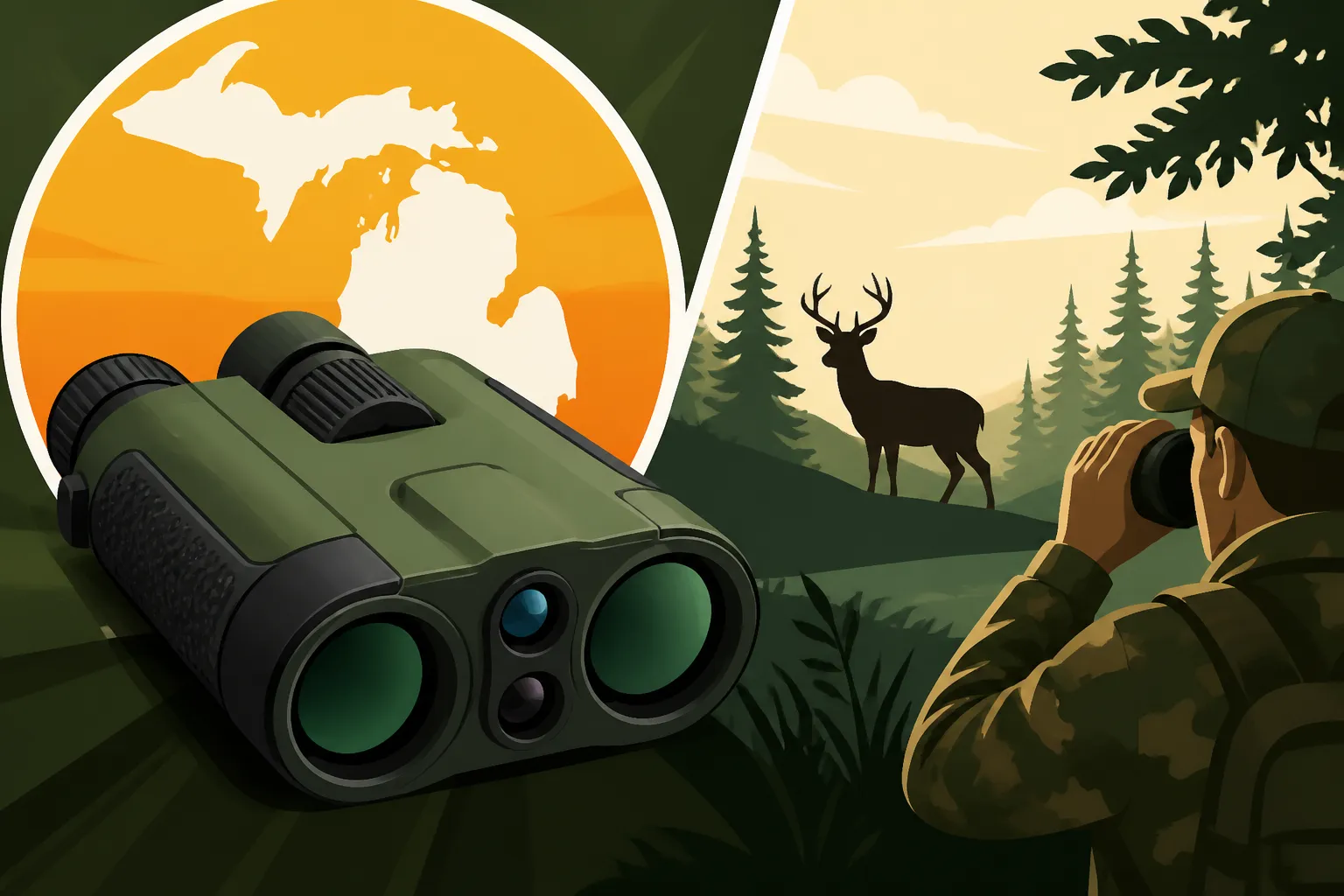
Rangefinding binoculars, or "range binos" as many call them, combine two of a hunter's most critical pieces of gear into one streamlined unit. For Michigan hunters facing diverse terrains and often tight windows of opportunity, this integration offers some compelling advantages.
Combining Two Essential Tools into One Streamlined Unit
The most obvious benefit is the sheer efficiency. Instead of carrying separate binoculars for glassing and a rangefinder for measuring, you have one device that does both. This not only reduces the weight and bulk in your pack (or around your neck) but, more importantly, it streamlines your movements in the field. Imagine glassing a distant clearcut, trying to locate deer feeding on a late October evening. With rangefinding binoculars, the moment you spot a legal buck, you can depress a button and instantly get an accurate distance reading without ever taking your eyes off the animal. This continuous observation, combined with immediate data, is a huge tactical advantage.
This integration is particularly useful when you're glassing from a stationary position, like a blind overlooking a field or a high point in a vast state forest. You can systematically scan the terrain, and as soon as an animal is detected, you can range it without breaking your sight picture. This fluid motion is far less likely to spook game than fumbling with two separate devices. For hunters who prioritize minimalist setups or those who move frequently, such as when Still-Hunting Michigan Cedar Swamps or employing Run-and-Gun Turkey Tactics on State Land, having one less item to manage can simplify your approach significantly.
Advantages in Different Michigan Hunting Scenarios
The versatility of rangefinding binoculars shines in Michigan's varied habitats.
- Thick Hardwoods: In the dense timber of northern Michigan, where shots are often close and fleeting, the ability to quickly range a deer as it slips between trees can be invaluable. You might be still-hunting and spot a buck 70 yards out. With range binos, you can confirm that range quickly and prepare for a shot before it disappears. This is especially true when setting up near a natural funnel, like Hunting a Funnel Between Two Swamps, where deer might cross quickly.
- Swamp Edges: Michigan's infamous swamps are notorious for reducing visibility and making distance estimation tricky. The murky, often shadowed edges can play tricks on your eyes. Whether you're trying to discern a deer moving along a Hanging a Stand on a Swamp Edge or trying to figure out if that darker patch is a deer or a stump, range binos provide clarity and accurate distance in challenging light conditions.
- Open Fields and Ag Land: In southern Michigan farm country, especially when Hunting a Standing Cornfield in the Thumb, you might have opportunities for longer shots. Range binos allow you to quickly range multiple points in a field as you glass, such as a distant treeline, a specific clump of weeds, or a scrape along the edge. This pre-ranging helps you understand your maximum effective range for a particular setup. Many serious hunters studying maps on platforms like GoHunt will pre-range likely shooting lanes from their intended stand locations, translating directly to confidence when a deer appears.
- Upper Peninsula Big Woods: In the expansive Upper Peninsula Big Woods Counties, deer can appear at unexpected distances in varied terrain. For those hunting the vastness of the U.P., where shots can be at moderate to long ranges depending on the cover, a high-quality rangefinding binocular provides the optical performance needed to pick apart distant cover and the ranging capability to confirm those longer shots. They also excel when you're observing deer in their Upper Peninsula Deer Yarding and Winter Movement, allowing you to monitor distances without disturbing them.
Factors to Consider When Deciding if They're Worth the Investment
So, are rangefinding binoculars truly worth the significant upfront cost? It's not a simple yes or no; it really depends on your hunting style, budget, and priorities.
Understanding the Cost vs. Benefit for Your Hunting Style
Let's be honest: rangefinding binoculars are an investment. They typically cost significantly more than buying a high-quality binocular and a separate rangefinder of comparable quality. However, the benefits often extend beyond just having two tools in one. For the serious hunter who spends a lot of time in the field, for whom efficiency and precision are paramount, that cost can be justified.
Consider the hunter who primarily bowhunts Michigan's public land. They need to be agile, minimize movement, and make precise shots in often tight windows. For them, the seamless transition from glassing to ranging can increase their success rate and confidence tenfold. The added weight and cost become less of a factor compared to the enhanced capability. Similarly, for someone pursuing Michigan Black Bear Hunting where an accurate range on a dark animal in low light is critical, the optical quality and ranging precision are invaluable.
If you're a casual hunter who goes out a few times a season, primarily still-hunting with a rifle in areas where shots are typically under 100 yards, a separate, more affordable setup might suit your needs just fine. But if you are continually pushing your boundaries, hunting challenging terrain, or simply want every advantage you can get, the benefits of rangefinding binoculars might far outweigh the cost over the long term.
Key Features to Look For Beyond Just Ranging
When evaluating rangefinding binoculars, don't just focus on the "ranging" part. The "binocular" part is equally, if not more, important.
- Optical Quality: This is paramount. Even the best rangefinder is useless if you can't clearly see the target. Look for binoculars with excellent light transmission, edge-to-edge clarity, and good color fidelity. Brands that excel in traditional optics often transfer that quality to their rangefinding models. This is especially crucial for Low-Light Performance in a Scope or binoculars, as Michigan hunting often starts and ends in dim conditions.
- Ranging Performance: Check the advertised maximum range, but more importantly, consider the practical maximum range on deer-sized targets in varied terrain. Look for models with good accuracy at common hunting distances (5-600 yards for most rifle hunters, 20-80 yards for bowhunters). Angle compensation is also a critical feature, especially when hunting from a treestand or on hilly ground, as it provides the "shoot-to" distance.
- Durability and Ergonomics: These devices need to withstand Michigan's weather – rain, snow, and cold. Look for robust, waterproof, and fog-proof construction. Ergonomics, how they feel in your hands, the ease of button presses with gloves on, and the comfort of the neck strap, are all small details that make a big difference over a long hunting day.
- Battery Life: Ranging drains batteries. Understand the battery type and typical life. You don't want your rangefinder dying halfway through your Michigan Muzzleloader Season Tactics hunt in December cold.
- Weight: While they combine two tools, they can still be heavier than standalone binoculars. Factor this into your pack weight, especially if you're on a multi-day trip in the backcountry. A good quality harness can mitigate perceived weight around your neck.
Potential Downsides and When Separate Units Might Still Be Better
While rangefinding binoculars offer undeniable advantages, they aren't without their drawbacks, and they aren't for everyone.
The most significant downside is, as mentioned, the cost. For many, the premium price tag simply isn't feasible or justifiable for their level of hunting commitment. You can often get excellent standalone binoculars and a good handheld rangefinder for less money combined than a single high-end rangefinding binocular.
Another consideration is weight and bulk. While they combine two items, the combined unit is usually heavier than a pair of regular binoculars and might feel bulkier around your neck. If you are extremely weight-conscious, perhaps for a high-intensity hunt or simply prefer the lightest possible setup, two separate, lightweight units might still win out. A hunter focused on Grouse Hunting Michigan Aspen Cover, where quick, fluid gun movements are key and long-distance ranging is rarely needed, might find the extra weight of range binos more of a hindrance than a help.
Finally, failure points. If the ranging component fails in a rangefinding binocular, you're left with just a binocular. If your standalone rangefinder breaks, you still have your binoculars. While reliable brands are generally very durable, it's a factor to consider. This is where researching reputable brands, often discussed on forums or reviewed on sites like GoHunt, becomes crucial.
| Feature | Rangefinding Binoculars (Integrated) | Separate Binoculars + Handheld Rangefinder |
|---|---|---|
| Efficiency | Seamless glassing and ranging, less movement | Two-step process, more movement |
| Gear Weight/Bulk | One item, but often heavier than standard binos | Two lighter items, more to manage |
| Cost | Generally higher upfront investment | Can be more affordable, greater flexibility |
| Optical Quality | Can be excellent in high-end models | Can mix and match top optics with budget RF |
| Durability | One robust unit, but total failure risk is higher | Two separate units, lower total failure risk |
| Ergonomics | Designed for integrated use, but can be heavier | Lighter binoculars, compact rangefinder |
| Battery Life | Shared power for optics and ranging | Separate batteries, potentially longer life |
Maximizing Your Investment: Tips for Using Rangefinding Binoculars Effectively
If you decide that rangefinding binoculars are indeed worth the cost for your Michigan hunting adventures, the next step is to master their use. Owning a premium tool is one thing; wielding it effectively is another.
Practice, Practice, Practice: Getting Proficient with Your New Tool
Just like any new piece of gear, proficiency comes with practice. Don't wait until opening day to pull out your new range binos. Take them out frequently before the season. Practice ranging everything: trees, rocks, fence posts, and even your dog (if it stands still long enough!).
- Vary the Light Conditions: Practice at dawn, dusk, and midday to understand how your unit performs in different lighting. Pay attention to how quickly it acquires a target in low light.
- Range Different Textures and Colors: Some surfaces are easier to range than others. Get a feel for how your unit handles dark bark, light foliage, or reflective surfaces.
- Practice with Gloves On: Many Michigan hunts involve cold weather and gloves. Make sure you can comfortably operate the buttons and focus wheel while wearing your typical hunting gloves.
- Range from Different Positions: Practice ranging from a sitting position, standing, kneeling, and even from mock treestand heights to get comfortable with angled shots. Understanding the angle compensation feature, if your unit has one, is critical for consistent results. This muscle memory will pay dividends when that trophy buck steps out and your heart is pounding.
Integrating Them into Your Michigan Hunting Strategy
Once you're comfortable with the mechanics, it's time to integrate your rangefinding binoculars seamlessly into your actual hunting strategy.
- Pre-Season Scouting: Use them extensively during your scouting trips. As you identify potential stand locations or natural funnels, range landmarks from those spots. Knowing that the old oak is 40 yards, the deadfall is 65, and the cedar thicket begins at 80 yards, allows you to mentally map your shooting lanes. This kind of detailed scouting, often combined with studying Scouting With Michigan's Mi-HUNT Map and aerial photos, sets you up for success.
- Still-Hunting and Spot-and-Stalk: When Still-Hunting Michigan Cedar Swamps or moving slowly through the timber, keep your range binos ready. The moment you spot movement, you can quickly identify and range the animal without having to swap gear. This speed is invaluable in areas where opportunities are fleeting.
- Stand Hunting: From your treestand or ground blind, constantly scan and range. Before legal light, range key trees or terrain features in every possible shooting lane. This forms a mental grid that helps you instantly know the range when an animal appears. You can even range the edges of a nearby Food Plots Instead of Bait to know your maximum ethical shot distance. For hunters in the Upper Peninsula, keeping tabs on deer in deep snow can be made easier with the clarity and ranging ability.
- Critter Control: If you're into Coyote Calling in Michigan Winter, rangefinding binoculars can help you precisely determine the distance of incoming coyotes, ensuring you make an accurate shot on these wary predators.
By mastering your rangefinding binoculars, you're not just buying a piece of gear; you're investing in increased confidence, precision, and ultimately, a more successful and ethical hunting experience in Michigan's wild places.
Disclaimer
This article is for general informational purposes only and does not constitute professional advice. Laws, prices and regulations vary by location and change over time. Consult a qualified professional for guidance on your specific situation.