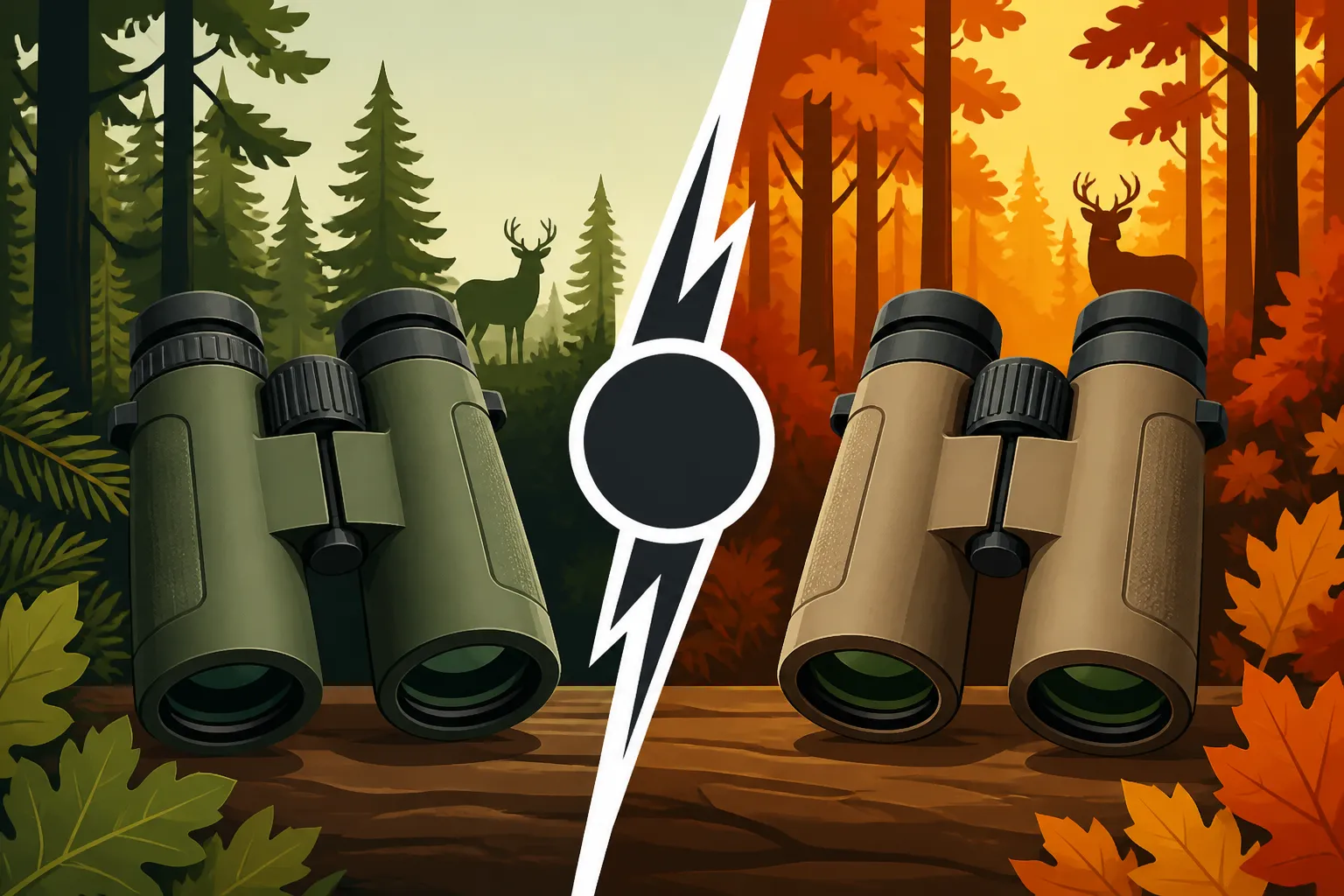
8×42 Versus 10×42 in the Woods
Choosing the right set of binoculars for your Michigan hunting adventures can feel like a surprisingly daunting task. You're standing in the store, looking at two seemingly identical pairs, one labeled 8×42 and the other 10×42, and wondering if that little jump in magnification really makes a difference out in the real world. Many of us have been there, agonizing over the decision, knowing that our optics are a crucial link to spotting that elusive buck or distant gobbler. This guide is here to unravel the mystery, helping you understand the practical differences between 8×42 and 10×42 binoculars and how each performs in the diverse landscapes Michigan throws at us.
Understanding Binocular Specifications: 8×42 vs. 10×42
When you see numbers like "8×42" or "10×42" on a pair of binoculars, you're looking at two fundamental specifications: magnification and objective lens diameter. Understanding what these numbers mean is the first step to making an informed decision for your Michigan hunting trips. It's not just about a bigger number being "better"; it's about what suits your specific hunting style and the terrain you'll be navigating.
The first number, "8x" or "10x," refers to the magnification power. An 8x magnification means that an object viewed through the binoculars will appear eight times closer than it would to your naked eye. Similarly, 10x means it appears ten times closer. So, if a deer is 800 yards away, an 8x binocular makes it look like it's 100 yards away, while a 10x makes it look like 80 yards away. On the surface, more magnification sounds like a clear winner, but it comes with trade-offs, especially in the thick cover we often find in Michigan.
The second number, "42," represents the diameter of the objective lens (the front lens) in millimeters. A larger objective lens gathers more light. For example, a 42mm objective lens is a standard, versatile size that offers a good balance between light-gathering capability and manageable size/weight. This light-gathering ability is crucial for those dim pre-dawn and late-dusk hours when deer are most active, or when you're peering into the shadowy depths of a Michigan cedar swamp. While 42mm is common, you'll also see 32mm (lighter, less light) or 50mm (heavier, more light) options, but 42mm is generally considered the sweet spot for a versatile hunting binocular.
| Feature | 8×42 Binoculars | 10×42 Binoculars |
|---|---|---|
| Magnification | 8 times closer | 10 times closer |
| Objective Lens | 42mm | 42mm |
| Field of View | Wider (easier to scan, track moving objects) | Narrower (harder to scan, track moving objects) |
| Image Brightness | Generally brighter in low light (larger exit pupil) | Slightly dimmer (smaller exit pupil) |
| Image Stability | More stable, less noticeable hand shake | Less stable, hand shake more pronounced |
| Eye Relief | Often more forgiving (easier to use with glasses) | Can be tighter |
| Weight/Size | Often slightly lighter/more compact | Can be slightly heavier/bulkier (due to optics) |
| Ideal Use Case | Thick timber, close/mid-range, moving targets, low light, dense cover | Open fields, long-range scouting, stationary targets, clearcuts |
Exit Pupil and Light Transmission
Beyond just magnification and objective lens size, understanding exit pupil and light transmission is key to evaluating binocular performance, especially in the low-light conditions prevalent during Michigan's hunting seasons. The exit pupil is the diameter of the light beam that exits the eyepiece and enters your eye. You can calculate it by dividing the objective lens diameter by the magnification.
For an 8×42 binocular, the exit pupil is 42mm / 8 = 5.25mm. For a 10×42, it's 42mm / 10 = 4.2mm. In broad daylight, your eye's pupil might constrict to 2-3mm, so both deliver more than enough light. However, as light fades, your pupil can dilate up to 5-7mm in adults (and even larger in younger individuals). This is where the difference becomes noticeable. The 8×42's larger exit pupil means more light can enter your eye when your pupil is dilated, resulting in a perceptibly brighter image in twilight or deep shadows, which is often the case when you're hunting deer during Michigan's November Firearm Deer Season or even during Hunting the Pre-Rut in Late October.
Light transmission refers to how efficiently the binoculars pass light from the objective lens through all the internal prisms and lenses to your eye. High-quality glass and advanced lens coatings significantly improve light transmission, reducing glare and enhancing clarity and color fidelity. You might find a premium 10×42 with better coatings that appears brighter than a cheaper 8×42, despite the exit pupil difference. This is why it's not just about the numbers, but also the quality of the glass and coatings. Always consider this when comparing optics, as a bright, clear image is paramount when trying to distinguish a branch from a deer antler in the low light of a Michigan morning.
Field of View and Stability
Another critical difference between 8×42 and 10×42 binoculars is their field of view (FOV). Field of view refers to the width of the area you can see through the binoculars at a specific distance, usually measured in feet at 1,000 yards. Generally, lower magnification binoculars (like 8x) offer a wider field of view than higher magnification ones (like 10x), assuming the objective lens size is the same.
A wider field of view is incredibly advantageous when you're hunting in thick timber, dense swamps, or other areas with limited visibility common across Michigan. It allows you to scan a larger area quickly, increasing your chances of spotting movement or an animal trying to sneak through the cover. Imagine trying to follow a running deer through thick aspen stands; a wider FOV makes it much easier to keep the animal in your sight picture. It's also a huge benefit for Grouse Hunting Michigan Aspen Cover or Woodcock Hunting Michigan Alder Runs, where fast-moving birds require quick target acquisition.
Stability is also directly impacted by magnification. The higher the magnification, the more exaggerated any hand shake or movement becomes. A 10x binocular will show noticeable jiggle from your natural hand tremors, especially after holding them up for a while or when you're cold and tired. An 8x binocular, due to its lower magnification, is much more forgiving. The image appears steadier, which reduces eye strain and makes it easier to hold on target for extended periods. This stability can be a real game-changer when you're trying to pick apart shadows in a dense Hunting a Funnel Between Two Swamps or identify antler points on a distant buck through a small opening in the woods. For hunters who may have less steady hands or simply want a more comfortable viewing experience, the 8×42 often proves to be the more practical choice.
When 8×42 Shines in Michigan's Woods
The dense forests and varied terrain of Michigan offer unique challenges and opportunities for hunters. In many of these situations, an 8×42 binocular is often the unsung hero, providing a clear advantage where magnification alone isn't the primary need. It's not about seeing further, but seeing better in specific, close-to-mid-range scenarios.
Think about the sheer amount of thick cover we navigate in Michigan, from sprawling state forests to tight private woodlots. Whether you're still-hunting through a cedar swamp or slowly picking apart a hardwood ridge, chances are your shots, and therefore your viewing distances, are going to be under 200 yards, often much closer. In these settings, the benefits of the 8×42 become immediately apparent.
I recall a late October morning during the archery season, hunting a ridge overlooking a series of thick clearcuts in Northern Michigan. The fog was just lifting, and the woods were still dim. I spotted a flicker of movement about 70 yards out. With my 8x42s, I could quickly get on the movement, and the wide field of view allowed me to follow the ghosting form of a buck as it slipped through the young aspen. The steadier image allowed me to pick out the three points on one side, confirming it was a shooter under the local What the Three-Point Rule in Michigan Means before it disappeared. A 10x, with its narrower field of view and amplified handshake, might have made that quick identification much harder.
Superior Field of View for Dense Cover
Michigan hunting, for many, means navigating incredibly dense cover. From the thickest cedar swamps to the regenerating aspen cuts, having a wide field of view (FOV) is paramount. This is where 8×42 binoculars truly excel. Their wider FOV allows you to scan a larger area at once, which is a huge advantage when you're trying to locate a deer that might only be partially visible through the brush.
Imagine still-hunting through a section of new growth in the Huron-Manistee National Forest. You’re moving slowly, stopping frequently to glass ahead. With an 8×42, you can quickly sweep an entire section of regenerating forest, picking out horizontal lines that don't belong, or spotting the flick of a tail through a maze of branches. If you were using a 10×42, you'd have to scan in smaller sections, essentially "panning" more often, increasing the chance of missing something just outside your narrower sight picture. This wider view is crucial for tracking moving game, too; a deer slipping through the pines can be hard enough to follow with your naked eye, let alone with binoculars that give you a tunnel-vision effect. The ability to keep the animal in view as it moves through openings and shadows with an 8×42 means you’re less likely to lose it before it stops.
This superior field of view also benefits hunters pursuing small game or birds in heavy cover. For instance, when Grouse Hunting Michigan Aspen Cover, those birds flush fast and erratically. While you won't be glassing for grouse, the principle of quick target acquisition in dense conditions carries over. Being able to quickly acquire and track a buck through thick cover, similar to how a bird hunter focuses on a flushing grouse, is a skill aided by that wide, forgiving field of view.
Enhanced Low-Light Performance
Michigan hunting often starts and ends in the twilight hours. Those magical moments just after legal shooting light begins and just before it fades are when many big game animals, especially deer and bear, are most active. In these critical low-light conditions, the 8×42 often offers a noticeable advantage in brightness compared to a 10×42 with the same objective lens diameter.
As we discussed, the 8×42 has a larger exit pupil (5.25mm compared to 4.2mm for a 10×42). This means that more light is delivered to your eye's pupil, especially when your own pupils are dilated in dim light. For hunters peering into the dark shadows of a river bottom at dawn, or trying to confirm if that dark shape under a distant oak is a deer as evening sets in, this extra bit of brightness can make all the difference. It might be the deciding factor in distinguishing antlers from branches, or clearly seeing a deer's body language before it commits to an open area. I’ve often found this to be true when Hunting Michigan Swamp Edges for Deer, where shadows are deep and light struggles to penetrate even midday.
While premium optics with superior coatings can somewhat mitigate the inherent brightness difference, generally speaking, an 8×42 will provide a brighter image in challenging light conditions. This can reduce eye strain during extended glassing sessions in the gloom, making you more comfortable and more effective over the course of a long day in the woods, especially during late-season hunts when days are short and light is at a premium. When you're spending hours on a stand during Muzzleloader Deer Hunting in Michigan, often in very cold and dreary December weather, every bit of optical advantage helps keep you sharp.
Greater Stability and Ease of Use
One of the often-underestimated benefits of 8×42 binoculars is their inherent stability. Holding binoculars steady, especially for extended periods, can be a challenge. Whether it's the natural tremor in your hands, the effects of cold, or simply fatigue, any movement is magnified by the optics. With an 8x magnification, this natural shake is less pronounced than with a 10x magnification, resulting in a much steadier image.
This improved stability translates directly to ease of use. You can hold an 8×42 up to your eyes for longer periods without feeling the same level of eye strain or fatigue. This is particularly valuable when you're glassing from an unsupported position, like standing in a treestand, kneeling on the ground, or trying to pick apart a distant hillside from a seated position on a stump. For hunters who may have slightly shaky hands, or for younger hunters just starting out, the 8×42 provides a more forgiving and comfortable viewing experience.
Furthermore, the wider field of view combined with greater stability makes it easier to quickly acquire a target and track it if it moves. Imagine trying to follow a deer that just stepped out of a thicket and is walking briskly across a small opening. With an 8×42, you’re more likely to keep that animal in your sight picture without having to constantly readjust or struggle against image shake. This combination of factors often makes the 8×42 the more practical and user-friendly choice for the majority of Michigan's diverse hunting scenarios, where quick decisions and clear, steady views are often more valuable than simply "more" magnification. This is especially true when you are trying to confirm legal antler points on a quick-moving buck under Michigan's Antler Point Restrictions by DMU rules.
The Advantages of 10×42 for Wider Michigan Landscapes
While 8×42 binoculars excel in many close-quarters Michigan hunting scenarios, there are definitely situations where the extra reach of a 10×42 becomes a significant advantage. If your hunting often takes you to more open environments, across expansive fields, long power lines, or vast clearcuts, then a 10×42 might be your preferred optic. It's about seeing details at greater distances, which can be critical for identifying game before it's within range, or for thorough long-range scouting.
Consider hunting the edge of a large cornfield in southern Michigan farm country, or scanning a sprawling clearcut in the Upper Peninsula. In these environments, deer might be hundreds of yards away, and without that extra magnification, identifying whether it’s a legal buck or just a doe might be impossible. That 10x magnification brings those distant details just a bit closer, making it easier to count antler points, assess body size, or identify specific behaviors that might give away a mature animal.
I remember a time scouting a massive alfalfa field in the Thumb region, miles from any real timber. I was set up on a hillside overlooking the entire field. With my 10x42s, I could clearly see a bachelor group of bucks feeding near the far treeline, almost 800 yards away. The extra magnification allowed me to discern at least one definite shooter from the group and observe their entry and exit points into the field without having to move closer and risk spooking them. This kind of detailed, long-range observation is where the 10×42 truly shines, offering insights you simply can’t get with less powerful optics, especially when you're trying to figure out Where Big Woods Bucks Bed in Michigan from a safe distance.
Increased Detail at Extended Ranges
The most obvious advantage of 10×42 binoculars is their ability to bring distant objects into sharper focus, providing more detail at extended ranges. When you're hunting expansive areas in Michigan, such as the vast clearcuts of the Northern Lower Peninsula, the open agricultural fields in the southern part of the state, or the long vistas across the Upper Peninsula, that extra 2x magnification can make a real difference.
Imagine you're overlooking a sprawling soybean field, and you spot a deer browsing near the far treeline, maybe 500 yards away. With an 8×42, you might be able to tell it's a deer, and perhaps even discern antlers, but confirming legality or estimating body size could be a challenge. With a 10×42, that same deer will appear closer, allowing you to pick out finer details like the number of antler points, ear position, or even subtle differences in a buck's gait. This level of detail is crucial for making informed decisions before you decide to move in for a stalk or if you're assessing trophy potential from a distance.
This enhanced detail is also incredibly valuable for scouting before the season. Using a mapping tool like GoHunt, you might identify vast areas of public land with open fields or clearcuts. From a vantage point, a 10×42 allows you to effectively glass these large expanses, locating bedding areas, travel corridors, or pinch points that might be too subtle to detect with lower magnification. It's about maximizing your ability to extract information from the landscape without having to cover every inch on foot, which can save you valuable time and effort, particularly when trying to scout large areas of Michigan State Forest Hunting.
Better for Open Country and Elevated Positions
If your preferred Michigan hunting spots involve open country, such as large agricultural fields, power lines, open timber, or elevated positions with wide views, then 10×42 binoculars become a powerful tool. In these environments, the slight disadvantage in field of view or low-light brightness is often outweighed by the sheer ability to resolve targets at greater distances.
Think about glassing from a blind set up on the edge of a cut cornfield, hoping to intercept geese or deer. Or perhaps you're on an elevated ridge in the Upper Peninsula, scanning a valley below. In these scenarios, game often appears at long distances, and the goal is to identify it well before it gets close. A 10×42 helps you do just that. You can scrutinize distant treelines for subtle movement, pick out individual birds from a flock hundreds of yards away, or identify small game animals in distant brush piles. This capability is especially useful if you're targeting animals that tend to hang up at longer ranges or are naturally wary of human presence in open areas.
Moreover, in open country, you're often able to use a tripod or other support to stabilize your binoculars. When supported, the primary drawback of 10x magnification – noticeable handshake – is virtually eliminated. This allows you to truly capitalize on the increased power, holding the image perfectly steady to study every detail without fatigue. While not always practical for every hunter, bringing a tripod or using a tree branch as a rest in open terrain can transform your 10×42 into a powerful long-range observation tool, making it ideal for scouting new areas or observing game during Hunting the Peak Rut Week in Michigan when bucks might be cruising far and wide.
Effective for Specific Hunting Methods
Beyond just open country, 10×42 binoculars are particularly effective for certain hunting methods that require precise long-range observation. Hunters who engage in spot-and-stalk tactics, especially for deer or even bear in more open areas of the Upper Peninsula, will find the increased magnification invaluable for thoroughly picking apart terrain before making a move.
For instance, if you're Spot-and-Stalk Bear in the Upper Peninsula, you might be glassing distant hillsides or clearings, looking for a black bear foraging. That extra magnification helps you confirm it's a bear, gauge its size, and determine its direction of travel before you even begin your approach. Similarly, for hunters who spend a lot of time perched on a high point, using a mapping tool like GoHunt to identify potential travel corridors or bedding areas, the 10×42 allows for much more detailed reconnaissance from afar. You can watch deer move between distant cover, noting exact entry and exit points, feeding patterns, and interactions between animals.
Even for turkey hunting in areas where birds are visible across large fields, a 10×42 can help you spot gobblers strutting a quarter-mile away, allowing you to plan your setup without bumping them. Turkey Tactics for Southern Michigan Farms often involve seeing birds at extreme distances before making a move. While an 8×42 is fine for close-up gobblers in the timber, the 10×42 allows you to be much more strategic when working birds in open agricultural landscapes. This focused, long-distance observation capability means you can often gain crucial information and plan your hunt more effectively, reducing the risk of spooking game and increasing your chances of success.
Making Your Choice: Factors Beyond Magnification
Deciding between an 8×42 and a 10×42 isn't just about the numbers; it's a deeply personal choice that should reflect your hunting style, the specific terrain you frequent in Michigan, and even your budget. While the technical specifications give us a baseline, the real-world performance in your hands, under your typical hunting conditions, is what truly matters.
Many hunters, myself included, started with one and found themselves wishing for the other in certain situations. It's common to hear hunters debate this endlessly around a Michigan deer camp fire, each swearing by their chosen optic. The truth is, there's no single "best" answer for everyone. The ideal binocular for someone hunting deep cedar swamps might be very different from the ideal choice for someone glassing open fields on the Michigan-Ohio border.
Before you make a final decision, consider trying both in person. Go to a sporting goods store and step outside with them. Look at objects at various distances, in different light conditions. Better yet, if you have a friend with the other model, take them out to your hunting property. See how each feels in your hands during a long glassing session. Does the 10x feel too shaky? Does the 8x feel like it lacks reach for your preferred spots? These experiential factors are often more important than what the spec sheet says.
Terrain and Habitat Considerations
The type of terrain and habitat you most frequently hunt in Michigan should heavily influence your binocular choice. Michigan offers an incredible diversity of landscapes, from the vast, dense forests of the Upper Peninsula to the rolling agricultural fields of the Lower Peninsula, and everything in between.
If your hunting grounds are primarily dense timber, thick brush, and dark cedar swamps—think the type of cover where deer often get harvested within 100 yards—then the wider field of view and enhanced stability of an 8×42 will likely serve you better. In these environments, quick target acquisition and the ability to scan broad areas of close-range cover are more critical than raw magnification. You're trying to pick apart shadows, spot a flick of an ear, or track a deer as it slips through tight openings. For tasks like Still-Hunting Michigan Cedar Swamps or hunting the edges of Michigan Clearcuts and Aspen Cuts, the 8×42 is often king.
Conversely, if you primarily hunt open terrain such as large agricultural fields, power lines, wide-open hardwoods, or elevated positions that afford long views, a 10×42 will give you the edge. That extra magnification helps you evaluate game at distances where an 8x might leave you guessing. This is especially true when hunting Southern Michigan Farm Country Deer Hunting, where deer can be spotted far across expansive fields. Using a detailed map like those found on GoHunt, you can identify these open areas and plan your hunts accordingly, which might then dictate your optic choice. If your hunting involves extensive scouting from afar or observing wary game at long distances before making a move, the 10×42 will give you the necessary reach.
Personal Stability and Comfort
Your personal physical stability and overall comfort are often overlooked factors when choosing binoculars, but they play a huge role in practical field performance. It's one thing to look through binoculars in a warm, comfortable store; it's another to hold them steady after an hour-long walk into your stand, with adrenaline pumping, or when you're shivering in a late November cold front.
The natural tremor in our hands is always there, and higher magnification binoculars amplify this tremor, making the image appear shakier. If you find your hands aren't particularly steady, or if you're prone to fatigue, an 8×42 will be much more forgiving. The image will appear steadier, reducing eye strain and making it easier to glass for extended periods. This can be especially important if you plan on doing a lot of freehand glassing without the aid of a tripod or other support. For long hours on a deer stand during Cold Weather Sitting Strategy, trying to hold a 10x steady can quickly become a frustrating exercise.
Comfort also extends to factors like eye relief – the distance your eye can be from the eyepiece and still see the full field of view. Some 10x models can have tighter eye relief, which might be an issue if you wear eyeglasses while hunting. Always try on binoculars with your glasses if you wear them. The weight and ergonomics of the binoculars also contribute to comfort. While the objective lens size is the same (42mm), a 10x binocular often has slightly more internal glass, potentially making it marginally heavier. For all-day treks through the Michigan woods, especially when Hunting the Michigan Upper Peninsula for Deer, every ounce counts. Choose a pair that feels balanced and comfortable in your hands, one that you can carry and use effortlessly throughout your entire hunt.
Budget and Quality Considerations
While we've focused on magnification and objective lens size, the quality of the optics themselves plays a huge role, often outweighing the subtle differences between 8×42 and 10×42. A high-quality 8×42 can easily outperform a cheap 10×42 in terms of brightness, clarity, and overall image fidelity. Conversely, a top-tier 10×42 will blow away a mid-range 8×42 in its ability to resolve distant detail.
Your budget will inevitably influence the level of quality you can afford. When you're looking at optics, consider the glass quality (e.g., ED glass), prism type (BaK-4 is generally preferred), and lens coatings (fully multi-coated is best). These factors dramatically impact light transmission, color rendition, and edge-to-edge sharpness. For instance, a premium 8×42 from a reputable brand with excellent coatings might offer comparable, or even superior, low-light performance to a lower-end 10×42.
It's often better to invest in a high-quality 8×42 that delivers exceptional performance than to settle for a mediocre 10×42 just for the sake of higher magnification. A clear, bright, and sharp image, even at 8x, is far more useful than a slightly magnified but dim, blurry, or distorted image at 10x. Many brands offer excellent optics across various price points, so do your research. Read reviews, compare specifications, and if possible, try them out in person. Remember, your binoculars are an investment that should last for many hunting seasons, so prioritize quality and performance within your budget, regardless of the magnification you ultimately choose. Checking user reviews on hunting forums or even on a platform like GoHunt can provide real-world insights into durability and optical performance.
Disclaimer
This article is for general informational purposes only and does not constitute professional advice. Laws, prices and regulations vary by location and change over time. Consult a qualified professional for guidance on your specific situation.