Bone Saws Versus the Gutless Method
One of the most daunting parts of deer hunting, especially for those of us who venture deep into Michigan's vast public lands or find ourselves alone when success strikes, is figuring out how to get that animal from the point of harvest back to the truck. It’s a challenge that can turn a moment of triumph into a grueling physical test. This guide is all about demystifying two primary methods for breaking down a deer in the field – the traditional bone saw method versus the increasingly popular gutless method – so you can decide which approach makes the most sense for your next Michigan hunt.
The Traditional Bone Saw Method: Pros and Cons of a Classic Approach
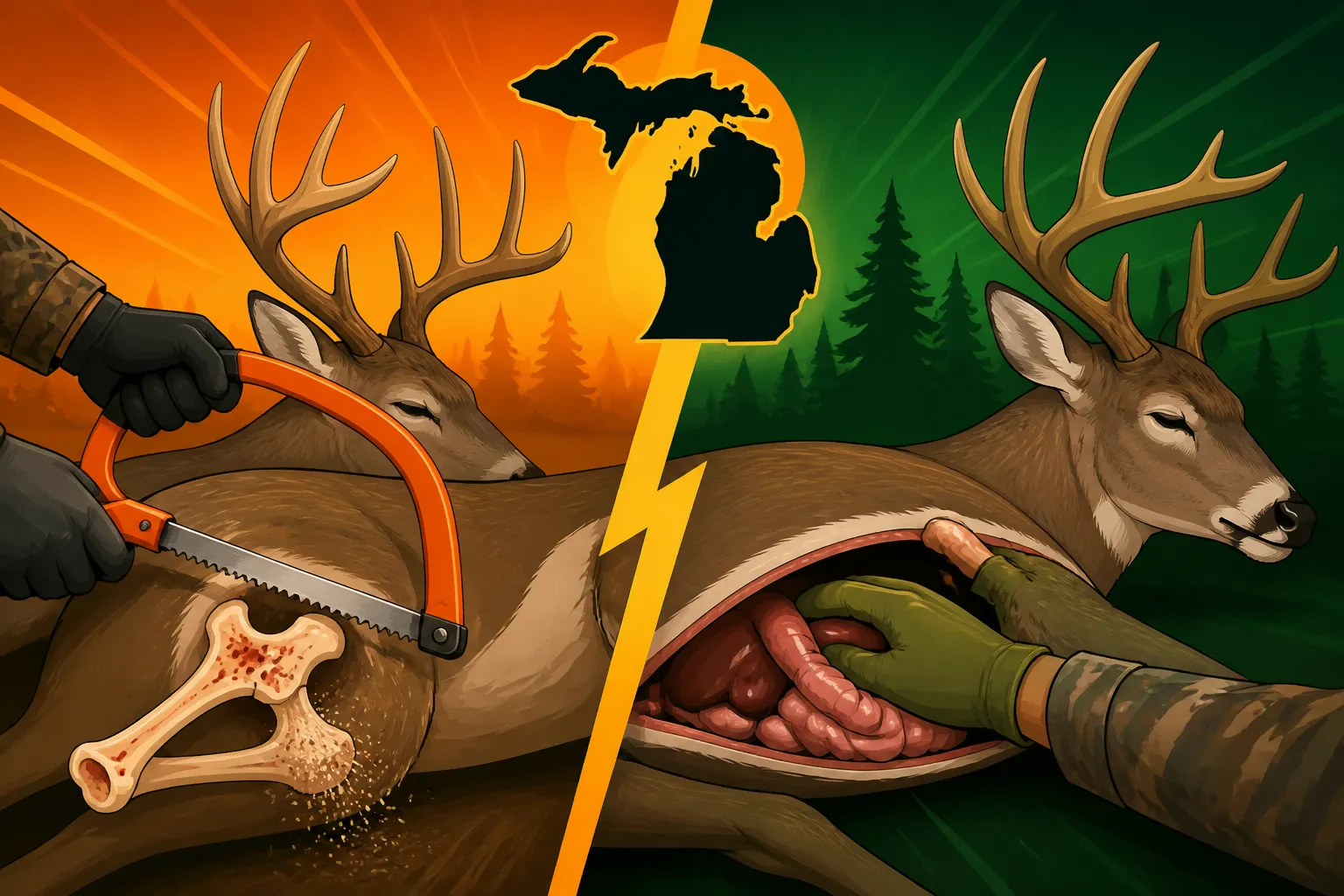
For generations, the bone saw has been a staple in many a Michigan deer hunter’s pack. It's the tool that comes to mind when you picture field dressing, and for good reason: it’s effective for getting through bone and allows for a relatively complete carcass breakdown in the field, assuming you're taking the whole animal out.
When a Bone Saw Shines
A bone saw truly shines when you're fortunate enough to harvest a deer relatively close to a vehicle or an easily accessible trail. Imagine you're hunting a small private tract in southern Michigan farm country, perhaps on the edge of a woodlot that backs right up to your property line. You tag a nice buck and it drops within a hundred yards of the two-track. In this scenario, dragging the deer out intact, or at least only field-dressed, might be perfectly feasible. Once back at the truck, or even just a short haul away, a bone saw becomes invaluable for tasks like splitting the sternum to make evisceration easier, or later, quartering the animal for transport in larger pieces or for easier handling at deer camp.
It’s also the go-to if your plan involves processing the animal at a dedicated skinning shed or a well-equipped deer camp, where you want to keep the carcass as whole as possible for hanging and aging. The saw makes clean, precise cuts through the pelvis and sternum, which are crucial for thorough cleaning and preparation. If you’re a hunter who likes to keep the hide intact for tanning, or perhaps you want to preserve the ribcage for special cuts, a bone saw offers the control to do just that. It’s a clean and efficient tool when you have the space and resources to manage the entire animal. Field Dressing a Deer in Cold Weather is much easier with proper tools and less concern about immediate meat spoilage, making a bone saw more appealing in cooler conditions.
The Downsides of Sawing in the Field
However, the reality of Michigan hunting often means you're far from the truck, deep in a cedar swamp or traversing significant elevation changes in the Upper Peninsula. This is where the bone saw's utility can quickly diminish. First, carrying a bone saw adds weight and bulk to your pack. While some folding saws are compact, even they can be cumbersome when you're already loaded down with stand gear, calls, and safety equipment.
More significantly, using a bone saw for extensive breakdown in the field can be a messy affair. Sawing through bone creates bone dust and fragments, which can cling to the meat, increasing the risk of contamination. If you're trying to quarter an animal on the ground, especially in damp or dirty conditions like a Michigan swamp, it's incredibly difficult to keep the meat clean. The process is also physically demanding. Sawing through the heavy bones of a mature deer’s pelvis or spine takes considerable effort, time, and leaves you winded – not ideal if you then have to pack out heavy quarters. Plus, if you don't have a reliable water source nearby, cleaning the saw and your hands afterward can be a challenge, potentially leaving you with blood-covered gear that could attract scavengers back at camp.
Embracing the Gutless Method: A Modern Approach to Field Processing
The "gutless method" has revolutionized how many backcountry and public land hunters handle their deer. As the name implies, the core idea is to remove all the prime meat from the animal without ever opening the body cavity. This leaves the gut pile and carcass largely intact, and often, right where the deer fell, significantly reducing the weight you need to pack out.
How the Gutless Method Works
The gutless method is essentially an advanced field quartering technique. Here's a simplified overview:
- Positioning and Initial Cuts: First, you roll the deer onto its back, or at least on its side, to access the upper side. You'll make an incision along the spine, from the hip up towards the neck, effectively outlining the "backstrap" meat.
- Skinning: The key is to skin only the side you're working on, peeling the hide back to expose the muscle groups. This keeps the meat clean.
- Removing Quarters: Starting with the hindquarter, you'll locate the ball joint where the femur meets the pelvis. With a sharp knife, you can cut around this joint, detaching the entire hindquarter. The front shoulder is even easier, as it's not connected by bone to the rest of the skeleton – it's held by muscle. A few cuts around the shoulder blade will free the entire front quarter.
- Backstraps and Tenderloins: Once the quarters are off the top side, you can easily slice along the spine to remove the backstrap. Then, for the real prize, roll the carcass onto the skinned side, and you can reach inside the pelvic cavity (still closed, but accessible) from the rear to carefully extract the tenderloins, which lie along the inside of the spine.
- Neck Meat and Other Trim: Don't forget the neck meat, which can be substantial and delicious. You can also trim off any other good muscle groups from the ribs or brisket.
- Repeat on the Other Side: Roll the carcass over and repeat the entire process on the other side.
The goal is to leave the bones and internal organs exactly where they are, taking only the meat. This drastically reduces the weight and mess you have to deal with. It's truly amazing how much less you have to carry when you leave the entire skeletal structure and organ cavity behind. Using a high-quality mapping tool like GoHunt can be a tremendous asset for marking your kill site and ensuring you can navigate back to pack out subsequent loads if needed.
Advantages for Michigan Hunters
For those of us who hunt Michigan's extensive public lands, especially the sprawling state forests of the Northern Lower Peninsula or the remote big woods of the Upper Peninsula, the gutless method is a game-changer. It’s perfect for solo hunters who can’t rely on a buddy to help drag a heavy deer. Instead of a grueling, hours-long drag, you can quickly convert the animal into manageable, packable portions. This is especially true when you find yourself Hunting the Michigan Upper Peninsula for Deer where dense cover and rugged terrain are common.
Consider a scenario where you've punched your tag deep in the Pigeon River Country State Forest, two miles from the nearest two-track, and the temperature is mild. Dragging that whole deer out would be brutal, risking spoilage and exhaustion. With the gutless method, you can process the animal quickly, put the meat into game bags, and carry it out in a Packs for a Day on State Land. This also minimizes disturbance to the area, as you leave much less of a trail than dragging a whole deer would.
Furthermore, in areas where regulations or common sense dictate minimal impact, or perhaps you're on a small, isolated private parcel and want to be discreet, leaving the bulk of the carcass behind is advantageous. It’s also incredibly sanitary compared to a bone saw. Since you never open the body cavity, you significantly reduce the chance of fecal matter or stomach contents contaminating your meat. This is particularly important for Coolers and Game Bags for Early Archery season when warmer temperatures mean spoilage is a bigger concern. The gutless method works wonderfully for processing bear as well, especially Handling a Bear After the Shot in thick cover, where the sheer size and weight of a bear make traditional dragging almost impossible.
Potential Challenges and Considerations
While the gutless method offers many advantages, it's not without its challenges. The biggest hurdle for most hunters is the learning curve. It takes a few attempts to get comfortable with the anatomy and the specific cuts required. Watching instructional videos beforehand and even practicing on a deer or hog you harvest closer to home can make a world of difference. You absolutely need extremely sharp knives – a good fixed blade knife and a replaceable blade knife are often preferred. Knives and Saws Worth Carrying will discuss specific types of blades suitable for this method. Dull knives will make the process frustrating and dangerous.
Another consideration is proper game bags. You'll need durable, breathable game bags to protect your meat from flies, dirt, and debris as you pack it out. The number of bags depends on how many quarters and other pieces you plan to take. While the gutless method keeps the body cavity closed, meat can still spoil if not cooled quickly enough. In warm weather, especially during Michigan’s early archery season, it's critical to work efficiently and get the meat into a cooler as soon as possible. Some hunters choose to pack out an initial load and then return for the rest, using their GoHunt app to pinpoint the exact location of the remaining meat.
Making the Choice for Your Hunt
Deciding between a bone saw and the gutless method often comes down to a few key factors: the location of your harvest, the ambient temperature, whether you're hunting solo or with a group, and your personal preference for processing.
Situational Adaptability
There's no single "best" method that fits every situation. For a deer killed within a short, easy drag from the truck, especially if you have help, bringing the whole animal out for traditional processing with a bone saw might still be the most straightforward option. This is often the case in situations like Deer Drives With Three or Four Hunters where multiple people can assist with the drag.
However, if you're deep in Michigan's state forests, facing difficult terrain, or if the thermometer is climbing, the gutless method quickly becomes the superior choice. Imagine dropping a buck in a remote section of the Hiawatha National Forest. That's not the time for a long, arduous drag. Quartering the animal into manageable packs allows you to carry it out more efficiently, preserving the meat and your energy. Even for smaller deer or younger hunters, the ease of packing out meat can be a significant advantage. Hunting the Liberty Hunt With a Youth could be less intimidating if they only need to carry a quarter, rather than helping drag an entire animal.
| Feature | Bone Saw Method (Traditional) | Gutless Method (Field Quartering) |
|---|---|---|
| Primary Use | Full carcass field dressing, camp processing | Remote field processing, packing out meat |
| Weight to Carry | Minimal (saw only) for field dressing; heavy for whole animal drag | Minimal (knives, bags) for field; light meat pack-out |
| Mess Factor | Can be messy (bone dust, gut removal) | Very clean (cavity remains closed) |
| Ease of Transport | Difficult to drag whole animal; easier with vehicle access | Easy to pack out meat quarters |
| Risk of Contamination | Higher during gutting if not careful; bone dust | Lower, as cavity is not opened |
| Tools Needed | Bone saw, knives | Very sharp knives, game bags |
| Learning Curve | Low for basic field dress; moderate for full breakdown | Moderate to high for initial attempts |
| Meat Care | Good for hanging whole carcass in cool temps | Excellent for immediate cooling and transport |
| Best For | Close to vehicle, deer camp, cooler weather | Remote kills, solo hunting, warmer weather |
Essential Gear Beyond the Cut
No matter which method you choose, a few pieces of gear are non-negotiable. First and foremost, a top-quality, sharp knife (or two). Many hunters swear by a fixed blade for general work and a replaceable blade knife for fine, sharp cuts. You'll also want good quality game bags – not just old pillowcases, but breathable, strong bags designed to protect meat. Disposable gloves are a must for hygiene, especially with the gutless method, where you'll be working hands-on with the meat. A small tarp or contractor bag can also be useful to lay meat on temporarily, keeping it off the ground.
And don’t forget the navigation tools. Whether it's a dedicated GPS unit or an app like GoHunt on your phone, knowing exactly where you are and how to get back to your vehicle is critical. When you're packing out heavy quarters, the last thing you want is to get disoriented. These tools allow you to mark your kill site, track your route, and ensure a safe, efficient extraction. Proper preparation, including understanding these methods, is key to a successful and enjoyable hunting experience in Michigan, whether you're Hunting Michigan's November Firearm Deer Season or Bowhunting Michigan's Split Archery Season.
Disclaimer
This article is for general informational purposes only and does not constitute professional advice. Laws, prices and regulations vary by location and change over time. Consult a qualified professional for guidance on your specific situation.