Late-Season Food Sources for Whitetails
The crisp air of Michigan's late season often brings with it a sense of desperation for many deer hunters. After the general firearm season wraps up, it can feel like the whitetails have simply vanished, leaving behind empty woods and frustrated hunters. The truth is, they haven't disappeared; their priorities have just shifted, and finding reliable food sources becomes paramount for survival in the deep cold. This guide is dedicated to helping you unravel the mystery of late-season whitetail movements by focusing on their crucial food sources, offering realistic strategies to put venison in the freezer when the going gets tough.
The Late-Season Challenge and Shifting Deer Priorities
As Michigan transitions from the frenzy of the rut into the bitter cold of late autumn and early winter, deer change their behavior dramatically. The boundless energy once spent chasing does and establishing dominance quickly gives way to a singular focus on survival. This fundamental shift is the key to understanding where deer will be, and more importantly, what they'll be doing.
Why Food Becomes King in Deep Winter
After the high-octane weeks of the rut, bucks are often run down, having expended significant energy reserves. Does, too, are preparing for the lean months ahead, needing ample calories to support themselves and the fawns they’ll carry through the winter. When temperatures plummet, and snow blankets the landscape, every calorie counts. Deer need to consume high-energy, digestible foods to generate enough body heat and maintain their physical condition. It's a grueling time for them, and they're constantly balancing energy intake with energy expenditure.
This intense focus on survival is precisely why food becomes the ultimate magnet. The big, beautiful woods that were so productive in October and November can seem utterly devoid of deer sign once the cold truly sets in. This often leads to that frustrating feeling that deer have vanished. But rest assured, they haven't; they're simply concentrating their efforts on the most efficient food sources available and the thickest thermal cover nearby. They'll spend less time wandering and more time hunkered down, only moving when absolutely necessary to feed.
Reading the Landscape for Scarce Resources
Successfully hunting late-season whitetails hinges on your ability to read the winter landscape for these scarce yet vital resources. A crucial step involves leveraging modern tools like detailed aerial imagery, which platforms like GoHunt provide. Before the snow flies, you should be poring over these maps, identifying potential agricultural fields, standing timber types, and areas of dense cover. Once the snow hits, it becomes your best friend for scouting. Fresh snow reveals every deer track, showing clear travel corridors, specific browse areas, and even individual feeding preferences.
Look for areas where deer have been pawing through the snow, exposing dormant vegetation or crop remnants. Note how far deer are traveling from their bedding areas to these food sources. In deeper snow, these travel routes will become more defined, forming literal highways. These aren't just random trails; they represent the most energy-efficient paths deer are taking to survive. Identifying these subtle (and sometimes not-so-subtle) clues on the winter landscape is paramount to pinpointing where you should be focusing your efforts.
Identifying Key Natural Food Sources
While some hunters might lament the loss of baiting in much of Michigan, especially in the Lower Peninsula, it forces us to become better naturalists. The good news is, Michigan’s diverse landscape still offers a variety of natural food sources that can draw deer like a magnet in the late season, if you know where to look.
Standing Agricultural Fields: The Obvious Magnets
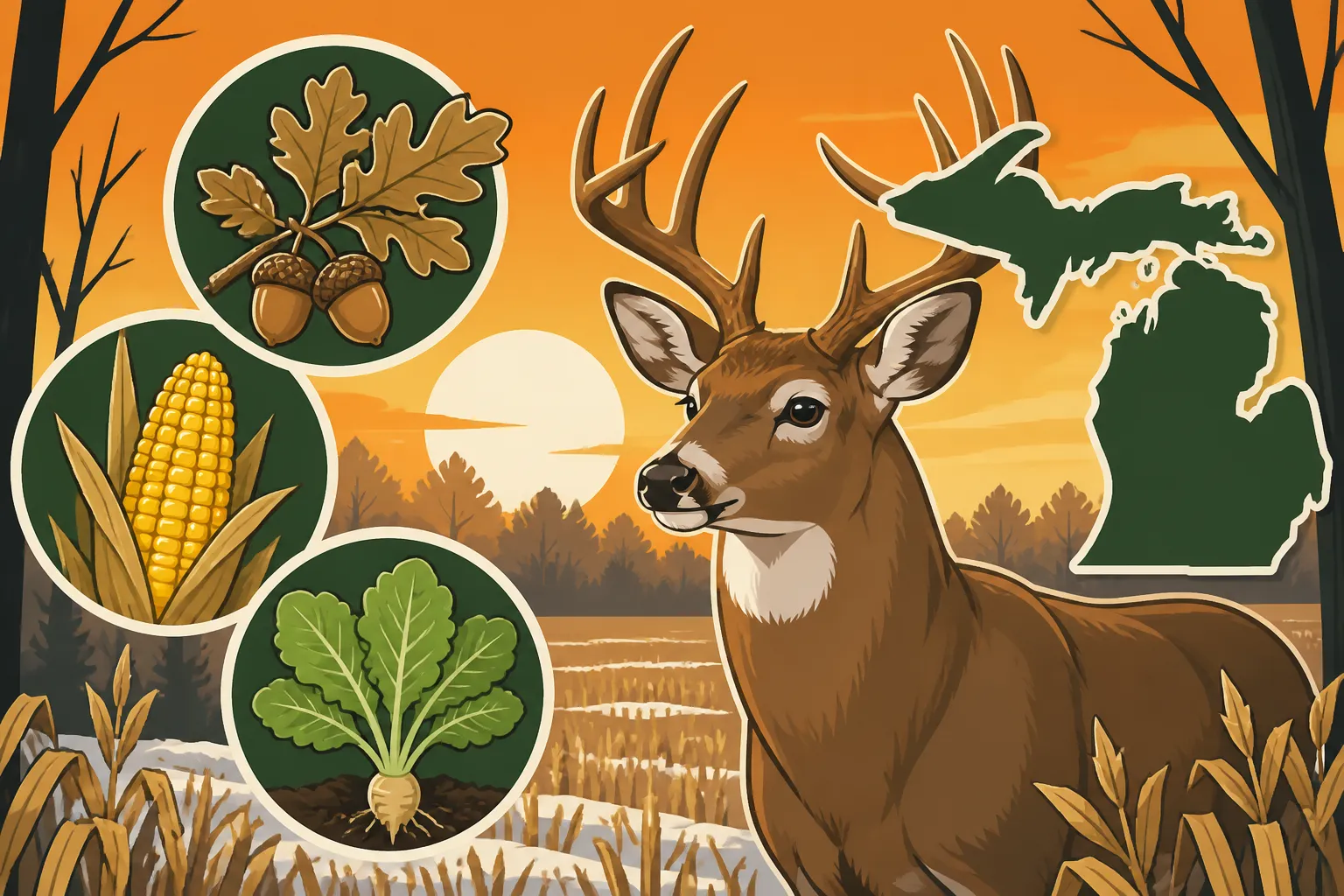
When it comes to high-energy, late-season food, standing agricultural fields are often the undisputed champions. In Michigan's farm country, particularly regions like "the Thumb" or the expansive agricultural lands of Southern Michigan, you might find pockets of unharvested corn, soybeans, or even some brassica crops like turnips or radishes that farmers plant as cover crops or for livestock.
Corn is perhaps the most famous late-season draw. If a farmer leaves even a few rows standing, or if they had a messy harvest, those leftover kernels on the ground become an irresistible buffet for deer seeking quick calories. Soybeans, even after harvesting, can have residual pods with beans that deer will eagerly paw through the snow to find. In areas where winter rye or wheat is planted as a cover crop, deer will graze on the tender shoots once the snow melts or if it's not too deep.
Hunting these fields requires careful planning. Deer will often stage in nearby thick cover, only venturing into the open field in the last hour of daylight, or sometimes even after dark. You’ll need to focus on the field edges, pinch points where deer enter and exit, and be extremely conscious of wind direction. A common mistake is setting up too close to the field in the open; often, the best approach is to find a transition area, a thicket, or a woodline that funnels deer directly to the food. You can learn more about specific strategies for hunting agricultural zones in our guide on Southern Michigan Farm Country Deer Hunting.
Mast Crops and Browse That Still Deliver
Beyond the obvious agriculture, natural food sources can still be goldmines. While most acorns are long gone by late season, don't completely discount them. If you can locate a stand of white oaks that had a bumper crop, and especially if they’re in a low-pressure area, deer will continue to dig through snow and leaves for those precious, less tannic nuts.
Forgotten orchards are another often-overlooked gem. Old apple trees, especially those still bearing fruit, can be absolute deer magnets. Crabapple trees, too, offer a persistent food source. These small, often sour fruits hang on the branches well into winter, providing a consistent energy boost for deer. Many old farmsteads or abandoned properties across Michigan have these hidden treasures.
Then there's browse. While not as calorically dense as corn, browse is the deer's consistent lifeline. In the late season, deer will heavily strip buds and twigs from certain species. Dogwood, sumac, maple, and specific evergreens like cedar and hemlock can provide crucial sustenance. Cedar swamps, for instance, offer not only thermal cover but also palatable browse that deer rely on when other options are buried under snow. A deep dive into understanding deer movement in these areas can be found in our post about Hunting Michigan Cedar Swamps. You'll often see deer yarding up in these areas in harsh winters, making the most of both cover and food.
Cover and Food in Unlikely Places
Deer are masters of efficiency, especially when winter tightens its grip. They'll gravitate towards areas that offer a dual benefit: dense thermal cover and a nearby food source. This means certain timber stands or regenerating areas become prime spots.
Young clearcuts and aspen cuts, often just a few years old, are typically overlooked by hunters focusing on older timber. However, these areas explode with new growth – saplings, shrubs, and briars – that offer excellent browse. The dense network of young trees also provides fantastic thermal cover, protecting deer from brutal winds and heavy snow. A buck might spend his entire day bedded down in a dense patch of regenerating aspen, only moving a few yards to browse on the tender shoots around him.
Similarly, swamp edges, especially those bordering thick cedar, tamarack, or even cattails, provide excellent sanctuaries. The denser vegetation creates a microclimate that’s often warmer than the surrounding woods, and the edges frequently contain palatable browse. Deer will use these areas to escape the elements and feed on the available woody browse without expending too much energy. Understanding where these deer are bedding and why they choose particular spots can be vital, as discussed in detail in Where Big Woods Bucks Bed in Michigan.
Man-Made & Managed Food Sources
While natural food sources are abundant, human intervention also plays a significant role in creating late-season deer magnets. From dedicated food plots to carefully managed timber stands, these areas can concentrate deer, offering prime hunting opportunities.
Food Plots: The Hunter's Late-Season Ace
For those who have access to private land or participate in cooperative land management, strategically planted food plots can be an absolute game-changer for late-season hunting. Unlike the bait piles that are largely restricted in the Lower Peninsula, food plots are a legal and ethical way to provide sustained nutrition for deer. Plots designed specifically for late-season appeal typically feature cold-hardy plants that remain palatable even under snow.
Brassicas, such as turnips, radishes, and rape, are excellent choices. As temperatures drop, these plants convert starches into sugars, making them incredibly attractive and nutritious for deer. Deer will often ignore them earlier in the fall, only to hammer them relentlessly once the first hard frosts arrive and soften the leaves and bulbs. Winter rye and wheat are also fantastic options, offering green forage long after other vegetation has died back. Even standing soybeans, left unharvested, provide a high-protein, high-energy food source that deer will diligently seek out.
The beauty of a well-maintained late-season food plot is its consistency. While natural mast crops can be unpredictable year to year, a planted food plot reliably draws deer. It’s a direct response to the baiting ban in many areas, providing hunters with a valuable tool. To delve deeper into how these managed areas can be implemented, check out our guide on Food Plots Instead of Bait. For hunters seeking comprehensive land management strategies, using detailed mapping services from providers like GoHunt can help you strategically place and manage your food plots for maximum late-season appeal.
Other Attractants (Where Legal) and Considerations
While baiting is a contentious topic in Michigan, it's essential to understand the rules. In the Upper Peninsula and certain areas of the northern Lower Peninsula, baiting is still legal, albeit with specific restrictions on volume and timing. Where legal, a well-placed bait pile can certainly act as a late-season food source, but it comes with its own set of challenges, including attracting other wildlife and the potential for increased disease transmission. Most Michigan hunters, however, operate under the baiting ban outlined in Hunting Deer Without Bait in Michigan, making food plots or natural food sources their primary focus.
Beyond direct food sources, understanding residual attractants and gathering intel is key. Old mineral sites, though not a primary food source, can sometimes hold a lingering appeal. The real intelligence comes from trail cameras. Even in the late season, a trail camera placed over a suspected food source or a well-worn travel corridor leading to one can provide invaluable information on deer movement patterns, timing, and specific preferences. Using a good mapping tool, like the detailed overlays available through GoHunt, to mark camera locations and potential food sources from your scouting efforts can create a powerful advantage. This intel allows you to confirm which food sources are being actively used and when, helping you refine your hunting strategy.
Scouting and Hunting Strategies for Late-Season Food
Successfully hunting Michigan's late-season whitetails demands a combination of diligent scouting, meticulous planning, and a deep understanding of deer behavior in harsh conditions. It's a game of patience and precision, where every detail matters.
Pre-Season and In-Season Scouting for Leftovers
Effective late-season hunting doesn't start in December; it begins weeks, if not months, earlier. Your pre-season scouting efforts should include identifying potential late-season food sources like unharvested agricultural fields, neglected apple orchards, and areas of dense browse. Pay attention to how farmers harvest their crops – a sloppy harvest means more leftover corn or beans. Mark these spots on your digital maps, perhaps using an app that integrates with services like GoHunt, which can help track specific details of your finds.
Once the snow falls, your in-season scouting truly begins. Snow is the ultimate truth-teller. It clearly reveals deer tracks, showing you not just where deer are moving, but how they’re moving. Follow fresh tracks to understand their travel routes from bedding to feeding. Observe where they paw through the snow to access forage. Are they hitting the standing corn? Are they browsing on specific dogwood thickets? This real-time intelligence is invaluable. Look for areas with concentrated droppings, indicating heavy feeding activity. These small details paint a comprehensive picture of deer activity. You can learn a lot from Scouting Michigan Public Land Before Season even if you are hunting private land, as many of the principles apply.
Patience and Precision in the Cold
Late-season deer are wary. They've been hunted for months, and their survival instinct is at its peak. This means your hunting strategy needs to be refined. Instead of hunting directly over the food source, especially in open fields, consider setting up on the travel corridors leading to the food. Deer will often emerge from thermal cover and stage in the timber before committing to an open field. Intercepting them during this staging phase can be highly effective.
Your entry and exit routes become even more critical in the late season. Deer are often bedding close to their food sources to minimize energy expenditure. Any disturbance can send them packing. Utilize terrain features, wind direction, and existing cover to approach your stand or blind undetected. Speaking of stands, understanding Treestand Setups in Michigan Hardwoods is still relevant, but for late season, ground blinds are often a better choice, offering warmth and concealment, especially when set up on a field edge and properly brushed in.
The impact of wind and thermals is magnified in the cold. Deer will almost always approach a food source with the wind in their favor, circling to scent-check the area. Be meticulous about your wind direction, and if hunting near open fields, be aware of how thermals might shift at dawn and dusk. This is not the time for casual hunting; it demands a strategic mindset and an understanding of Cold Weather Sitting Strategy to remain effective and comfortable.
The Importance of Thermal Cover Near Food
In the depths of a Michigan winter, deer prioritize thermal cover almost as much as food. They simply cannot afford to expend precious energy battling the elements. This means that the most productive late-season food sources will almost always be located close to heavy thermal cover. Think dense conifer swamps (cedar, spruce, pine), thick clearcuts, or deep, protected ravines.
Deer will bed in these areas, protected from wind and snow, and only move a short distance to feed. This proximity minimizes their exposure to the cold and reduces their energy output. When scouting, don’t just look for food; look for food that has immediate access to thick, insulating cover. A standing cornfield might be a magnet, but if there isn’t a dense woodlot or cedar swamp directly adjacent to it, deer may not use it as consistently during daylight hours in severe cold.
Understanding how to identify and hunt these areas that combine food and cover is paramount. The ability to read maps and aerial photos, a skill often enhanced by platforms like GoHunt, to pinpoint these specific landscape features can give you a significant advantage. Focus on bottlenecks, funnels, and transition lines that connect bedding cover to feeding areas. These are the late-season hotspots where you're most likely to encounter a whitetail that has made it through the rigors of Michigan's hunting seasons and is now fighting for survival.
| Food Source Type | Primary Appeal | Typical Location | Hunting Strategy Considerations |
|---|---|---|---|
| Standing Agricultural | High caloric energy | Farm fields (corn, beans, brassicas) | Morning/evening movements, entry/exit, thermal cover nearby |
| Browse (Dogwood, Sumac) | Persistent, accessible | Regenerating cuts, swamp edges, forest openings | Still-hunting, focus on thickets, snow tracking, close to cover |
| Hard Mast (Acorns) | High energy (if available) | Oak ridges, mature timber (sparse late-season) | Check for remaining nuts, focus on transition areas from cover |
| Soft Mast (Apples) | Sweet, accessible (if present) | Abandoned orchards, old homesteads | Evening sits, check for fresh tracks, often near heavy cover |
| Food Plots (Brassicas, Rye) | Consistent, tailored energy | Private land, managed areas | Monitor with cameras, focus on travel lanes, wind awareness |
Disclaimer
Hunting involves inherent risks. Always prioritize safety, understand and adhere to all Michigan hunting regulations, and respect wildlife. This guide is for informational purposes only and does not substitute professional advice or hands-on experience.