What Counts as an Antler Point in Michigan
There's nothing quite like the rush of spotting a buck, heart pounding as you raise your optics, trying to decide if he's the one. But for many Michigan deer hunters, that moment is often clouded by a specific, nerve-wracking question: "Does that actually count as a point?" With Michigan's antler point restrictions (APRs) varying across different Deer Management Units (DMUs), understanding precisely what constitutes a legal antler point is absolutely crucial to avoid costly mistakes and enjoy a responsible hunt. This guide will clarify the official definition, walk you through real-world scenarios, and help you make confident decisions in the field.
Navigating Michigan's Antler Point Restrictions
Michigan's deer hunting landscape is wonderfully diverse, from the thick cedar swamps of the Upper Peninsula to the sprawling farm fields of the Lower. Just as varied are the rules governing antlered deer in certain areas. It's not a statewide blanket rule, which is why a lot of hunters find themselves scratching their heads or, worse, making assumptions that could lead to trouble.
The Purpose Behind the Rules
Let's be honest, nobody likes more rules, but Michigan's antler point restrictions aren't just there to make your life harder. The Michigan Department of Natural Resources (DNR) implements APRs with a few key goals in mind. Primarily, it's about shifting the buck age structure to create a healthier, more balanced deer herd. By protecting younger bucks, especially those 1.5 years old, they're given a chance to mature, spread their genetics, and grow larger antlers. This can lead to a more balanced buck-to-doe ratio, which can improve breeding success and overall herd vitality.
Another significant benefit is the potential for improved hunting experiences. When a higher percentage of bucks survive to older age classes, hunters have the opportunity to pursue more mature animals, often with larger racks. It’s about quality over quantity for many who hunt in these special regulation areas. You can learn more about how these rules influence the deer herd in our detailed piece on Buck Age Structure Under Michigan APRs.
Understanding Your DMU's Specifics
The biggest hurdle for many hunters is realizing that APRs are not universal across the state. They are implemented on a DMU-by-DMU basis. You might hunt in a county where any antlered buck is legal, drive thirty minutes, and be in an area with a mandatory 3-point or 4-point rule on one side. This variability is designed to address specific herd management objectives in different regions. For instance, areas with high hunting pressure might benefit more from APRs than remote, big-woods country where deer already mature naturally.
It's your responsibility as a hunter to know the regulations for the specific DMU you plan to hunt before you ever step foot in the woods. This means checking the Michigan DNR's current hunting digest or using online resources. Many modern hunting apps, like GoHunt, offer mapping layers that can show DMU boundaries and associated regulations right on your phone, which is incredibly helpful when you're scouting new ground. Don't rely on word-of-mouth from last season, as rules can occasionally change. Our comprehensive guide on Michigan Antler Point Restrictions by DMU offers an in-depth look at where these rules apply.
The Official Definition of an Antler Point in Michigan
This is where the rubber meets the road, folks. The frustration often stems from seeing a "point" that looks like a point to the naked eye but doesn't quite meet the legal definition. Misinterpreting this can lead to an illegal harvest, and nobody wants that. The Michigan DNR has a very specific criterion that you absolutely must understand.
The Golden Rule: One Inch Matters
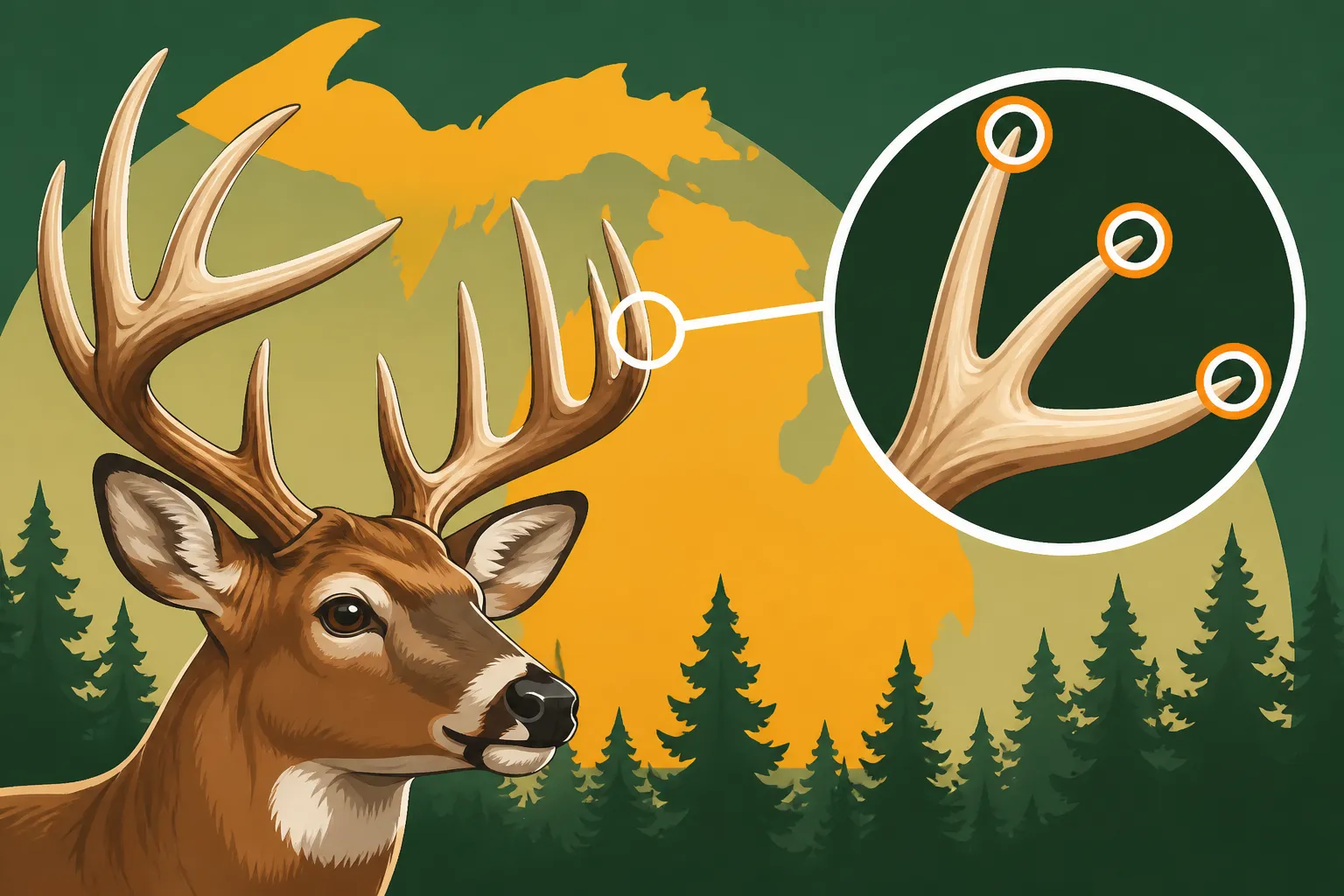
In Michigan, for an antler projection to count as a legal point, it must meet two critical conditions:
- Length: The projection must be at least one inch long.
- Diameter: It must be at least one inch in length when measured from its tip to the nearest edge of the main beam or another tine. This often trips people up. It's not just about how long it is; it's also about its base. Essentially, it needs to be a distinct projection, not just a burr or a tiny bump.
Think of it like this: if you could hook a one-inch-long piece of string over the tip of the projection and measure it down to the main beam, and that measurement is one inch or more, and the base itself is substantial enough to clearly be a point, then it counts. This rule is designed to distinguish true tines from mere bumps, abnormal growth, or remnants of velvet shedding that aren't actually part of the antler's structure.
Where Points Can Originate
One common misconception is that a point must be a specific type of tine, like a G2 or G3, or that brow tines are somehow different. That's simply not the case in Michigan. As long as a projection meets the one-inch length and diameter rule, its location on the antler is irrelevant.
- Brow Tines (G1s): Yes, these absolutely count if they meet the criteria. Many bucks legal under a 3-point rule will have brow tines that contribute to their point count.
- Main Beam Projections: If the main beam itself forks or has a distinct projection coming off it that measures one inch or more in length and diameter, it counts.
- Split Tines/Forks: Often, a main tine will split into two distinct points. If both of those splits meet the one-inch rule, they both count individually.
The key is always that one-inch standard. Don't get caught up in whether it's a "true" fork or just a gnarly looking main beam. Measure it.
What Doesn't Count as a Legal Point
Equally important as knowing what does count is understanding what doesn't. This is where most hunters run into trouble, especially in the heat of the moment or when field-judging a buck in poor light.
- Burrs: The rough, bony growth at the base of the antler, where it meets the pedicle on the skull, does not count as a point, no matter how gnarly or pronounced it might appear.
- Small Bumps or Knobs: If a projection is less than one inch long or doesn't have that distinct one-inch length-from-base measurement, it's not a legal point. These are often just irregularities in the antler growth.
- Broken Tines: This is a big one. If a tine was clearly a legal point at one time but has broken off, leaving only a stub that is now less than one inch, it no longer counts. You're counting what's currently present and meets the rule, not what was there.
- Main Beam Irregularities: The main beam itself, no matter how long, is considered one continuous structure. Only distinct projections off the main beam count as points. If the main beam has a slight bend or a lumpy spot, but no distinct projection meeting the one-inch rule, it's not a point.
Real-World Scenarios for Counting Points in the Field
Knowing the rules on paper is one thing, but applying them in a cold, dim Michigan woods with a buck walking by at 30 yards is an entirely different beast. This is where most hunters feel the crunch. The split-second decisions required can be incredibly stressful, and it's easy to second-guess yourself later.
The Pressure of the Moment: Making Quick Decisions
Imagine this: You've been sitting for hours, maybe on a marginal cold day in Michigan's November Firearm Deer Season, and suddenly a buck steps out into a small opening. The adrenaline surges. He's moving quickly, maybe through some brush that obscures his rack. You've got a narrow window to assess if he meets the 3-point or 4-point rule for your DMU. In these moments, your brain can play tricks on you. That small nub looks bigger, or a broken tine appears whole. The frustration of trying to accurately count points under such pressure is a feeling every hunter in APR zones knows all too well.
It's during these high-stress situations that mistakes are most often made. You don't have a measuring tape, you don't have perfect light, and you certainly don't have all day. That's why preparation and conservative judgment are your best friends. We have a whole article dedicated to the considerations of Counting Antler Points From a Stand that delves into this challenge.
Tools and Tactics for Better Judgment
While you can't bring a tape measure into the stand, you can certainly equip yourself with tools and habits that improve your chances of making the right call.
- Good Optics: A quality pair of binoculars is not a luxury; it's a necessity in APR zones. Binoculars like those from Vortex or Leupold can make a world of difference in discerning small tines and estimating their length. Don't skimp here. Check out our advice on Binocular Choice for Michigan Whitetails for more insights.
- Rangefinders: While primarily used for distance, a rangefinder can sometimes give you a clearer, steadier view of a buck's antlers, allowing for a better count. It stabilizes your view and focuses your eye. Learn more about their utility in Rangefinders in Thick Cover.
- Patience and Positive ID: If there's any doubt, wait. If the buck is moving too fast, if the light is bad, or if he's partially obscured, let him walk. It's far better to pass on a legal buck than to accidentally shoot an illegal one. This is perhaps the hardest advice to follow, but the most important. As we discuss in Passing a Buck You Cannot Count, taking the ethical high road is always the right call.
- Pre-season Study: Spend time looking at photos of deer with varying antler configurations. Train your eye to recognize that one-inch standard. The more you "practice" judging antlers, the better you'll become in the field.
When in Doubt, Opt for Caution
This is the golden rule when hunting in an APR zone. If you are not 100% certain that a buck meets the minimum point requirement for your DMU, do not take the shot. It’s that simple, and it saves a lot of heartache and potential legal issues. A responsible hunter understands that ethical hunting means following the rules to the letter, even if it means missing an opportunity.
Post-Harvest Antler Point Verification and Compliance
Okay, you’ve made the shot, and the deer is down. Congratulations! Now comes the moment of truth where you physically verify the point count. This step is just as important as the field judgment, as it confirms your compliance with the law and ensures you report your harvest accurately.
A Step-by-Step Guide to Counting Accurately
Once you have hands on the antlers, take your time and follow these steps to ensure an accurate count:
- Examine Each Side Separately: Start with one side, then move to the other. This helps prevent double-counting or missing points.
- Locate the Main Beam: Identify the primary antler beam coming off the pedicle.
- Identify All Projections: Systematically run your hand or eye along the main beam, looking for any projection coming off it.
- Measure Each Projection: For every projection you find, use a measuring tape or ruler.
- Place the end of the tape at the tip of the projection.
- Measure straight down the projection to the nearest edge of the main beam or the nearest distinct tine.
- If that measurement is one inch or greater, and the projection is clearly distinct, it counts.
- Count Only What Qualifies: Add up all the projections that meet the one-inch rule on both sides of the rack.
- Don't Forget the Brow Tines: Ensure you include any brow tines that meet the criteria.
This meticulous process ensures you’re not guessing and that your count is accurate according to Michigan regulations.
Common Misinterpretations and How to Avoid Them
Even with the deer in hand, it's easy to make mistakes if you're not careful.
- Wishful Thinking: It's natural to want that buck to be legal, especially after a long hunt. Be objective. Don't round up or convince yourself a 7/8-inch projection is "close enough."
- Confusing Burrs with Points: The base of the antler can be very rough. Remember, any growth below the main beam, originating from the pedicle, is part of the burr and does not count as a point.
- Ignoring the Diameter Aspect: Some hunters only focus on length. Remember, it needs to be a distinct projection, not just a scratch or a very thin sliver that happens to be an inch long. The "length from the main beam" part of the rule helps clarify this – it implies a certain amount of mass and distinctness.
- Counting Broken Tines: Reiterate: if it's broken and now measures less than an inch from its tip to the main beam, it doesn't count.
The Michigan DNR's rules on what counts as an antler point are very clear. Here's a quick reference to help solidify your understanding:
| Antler Feature | Does it Count as a Point? | Notes |
|---|---|---|
| Projection ≥ 1 inch long | YES | Must also be 1 inch in length from its tip to the nearest edge of the main beam or another tine. |
| Brow Tine (G1) | YES | If it meets the one-inch length and diameter requirements. |
| Split Tine / Fork | YES (each distinct part) | Each distinct projection must meet the one-inch length and diameter rule individually. |
| Main Beam "Kickers" | YES | Any distinct projection off the main beam that meets the one-inch rule. |
| Main Beam Itself | NO | The main beam is a continuous structure; only projections off it count. |
| Burrs (at antler base) | NO | Bony growth around the pedicle is not considered a point. |
| Bumps/Nubs < 1 inch | NO | Any projection that does not clearly measure one inch or more in length and diameter. |
| Clearly Broken Tine | NO | If it was once a point but is now broken off and measures less than one inch. |
| Velvet Shreds/Irregularities | NO | Not distinct bony projections; often just loose material or minor bumps. |
The Serious Business of Miscounting
Let's not sugarcoat this: shooting a buck that doesn't meet the legal antler point requirements in an APR zone is a serious violation. The consequences can be significant and are designed to deter illegal activity and protect the herd management goals.
Typically, an illegal antlered deer harvest can result in substantial fines, potentially hundreds or even thousands of dollars depending on the specific circumstances and if it's a repeat offense. Beyond the financial hit, you could face the loss of your hunting privileges for a period of time, which means you won't be able to buy licenses or participate in hunting seasons. In some severe cases, additional legal actions might be taken. It’s definitely not worth the risk. You can find more information about these consequences in our article on Michigan Wildlife Violation Penalties.
Ultimately, the responsibility rests squarely on your shoulders as the hunter. The Michigan DNR provides ample resources, including their annual hunting digests, their website, and the useful The Michigan DNR Hunt Fish App which can help you verify DMU regulations. If you're ever truly unsure, consult with a conservation officer or another trusted resource before taking a shot or validating a tag. Understanding your Michigan Deer Management Units is key to staying legal and ethical in the field.
Disclaimer
Please note: The information provided in this guide is for general informational purposes only and is not a substitute for the official Michigan hunting regulations. Hunting laws and regulations can change, and it is the hunter's sole responsibility to consult the most current Michigan DNR Hunting Digest and local ordinances for specific and up-to-date information before hunting. Always prioritize safety and ethical hunting practices.