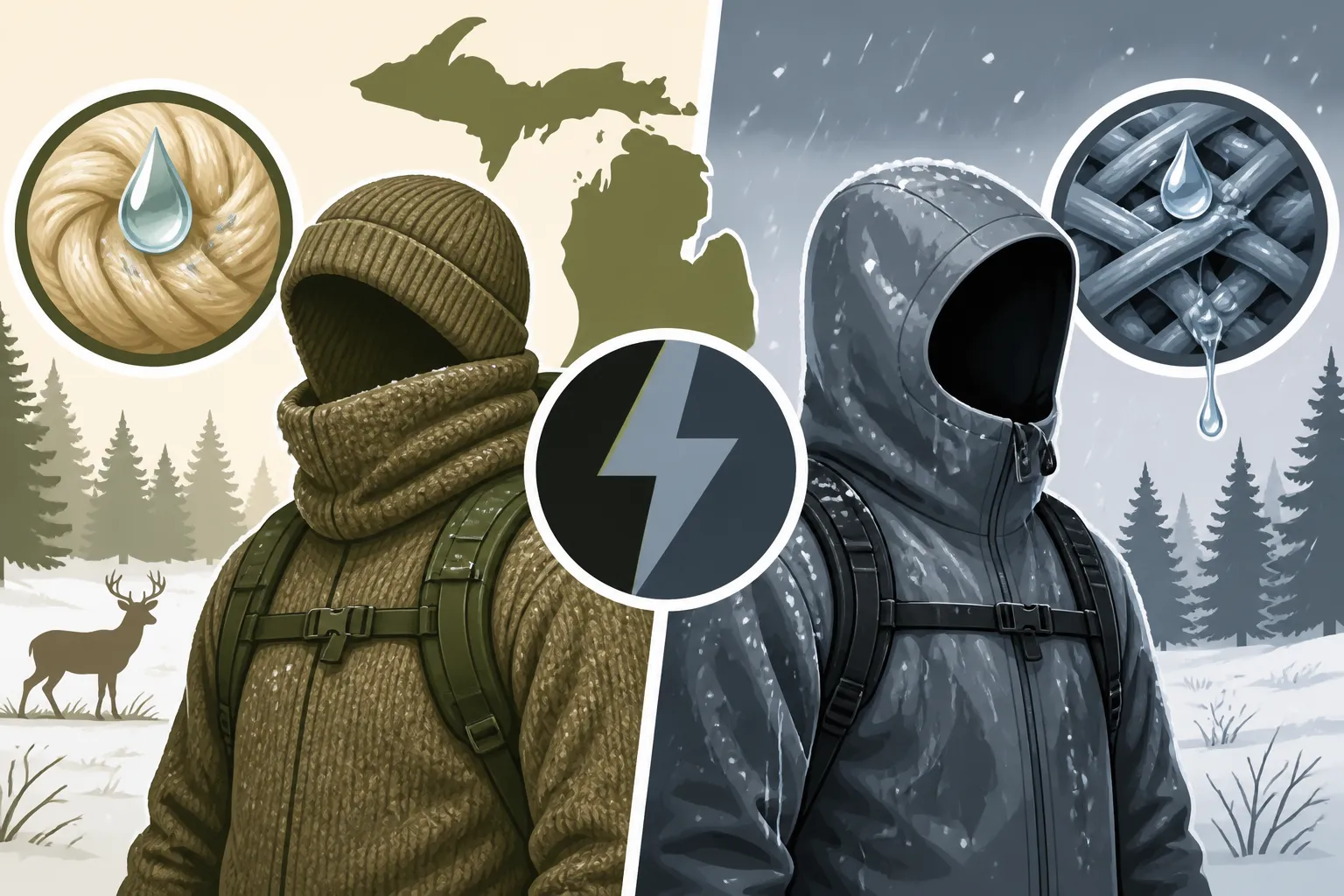
Wool Versus Synthetics in Wet Snow
There's nothing quite like the feeling of a crisp Michigan morning in the deer woods, but that feeling can turn miserable fast when wet snow starts falling, soaking through your gear and chilling you to the bone. Every hunter who's spent more than a few days out knows the struggle of staying warm and dry when the weather takes a turn. This guide will dive deep into the age-old debate of wool versus synthetic hunting apparel, helping you understand their strengths and weaknesses when faced with Michigan's infamous wet snow, so you can make informed choices to stay comfortable and effective.
Understanding the Challenge: Wet Snow in Michigan
Michigan weather, especially during hunting season, is a fickle beast. One day it's a dry, cold snap, perfect for crunching through fallen leaves, and the next it's a relentless, heavy wet snow, clinging to every branch and soaking right through your "waterproof" outer shell. This isn't just a minor inconvenience; it's a critical factor that can make or break a hunt, affecting your comfort, focus, and even your safety.
The Unique Misery of Michigan's Wet Snow
When we talk about wet snow in Michigan, we're not always talking about light, fluffy flakes. Often, especially during the crucial firearm and late archery seasons, it's heavy, moisture-laden snow that falls at temperatures right around freezing. This kind of snow melts almost on contact with anything even slightly warmer than freezing, be it your jacket, your backpack, or the ground you're sitting on. It creates slushy trails, drips constantly from trees, and turns what might otherwise be beautiful winter scenery into a damp, chilling experience. Imagine still-hunting through a cedar swamp in early December, and every time you brush against a branch, a cascade of cold, melting snow dumps down your neck. It’s enough to make even the most seasoned hunter consider heading back to the truck. This is precisely why hunters here talk so much about reliable gear.
Why Staying Dry is Key in the Cold
The primary reason wet snow is such a killer for hunter comfort is its ability to wick away your body heat. Water conducts heat away from your body much faster than air does. So, if your clothes get wet, whether from external moisture like snow or internal moisture like sweat, your body has to work overtime to maintain its core temperature. This leads to shivering, muscle stiffness, and a rapid decline in focus. You’re not glassing that distant ridge for deer movement; you’re dreaming of a warm campfire. Furthermore, wet clothing takes up more space and can restrict movement, making it harder to quietly draw a bow or shoulder a rifle. For prolonged exposure, especially when sitting still on a stand, staying dry isn't just about comfort—it's about preventing hypothermia, even in seemingly mild freezing temperatures. Your ability to withstand a prolonged sit in a Michigan November often hinges entirely on how well your clothing system manages moisture. Cold Weather Sitting Strategy is crucial for success.
The Timeless King: Wool for Hunters
For generations, wool has been the gold standard for outdoor enthusiasts, and for good reason. Before the advent of modern synthetics, wool was the only game in town for reliable warmth in adverse conditions. Its natural properties make it incredibly well-suited for the demands of hunting, especially when the weather turns nasty and wet. There's a certain romanticism about wool, perhaps because it connects us to a long line of hunters who relied on its warmth and durability.
Merino Wool's Magic: Warmth When Wet
One of wool's most celebrated attributes, particularly fine merino wool, is its ability to retain warmth even when wet. Unlike cotton, which loses almost all its insulating properties once damp, wool fibers are structured in a way that allows them to continue trapping air even when they absorb moisture. This means that if you get caught in a heavy, wet snowstorm, or if you work up a sweat while dragging a deer, your wool layers won't leave you feeling instantly freezing. The fibers themselves are naturally crimped, creating countless tiny air pockets that provide insulation. Think about those chilly, damp mornings in November when the fog rolls in, then turns to a spitting rain mixed with snow. Your wool base layers and mid-layers will still be working hard to keep you comfortable, even if your outer shell isn't holding up its end of the bargain. Many hunters swear by high-quality merino as their base layer for this very reason. Base Layers for a Michigan November are a critical part of any successful hunt.
Durability and Quietness in the Woods
Beyond its warmth-when-wet capability, wool offers several other significant advantages for the Michigan hunter. It's remarkably durable, resisting snags and tears from brush and thorns better than many delicate synthetics. A good wool outer layer can withstand years of abuse in the thickets and swamps. Moreover, wool is inherently quiet. There's no rustle or crinkle when you move, which is absolutely critical when still-hunting or drawing a bow on a wary whitetail in close quarters. Imagine a buck just 30 yards away, and your synthetic jacket makes a slight swish every time you shift your weight – that's often enough to send him bounding away. Wool, on the other hand, moves silently with you, allowing for those subtle adjustments that lead to success. Its natural elasticity also allows for a good range of motion, which is essential for climbing into a stand or navigating uneven terrain. For those who rely on stealth, wool is often the preferred choice.
Wool's Downsides: Cost and Care
While wool is fantastic, it's not without its drawbacks, and these are important to consider for anyone building out their hunting wardrobe. First and foremost, quality wool, especially merino, can be significantly more expensive than synthetic alternatives. This initial investment can be a deterrent for many hunters, especially those just starting out or on a tighter budget. You might get sticker shock looking at a full wool layering system. Secondly, wool requires more careful cleaning and maintenance. It's prone to shrinking if washed incorrectly (hot water and high heat dryers are wool's enemy), and it can take longer to dry than synthetics. If you're on a multi-day hunting trip where you need to quickly wash and dry clothes, this can be an issue. Additionally, some people find wool to be itchy, though modern merino wools are much finer and softer, often mitigating this problem. Finally, while it retains warmth when wet, it can become quite heavy when saturated, which is something to consider if you anticipate a lot of heavy, prolonged rain or wet snow.
The Modern Contender: Synthetic Materials
For those of us who grew up in the era of fleece and space-age fabrics, synthetics represent the cutting edge of performance apparel. They’ve revolutionized everything from running shoes to hunting jackets, and their dominance in many outdoor markets is undeniable. While wool holds a revered place, synthetics bring a different set of advantages to the Michigan hunter, especially when it comes to speed and specific conditions.
Fleece and Polyester: Quick-Drying and Light
Synthetic materials, primarily polyester and various forms of fleece, excel at being lightweight and incredibly fast-drying. This is a huge advantage when you're dealing with intermittent wet weather or when you're highly active. A polyester base layer, for instance, will wick moisture away from your skin and dry out much quicker than a wool equivalent. This means if you're hiking into a remote spot in the Hunting the Michigan Upper Peninsula for Deer and break a sweat, your synthetic layers will transport that moisture to the surface where it can evaporate, helping you stay dry internally. If your synthetic mid-layer gets damp from a brief wet snowfall, it will shed that moisture and dry out quickly once the snow stops, preventing that prolonged clammy feeling. They’re also typically much lighter than wool, making them excellent choices for packing in long distances or for layering without adding bulk. The packability of synthetic puffy jackets, for example, is truly remarkable.
Insulation Power and Packability
Modern synthetic insulation, such as Primaloft or Thinsulate, often found in puffy jackets and vests, provides an exceptional warmth-to-weight ratio. These materials are engineered to mimic the loft and warmth of down but with the added benefit of performing better when wet. A synthetic puffy jacket can be incredibly warm while compressing down into a tiny package in your backpack, ready to be pulled out for an extra layer during a stand sit. This packability is a huge boon for hunters who need to adapt to changing temperatures throughout the day. You might start your morning with a brisk walk, needing minimal layers, but once you're on stand for Hunting the Peak Rut Week in Michigan, you’ll want that extra insulating layer to combat the chill. Synthetics allow for this kind of dynamic layering system without burdening you with excessive weight or bulk.
Synthetics' Weaknesses: Smell and Burn
While synthetics offer many advantages, they also have their Achilles' heel. One of the biggest complaints from hunters is their tendency to retain body odor. Unlike wool, which has natural antimicrobial properties, polyester and fleece can quickly start to smell after a few days of hard hunting, even with specialized treatments. This is a significant disadvantage when you're trying to remain undetected by a deer's keen nose. Imagine being winded by a buck because your synthetic base layer, worn for three days straight, is screaming "human!" Another major drawback is their vulnerability to sparks and heat. Sitting too close to a campfire can quickly melt or burn holes in synthetic fabric, rendering it useless. For those who enjoy the warmth of a fire at deer camp or during a break in the woods, this is a real concern. Finally, while generally durable, some synthetic fabrics can be noisy, producing a swishy sound against brush, which can compromise stealth.
Real-World Scenarios: When to Choose Which
The choice between wool and synthetics isn't always cut and dry; often, it depends heavily on the specific hunting scenario you find yourself in. Michigan offers a diverse range of conditions, from frosty clear mornings to biting wet snowstorms, and understanding how each fabric performs in these situations can make all the difference in your comfort and success.
Sitting on Stand in a Wet Snowfall
This is perhaps one of the most challenging scenarios for any hunter. You're trying to remain absolutely motionless, which means your body isn't generating much heat, and you're exposed to falling, wet snow. In this situation, the debate between wool and synthetics truly shines a light on their core differences. For your inner layers – think base layers and perhaps a mid-layer – wool really earns its keep. Its ability to retain warmth even when damp means that if snow starts to melt and seep in, or if you had a bit of a hike to your stand and broke a sweat, you won't immediately feel that penetrating chill. A quality merino wool base layer under a mid-weight fleece or wool sweater, all topped with a truly waterproof outer shell, is a fantastic combination.
However, for your outer layer, especially in a steady, wet snowfall, you absolutely need a reliable waterproof synthetic jacket and pants. While wool can handle some dampness, it's not truly waterproof and will eventually saturate. A silent, waterproof shell with good DWR (Durable Water Repellent) treatment is paramount. The key is to keep the wet snow from ever reaching your insulating layers. If you're a fan of high-tech gear, brands like GoHunt often feature excellent waterproof-breathable synthetics designed for these exact conditions, helping you stay dry from the outside in, while also allowing internal moisture vapor to escape. Combining a wool inner layer for warmth-when-wet performance with a synthetic waterproof outer layer is often the winning strategy here. Rain Gear for a Michigan Downpour will make a huge difference in your comfort.
Active Hunting in Snowy Swamps
Now, let's consider a completely different scenario: actively Still-Hunting Michigan Cedar Swamps in several inches of wet snow. This is high-exertion hunting, often involving pushing through thick brush, climbing over fallen logs, and slogging through slushy terrain. Here, the quick-drying and lightweight properties of synthetics truly come into their own. You're going to sweat, period. No matter how cold it is, that physical exertion will generate heat and moisture.
Synthetic base layers and mid-layers will excel at wicking that sweat away from your skin and allowing it to evaporate quickly, preventing that clammy, chilled feeling when you slow down or stop. They're also less prone to absorbing large amounts of water and becoming heavy if you accidentally step into a deeper puddle or slip in a creek. For this kind of hunting, a durable synthetic outer layer that can shed snow and resist abrasions from brush is also ideal. Look for something that balances toughness with breathability. GoHunt's gear reviews often highlight pieces that are built for active pursuits, emphasizing moisture management and durability. While wool can still work, the rapid drying time and lighter weight of synthetics often give them an edge for high-movement, high-sweat hunts in wet snow. Paired with reliable waterproof Rubber Boots for Swamp Walking, you'll be set.
Layering Strategies for Michigan's Variable Weather
Michigan weather is rarely static. You can start the day with temperatures in the teens and a light dusting, only for it to warm up to near freezing by midday with a heavy, wet snowfall, then drop again in the evening. This variability demands a smart layering strategy, and both wool and synthetics play crucial roles in building that system.
A solid layering system starts with a base layer, moves to mid-layers for insulation, and finishes with an outer layer for protection from the elements.
For base layers, many hunters prefer merino wool because of its comfort, natural odor resistance, and the aforementioned warmth-when-wet. It's the closest thing to a second skin you can get.
For mid-layers, you have more flexibility. A lightweight synthetic fleece can be great for active periods due to its quick-drying properties, while a heavier wool sweater or jacket might be preferred for stationary sits for its superior warmth retention.
The outer layer is almost always where synthetics shine for wet conditions. A waterproof-breathable membrane (like Gore-Tex or similar technologies) is crucial to keep external moisture out while still allowing internal sweat vapor to escape. This is where brands often differentiate themselves, offering different levels of waterproofing and breathability. Your ability to adjust these layers throughout the day—adding or removing them as your activity level or the weather changes—is what keeps you comfortable and focused. GoHunt often reviews these layering systems in detail, highlighting how different pieces interact to provide optimal performance. A well-thought-out system allows you to adapt to whatever Michigan throws at you. For more insights, check out Layering for a Michigan Deer Stand.
| Feature | Wool (Merino) | Synthetics (Polyester, Fleece) |
|---|---|---|
| Warmth When Wet | Excellent, retains significant insulation | Good, but generally less than wool; quick-drying |
| Drying Time | Slower | Fast |
| Weight | Heavier when wet, moderate dry weight | Lightweight, even when damp |
| Odor Control | Excellent, natural antimicrobial properties | Fair to good (often treated), can retain odor |
| Quietness | Very Quiet | Can be noisy (swishy) in some fabrics |
| Durability | Good, resistant to snags | Varies, can be durable but prone to melting |
| Comfort (Feel) | Soft (Merino), can be slightly itchy (traditional) | Generally soft and smooth |
| Cost | Higher initial investment | Lower to moderate |
| Care | Requires careful washing, air dry often | Easier to wash, machine dryable |
| Fire Resistance | Good (resists sparks) | Poor (melts, burns easily) |
Beyond the Fabric: The Importance of a System
While the choice between wool and synthetics for your core layers is critical, it's just one part of a much larger equation. Hunting in Michigan's variable and often brutal conditions requires a complete system, where every piece of gear works together to keep you warm, dry, and hidden. Overlooking any single component can compromise your entire setup, leading to discomfort and, potentially, an early end to your hunt.
Outer Layers and Waterproofing
No matter how good your base and mid-layers are, they're only as effective as your outer layer's ability to keep external moisture at bay. In wet snow, a truly waterproof and breathable outer shell is non-negotiable. This means investing in a jacket and pants with a robust waterproof membrane and taped seams. While some "water-resistant" fabrics might shed light snow for a short period, they will eventually wet out in a prolonged or heavy wet snowfall. Once your outer layer fails, the wet snow starts to saturate your insulating layers, and that's when the misery begins.
Pay attention to features like adjustable cuffs, hoods that fit well over hats, and storm flaps over zippers. These small details prevent snow and water from creeping in. Many brands offer excellent synthetic waterproof shells that are designed to be quiet for hunting. Remember, the goal isn't just to keep water out; it's also to allow sweat vapor to escape, preventing you from getting soaked from the inside out when you're moving. A quality outer layer, even a lightweight one, should be carried on every trip where wet weather is a possibility. When considering your Packs for a Day on State Land, always account for a compact rain shell.
Base Layers: The Foundation of Warmth
Your base layer is the first line of defense against both cold and moisture, making it arguably the most important component of your entire system. It sits directly against your skin, and its job is twofold: to wick sweat away from your body and to provide initial insulation. This is where the wool versus synthetic debate is most poignant. A good base layer will move moisture away from your skin, keeping you dry. If it gets saturated and stays wet, it will draw heat away from your body, even if your outer layers are doing their job.
For cold, sedentary hunting in Michigan, many hunters prefer merino wool base layers because of their natural warmth and odor-fighting properties. For active hunting, synthetics like polyester excel at rapid moisture transfer and quick drying. You might even consider having both types: a merino top for stand hunting and a synthetic one for active pursuits. Whichever you choose, ensure it fits snugly against your skin without being restrictive. The closer the fit, the more efficiently it can wick moisture. Investing in high-quality base layers will pay dividends in comfort throughout the season.
Head, Hands, and Feet: Critical Contact Points
It's easy to focus solely on your torso and legs, but neglecting your extremities is a common mistake that can quickly lead to discomfort and premature ending of a hunt. Your head, hands, and feet are critical areas for heat loss, and they are often the first to get cold and wet in snowy conditions.
For your head, a warm, moisture-wicking hat is essential. Wool or fleece beanies are excellent choices, and a balaclava can provide extra protection for your face and neck in bitter cold or driving snow. For hands, a layered approach often works best: a thin, dexterity-providing glove as a liner (often synthetic or merino), covered by a warmer, waterproof mitt or glove for when you're not actively manipulating your firearm or bow. And for your feet, a quality pair of Insulated Boots for All-Day Sits paired with appropriate socks is non-negotiable. Wool socks are highly favored for their warmth-when-wet properties and cushioning. Ensure your boots are truly waterproof and fit well enough to accommodate thick socks without cutting off circulation. Nothing saps morale faster than cold, wet feet in a Michigan deer swamp.
A true hunting system is like a chain; it's only as strong as its weakest link. GoHunt often emphasizes the importance of a complete system, from head to toe, ensuring that every piece of gear contributes to your overall comfort and effectiveness in the field.
Disclaimer
This article is for general informational purposes only and does not constitute professional advice. Laws, prices and regulations vary by location and change over time. Consult a qualified professional for guidance on your specific situation.