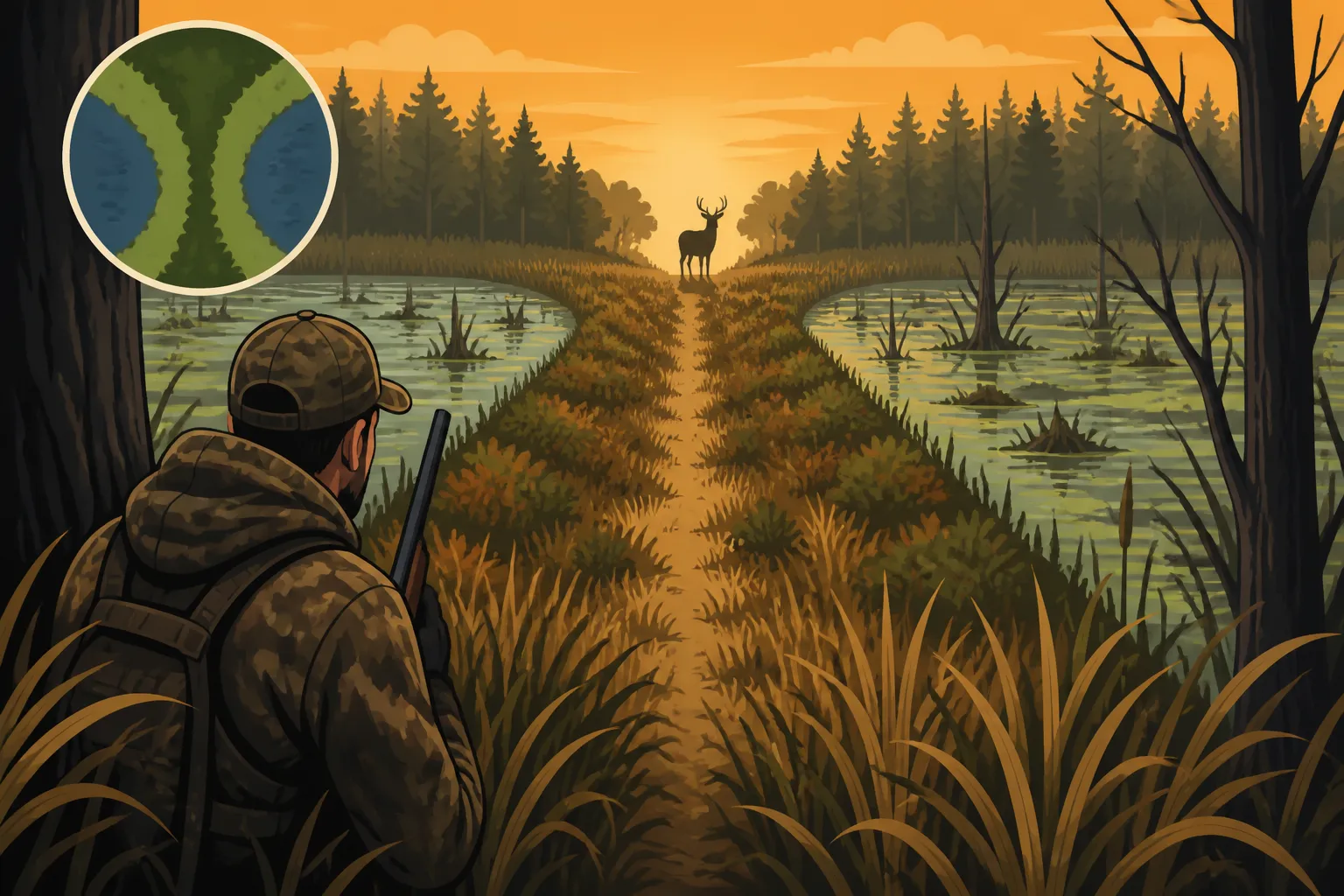
Hunting a Funnel Between Two Swamps
There’s nothing quite as frustrating as seeing deer sign everywhere you scout, only for those big Michigan bucks to vanish come opening day. We’ve all been there, scratching our heads, wondering where they went. Oftentimes, these elusive deer aren't truly gone; they've simply retreated to the most secure, impenetrable spots they can find, using specific travel corridors to navigate them safely. One of the most overlooked, yet incredibly productive, hunting strategies in Michigan revolves around understanding and exploiting these natural travel routes, especially the subtle funnels that connect two seemingly isolated swamps. This guide will walk you through how to identify, scout, and effectively hunt these deer superhighways, turning those frustrating disappearances into successful encounters.
Understanding Swamp Funnels and Deer Movement
Michigan is blessed with an abundance of diverse habitats, and few are as critical to whitetail deer as our vast swamps. From cedar bogs in the Upper Peninsula to lowland hardwood swamps in the Lower, these wet, thick areas offer unparalleled security and resources. Understanding why deer gravitate to these areas and how they navigate between them is the first step to successful hunting.
Why Swamps Are Deer Magnets
Swamps, for a deer, are akin to an impenetrable fortress. They offer dense thermal cover, protecting deer from harsh winter winds and deep snow, or providing shade and relief during a hot early archery season. Think about those frigid December days when the wind howls – a deer tucked into a thick cedar swamp is well insulated and out of sight. During warmer periods, the cool, moist air and shade within a swamp provide a respite from the sun and biting insects. Beyond mere comfort, these areas are often incredibly difficult for humans to access, providing a sanctuary where deer feel safe from hunting pressure. This is a critical factor, especially on public land.
Beyond cover, many Michigan swamps offer a surprising array of food sources. While we often think of acorns and agricultural fields, swamps can provide vital browse year-round. Young dogwood, willow, and other woody shrubs thrive in these moist environments, offering continuous sustenance. Even cattails, in a pinch, can be a food source. The edges of these swamps, where upland meets wetland, are transition zones that are rich in diverse plant life. Deer often spend their daylight hours bedded deep within the thickest parts of the swamp, only venturing out into more open areas or higher ground under the cover of darkness. This pattern of behavior makes understanding their travel corridors between these sanctuaries absolutely essential. You'll find deer use these areas for more than just bedding; they'll often stage here before moving to primary food sources or use them as a secure travel route to get from one part of their range to another. For a deeper dive into how deer use these wet areas, check out our article on Hunting Michigan Swamp Edges for Deer.
Identifying Natural Funnels Between Swamps
Now, a swamp might seem like one big, unnavigable tangle, but deer don't just randomly wander through it. They are creatures of efficiency and safety. When two significant swamps are relatively close to each other, deer will almost always find the path of least resistance and greatest security to travel between them. This is where the concept of a "funnel" comes into play. A funnel, in this context, is a narrow strip of land, often slightly elevated or less densely vegetated, that connects two larger areas of prime deer habitat like swamps. These funnels can be subtle – a small ridge of higher ground, a narrow band of hardwoods between two lowland bogs, or even a dry finger of land extending into a wet area. The key characteristic is that deer prefer to use this path over slogging through deeper water or thicker brush.
Before you even step foot in the woods, tools like GoHunt can be invaluable for identifying these potential funnels. Using the detailed topo and satellite imagery on GoHunt, you can often spot these subtle elevation changes or narrower sections of timber that connect larger swamp complexes. Look for areas where the contour lines pinch together, indicating a natural bottleneck, or where satellite images show a distinct change in vegetation type, suggesting a drier travel corridor. Sometimes these funnels are obvious, like a long, narrow timber stand. Other times, they're barely perceptible on a map, perhaps just a slight rise in elevation that allows deer to keep their hooves mostly dry. The deer will choose the easiest, safest route, and often, that means staying just inside the edge of the cover, where they have both concealment and an easy path. Understanding how to Reading a Michigan Cedar Swamp for Deer can give you even more insights into these crucial travel lanes.
Scouting and Locating Key Funnel Features
Finding a potential funnel on a map is one thing; confirming its active use by deer and identifying prime stand locations is another entirely. This requires dedicated, intelligent scouting, paying close attention to the subtle cues deer leave behind.
Reading the Sign: Tracks, Rubs, and Scrapes
Once you've identified a promising funnel on your maps, it's time to put boots on the ground. Your goal is to confirm that deer are actively using this corridor and to pinpoint the specific micro-funnels or pinch points within it where you should set up. The most obvious sign of deer activity is tracks. Look for well-worn trails, especially where multiple trails converge into a single, defined path within the funnel. Heavy, fresh tracks indicate recent and consistent use. Pay attention to the size of the tracks – larger prints can point to mature bucks. You'll often find these trails just inside the edge of the thicker cover, where deer feel most secure.
Beyond tracks, keep an eye out for rubs and scrapes. Rubs, where bucks strip bark from saplings and small trees, are essentially signposts. A consistent line of rubs along a funnel, especially fresh ones, is a clear indicator that bucks are using this route, particularly during the pre-rut and rut phases. Similarly, scrapes – disturbed patches of ground where bucks urinate and paw, often under an overhanging branch – serve as communication hubs. Finding scrapes within a funnel, particularly active ones, signals that bucks are regularly passing through and checking for does. The combination of tracks, rubs, and scrapes, especially if they're fresh and consistently spaced, is a strong signal that you've found an active, high-traffic corridor. For more information on identifying these crucial calling cards, check out Scrape Lines Along a Two-Track. If you find these signs, it's not just a deer trail, it's a deer highway.
Wind Direction and Thermal Considerations
When scouting a funnel, it’s not enough to simply find deer sign; you must also consider the ever-present variables of wind and thermals. These natural forces dictate how deer move and, crucially, where you can effectively set up without alerting them to your presence. In Michigan, especially in swampy areas, the wind can be fickle, and thermals play an enormous role. Thermals are air currents that move due to temperature differences: cold air sinks, and warm air rises. In the morning, as the sun warms the land, thermals tend to rise, pulling scent uphill or out of low-lying areas. In the evening, as the air cools, thermals reverse, carrying scent downhill or into low spots.
Hunting a funnel effectively means understanding how the wind and thermals will carry your scent. You want your stand placement to be downwind or crosswind of the anticipated deer travel, but also above the thermals in the morning and below them in the evening. For example, if a funnel runs along a slight ridge connecting two swamps, you might want to be on the side of the ridge where your scent will blow away from the deer’s approach. However, if deer are walking directly through a narrow, low-lying funnel, you need to be very careful that shifting thermals don't swirl your scent directly into their path. Always remember that deer rely heavily on their sense of smell. Neglecting wind and thermals will result in busted hunts, no matter how perfect the sign. For a more detailed look at these atmospheric factors, our guide on Wind and Thermals on Michigan Ridges offers excellent insights, many of which apply to subtly elevated funnels too.
Stand Placement and Hunting Strategies
Once you’ve identified an active funnel and understand the wind and thermal dynamics, the next critical step is to strategically place your stand or blind and implement effective hunting strategies. This isn't just about getting high in a tree; it's about making yourself invisible and setting yourself up for a shot.
Optimal Stand Locations within the Funnel
Choosing the right spot for your stand is paramount. In a funnel, deer are often moving with purpose, and you need to intercept them without being detected. Look for a location that offers excellent shooting lanes along the main trail, but also provides enough cover for you to draw your bow or shoulder your firearm without silhouetting yourself. A common mistake is setting up too close to the main trail in thick cover, limiting your shooting opportunities or making it hard to go undetected. Conversely, setting up too far away might mean deer pass just outside your effective range.
Consider setting up on the downwind side of the main travel corridor, allowing your scent to blow away from the approaching deer. If the funnel offers a slight bend or a natural pinch point, these are often high-traffic zones. You might find a single dominant tree, like a mature oak, that offers a good perch for a treestand. Ensure your entry and exit routes to and from the stand are quiet and don't cross the anticipated deer travel paths. An entry route that approaches from the opposite side of the funnel from where deer are expected is often ideal. For example, if deer are typically coming from the north swamp, approach your stand from the south. Sometimes, a well-brushed-in ground blind can be just as effective, especially in areas with limited suitable treestand trees or during firearm season when you might be still-hunting into a setup. Our guide on Using a Ground Blind on Michigan State Land provides valuable tips for optimizing ground blind setups, including brushing them in effectively. Remember, the goal is to be a ghost in their living room. Think about how deer will approach and where they will feel safe moving, and then place yourself where you can intercept them without alarming them, even down to the subtle ways you handle Entry Routes on Flat Michigan Ground.
Timing Your Hunt: Rut and Weather Conditions
Hunting a swamp funnel effectively also means knowing when to be there. While deer use these corridors year-round, certain times of the season and specific weather conditions will amplify their activity, increasing your chances of success. Without a doubt, the pre-rut and peak rut are prime times to hunt these funnels. During the rut, bucks are actively searching for does, and these secure travel corridors become high-traffic highways. A buck looking for a receptive doe will often follow these predictable routes between bedding areas and feeding areas, or between two different groups of does. This is when a mature buck, usually nocturnal, might be seen moving during daylight hours, making himself vulnerable. Our article on Hunting the Pre-Rut in Late October details how bucks begin expanding their range and searching, making these funnels hot spots. For the absolute best opportunity, be in your funnel stand during Hunting the Peak Rut Week in Michigan.
Beyond the rut, weather plays a significant role. Cold fronts, especially early in the season, can trigger increased deer movement as they forage more actively. The first significant snowfall can also push deer to utilize the most sheltered and defined travel routes, making funnels even more crucial. Conversely, warm, high-pressure days often lead to decreased deer activity, and you might be better off saving your pressure for a more opportune time. Knowing these patterns and being able to predict when deer will be most active in your chosen funnel can make all the difference, especially when you consider the sheer number of hunters out during Michigan's November Firearm Deer Season. A funnel provides security during these high-pressure times.
Gear and Tactics for Success in Swamp Funnels
Hunting Michigan's swamp funnels requires more than just a stand and a bow or gun. The unique environment demands specific gear choices and refined tactics to maximize your chances of success and ensure your comfort and safety.
Essential Gear for Wet and Thick Cover
Michigan swamps are notorious for being wet, muddy, and thick. Your gear needs to reflect these conditions. First and foremost, invest in high-quality, waterproof boots. Rubber boots are often preferred as they keep your feet dry and reduce scent transfer, a huge advantage when walking through damp leaves and mud. Lacrosse and Muck Boots are popular choices among Michigan hunters for a reason. Pair these with good wool socks to wick away moisture and provide warmth, even if they get damp. Next, proper rain gear is non-negotiable. A quiet, waterproof jacket and pants will keep you dry during unexpected Michigan downpours, which are common throughout the fall and early winter. Look for materials that don't rustle or make noise when you move, as stealth is key in these close-quarter environments.
Layering your clothing is also critical. Michigan weather can be unpredictable, with significant temperature swings from morning to afternoon. Start with a moisture-wicking base layer, add insulating layers (fleece or wool are excellent), and top it with your waterproof outer shell. This allows you to adapt to changing conditions without overheating or getting cold. Lastly, don't overlook your optics. Since funnels often mean hunting in shaded, low-light conditions, especially within or near thick swamps, good binoculars and a quality rifle scope are crucial. Look for binoculars with excellent light-gathering capabilities, such as 8×42 or 10×42, to pick out details in the dim light. Our guide on Binocular Power for Timber Hunting delves into this in more detail. If you're using a rifle, a scope with good low-light performance and an illuminated reticle can be a game-changer when those dark swamp bucks step out right at legal shooting hours. You can learn more about picking the right glass in Rifle Scopes for Low-Light Swamps.
Calling and Decoying Strategies in Funnels
While funnels are natural travel corridors, you can sometimes enhance their effectiveness with strategic calling and, in limited situations, decoying. During the pre-rut and rut, grunt calls and rattling can be incredibly effective in pulling a curious buck off his travel path and into your shooting lane. When a buck is cruising a funnel, he’s often looking for action. A well-timed series of grunts can mimic another buck or a searching doe, piquing his interest. Rattling can simulate a fight between two bucks, which is a powerful attractant during the rut. However, volume is key. In the close confines of a swamp funnel, you don't need to be overly aggressive with your calls; a more subtle approach is often more realistic. Our comprehensive guide on Rattling and Grunting in Michigan provides in-depth tactics for using these calls effectively in various Michigan habitats.
Decoys, on the other hand, require a more cautious approach in thick funnels. While a large buck decoy might work in an open field, in a narrow, brushy funnel, it can look unnatural and be difficult to position. If you do consider a decoy, a smaller, bedded doe decoy or a simple silhouette might be more appropriate. The goal is to present a realistic visual that confirms the "sound" of your calls without creating a spooky, out-of-place image. Often, in a tight funnel, the risk of a decoy alerting or alarming deer outweighs the potential benefit, especially if the deer are already using the funnel consistently. Your primary tactic should always be stealth and precise stand placement, with calls as a secondary, augmenting strategy.
| Stand Type | Pros | Cons | Ideal Funnel Scenario |
|---|---|---|---|
| Treestand | Elevated view, scent dissipation, stealth. | Limited tree choices, noisy setup, dangerous if not careful. | Funnels with mature, straight trees; good visibility. |
| Ground Blind | Great concealment, warmth, scent containment. | Limited visibility, deer can spot unnatural shapes, difficult entry. | Funnels with thick underbrush, no suitable trees, hunting with youth. |
| Saddle Hunt | Highly mobile, versatile, minimalist. | Learning curve, exposed in small trees, requires specific trees. | Narrow funnels, constantly changing deer patterns, run-and-gun. |
Disclaimer
Hunting is an inherently dangerous activity. Always prioritize safety, follow all local and state regulations, and ensure you have the proper training and licensing. The advice provided here is for informational purposes only and should not replace professional instruction or personal judgment. Be aware of your surroundings, hunt ethically, and respect wildlife.