Setting Up on an Aspen Cut Edge
Finding consistent deer activity in Michigan's ever-changing landscape can feel like a guessing game, especially when familiar timber stands get cut or habitat shifts. Many hunters drive past what looks like a messy clearcut, assuming deer avoid such areas. But trust me, an aspen cut edge, when understood and hunted correctly, can be an absolute magnet for whitetails. This comprehensive guide will pull back the curtain on why these dynamic habitats are so productive and show you precisely how to identify, scout, and set up your stand or blind to capitalize on the deer movement along these critical transition zones.
The Irresistible Allure of Aspen Clearcuts for Michigan Deer
Aspen clearcuts might look chaotic to the untrained eye, but for a Michigan whitetail, they represent a goldmine of resources. These aren't just random patches of removed timber; they're often carefully managed areas designed to promote new growth, benefiting a host of wildlife, especially deer.
More Than Just Food: Cover and Regeneration
When a stand of mature aspen is clearcut, the forest floor is suddenly exposed to sunlight, triggering a vigorous regeneration of aspen sprouts. This isn't just a few saplings; it's often thousands of young shoots per acre, creating an incredibly dense, almost impenetrable thicket within a few years. For deer, especially young bucks and does with fawns, this means unparalleled security cover. They can bed down in these areas, hidden from predators and human disturbance, feeling safe and secure.
Beyond security, these regenerating cuts provide excellent thermal cover. In Michigan's brutal winters, those thick stands of young aspen can trap warmth and block chilling winds, offering deer a much-needed sanctuary. Conversely, in the summer, the dense canopy can provide shade from intense sun. It's a year-round shelter that mature, open hardwoods simply can't offer. This dynamic interplay of cutting and regeneration is why understanding Hunting Michigan Clearcuts and Aspen Cuts is so vital for consistent success.
A Buffet of Browse and Forage
The sheer volume of new growth in an aspen clearcut creates an instant food plot on a massive scale. Deer are primarily browsers, and those tender, young aspen sprouts are incredibly nutritious and palatable. As the cut ages, other pioneer species like sumac, dogwood, and various forbs also colonize the area, adding to the smorgasbord. This provides an almost continuous supply of high-quality forage throughout the spring, summer, and fall.
Even as the aspen grows taller, reaching the sapling stage, deer will continue to browse the lower branches and any secondary growth that can still reach. During the late season, when acorns and other primary food sources might be depleted or buried under snow, these areas can still offer vital sustenance. Hunters keen on understanding Late-Season Food Sources for Whitetails will often find deer concentrated around these browse-rich pockets when the pickings are slim elsewhere.
Creating Funnels and Travel Corridors
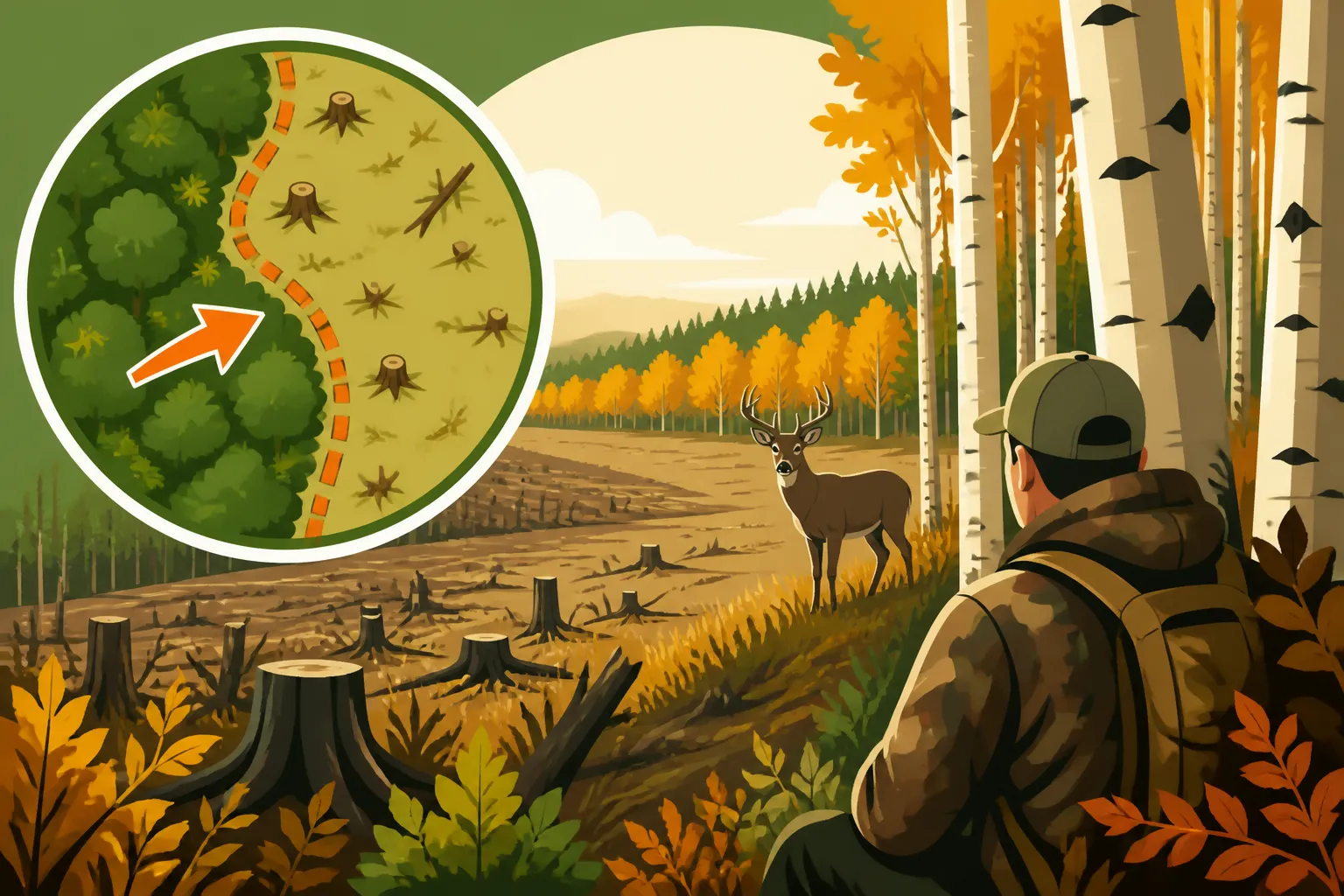
Perhaps one of the most significant advantages of hunting an aspen clearcut is how its distinct edge creates natural funnels and travel corridors for deer. Imagine a dense, almost impenetrable wall of young aspen meeting a more open stand of mature hardwoods or a swamp. Deer, being creatures of efficiency, will naturally follow the path of least resistance. This means they'll often skirt the edge of the clearcut, using the mature timber or the slightly less dense swamp edge as their primary travel route.
These edges become highways for deer moving between bedding areas within the cut and feeding areas outside it, or simply transiting between different parts of their range. A sharp corner or an inward curve of the clearcut edge can become a particularly potent pinch point, concentrating deer movement into a very predictable area. Identifying these geographical nuances is crucial for any hunter hoping to intercept a cruising buck.
Decoding the Aspen Edge: Scouting for Success
You can’t just walk up to any clearcut and expect to find the mother lode. Successful hunting on an aspen edge demands meticulous scouting, both from afar and on the ground. It’s about understanding the subtle language deer use to communicate their presence and patterns.
Identifying Productive Edges and Transition Zones
Before you even step foot in the woods, modern mapping tools are your best friend. Services like GoHunt, or the Michigan DNR's Mi-HUNT map, allow you to study aerial imagery and topographic maps from the comfort of your home. Look for clearcuts that butt up against swamps, mature timber, oak ridges, or agricultural fields. These transition zones are where deer activity often escalates. A clearcut that simply borders another clearcut might not be as productive as one that forms a distinct boundary with an entirely different habitat type.
Pay close attention to fingers or peninsulas of mature timber that extend into the clearcut, or vice versa. These provide excellent staging areas or travel routes. Understanding Reading Aerial Photos for Swamp Deer can be highly beneficial here, as the same principles apply to identifying advantageous features along clearcut edges. Don't be afraid to zoom in and spend time analyzing the contours and vegetation changes; it’s the first step in Scouting Michigan Public Land Before Season effectively.
Locating Fresh Sign and Activity
Once you've identified promising areas on a map, it's time for boots on the ground. Walk the edges of the clearcut. What you're looking for is fresh sign that indicates active deer use. This includes:
- Trails: Look for well-worn deer trails entering and exiting the thick cover of the clearcut. These are often most visible right on the edge where the dense saplings meet more open ground. Pay attention to how many trails converge or diverge.
- Rubs: Rubs, especially fresh ones, tell you a buck has been in the area. Often, bucks will rub trees along the edge of thick cover before stepping out into more open areas. The size and freshness of the rub can give you clues about the buck.
- Scrapes: Scrapes are another fantastic indicator of buck activity. While you might find some deeper in the woods, many bucks will create Scrape Lines Along a Two-Track or along the distinct edges of clearcuts as part of their scent communication.
- Browsing: Look for clipped branches on young aspen, sumac, or other browse species. Fresh browsing, often with ragged edges from deer teeth, confirms current feeding activity.
- Droppings: Fresh droppings indicate recent deer presence.
It's not just about finding any sign, but interpreting its freshness and density. A cluster of fresh rubs and scrapes, coupled with heavily used trails and abundant fresh droppings, signals a hot spot.
Understanding Deer Movement Patterns
Deer use aspen edges differently throughout the day. In the early morning, they might be moving from feeding areas (either within the clearcut or adjacent fields) back into the dense cover to bed down. In the late afternoon, they'll often stage just inside the clearcut or along its edge before stepping out to feed. During the rut, bucks will cruise these edges, scent-checking for does, making them prime ambush points all day long.
Wind direction and thermals also play a huge role. Early morning thermals typically pull scent downhill, while evening thermals rise. Understanding these dynamics is crucial for setting up your stand or blind without being detected. During periods of high wind, deer often seek the shelter of the dense clearcut, moving less but still using the most protected sections of the edge.
Strategic Stand Placement on the Aspen Cut Edge
Once you've scouted and identified a prime aspen edge, the next critical step is positioning your stand or blind strategically. This is where many hunts are made or broken, as a poorly placed setup can educate deer and ruin your chances.
Wind, Thermals, and Entry/Exit Routes
This cannot be stressed enough: always hunt with the wind in your favor. On an aspen cut edge, this often means understanding how the wind behaves along the transition. The dense cover of the clearcut can sometimes create swirling winds or microcurrents, so pay extra attention to what your wind checker is telling you. As mentioned earlier, thermals, the movement of air as it warms or cools, are also vital. In the morning, cold air sinks, carrying your scent downhill. In the evening, warm air rises, carrying your scent upwards. Position your stand so that your scent is carried away from the expected travel routes of the deer.
Equally important are your entry and exit routes. You must be able to get to and from your stand without spooking deer. This often means using natural terrain features, ditches, thick cover, or walking against the wind/thermals on your approach. Avoid walking directly across areas where you expect deer to be moving. A quiet, concealed approach is key. Consider paths that allow you to skirt the main activity, perhaps following an old two-track or a creek bed. This mindfulness is directly related to principles in Entry Routes on Flat Michigan Ground.
Choosing Your Setup: Treestand, Saddle, or Blind
The type of setup you choose will depend on the specific location, your hunting style, and even the time of year.
- Treestand: A classic choice. An elevated position allows your scent to dissipate better and provides an excellent vantage point over the dense clearcut edge. Look for mature trees along the border that offer good cover for concealment. Make sure your treestand is secure and offers shooting lanes in the directions you anticipate deer coming from. Just like with Treestand Setups in Michigan Hardwoods, concealment and a steady platform are paramount.
- Saddle: For the mobile hunter, a saddle offers incredible versatility. You can quickly set up on different trees along a long edge, adapting to changing wind conditions or deer movement. This is especially useful when scouting new ground or if you suspect deer are using multiple parts of the edge.
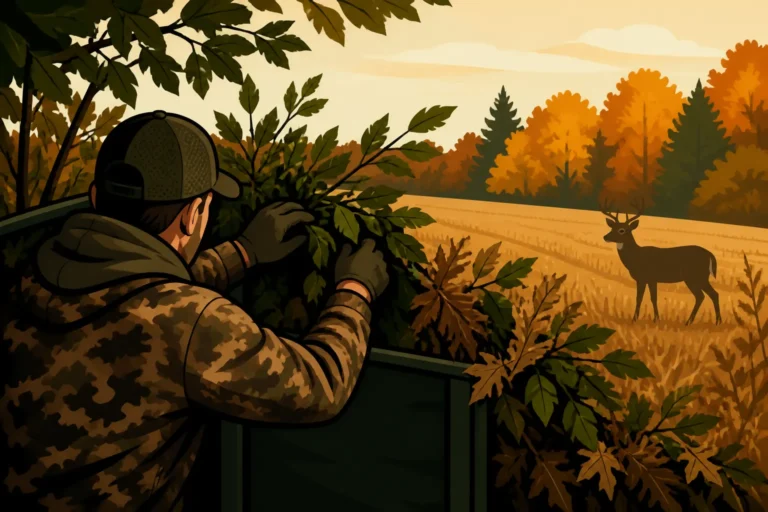
- Ground Blind: If the edge offers natural ground cover (thick brush, downed trees), a ground blind can be highly effective. It provides excellent concealment and protects you from the elements. However, scent control is even more critical at ground level. Make sure to brush in your blind thoroughly to break up its outline. For tips on effective concealment, refer to Using a Ground Blind on Michigan State Land. A well-placed ground blind can offer comfort and a stable shooting rest, especially important for longer sits.
Your choice should always prioritize concealment, scent control, and a clear, safe shooting lane.
Anticipating Shot Opportunities and Shooting Lanes
When hanging a stand or brushing in a blind, visualize where deer are likely to come from and where they will pause. Deer often stop at the edge of thick cover before stepping out into the open or crossing a more exposed trail. This is your prime opportunity. Clear only the absolute minimum amount of shooting lanes necessary. Over-trimming can alert deer to your presence and destroy natural cover.
Focus on lanes that provide clear shots at 20-40 yards, depending on your weapon. Pay attention to small openings in the saplings or gaps where deer might naturally funnel. Think about both broadside and quartering-away shots. Remember, a deer walking parallel to the edge might not present a good shot until it turns or pauses. Patience, combined with foresight, will be your best friend.
Timing and Tactics for Hunting Aspen Edges
You've done the legwork, found the spot, and set up perfectly. Now it's about executing the hunt, knowing when to be there, and how to react to conditions.
Best Times of Season and Day
Aspen clearcut edges can be productive throughout much of Michigan's deer season, but some periods offer distinct advantages.
- Early Archery (October): As deer transition from summer patterns, they'll heavily utilize the browse in clearcuts. Bucks are often still in bachelor groups or easing into pre-rut patterns. Mornings and evenings along these edges can be very productive as deer move to and from bedding.
- Pre-Rut (Late October/Early November): This is arguably one of the best times. Bucks begin cruising, expanding their range, and actively seeking does. Aspen edges, with their combination of cover and travel corridors, become high-traffic areas. This period aligns perfectly with Hunting the Pre-Rut in Late October.
- Firearm Season (November): With increased hunting pressure, deer often retreat deeper into dense cover like clearcuts during the day. However, they will still use the edges to move discreetly. Early morning and late evening movement can be strong, but during midday, deer drives along the edges can also be effective.
- Late Archery/Muzzleloader (December): If the clearcut still offers accessible browse above the snow or excellent thermal cover, deer will continue to use it, especially during colder periods. Focusing on south-facing slopes or edges that get more sunlight can be beneficial.
Mornings are generally good for catching deer moving back into the cut to bed, while evenings are prime for catching them moving out to feed. However, during the peak rut, a buck could be cruising an edge at any time of day.
Adapting to Weather and Pressure
Michigan weather is notoriously fickle, and deer movement along aspen edges will respond to it.
- Cold Fronts: Following a cold front, deer often become very active, especially during the day, as they need to feed more to maintain body temperature. This can make for excellent hunting.
- Rain/Snow: Light rain or snow can actually improve hunting, as it quiets the woods and can mask your scent. Heavy downpours or blizzards will typically keep deer bedded, but movement might pick up right before or immediately after severe weather. If you find yourself in a fresh snowfall, it's a great opportunity for Still-Hunting After a Michigan Snow.
- Hunting Pressure: Aspen clearcuts, being dense cover, become sanctuaries for deer once hunting pressure increases on public land. This means deer may spend more time inside the cut during the day, making the edges even more critical as transition points. Knowing how to deal with Hunting Pressure on Michigan State Land is key. Using mapping apps like GoHunt can help you identify remote pockets where pressure might be lower, or plan your approach to avoid heavily trafficked areas.
Still-Hunting and Drives Along the Edge
For those who prefer a more active approach, still-hunting or organizing small deer drives along aspen cut edges can be highly productive.
- Still-Hunting: Move slowly, taking one or two steps, then pausing for several minutes to scan for deer. Focus on areas where the clearcut isn't too dense, allowing for some visibility into the edge. Pay attention to every sound and movement. The natural funneling effect of the edge means deer are often moving parallel to you, making it easier to intercept them.
- Deer Drives: If you have a few hunting buddies, a small, organized deer drive can push deer out of the dense cover of an aspen cut and along its edge. Position standers at key pinch points or along suspected travel routes on the edge, while drivers slowly push through the densest part of the cut, pushing deer towards the standers. This tactic, when done safely and with good communication (perhaps using GoHunt's shared maps for hunter positions), can be very effective, especially for Deer Drives With Three or Four Hunters. Always prioritize safety and communicate clearly.
Ultimately, hunting an aspen cut edge is about understanding the deer's perspective: it's a safe haven, a bountiful food source, and a natural travel corridor. By combining thorough scouting with smart stand placement and adaptable tactics, you can unlock the full potential of these often-overlooked habitats.
| Setup Type | Pros | Cons | Best Use Case |
|---|---|---|---|
| Fixed Treestand | Excellent elevated view; good scent dissipation; comfortable for long sits. | Less mobile; requires a suitable tree; noisy to set up initially. | Established, high-traffic trail on a specific wind direction. |
| Climbing Treestand | More mobile than a fixed stand; adjustable height. | Requires a straight, limbless tree; can be noisy to ascend/descend. | Hunting different trees along an edge as conditions change. |
| Saddle Hunting | Highly mobile and lightweight; quick setup/takedown; 360-degree shooting. | Steep learning curve; can be physically demanding; requires practice. | Scouting new areas; adapting to shifting winds; quick adjustments. |
| Ground Blind | Superior concealment; protection from elements; comfortable for all-day sits. | Limited visibility (especially in dense cover); scent pooling at ground level; fixed location. | High-traffic pinch points; bad winds for elevated stands; hunting with youth. |
| Still-Hunting | Highly adaptive and mobile; covers a lot of ground; engaging. | Requires extreme patience and stealth; easy to spook deer; limited shot opportunities. | During light rain/snow; scouting new edges; less pressured areas. |
Disclaimer
Hunting carries inherent risks, and conditions in Michigan can change rapidly. Always prioritize safety, wear appropriate hunter orange when required, understand and follow all Michigan DNR regulations, and be aware of your surroundings and other hunters. This information is for educational purposes only and does not supersede official hunting regulations or safety guidelines.