Canvasbacks on Lake St. Clair
For many Michigan waterfowl hunters, the thought of chasing canvasbacks on Lake St. Clair brings a mix of excitement and trepidation. This vast, shallow lake, often referred to as the "sixth Great Lake," is a notorious canvasback magnet, but its unpredictable conditions and challenging environment can test even the most seasoned hunter. This guide will dive deep into what makes Lake St. Clair a prime spot for these majestic divers and how you can prepare to tackle its unique hunting demands.
The Allure of Lake St. Clair Canvasbacks
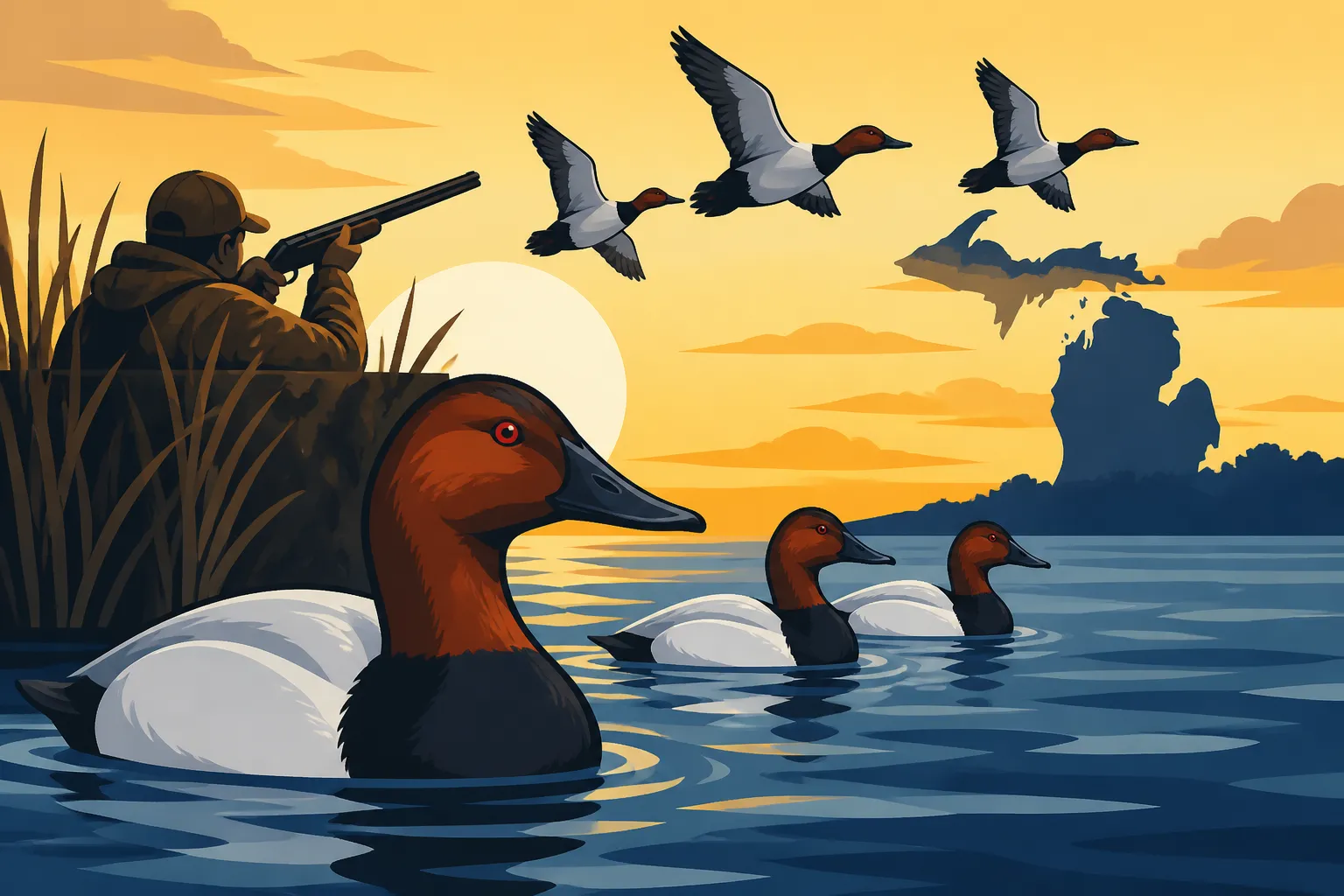
There's something truly special about canvasbacks, isn't there? Their sleek profile, powerful flight, and the distinct red eye of the drakes make them a prized trophy for any waterfowler. On Lake St. Clair, the "King of Ducks" thrives, drawing hunters from all over the Midwest to experience diver hunting at its finest. But it’s not just their beauty; it’s the intense, often grueling, experience of hunting them in such a formidable environment that creates lifelong memories and legends.
Why Canvasbacks Choose St. Clair
Lake St. Clair isn't just a stopover; it's a critical staging and feeding ground for canvasbacks and other diver ducks migrating through the Great Lakes flyway. The primary reason for this attraction lies beneath the surface: an abundance of wild celery and sago pondweed. These submerged aquatic plants are prime food sources, especially for canvasbacks, which are known for their preference for plant tubers and rhizomes. As autumn progresses and other wetlands freeze over or get hunted hard, Lake St. Clair’s expansive, relatively shallow waters offer a consistent and rich food buffet, allowing these birds to fuel up for the rest of their journey south. The lake's connection to Lake Huron and Lake Erie also places it perfectly within a major migration corridor, guaranteeing a steady flow of birds.
The Challenge and Reward of Diver Hunting
Let's be honest, diver hunting, especially on big water like Lake St. Clair, isn't for the faint of heart. It requires specialized gear, a deep understanding of boat safety, and a willingness to brave often harsh weather conditions. Unlike puddle duck hunting in sheltered marshes, you're dealing with vast open expanses, unpredictable winds, and waves that can turn a calm morning into a white-knuckle ride in minutes. The effort, the early mornings, the bitter cold, the meticulous decoy spreads – it all culminates in a moment of pure adrenaline when a flock of canvasbacks, wings locked, commits to your spread. That visual, the sound of their wings cutting the air, and the subsequent retrieval of a beautiful bull 'can' after a successful shot, is a reward that truly makes all the challenges melt away. It’s a testament to patience, preparation, and respect for the powerful forces of nature.
Essential Gear and Setup for Big Water Divers
To even consider hunting canvasbacks on Lake St. Clair, you need to be properly equipped. This isn't a hunt where you can skimp on gear or cut corners on safety. The right equipment is not just about success; it's about survival. Every piece of gear, from your boat to your clothing, plays a crucial role in ensuring a safe and productive day on the water.
Decoy Spreads for Canvasbacks
Canvasbacks are social birds, and they often travel and raft in large groups. Your decoy spread needs to reflect this. Forget your small handful of puddle duck decoys; you'll need dozens, if not hundreds, of diver decoys, predominantly canvasbacks, redheads, and bluebills. The goal is to create a large, visible landing zone that appears welcoming and safe.
Traditional diver spreads often utilize long lines, with several decoys spaced along a single main line, weighted at both ends. These lines can be deployed quickly and retrieved efficiently, which is crucial in changing conditions. A common setup might involve several long lines creating a large "V" or "J" shape, with the open end facing the direction the birds are likely to approach from, creating a natural landing pocket for them. Some hunters also add a few "super magnum" decoys or even a few goose floaters to increase visibility from a distance. Motion decoys, while effective for puddle ducks, are less common for diver spreads on big water, as the natural movement of the waves provides plenty of lifelike motion. Remember, the key is density and realism; make your spread look like a safe haven where dozens of birds are already contentedly feeding.
Layout Boats and Safety
The layout boat is the quintessential tool for diver hunting on Lake St. Clair. These low-profile boats are designed to blend seamlessly into the water, making you virtually invisible to incoming birds. However, they come with significant safety considerations.
First, never hunt from a layout boat alone. You absolutely need a tender boat – a larger, more stable vessel – to transport you, your decoys, and your gear to the hunting spot, deploy the spread, drop off the layout boat and hunter, and then stand by at a safe distance. The tender boat also serves as a critical safety net, ready to assist with retrieving downed birds, repositioning the layout boat, or providing immediate help in an emergency. Big Water Safety in a Layout Boat is paramount.
Essential safety gear for both the layout boat hunter and the tender boat crew includes:
- Life Jackets (PFDs): Worn at all times in the layout boat, and readily accessible in the tender boat. Consider an inflatable PFD for comfort.
- Kill Switch: For the tender boat engine, always attached to the operator.
- Marine Radio/Communication: VHF radio is a must, along with a fully charged cell phone in a waterproof case.
- Navigation: GPS is essential for navigating vast, featureless water, especially in fog or low light.
- Emergency Supplies: Flares, air horn, first-aid kit, extra clothes, dry bags, and warm drinks.
- Float Plan: Always tell someone on shore your hunting location and estimated return time.
| Gear Category | Essential Items | Why It's Crucial on Lake St. Clair |
|---|---|---|
| Boats | Layout Boat, Tender Boat (larger, stable) | Layout for concealment, Tender for transport, safety, and retrieval. |
| Decoys | 50-100+ Diver Decoys (Cans, Redheads, Bluebills) | Attract large rafts of social birds; visible on big water. |
| Decoy Rigs | Long Lines, Heavy Weights (3-5 lbs), Heavy Cord | Efficient deployment/retrieval; withstand strong currents/waves. |
| Safety | PFDs, Kill Switch, VHF Radio, GPS, Flares, First Aid | Non-negotiable for survival and emergency communication on open water. |
| Weaponry | 12-gauge Shotgun, Non-toxic Ammo (BB, 1, 2), Chokes | Reliable performance, legal compliance, effective range on fast-flying birds. |
| Clothing | Layered, Waterproof, Insulated, Hunter Orange (tender) | Protection from extreme cold, wind, and spray; visibility for tender boat. |
| Retrieval | Dog (with vest), Long Handle Net, Grabber Hooks | Efficiently retrieve downed birds and lost decoys in challenging conditions. |
Shotguns, Loads, and Chokes
For chasing divers on Lake St. Clair, a reliable 12-gauge shotgun is the standard. The fast, powerful flight of canvasbacks often means you'll be taking shots at longer distances than you might be used to in a timber hole. Your ammunition choice is critical. Waterfowl Loads for Michigan Divers should always be non-toxic, as it's required for waterfowl hunting throughout Michigan, especially on public waters. Steel shot, bismuth, or tungsten loads in sizes BB, 1, or 2 are common choices. Many hunters prefer bismuth or tungsten for their superior knockdown power and performance at range, though they come at a higher cost.
Choke selection also plays a significant role. Modified or improved modified chokes are popular choices, offering a good balance between pattern density and spread. Full chokes can be too tight for fast-moving birds at closer ranges, while open chokes like improved cylinder might not provide enough density at the longer distances often encountered. Always pattern your shotgun with your chosen loads and chokes before hitting the water to understand its effective range and shot dispersion.
Mastering Tactics on the Big Water
Hunting canvasbacks on Lake St. Clair is a chess match against nature. It demands not only good gear but also keen observation, strategic thinking, and the flexibility to adapt to rapidly changing conditions. Success often hinges on understanding the nuances of the birds' behavior and the environment.
Reading the Conditions: Wind and Waves
Wind is arguably the single most important factor in diver hunting on Lake St. Clair. It dictates everything: where the birds fly, how the waves build, and how you deploy your decoys and position your layout boat. Canvasbacks, like most waterfowl, prefer to land into the wind. Therefore, your decoy spread should be set up so that the open "landing zone" faces directly into the prevailing wind.
Waves are a direct consequence of wind, and they dictate safety. A strong wind can quickly whip up dangerous waves on St. Clair's shallow, expansive waters. Always check the marine forecast before heading out, paying close attention to wind speed and wave height predictions. Most layout boat hunters consider anything over 1-2 feet of wave height to be marginal, and anything consistently over 2 feet to be unsafe. It's crucial to know when to call it a hunt and head back to shore; no duck is worth risking your life. Wind also influences visibility and how birds perceive your spread. Bright sun with a strong wind can create glare, making it harder for birds to see your spread, or for you to see them coming in. Overcast days with a steady breeze are often ideal.
Approaching Birds and Decoy Placement
When you’re setting up, consider not just the wind direction, but also common flight paths. Are birds coming off a distant roost or moving between feeding areas? Try to position your spread along these routes. Your layout boat should be situated just downwind of your main decoy spread, within shooting range of the landing zone. The tender boat should then retreat to a distant, unobtrusive location, often tucked behind an island or a far-off shoreline, staying within sight for safety but out of view of incoming birds.
When birds approach, remain absolutely still in your layout boat. Any sudden movement, even a subtle head turn, can flare a wary canvasback. Let them commit, let them set their wings, and let them get into comfortable shooting range before sitting up to shoot. Many experienced diver hunters count on the "cupped wings" moment – when the birds are fully committed and ready to drop into the spread – as their signal to rise and shoot. Always be mindful of your shooting lanes and ensure your shot is safe, especially if other layout boats or tender boats are nearby, though proper spacing should prevent this.
Retrieving Birds and Decoys Safely
Retrieving downed birds on Lake St. Clair requires careful coordination with your tender boat operator. Once a bird is down, signal your tender boat immediately. They will approach cautiously, retrieve the bird, and ideally, not disturb the main decoy spread too much. This allows you to stay in the layout boat, remaining concealed for subsequent flocks. If multiple birds are down, or if the tender boat needs to reposition decoys, the layout hunter might temporarily move to the tender boat for safety and to assist.
Lost birds are a frustrating reality of waterfowl hunting, but on big water, they can quickly drift away in currents or be swept off by waves. A well-trained retrieving dog can be an invaluable asset in these situations, but even without one, prompt retrieval by the tender boat is key. Always keep an eye on your downed bird, noting its exact location relative to a fixed point in your spread or on the horizon, to guide your tender boat operator. A long-handled net or a decoy grabber can also be useful for scooping up birds or stray decoys.
Overcoming Common Lake St. Clair Challenges
Hunting Lake St. Clair is rarely easy. From navigating crowded waters to enduring punishing weather, there are numerous hurdles to clear. Being prepared for these challenges can make the difference between a frustrating day and a memorable hunt.
Navigating Crowds and Pressure
Lake St. Clair is a well-known waterfowl hotspot, meaning you're rarely going to have it all to yourself, especially during peak migration. Public access points can be bustling with hunters launching their boats before dawn. Finding a spot where you can set up your spread without interfering with other hunters, and without being impacted by their shooting or calling, is crucial. Opening Day Crowds on Michigan State Land can be a major challenge for deer hunters, and the same principle applies here.
Scouting is your best friend. Spend time before the season or on non-hunting days observing where birds are rafted, where they're flying, and where other hunters are setting up. Look for less accessible areas, perhaps those that require a longer boat ride or are harder to reach in certain wind conditions. Sometimes, a slightly longer run in the tender boat can put you in a prime, less-pressured spot. Patience and courtesy are also key; be respectful of other hunters' space, and expect the same in return. A general rule of thumb is to give other spreads at least 500 yards of space, if not more, to avoid "sky-busting" their birds or having them work your spread only to get shot at by someone else.
Weather Contingencies and Emergency Preparedness
Michigan weather, particularly near the Great Lakes, is famously fickle. A sunny, calm morning can quickly give way to a whiteout snow squall, strong winds, and freezing spray. Cold Weather Sitting Strategy is essential for maintaining comfort and safety.
- Layered Clothing: Start with moisture-wicking base layers, add insulating mid-layers (fleece, down, wool), and finish with a waterproof, windproof outer shell. Your layout boat provides some shelter, but you'll still be exposed to the elements.
- Warmth for Extremities: Insulated, waterproof gloves or mittens, a warm hat that covers your ears, and heavy-duty, insulated boots are critical. Consider chemical hand and foot warmers for extended comfort.
- Emergency Kit: Beyond the basic safety gear, carry an extra set of dry clothes in a waterproof bag, high-energy snacks, plenty of hot coffee or soup in a thermos, and any necessary medications.
- Communication Backup: While a marine radio is primary, a satellite messenger or personal locator beacon (PLB) can be a literal lifesaver if you venture far from shore or lose all other means of communication.
- Know Your Limits: Develop a healthy respect for the lake. If the conditions are deteriorating, or the forecast looks grim, make the smart decision to stay home or pack up early. No hunt is worth risking hypothermia, capsizing, or getting lost.
Respecting the Resource and Regulations
Hunting canvasbacks and other divers on Lake St. Clair comes with a responsibility to uphold ethical hunting practices and adhere to all Michigan waterfowl regulations. Familiarize yourself with Michigan Duck Daily Bag Limit, paying close attention to species-specific limits, as canvasbacks often have more restrictive bag limits than other ducks. Accurate species identification is crucial, especially when birds are flying fast or in low light.
Ensure you have all the necessary licenses and stamps: a Michigan Base Licence, a Michigan Waterfowl Licence, and a Federal Duck Stamp. Don't forget your Michigan HIP Certification for Bird Hunters. These requirements help fund conservation efforts that ensure healthy waterfowl populations for future generations.
It's also important to minimize disturbance to non-target wildlife and the lake environment. Pick up all your spent shells, retrieve all your decoys, and leave no trace of your presence. Ethical hunting is about more than just following the rules; it's about being a steward of the land and its resources.
Disclaimer
This article is for general informational purposes only and does not constitute professional advice. Laws, prices and regulations vary by location and change over time. Consult a qualified professional for guidance on your specific situation.