Elk Damage to Michigan Farms
For Michigan farmers, the sight of a magnificent elk herd can quickly turn from a wonder of nature to a crushing source of frustration and financial loss. These incredible animals, majestic as they are, often don't distinguish between a lush forest opening and a farmer's carefully cultivated field, leading to significant damage that can impact livelihoods and create immense stress. This guide aims to thoroughly explore the challenges Michigan farmers face due to elk damage and delve into the various strategies, resources, and community efforts available to mitigate these impacts.
The Root of the Problem: Why Elk Cause Farm Damage
Understanding why elk damage farms is crucial to finding effective solutions. It's not out of malice, of course, but a natural consequence of their biology, population dynamics, and the increasing overlap of their habitat with agricultural land. Michigan's successful elk restoration program, while a conservation triumph, has naturally led to challenges as the herd has grown and expanded its range.
Expanding Elk Range and Agricultural Proximity
Michigan's elk herd, primarily concentrated in the northeastern Lower Peninsula, has seen remarkable growth since its reintroduction. As these populations thrive and expand beyond the core Elk in Michigan's Pigeon River Country, they inevitably bump up against human development, including farms. What was once largely forested elk habitat now increasingly borders fields of corn, alfalfa, and other attractive crops. The traditional boundaries of their historic range are becoming less distinct, and young elk, especially, will often venture into new territories seeking food or less competition. This expansion brings them into direct conflict with agricultural interests, transforming picturesque farmland into an unintended buffet.
Consider a large, healthy elk herd needing vast amounts of forage daily. If their natural browse is limited or less appealing than what's on offer in a nearby field, they will choose the path of least resistance. This is especially true during harsh winters or dry summers when natural food sources might be scarce. The sheer abundance and nutritional value of agricultural crops act like a magnet, drawing elk directly to farmlands, regardless of property lines or fences.
Food Sources and Crop Appeal
Elk are generalist browsers and grazers, meaning they'll eat a wide variety of vegetation. While they naturally prefer woody browse, grasses, and forbs found in forest openings, the cultivated crops on a farm often offer a more concentrated and easily digestible source of energy and nutrients. Alfalfa fields, corn, oats, and even potato crops are incredibly attractive to elk. A field of tall corn, for instance, not only provides a high-energy food source but also offers cover, making it a safe haven for elk to feed undisturbed.
The appeal isn't just about nutrition; it's about accessibility. A dense cornfield is far easier to forage in than navigating through thick underbrush in the woods. This leads to a situation where elk will preferentially feed on crops, often returning to the same fields night after night until the resource is depleted or they are significantly disturbed. This pattern of behavior means that even a smaller number of elk can inflict substantial damage over time if they become habituated to a particular farm's offerings.
Herd Size and Impact Magnification
The overall Michigan's Elk Herd Size and History plays a significant role in the extent of agricultural damage. While the total number of elk in Michigan is carefully monitored and managed, even a stable population can exert considerable pressure on localized areas, especially those near agricultural operations. A larger herd means more mouths to feed, increasing the likelihood that elk will venture into farm fields, particularly as natural forage fluctuates seasonally.
Imagine a farmer trying to bring in a hay crop, only to find a herd of fifty elk has trampled and grazed a significant portion of it overnight. The collective impact of a large herd can be devastating, not just from direct consumption but also from trampling. As the Michigan elk population continues to be a conservation success story, the challenges of managing their impact on private land, particularly farms, become ever more critical. The Michigan elk harvest trends and management strategies are always under review to balance ecological health with human-wildlife coexistence.
Types of Damage Elk Inflict on Michigan Farms
The damage caused by elk is rarely just about eaten crops. It's a complex problem that affects multiple aspects of a farming operation, leading to direct financial losses, long-term land degradation, and even safety hazards for both farmers and the elk themselves.
Crop Devastation and Economic Loss
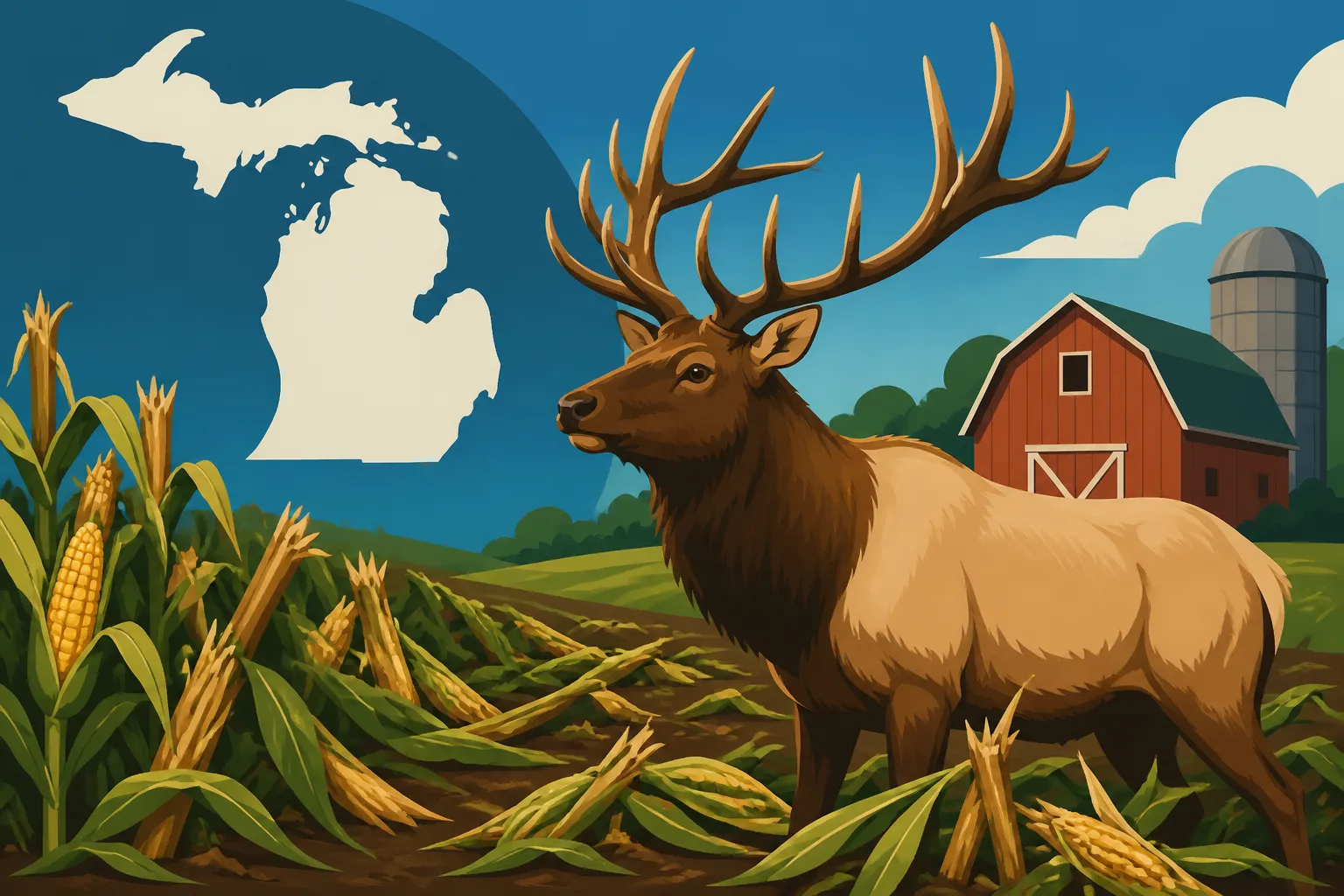
The most obvious and immediate impact of elk on farms is the direct destruction of crops. Elk are large animals, and when a herd moves through a field, they don't just eat; they trample, bed down, and break stalks. A cornfield can be flattened, making mechanical harvesting impossible for the damaged sections. Alfalfa and other hay crops can be grazed down prematurely, reducing yields and requiring earlier, less productive cuts. Specialty crops like potatoes or vegetables can be completely dug up or consumed. This direct loss of harvestable product directly translates into significant economic losses for farmers, impacting their annual income and potentially their ability to sustain their operations.
Consider a farmer who has invested countless hours and resources—seed, fertilizer, fuel, labor—into a crop, only to see a substantial portion of it destroyed before harvest. This isn't just lost profit; it's lost investment that can cripple a farm's finances. Furthermore, crops damaged by elk may not be covered by standard crop insurance, or the deductible might be so high that it doesn't adequately compensate for the actual losses incurred. The uncertainty of elk damage adds another layer of risk to an already challenging profession.
Infrastructure Damage and Safety Concerns
Elk are powerful animals, and their movements aren't always confined to open fields. Fences, especially perimeter fences, are often no match for a determined elk herd. They can push through, break wires, snap posts, and create large breaches, allowing not only elk but also other wildlife to access fields, and potentially allowing valuable livestock to escape. Repairing this damage is costly and time-consuming, requiring materials and labor that divert resources from other farm needs. Farm gates, irrigation lines, and even smaller structures can be damaged or displaced by the sheer force of elk moving through an area.
Beyond property damage, there are significant safety concerns. Elk are wild animals, and while generally shy, a startled or cornered animal, especially a bull during the rut, can be dangerous. Farmers working in fields where elk frequent might face unexpected encounters. Additionally, elk on roads, particularly at dusk or dawn, pose a serious risk of vehicle collisions, endangering motorists and the animals themselves. Understanding Michigan Elk Management Unit Boundaries can help some hunters and farmers anticipate where these conflicts might be more common.
Spreading Disease and Soil Compaction
While not as immediately visible as crop destruction, elk can also contribute to longer-term issues like disease transmission and soil compaction. Though less common for elk than deer, any wild animal population living in close proximity to livestock carries a theoretical risk of transmitting diseases. For example, diseases like bovine tuberculosis, while more commonly associated with white-tailed deer in certain Michigan counties, underscore the importance of minimizing direct interaction between wild cervids and domestic livestock. While there's no widespread issue of disease transmission from elk to Michigan livestock, it remains a concern that wildlife managers and farmers monitor.
Furthermore, the heavy hooves of a large elk herd moving across wet farm fields can lead to significant soil compaction. Compacted soil reduces water infiltration, limits root growth, and can decrease overall soil fertility and crop yields in subsequent seasons. This is a subtle, cumulative form of damage that might not be evident in a single growing season but can impact the long-term productivity and health of the farmland.
Here's a quick look at common types of elk damage:
| Type of Damage | Description | Primary Impact | Affected Crops/Areas |
|---|---|---|---|
| Crop Depredation | Direct consumption, grazing, and trampling of standing crops. | Significant yield reduction, economic loss, wasted inputs. | Corn, alfalfa, oats, potatoes, winter wheat |
| Fence Damage | Breaking wires, snapping posts, tearing down fences to gain access. | Increased repair costs, livestock escape risk, further wildlife access. | Perimeter fences, internal pasture fences |
| Infrastructure | Damage to irrigation lines, farm gates, smaller sheds, or equipment by collision or forceful movement. | Repair costs, operational disruptions, potential safety hazards. | Irrigation systems, gates, small structures |
| Soil Compaction | Heavy hooves compressing wet soil, reducing aeration and drainage. | Decreased future crop yields, reduced soil health, increased erosion potential. | Any farmed field, especially after rain |
| Disease Risk | Potential (though low) for disease transmission between wild elk and domestic livestock. | Animal health concerns, potential economic loss for livestock producers. | Livestock pastures, shared water sources |
Strategies for Mitigating Elk Damage
Dealing with elk damage requires a multi-faceted approach, combining proactive measures, state-level assistance, and, in some cases, regulated hunting. Michigan's DNR works closely with landowners to develop strategies that minimize conflict while sustaining the elk herd. Many hunters utilize resources like GoHunt to understand elk behavior and habitat, which can indirectly help farmers by encouraging hunting pressure in problem areas.
Non-Lethal Deterrents and Habitat Management
One of the first lines of defense against elk damage involves non-lethal deterrents. These strategies aim to make farm fields less appealing or accessible to elk without harming the animals. Fencing, particularly electric fencing, can be effective, though the cost of installing and maintaining a robust fence around large agricultural properties can be prohibitive. Specialized "elk fences," often taller and stronger, are even more expensive. Propane cannons, scarecrows, or reflective Mylar strips can provide temporary relief by startling elk, but these animals are intelligent and often habituate to such measures quickly.
Habitat management within and around elk ranges can also play a role. Encouraging alternative food sources on public lands adjacent to farms, or creating buffer zones of less palatable vegetation, might draw elk away from valuable crops. Michigan Elk Range Public Land is a good resource for understanding these areas. Farmers might also consider planting sacrificial plots of less valuable crops further from their main fields, hoping to divert elk attention. However, these methods require significant planning, resources, and cooperation, and their effectiveness can vary greatly depending on the specific location and herd behavior.
Assistance Programs and Compensation for Farmers
Recognizing the economic burden placed on farmers, the state of Michigan offers various assistance programs. The Michigan DNR, in collaboration with other agencies, has programs designed to help landowners implement damage mitigation measures, such as providing materials for fencing or offering technical advice. In some cases, there might be financial compensation for verified crop losses due, in part, to elk depredation, though specific program details, eligibility, and funding can change over time. It's crucial for farmers experiencing damage to immediately report it to the DNR so that documentation can begin and potential assistance can be explored.
These programs are vital for maintaining good relationships between farmers and the state's wildlife management efforts. They acknowledge that the presence of a healthy elk herd, while a public benefit, comes with private costs that should, to some extent, be offset. Farmers who actively seek out and utilize these programs are often better equipped to manage the ongoing challenges.
Regulated Hunting as a Management Tool
Regulated hunting is a critical component of Michigan's elk management strategy. By controlling How Many Elk Michigan Has and influencing herd distribution, hunting helps to keep elk populations within ecological and social carrying capacities. When elk numbers grow too large, or when specific herds repeatedly cause significant damage in agricultural areas, increasing hunting pressure in those zones can be an effective way to disperse animals and reduce overall impact. The highly coveted Michigan elk hunt licenses are designed to manage the herd for health and to mitigate human-wildlife conflicts, including farm damage.
The Michigan DNR carefully sets quotas and allocates licenses, often prioritizing areas with high conflict. Hunters who draw a tag, which is a rare and exciting event, become active partners in conservation. Platforms like GoHunt can provide hunters with valuable insights into potential elk hotspots, including those near agricultural fields, helping them to be more effective. Understanding the Michigan Elk Application Rules and Michigan Elk Hunt Period Dates is essential for any hunter hoping to participate in this important management effort. While hunting alone cannot solve all farm damage issues, it remains one of the most powerful and biologically sound tools in the wildlife manager's toolkit. Hunters contribute directly to managing the herd, ensuring its long-term health, and reducing the impact on private landowners.
Working with the Michigan DNR and Community
Addressing elk damage is rarely a solitary endeavor for a farmer. It requires communication, collaboration, and a willingness to engage with state agencies and the broader hunting and conservation community.
Reporting Damage and Seeking Support
The moment a farmer notices elk damage, the immediate and most crucial step is to contact the Michigan Department of Natural Resources (DNR). Prompt reporting is essential for documentation, assessment, and eligibility for any assistance programs. DNR wildlife biologists and technicians are trained to evaluate damage, identify patterns of elk use, and work with landowners to implement solutions. They can offer expertise on deterrents, provide guidance on fencing options, and explain the various channels for potential compensation.
Beyond formal reporting, building a relationship with local DNR staff can be incredibly beneficial. These individuals often have a deep understanding of local elk movements and the specific challenges faced by farmers in a particular area. Open communication ensures that concerns are heard and that management strategies are tailored to the unique circumstances of each farm and elk population. This also creates a network for information sharing, which is incredibly important, especially in regions where Which Counties Hold Michigan Elk populations are denser.
Collaborative Management and Future Solutions
The issue of elk damage to Michigan farms highlights the complex balance between wildlife conservation and agricultural sustainability. It’s a challenge that requires collaborative management, bringing together farmers, wildlife managers, hunters, and local communities. Discussions about land use planning, agricultural practices, and wildlife corridors all factor into finding long-term solutions. Initiatives that involve local land conservancies or agricultural extension offices can provide additional resources and expertise.
For instance, some farmers might explore options for habitat diversification on their own property, perhaps setting aside marginal land for wildlife, which could reduce pressure on cash crops. Hunters, using tools like GoHunt to understand public and private land boundaries, can help by focusing their efforts in designated damage zones during hunting seasons. The ongoing dialogue about Why Michigan Cut the Elk Harvest or how to manage Michigan's Elk Herd Size and History reflects the dynamic nature of this challenge. Ultimately, future solutions will likely involve a combination of strategic land management, adaptive hunting regulations, technological deterrents, and robust support systems for farmers to ensure that both Michigan's iconic elk herd and its vital agricultural industry can thrive side-by-side.
Disclaimer
This article is for general informational purposes only and does not constitute professional advice. Laws, prices and regulations vary by location and change over time. Consult a qualified professional for guidance on your specific situation.