Where Michigan Turkeys Are Densest
Finding consistent turkey action can be one of the most rewarding parts of spring (or fall!) hunting, but it's incredibly frustrating when you hit public land only to find nothing but silence. You might be putting in the miles, but if you're not in an area with a healthy, dense turkey population, you're fighting an uphill battle. This guide is here to unravel the mystery of where Michigan's turkeys are densest, helping you focus your scouting and hunting efforts for better success.
Understanding Turkey Habitat Preferences in Michigan
Michigan turkeys aren't just randomly distributed; they thrive in specific types of habitat that provide everything they need to survive and reproduce. If you can understand what makes a certain area attractive to turkeys, you're halfway to finding them. It's about more than just seeing a bird; it's about understanding the entire ecosystem that supports a robust flock.
The Role of Diverse Landscapes
Wild turkeys are truly creatures of edge habitat. They don't just live in dense, unbroken forests, nor do they exclusively inhabit wide-open fields. Instead, they seek out a mosaic of different cover types that allow them to move, feed, and roost with safety and efficiency. Think about those areas where the forest meets a field, or where a dense pine plantation borders a more open hardwood stand. These transition zones are prime turkey country.
A perfect example is the common Michigan landscape of mixed agricultural fields bordered by woodlots and swampy areas. Turkeys will often feed in the fields during the day, picking through waste grain or insects, and then retreat to the safety of the woods for roosting at night. The woodlots provide protection from predators, while the open areas offer easy foraging and excellent visibility. Even in more forested regions, clear-cuts or openings created by logging can mimic these beneficial edge conditions, providing new growth for foraging and dense cover nearby. These diverse areas provide a buffet of options for the birds throughout the day and year.
Food Sources That Draw Turkeys
Just like any other wildlife, turkeys are driven by their stomachs. Understanding their seasonal diet helps predict where they'll be. In Michigan, this means a changing menu throughout the year, from acorns and waste grain to a myriad of insects. Spring, of course, brings green-up, and with it, a flush of insects and tender new plant growth that turkeys absolutely crave.
During the fall and winter, hard mast like acorns from oak trees becomes a critical food source. If you can find a good oak ridge that's dropping acorns, you're likely to find turkeys scratching through the leaf litter. In agricultural areas, waste corn and soybeans after harvest are huge attractants. Come spring, they'll be bugging in fields, scratching for grubs and worms, and picking at clover and other tender greens. Late-Season Food Sources for Whitetails are often also good for turkeys, so scouting for deer sign can sometimes overlap with finding turkey food sources. The availability and variety of these food sources heavily dictate turkey density in any given region.
Roosting and Nesting Cover
Turkeys, especially the big gobblers we all dream of calling in, rely heavily on suitable roosting and nesting cover. They need tall, sturdy trees to safely spend the night, away from ground predators like coyotes and bobcats. Mature hardwoods, especially large oaks or pines, with strong horizontal limbs, are ideal. Often, these roosting areas are located near water or open fields, providing an extra layer of security and convenience for morning fly-down.
Nesting cover is equally important for the hens to successfully bring off a brood of poults. Hens will seek out dense, concealing cover like thick brush, tall grass, or even blowdowns to hide their nests from predators. A lack of good nesting cover can significantly impact local turkey populations, even if food sources are abundant. Understanding Where Michigan Gobblers Roost can give you a major advantage, helping you identify core areas where birds feel safe and return nightly.
Pinpointing Michigan's Turkey Hotspots
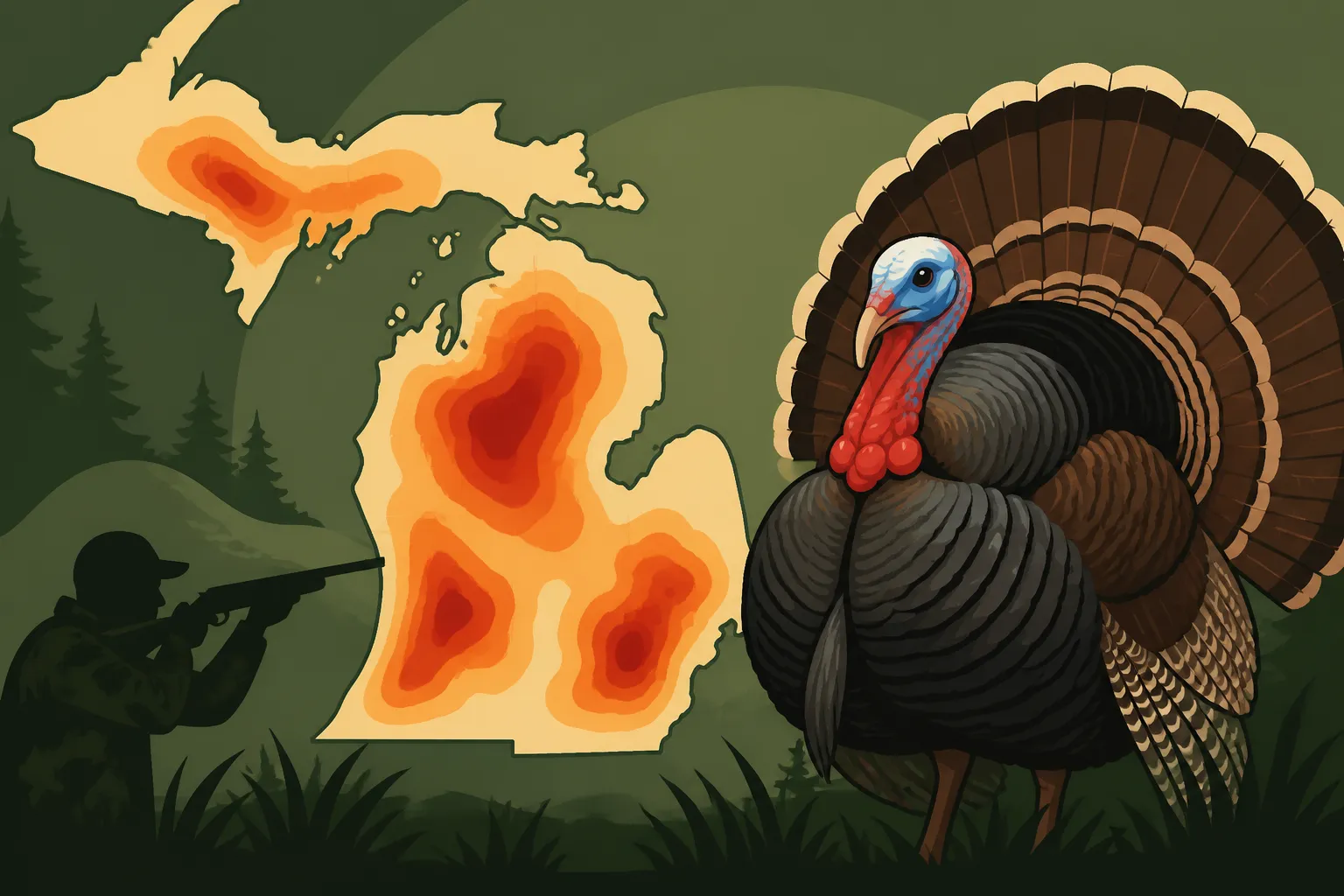
Michigan is a big state, and turkey densities vary significantly from the farmlands of the southern Lower Peninsula to the sprawling forests of the Upper Peninsula. Knowing which regions generally hold more birds, and why, can help you narrow down your search and focus your time where it matters most.
Southern Michigan's Agricultural Belt
When you think about high turkey populations in Michigan, the southern Lower Peninsula often comes to mind first. This region, characterized by its mix of agricultural fields, woodlots, and river bottoms, offers nearly ideal turkey habitat. The abundant waste grain from corn and soybean fields provides a consistent, high-energy food source, especially through the leaner winter months. These fields are often interspersed with mature timber stands that provide excellent roosting opportunities.
Counties in the southern half of the Lower Peninsula, especially those with rolling hills, diverse timber types, and ample agriculture, tend to boast some of the highest turkey densities. This combination of food, cover, and water creates a perfect storm for thriving turkey populations. Hunters here often find success calling birds out of woodlots that border crop fields. If you're looking for consistent action and a good chance at multiple encounters, areas within the traditional "farm country" belt should be at the top of your list. Turkey Tactics for Southern Michigan Farms will often revolve around these field-edge setups.
Northern Lower Peninsula's Mixed Forests
Moving north into the Lower Peninsula, the landscape shifts from predominantly agriculture to more extensive tracts of mixed hardwood and pine forests, interspersed with smaller farms and open areas. While turkey densities might not be quite as astronomical as in the southernmost counties, the northern Lower Peninsula still offers excellent turkey hunting, especially in areas with good habitat management. Look for counties that have a healthy mix of aspen, oak, and pine, along with openings like old logging clear-cuts or fields.
The turkeys in this region tend to utilize different patterns, often traveling more extensively through the timber and using river bottoms and swamp edges as travel corridors. Areas with good acorn crops will attract birds in the fall, and in the spring, they'll be found scratching in sun-drenched openings or along logging roads. Regions like the Huron-Manistee National Forest or various state forests often have thriving turkey populations, especially where habitat work has created diverse age classes of timber and ample openings. This is where a detailed mapping tool like the ones from GoHunt can really shine, allowing you to scout for those specific habitat features from your couch.
Upper Peninsula's Big Woods and Farm Pockets
The Upper Peninsula presents a unique challenge and opportunity for turkey hunters. While it has traditionally had lower turkey densities compared to the Lower Peninsula due to harsher winters and vast unbroken forests, turkey populations have made impressive strides. You won't find turkeys behind every tree in the U.P., but specific pockets, especially those with some agriculture or diverse timber management, can hold huntable numbers. Hunting Turkeys in Upper Peninsula Timber requires a different approach, often focusing on larger areas and more patient scouting.
The key to finding turkeys in the U.P. is to identify areas where the "big woods" break up with small farms, logging operations, or river drainages that provide suitable roosting cover and food. The eastern and central U.P. tend to have higher concentrations than the far western counties, which are dominated by dense, often unbroken conifer forests. Focus on counties with a history of timber management, where aspen cuts and small openings create that critical edge habitat. These pockets often see less hunting pressure than their Lower Peninsula counterparts, offering a more wilderness-like turkey hunting experience.
Factors Influencing Turkey Density Beyond Habitat
While habitat is undoubtedly king, several other factors play a crucial role in determining how many turkeys you'll find in a particular area. Understanding these can provide additional clues when you're trying to locate those high-density spots.
Population Management and Hunting Pressure
Michigan's turkey population has largely been a success story, rebounding dramatically thanks to intelligent conservation efforts, including trap-and-transfer programs. However, even with thriving populations, localized hunting pressure can significantly impact bird behavior and perceived density. Areas with easy access on public land, especially early in the season, can see birds become "educated" quickly, making them harder to find and call. This doesn't mean the birds aren't there, but they might be quieter, more cautious, and harder to locate.
Conversely, less-pressured areas, even if they have slightly lower overall bird numbers, can offer a more rewarding hunting experience because the birds are more responsive. The Michigan DNR continuously monitors turkey populations and sets harvest quotas and season structures to maintain healthy numbers. Michigan Turkey Population Trends show us that these populations are generally robust, but local management and hunter behavior definitely influence what you encounter in the woods. When reviewing potential hunting spots using a tool like GoHunt, you might also consider areas that are harder to access, as these often hold less pressured birds.
Weather and Reproduction Success
Mother Nature plays a huge role in turkey densities, especially when it comes to reproductive success. Mild winters are generally good for adult turkeys, allowing more birds to survive and be ready for spring breeding. However, the real determinant of future turkey populations is the success of the spring hatch. Cold, wet springs can be devastating for young poults, as they are very vulnerable to hypothermia in their first few weeks of life.
Biologists often look at "poult-to-hen ratios" to gauge reproductive success. A strong hatch means more young birds entering the population, which translates to higher densities in the following years. A series of poor hatches, due to severe weather during nesting or poult rearing, can lead to a noticeable dip in turkey numbers. This is why some years just feel "better" for turkeys than others, even if the habitat hasn't changed. Understanding Poult-to-Hen Ratios and What They Mean can give you an insight into the health of a local flock.
Disease and Predation Impacts
Like all wild game, Michigan's turkeys can be affected by diseases and predation. While widespread, catastrophic disease outbreaks are rare, localized issues can sometimes impact turkey densities. Avian pox or other illnesses, while usually not fatal to adult birds, can weaken them.
Predation is a constant factor. Everything from raccoons and opossums to coyotes, foxes, and even domestic pets can prey on turkey eggs and poults. While healthy adult turkey populations can absorb some predation, consistently high predator numbers, especially when combined with poor nesting cover, can suppress local turkey densities. Nest Predation and Turkey Hatches are a natural part of the ecosystem, but an imbalance can affect hunter success.
How to Scout and Find Dense Turkey Areas
Now that we understand the ingredients for high turkey density, how do we actually put that knowledge into action on the ground? Scouting, both remotely and on foot, is paramount to finding those honey holes.
Using Mapping Tools and Aerial Imagery
In today's hunting world, digital mapping tools are indispensable for efficient scouting. Platforms like GoHunt allow you to analyze vast tracts of land from your computer or phone, identifying key habitat features that scream "turkey!" Look for areas where different cover types meet: hardwood ridges bordering fields, pine stands near water, or dense thickets adjacent to more open timber. Use aerial imagery to spot potential roost trees – often the tallest trees near a water source or a field edge.
You can overlay property lines to identify public hunting lands or scout for potential private land permission. Look for subtle terrain features like benches or draws that turkeys might use as travel corridors. By identifying these features digitally, you can significantly reduce your "boots-on-the-ground" scouting time, focusing your physical efforts on the most promising spots. Don't forget to check the boundaries of Michigan State Forest Hunting or Michigan State Game Areas on these maps to ensure you're in an accessible location.
On-the-Ground Scouting for Sign
No digital map, no matter how good, can replace actually walking the woods. Once you've identified promising areas on your map, it's time to hit the ground. Look for physical signs of turkey activity:
- Droppings: Fresh droppings indicate recent turkey presence. Gobbler droppings are typically J-shaped, while hen droppings are more spiral or blob-like.
- Scratchings: Turkeys are constantly scratching through leaf litter to find insects, seeds, and nuts. Look for V-shaped clearings in the leaves, often with fresh dirt exposed.
- Feathers: Finding a turkey feather is a clear sign. If you find a primary wing feather, it might be from a roosting bird.
- Tracks: Look for distinct turkey tracks in soft dirt, mud, or snow.
- Dusting Bowls: Turkeys create shallow depressions where they dust themselves to remove parasites. These are often found in sandy soil or dry areas.
Focus your efforts around those edge habitats, food sources, and potential roosting areas you identified on your map. Early morning and late evening scouting trips can also yield valuable auditory clues, like gobbling on the roost or yelping hens.
Local Knowledge and DNR Resources
Don't underestimate the value of local knowledge. Chatting with other hunters (if they're willing to share!), farmers, or even just folks who live in the area can provide invaluable insights into turkey movements and local hotspots. They might know about a particular woodlot that always holds birds, or a field where turkeys love to feed.
The Michigan DNR also provides a wealth of information. Their website often has harvest reports, population trends, and unit-specific details that can help you understand turkey densities in different parts of the state. They might even offer specific Michigan Turkey Harvest Numbers that can guide your choices. Combining their data with your own mapping and scouting will give you the most comprehensive picture of where Michigan's turkeys are densest, increasing your chances of a successful hunt.
| Michigan Turkey Habitat Characteristics by Region | Southern Lower Peninsula (SLP) | Northern Lower Peninsula (NLP) | Upper Peninsula (UP) |
|---|---|---|---|
| Dominant Landscape | Agriculture (corn/soybean), mixed hardwoods, river bottoms | Mixed hardwoods, pine plantations, aspen cuts, smaller farms | Vast conifer/hardwood forests, small farms/openings |
| Primary Food Sources | Waste grain (corn/soybean), acorns, insects, clover | Acorns, insects, berries, waste grain (less prevalent) | Insects, berries, acorns (localized), mast crops |
| Roosting Cover | Mature oaks/maples in woodlots, river bottom timber | Tall pines, mature hardwoods, riparian zones | Large pines/hardwoods, usually near water/openings |
| Nesting Cover | Dense brush, tall grass, field edges | Thick understory, young clear-cuts, brushy areas | Dense conifer thickets, blowdowns, swamp edges |
| Turkey Density Trend | Generally highest | High to moderate | Moderate to lower, increasing in specific areas |
Disclaimer
This article is for general informational purposes only and does not constitute professional advice. Laws, prices and regulations vary by location and change over time. Consult a qualified professional for guidance on your specific situation.