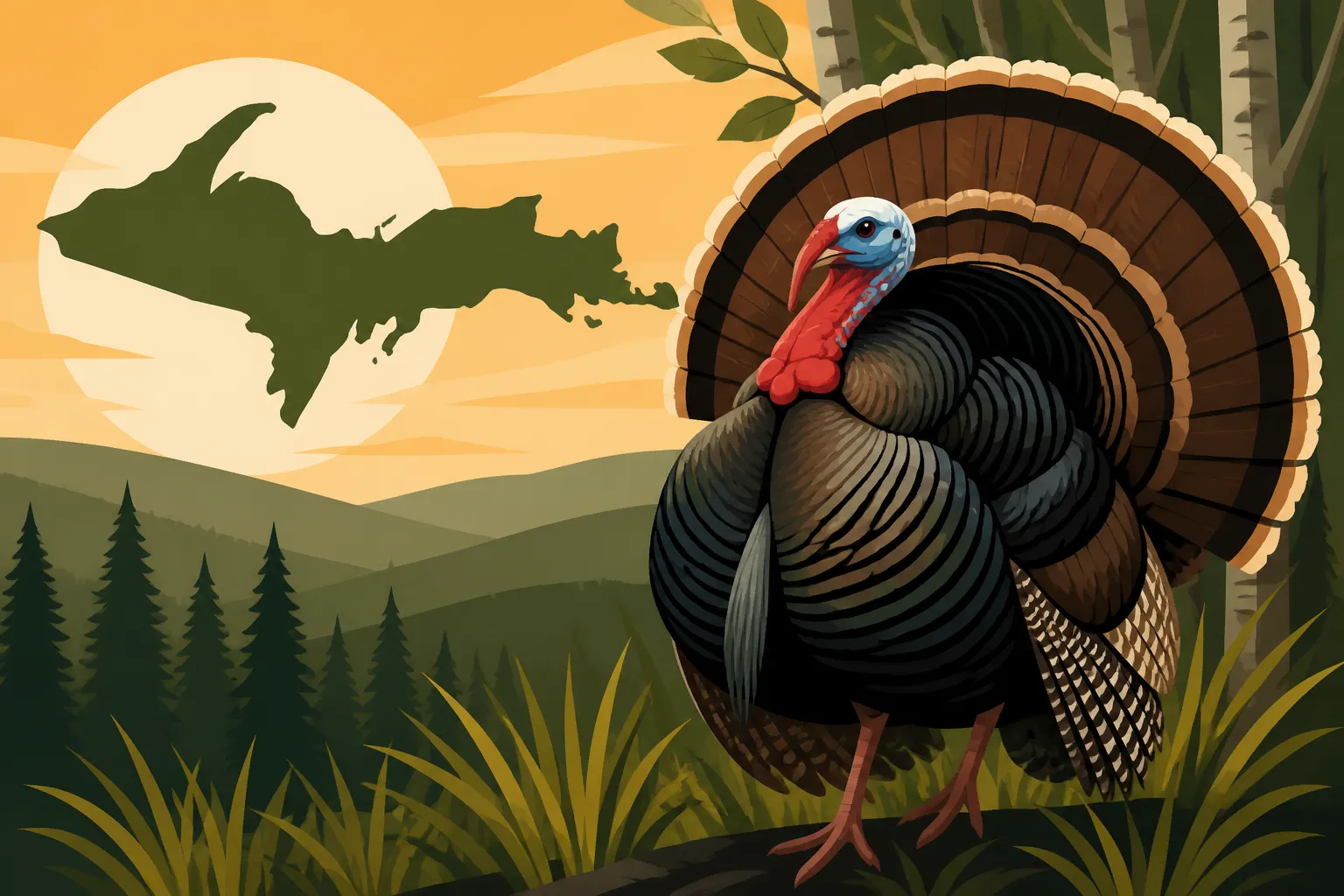
Turkeys in the Upper Peninsula
Many Michigan hunters picture turkey season as a springtime ritual in rolling farm country, but the sprawling, wild landscapes of the Upper Peninsula offer an entirely different, often more challenging, experience. The U.P.'s dense timber, rugged terrain, and persistent wilderness feel demand a unique approach to finding and calling in a gobbler. This guide will take you deep into the world of hunting wild turkeys north of the Mackinac Bridge, from their remarkable return to the specific strategies that will help you succeed in this unique environment.
The Resurgence of Turkeys in the U.P.
For many years, the Upper Peninsula was not considered prime turkey country. Harsh winters, vast tracts of unbroken forest, and the absence of diverse agricultural crops made it difficult for wild turkey populations to thrive. However, a concerted effort to reintroduce and manage these birds has led to a remarkable success story, transforming parts of the U.P. into a coveted destination for turkey hunters.
Early Challenges and Restoration Efforts
Back in the day, seeing a wild turkey in the Upper Peninsula was a rare occurrence, almost unheard of for most hunters. The historical accounts speak of wild turkeys being present in Michigan, but deforestation, unregulated hunting, and harsh conditions led to their disappearance by the early 1900s. When restoration efforts began in the Lower Peninsula, it was an overwhelming success, but the U.P. presented a much tougher nut to crack. Initial attempts to introduce eastern wild turkeys directly into the U.P. in the 1950s and 60s often failed, primarily because the birds couldn't cope with the deep, prolonged snows and the lack of readily available winter food sources.
The breakthrough came with a more strategic approach, learning from those earlier setbacks. Beginning in the 1980s and continuing into the 1990s, turkeys from robust Lower Peninsula populations were trapped and relocated to carefully selected sites in the U.P., often areas with a mix of mature hardwoods, conifer swamps for roosting and thermal cover, and some scattered agricultural fields that could provide crucial winter forage. These were strong, resilient birds, and the gradual reintroduction, combined with milder winters in some years and improved habitat management, allowed the populations to finally take root and expand. It was a testament to the dedication of wildlife biologists and the adaptability of the wild turkey itself. You can learn more about this incredible journey by reading How Turkeys Were Restored to Michigan.
Current Population Trends and Distribution
Today, wild turkeys are well-established across much of the central and southern portions of the Upper Peninsula, particularly in counties like Menominee, Delta, Marquette, and Dickinson. The sight of a strutting gobbler or a flock of hens and poults is no longer a novelty but a common occurrence for those who spend time in the woods. While the density of birds might not rival the sprawling farm country of southern Michigan, the populations are healthy and expanding, offering fantastic hunting opportunities.
The distribution tends to follow areas with a slightly more diversified landscape—think hardwood ridges interspersed with pockets of cedar swamp, along with proximity to some human development or farming operations that inadvertently create food plots. The vast, unbroken tracts of coniferous forest, especially in the northernmost counties, still present significant challenges for turkeys, and populations there remain sparser. However, even in these areas, you might find pockets of birds around logging operations or natural openings that provide crucial winter forage and grit. Keeping an eye on Michigan Turkey Population Trends can help you understand how these populations are faring year to year.
Understanding U.P. Turkey Habitat and Behavior
Hunting turkeys in the Upper Peninsula requires a different mindset than hunting them in the Lower Peninsula. Here, birds are often more dispersed, more wary, and more tuned into the rhythms of the deep woods. Their habitat use is intricately linked to survival in a tougher environment, especially when it comes to facing down a long, cold U.P. winter.
Forested Landscapes and Food Sources
The U.P. is defined by its forests, and wild turkeys have adapted to this reality. Unlike their southern counterparts that might spend a lot of time in open agricultural fields, U.P. birds are masters of the timber. They rely heavily on hard mast, primarily acorns from oak trees, along with beechnuts and wild cherries, especially in the fall and early winter. Spring brings a new bounty of insects, tender greens, and buds. In summer, they disperse to brood in areas with good insect populations and cover.
Identifying key forested areas is paramount. Look for mature hardwood ridges, especially those with a strong oak component, as these will be primary feeding grounds. South-facing slopes can warm up quicker in the spring, melting snow faster and exposing food sources earlier. The edges where these hardwoods meet dense conifer swamps or thickets are also critical, providing excellent roosting cover and thermal protection during inclement weather. Logging activity can create important openings and regenerate undergrowth, offering new food sources and bugging areas for poults. For hunters, this means your scouting needs to focus less on open fields and more on discerning subtle changes in forest type and topography.
Adapting to Harsh U.P. Winters
The U.P. winter is the ultimate test for wild turkeys. Deep snows can cover food sources for weeks, and brutally cold temperatures require specialized strategies for survival. Turkeys adapt by seeking out areas that offer both food and shelter from the elements. Conifer stands, particularly dense cedar swamps, act as crucial thermal cover, trapping warmth and breaking the wind. These swamps also sometimes hold patches of ground that remain snow-free longer or offer browse.
Hunters often find higher concentrations of turkeys in the spring around these critical wintering areas. The birds will be slowly dispersing as the snow melts, but their initial activity will often be within a reasonable distance of where they rode out the colder months. Understanding this winter survival strategy can be a huge advantage for spring hunters, as it helps narrow down potential areas where birds are likely to be found. It’s also why U.P. gobblers might seem less active or vocal early in the spring; they’re recovering from winter and conserving energy, making consistent, aggressive calling sometimes less effective than patient, strategic setups. Keep these harsh conditions in mind when thinking about Cold Weather Sitting Strategy for any game.
Strategies for Hunting Turkeys in the U.P.
Hunting U.P. turkeys isn't about running and gunning across open fields; it's a more deliberate, often physically demanding endeavor in big woods. Success here hinges on patience, strategic calling, and a keen understanding of the terrain.
Roosting and Run-and-Gun Tactics
One of the most effective strategies for U.P. turkeys begins the evening before your hunt: roosting birds. Because turkeys are often dispersed over vast areas, knowing where a gobbler is sleeping can save you hours of aimless wandering in the morning. Driving forest roads or two-tracks in the late evening, listening for fly-up cackles or drumming, can pinpoint a bird's location. Once you've heard one, mark the general area, and then retreat. The next morning, you can slip in silently, well before dawn, and set up within comfortable calling distance. This approach drastically increases your odds of getting a response and setting up for a shot right off the roost. Roost Hunting Michigan Gobblers can offer more insights into this tactic.
However, U.P. gobblers don't always cooperate and pitch down to your calls. They might fly down and head in the opposite direction, or they might simply be quiet and unresponsive. This is where a modified "run-and-gun" approach comes into play. Instead of covering miles of ground haphazardly, focus your moves on key terrain features: follow ridge lines, check the edges of clearcuts, or walk along logging trails that connect different habitat types. Stop frequently, call aggressively for a few minutes, then listen intently. If you don't get a response, move another few hundred yards and repeat. This isn't a race; it's about systematically covering good turkey country until you strike a bird. Patience, rather than speed, is key. Run-and-Gun Turkey Tactics on State Land provides more detailed advice.
Scouting and Accessing Remote Areas
Pre-season scouting is absolutely non-negotiable for U.P. turkey hunting. Given the sheer scale of public land and the lower density of birds compared to other regions, showing up on opening morning without prior knowledge is a recipe for frustration. Start by poring over topographical maps and aerial imagery. Look for those hardwood ridges, potential roosting cover in conifer stands, and any natural funnels or pinch points that might concentrate bird movement. Identifying old logging roads or two-tracks can be crucial for accessing remote areas that see less pressure. Digital mapping tools, like those found on GoHunt, are invaluable for this reconnaissance, allowing you to mark waypoints, measure distances, and visualize the terrain from the comfort of your home.
Once you’ve identified promising areas on a map, it’s time for boots on the ground. Hike in, look for turkey sign—droppings, tracks, strut marks, and primary dusting bowls. Pay attention to residual acorns from the previous fall, as these indicate prime feeding areas. The beauty of the U.P. is its vast public land, but this also means you need to be prepared for longer walks and more rugged conditions. A good backpack with water, snacks, and emergency gear is essential. Remember, getting a little off the beaten path is often where you’ll find the less pressured gobblers. Scouting Michigan Public Land Before Season is a great resource for developing these skills.
Key Considerations for U.P. Turkey Hunters
Beyond the specific tactics, a successful U.P. turkey hunt requires an understanding of the unique conditions and regulations in this rugged northern landscape. Proper preparation can make all the difference between a memorable hunt and a miserable one.
Weather, Gear, and Safety
The weather in the Upper Peninsula, especially during spring turkey season, can be notoriously unpredictable. A warm, sunny morning can quickly give way to cold rain, sleet, or even a late-season snowstorm. Layering your clothing is paramount, starting with good base layers that wick moisture, followed by insulating layers, and topped with waterproof and windproof outerwear. Insulated, waterproof boots are essential, as you'll likely encounter wet ground, mud, and possibly lingering snow patches, especially in shaded areas or cedar swamps. Consider carrying a small daypack with extra gloves, a warm hat, and a headlamp for navigating in low light or unexpected delays.
Safety is also a major concern in the expansive U.P. wilderness. Always let someone know where you are going and when you expect to return. Carry a fully charged cell phone, but don't rely solely on it, as service can be spotty or nonexistent in remote areas. A GPS unit or a reliable hunting app on your phone (like the one offered by GoHunt) with downloaded maps is crucial for navigation. Pack a basic first-aid kit, a compass, and emergency fire-starting materials. When moving through thick cover, especially on public land, wearing some hunter orange on your way to and from your setup—even if not legally required during the actual hunt setup—is a wise precaution to alert other users of your presence.
Regulations and License Considerations
Michigan's spring turkey season in the U.P. is generally managed through a limited quota system, meaning you typically need to apply for a specific unit (often the large Unit NN) or hunt period through the application process. It's not usually an "over-the-counter" affair for the primary spring hunts, though leftover licenses can sometimes be purchased later. The regulations regarding bag limits, legal shooting hours, and method of take are clearly outlined by the Michigan Department of Natural Resources (DNR). It’s absolutely critical to review these regulations annually, as they can change. Understanding Michigan Spring Turkey Application Deadline and Michigan Turkey Licence Quotas is essential for planning your hunt.
Hunters should also be aware of the specific rules for public land use, such as prohibitions on baiting for turkeys, restrictions on vehicle use on certain forest roads, and requirements for properly tagging and reporting your harvest. Checking the DNR website or contacting a local DNR office well in advance of your hunt can clarify any uncertainties. While the U.P. offers a wilder hunt, it's still governed by rules designed to ensure fair chase, safety, and sustainable populations. Knowing the rules makes your hunt smoother and more ethical.
Table: U.P. vs. Southern Michigan Turkey Hunting Comparison
| Feature | Upper Peninsula Turkey Hunting | Southern Michigan Turkey Hunting |
|---|---|---|
| Primary Habitat | Vast, unbroken hardwood and conifer forests, some clearcuts. | Mixed agricultural fields, woodlots, river bottoms. |
| Turkey Density | Generally lower, more dispersed populations. | Higher, more concentrated populations, especially near farms. |
| Terrain | Rugged, hilly, swampy, vast and remote. | Flatter, more open, smaller woodlots, more roads. |
| Weather | Highly variable spring, potential for late snow, cold, wet. | Milder spring, less extreme weather, but still can be wet. |
| Calling Style | Often more patient, softer, sometimes aggressive to locate. | Can be more aggressive and frequent, especially on active birds. |
| Scouting Focus | Identifying timber types, roosting cover, food sources, access. | Locating birds in fields, pinch points between woodlots. |
| Pressure | Generally lower, especially off main roads. | Higher, more competition, especially on public land. |
| Access | Often requires long walks, navigating remote forest roads. | Easier, more road access, shorter distances to cover. |
| Physical Demand | Moderate to high, due to terrain and distance. | Low to moderate, depending on specific location. |
Disclaimer
This article is for general informational purposes only and does not constitute professional advice. Laws, prices and regulations vary by location and change over time. Consult a qualified professional for guidance on your specific situation.