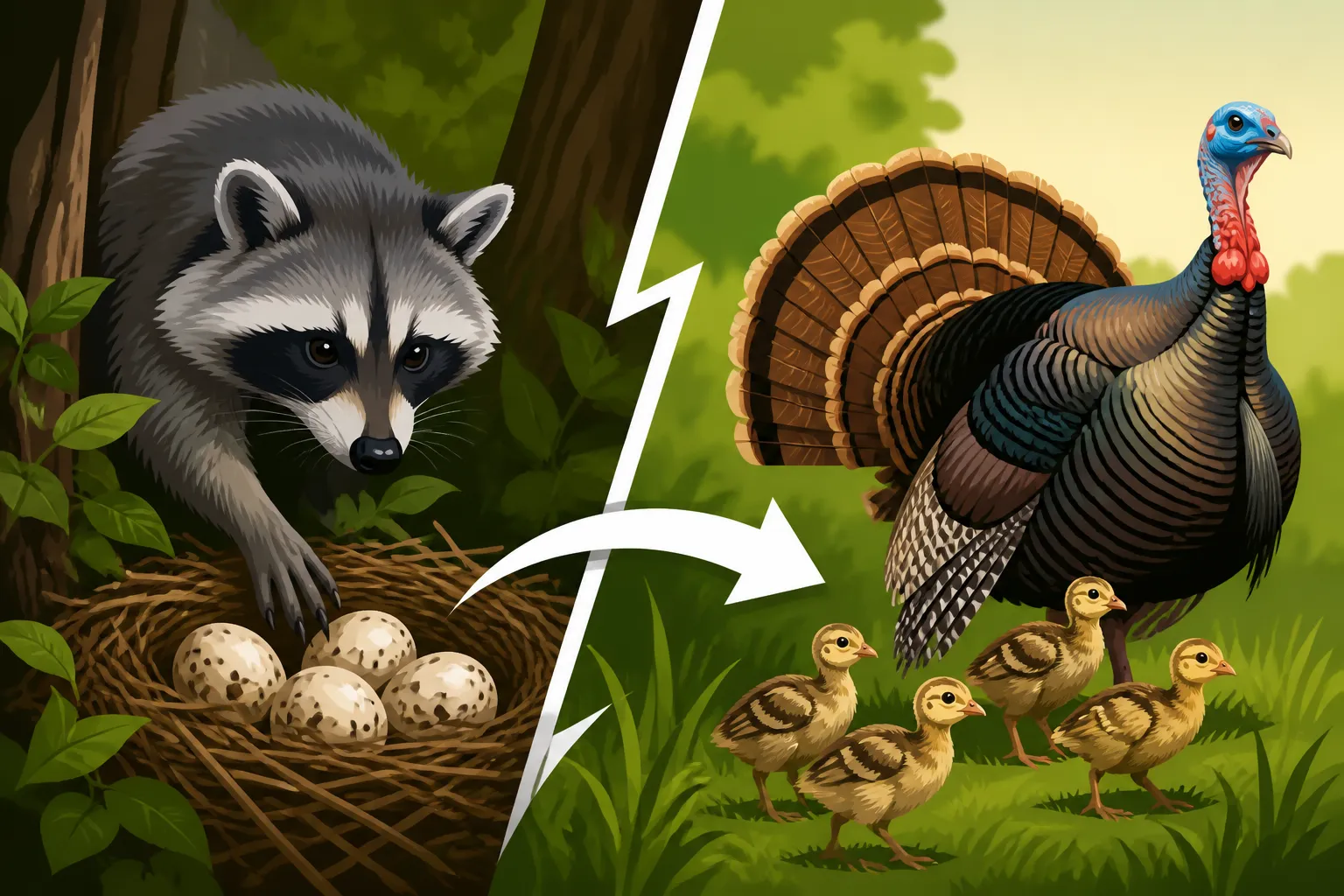
Nest Predation and Turkey Hatches
It's incredibly frustrating for Michigan turkey hunters and conservationists alike when you see what should be prime turkey habitat, hear gobblers in the spring, yet come fall, the woods seem eerily quiet, and the poult count is dishearteningly low. The reality is that successful turkey hatches are a delicate balance, and often, the biggest threat isn't the weather or habitat directly, but the relentless pressure from nest predators. This guide will dive deep into the world of nest predation, how it impacts Michigan's wild turkey populations, and what both nature and humans can do to help more poults make it to maturity.
The Delicate Balance of Michigan Turkey Reproduction
Wild turkeys in Michigan have made an incredible comeback story over the decades, a true testament to dedicated conservation efforts. But even with thriving adult populations, the future of the flock hinges entirely on successful reproduction, which means hens laying eggs, incubating them safely, and then raising their young poults through their most vulnerable weeks. It's a high-stakes game for these birds, and many factors are stacked against them, with nest predation being one of the most significant.
The Nesting Ritual and Its Vulnerabilities
Think about a wild turkey hen in Michigan. Sometime in late April or early May, after breeding, she'll meticulously choose a nesting site. This isn't just a random spot; she's looking for thick cover – a downed tree top, a dense brush pile, a patch of briars, or tall grasses – something that offers concealment from above and around. She'll scrape out a shallow depression, often at the base of a tree, under a bush, or in a brushy field edge, and begin laying her clutch of typically 8 to 15 eggs, one per day. Once her clutch is complete, she'll begin the 28-day incubation period, sitting tight on those eggs, relying on her camouflage and stillness to remain undetected.
This 28-day period is a critical vulnerability window. She leaves the nest only briefly each day to feed and drink, meaning the nest is unguarded for short spells. Even when she's on the nest, her scent and the slight disturbance she creates can draw attention. A hen's entire year of reproductive effort, and potentially the future of a local flock, can be wiped out in a matter of minutes if a predator stumbles upon her carefully chosen, but ultimately fragile, hideaway.
What Impacts Turkey Hatch Success Beyond Predators
While predators are a huge piece of the puzzle, they're not the only factor influencing whether a hen successfully hatches her poults. Weather, for instance, plays a massive role. A late spring snowstorm or a prolonged period of cold, wet weather during incubation can chill eggs to the point where they're no longer viable. Similarly, a cold, rainy spring right after hatching can be devastating for young poults. They are highly susceptible to hypothermia in their first few weeks, and excessive moisture can lead to rapid mortality. Poor habitat quality is another silent killer. If there isn't enough dense, protective cover for nesting, or if the landscape is fragmented, hens are forced to nest in less secure locations, increasing their exposure to predators and the elements.
Even things like disturbance from human activity, whether it's farming operations, logging, or recreational use of public lands, can cause hens to abandon nests. A hen might flush off her nest, leaving it exposed, and if the disturbance is significant enough, she might not return. Understanding these interconnected challenges gives us a more complete picture of why Poult-to-Hen Ratios and What They Mean are so vital for assessing the health of Michigan's turkey populations.
The Rogues' Gallery: Key Nest Predators in Michigan
Michigan's diverse ecosystem is home to a wide array of wildlife, and unfortunately for wild turkeys, many of these creatures view turkey eggs and young poults as a readily available meal. The sheer variety and abundance of these nest predators create a constant, relentless pressure that can severely limit turkey reproduction, especially in areas with high predator densities or poor nesting cover.
Mammalian Marauders: The Ground Attackers
When we talk about nest predators, our minds often jump to animals that scour the ground. Raccoons are arguably one of the most notorious. These clever, dexterous, and opportunistic omnivores have an uncanny ability to sniff out nests. They'll systematically work their way through cover, using their keen sense of smell and agile paws to locate and devour entire clutches of eggs. Skunks are another significant threat, particularly because of their excellent sense of smell and willingness to forage in dense undergrowth. Opossums, while often slower and less aggressive, are equally opportunistic and will readily consume eggs or even young poults if they find them. These three species often thrive in landscapes that are fragmented or near human habitation, where food sources are varied and cover can be dense.
Coyotes and foxes, both red and gray, are also formidable predators of turkey nests and poults. While they might not be as focused on eggs as a raccoon, a coyote or fox patrolling an area will certainly take advantage of an unguarded nest or a vulnerable hen. They are efficient hunters, and their widespread distribution across Michigan means they are a constant presence in most turkey ranges. Coyotes and Bobcats in Michigan highlights the prevalence of these canids, whose numbers can fluctuate and impact game species. These mammalian predators, through their sheer numbers and diverse foraging habits, account for a substantial percentage of turkey nest failures annually.
Avian Assailants and Other Threats: Air and Land
It's not just mammals that pose a threat from the ground. Birds like crows and jays, with their sharp eyesight and intelligence, will actively search for nests from above, swooping down to pilfer eggs when a hen is off the nest or has been spooked. Their ability to cover ground quickly and spot tell-tale signs makes them highly effective. Raptors, such as great horned owls and various hawks, while more typically targeting poults and even adult turkeys, can also be a threat to nests if they spot an unguarded clutch.
Beyond the common suspects, other less frequent but still impactful predators exist. Snakes, particularly larger species, can consume eggs. Even domestic animals, like dogs and cats that are allowed to roam free, can inadvertently or intentionally stumble upon and destroy turkey nests. The cumulative effect of this broad spectrum of predators means that a hen's nest is almost constantly under threat from multiple angles, highlighting the incredible odds a wild turkey must overcome to successfully reproduce. It's a tough world out there for a developing clutch of turkey eggs.
| Predator Type | Primary Target | Hunting/Foraging Strategy | Impact on Nests/Poults |
|---|---|---|---|
| Raccoon | Eggs, young poults | Olfactory (smell), opportunistic, dexterous | Devour entire clutches, highly destructive |
| Skunk | Eggs, young poults | Olfactory (smell), ground foraging | Similar to raccoons, effective at finding hidden nests |
| Opossum | Eggs, young poults | Olfactory (smell), opportunistic | Less aggressive but highly effective at nest destruction |
| Coyote | Eggs, poults, hens | Olfactory (smell), visual, ambush, pursuit | Destroy nests, take poults and occasionally incubating hens |
| Fox (Red/Gray) | Eggs, poults, hens | Olfactory (smell), visual, ambush, pursuit | Destroy nests, take poults and occasionally incubating hens |
| Crow/Jay | Eggs | Visual, opportunistic | Pilfer eggs when nests are unguarded |
| Great Horned Owl | Poults, hens | Visual, auditory, nocturnal ambush | Primarily take poults and adult birds, can target nests |
| Hawk (various) | Poults | Visual, ambush | Primarily take poults |
The Critical Role of Habitat in Predation Dynamics
When we talk about successful turkey hatches, it’s impossible to ignore the profound influence of habitat. Think of it this way: a hen can be as vigilant as possible, but if the landscape doesn't provide the right conditions, her efforts are severely undermined. Good habitat doesn't just offer food and shelter; it's the primary defense mechanism against the constant threat of nest predation.
Optimal Nesting Cover: A Hen's Best Defense
A prime nesting location for a wild turkey hen in Michigan isn't just "somewhere in the woods." It's a specific kind of cover – dense enough to conceal a basketball-sized nest and an incubating hen from the sharp eyes of a hawk flying overhead, yet thick enough to deter a sniffing raccoon or fox from easily pushing through. We're talking about areas with thick briars, dense shrubs, heavy pockets of switchgrass, or the tangled tops of fallen trees. These areas create a physical barrier that makes a predator's job much harder. When a hen has access to these types of secure, low-lying cover, her chances of a successful hatch go up significantly. It buys her time, forces predators to work harder, and makes her less likely to be visually detected.
Conversely, areas with sparse undergrowth or wide-open forest floors are death traps for turkey nests. A hen choosing such a spot is essentially putting her eggs on a silver platter. Land managers and conservation groups, and even individual landowners, constantly strive to create and maintain these specific types of nesting habitats because they recognize their immense value. This focus on nesting cover is a core component of healthy Michigan Turkey Population Trends.
Fragmented Landscapes and Their Predator Implications
Michigan’s landscape is a patchwork of forests, farmlands, suburbs, and rural residential areas. This "fragmentation" has a significant impact on turkey nesting success. When large, contiguous blocks of prime turkey habitat are broken up by roads, subdivisions, or large agricultural fields, it creates more "edge habitat." While edges can sometimes offer diverse food sources, they also concentrate predators. Raccoons, skunks, and opossums often thrive along these edges, where they can exploit both natural food sources and human-associated ones (like garbage or pet food).
Moreover, a fragmented landscape means that hens have to travel further, or cross more open ground, to get from their roosting sites to nesting cover, or from nesting cover to brooding cover once the poults hatch. Each journey across open ground is a moment of extreme vulnerability, not just for the hen, but potentially for her entire clutch. The more edge habitat there is, the higher the likelihood of a predator encounter. This is especially true in areas like Hunting Southern Michigan Farm Country, where wildlife must navigate a mosaic of cultivated fields and small woodlots. Understanding these dynamics is crucial for anyone hoping to improve turkey productivity on their property or hunting grounds.
Human Influence on Predator Abundance
It’s an uncomfortable truth that human activities can inadvertently contribute to higher predator densities, which in turn impacts turkey hatches. For instance, suburban and rural sprawl often leads to an increase in generalist predators like raccoons, skunks, and opossums. These animals are incredibly adaptable and can thrive on human refuse, pet food left outdoors, and readily available denning sites (like culverts, old barns, or sheds). When their populations boom due to these readily available resources, the pressure on natural prey species like turkey eggs and poults inevitably increases.
Even well-intentioned actions, like leaving out corn for deer feeding (where still legal and appropriate), can concentrate predators. While the focus might be on deer, raccoons and other omnivores are quick to discover and exploit these food sources, drawing them into areas where turkey nests might be present. Managing human-wildlife interactions, securing food sources, and responsible pet ownership are all subtle but important ways that we can indirectly help mitigate nest predation pressure on wild turkeys. It's a complex web, and every strand matters.
Proactive Strategies to Support Michigan Turkey Hatches
Understanding the challenges of nest predation is one thing; taking action to help Michigan's wild turkey populations is another. While we can't control every aspect of nature, there are concrete steps that land managers, conservation groups, and even individual hunters can take to create an environment where more turkey poults can survive and thrive. It's about working with nature, not against it, to tip the scales in favor of successful reproduction.
Habitat Management to Deter Predators
The single most effective long-term strategy to combat nest predation is through thoughtful habitat management. This isn't just about planting a few trees; it's about creating specific types of cover that benefit turkeys while making it harder for predators. For nesting cover, focus on areas that provide dense, low-growing vegetation. This could mean planting species like dogwood, hazelnut, or various shrubby evergreens in clumps, or allowing natural regeneration of briar patches and thickets. Controlled burns can also be a powerful tool, not only to stimulate new, dense herbaceous growth that turkeys prefer for nesting, but also to temporarily reduce heavy thatch that makes it easy for predators to tunnel through.
Furthermore, consider where these nesting areas are located relative to predator travel corridors. If you can create thick nesting cover away from obvious travel lanes like old two-tracks, field edges, or creek bottoms that predators frequently use, you increase the odds. Also, creating "brooding cover"—areas with overhead cover (like shrubs or scattered timber) but open ground underneath (often with high insect populations)—is vital for poult survival. This allows young poults to forage for insects, which are crucial for their growth, while having immediate refuge from aerial predators. Many state initiatives focus on habitat work in Michigan State Game Areas to boost populations of various game species, including turkeys.
Controlled Predator Removal: A Focused Approach
Predator removal is a more controversial, but sometimes necessary, strategy in specific situations where nest predation is exceptionally high and clearly identified as the limiting factor. It's crucial to understand that this isn't about eradicating all predators; rather, it's about intelligently managing localized populations to reduce pressure during critical nesting and brooding periods. This usually involves regulated Predator and Furbearer Hunting in Michigan and trapping activities. For instance, intense trapping efforts for raccoons, skunks, and opossums immediately before and during the nesting season can significantly reduce the number of individual predators in a given area.
Hunters participating in Michigan Small Game and Furbearer Seasons for coyotes and foxes can also contribute to reducing predation pressure, especially if those efforts are focused on known turkey nesting grounds. However, predator control needs to be approached with scientific understanding and legal compliance. Indiscriminate killing is rarely effective and can be detrimental to the ecosystem. Programs that encourage licensed trappers and hunters to focus on specific problem areas, or through specific conservation initiatives like those supported by the National Wild Turkey Federation, tend to see the most positive results. Tools like a comprehensive map from GoHunt can help identify potential predator travel corridors and habitat pinch points to focus efforts more effectively. Remember that successful trapping, as detailed in Running a Trapline in Northern Michigan, requires skill and knowledge of furbearer behavior.
The Role of Conservation Organizations and Community Involvement
Finally, a truly impactful strategy for improving turkey hatches in Michigan involves the collaborative efforts of conservation organizations and an informed, engaged community. Organizations like the Michigan chapter of the National Wild Turkey Federation (NWTF) are at the forefront of this work, funding habitat projects, conducting research, and advocating for policies that benefit wild turkeys. They often organize volunteer days for habitat improvement, which can include planting beneficial cover, clearing invasive species, or building brush piles.
Hunters and landowners can get involved by joining these groups, volunteering their time, or contributing financially. Education is also key: teaching others about the importance of securing garbage, not feeding pets outdoors, and understanding the role of various wildlife species can help reduce the inadvertent support of generalist predator populations. Every person who understands the delicate balance required for successful turkey reproduction contributes to a healthier, more robust wild turkey population across Michigan. It's a shared responsibility that, when embraced, can lead to more vibrant turkey flocks and more opportunities for hunters to pursue these magnificent birds.
Disclaimer
This article is for general informational purposes only and does not constitute professional advice. Laws, prices and regulations vary by location and change over time. Consult a qualified professional for guidance on your specific situation.