Turkey Shotguns and Chokes
One of the most frustrating things for a Michigan turkey hunter is when that big gobbler hangs up at 50 yards, just outside your comfortable range, and you know your pattern isn't going to cut it. Many of us have been there, left wondering if our shotgun and choke setup is truly up to the task of dropping a tom cleanly and ethically. This guide is all about demystifying turkey shotguns and chokes, helping you create a reliable, hard-hitting system for Michigan's spring and fall turkey woods.
Understanding the Turkey Shotgun's Role
When we talk about hunting turkeys, we're not talking about scattering pellets at a pheasant flushing wild or a duck decoying in close over the cattails. Turkey hunting is a specialized game, and your shotgun setup needs to be equally specialized to consistently put birds down. It's about precision at surprising distances, not just a wide spread.
More Than Just a Scattergun
Think of your turkey shotgun less like a traditional "scattergun" and more like a precision rifle that shoots a cloud of tiny projectiles. The goal isn't just to hit the bird anywhere; it's to deliver a dense, lethal pattern of pellets to a very specific, small target area on the turkey's head and neck. This requires a much tighter pattern than you'd typically use for other upland birds or waterfowl. The difference between a clean kill and a missed bird, or worse, a wounded bird, often comes down to how well your shotgun, choke, and ammunition work together to create that tight, consistent pattern. We're looking for surgical strikes, not a general peppering.
Gauge Considerations for Michigan Turkeys
For generations, the 12-gauge has been the undisputed king of turkey hunting, and for good reason. It offers the largest payload capacity, meaning more pellets downrange, which directly translates to denser patterns and more energy delivered to the target. Most modern turkey loads are designed with the 12-gauge in mind, providing a vast array of options from standard lead to high-tech tungsten super shot (TSS). If you're looking for maximum pattern density and knockdown power, especially when reaching out to those 40-50 yard distances, a 12-gauge is hard to beat.
However, the 20-gauge has seen a massive surge in popularity, and it's no longer just a "youth" or "light recoil" option. With advancements in ammunition, particularly the tungsten-based loads, a 20-gauge can now throw patterns that rival or even surpass traditional 12-gauge lead loads. This makes it an excellent choice for hunters who prefer a lighter, more maneuverable shotgun, which can be a real blessing when you're Run-and-Gun Turkey Tactics on State Land through thick Michigan timber or sitting for hours with the gun at the ready. A good 20-gauge setup can be incredibly effective, often with less felt recoil, making it a more pleasant shooting experience during patterning sessions and in the field. Even the .410, once unthinkable for turkeys, has entered the conversation with specialized TSS loads, though it typically demands extreme precision and limited range.
The Critical Choice: Choke Tubes
The choke tube is arguably the most important component in achieving a lethal turkey pattern. It's the secret sauce that takes your shotgun from a general-purpose fowling piece to a dedicated turkey slayer. Without the right choke, even the best ammunition will underperform.
What a Choke Tube Does
At its core, a choke tube is a removable device threaded into the end of your shotgun barrel that constricts the shot charge as it exits. Imagine a funnel: as the pellets travel down the barrel, the choke tube squeezes them together, reducing the spread and keeping them in a tighter column for a longer distance. This constriction is measured in thousandths of an inch, and even tiny differences can significantly impact your pattern density and effective range. A tighter constriction means the shot stays together more, resulting in a smaller, denser pattern downrange, exactly what you want for turkey hunting. The goal is to deliver as many pellets as possible into a 3-inch circle at the distance you expect to shoot a gobbler.
Types of Turkey Chokes and Their Constriction
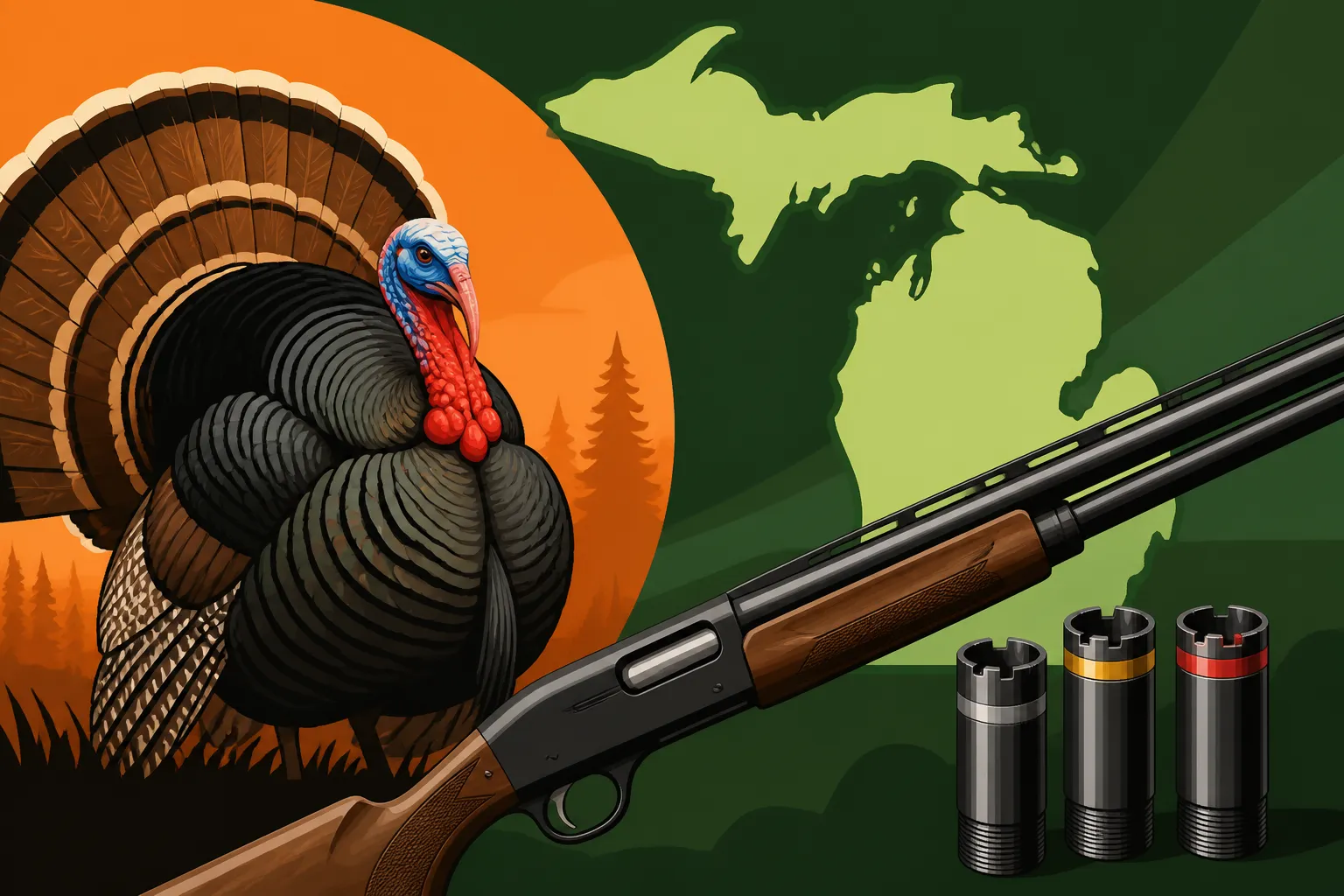
While you might be familiar with standard chokes like "improved cylinder," "modified," and "full," turkey hunting demands something far more specialized. Most turkey hunters opt for "extra full" or "super full" chokes, which have significantly more constriction than a standard full choke. These chokes are purpose-built to deliver the tightest possible patterns. You'll also see chokes specifically labeled "Turkey" or "Gobbler Getter" from various manufacturers, often with even more extreme constriction and specialized internal geometries designed to strip the wad away from the shot column quickly for improved pattern efficiency.
When selecting a turkey choke, consider your chosen ammunition. Some chokes perform better with specific shot materials or wad designs. It's a bit of a trial-and-error process, which is why testing at the range is absolutely non-negotiable. Don't assume a choke that works great for your friend will work equally well for you. Your shotgun, barrel length, and even the internal bore diameter can all affect how a choke patterns a given load. Brands like Carlson's, Jeb's, and Indian Creek are very popular among turkey hunters for their dedication to maximizing turkey patterns.
Finding the Right Choke for Your Shotgun
Finding the right choke isn't about buying the most expensive one or the one with the tightest constriction on paper. It's about finding the choke that consistently throws the most effective pattern with your specific shotgun and your chosen turkey load. This means going to the range and shooting pattern boards. You need to test different choke and ammunition combinations to see what truly performs.
Start with a few highly-rated turkey chokes for your gauge and try different premium turkey loads. It's not uncommon for one particular choke-and-load combo to dramatically outperform all others in a specific shotgun. Don't be afraid to try chokes from different manufacturers or even slightly different constrictions. Keep meticulous notes on which choke, which load, and which shot size produced the best results. A small investment in time and ammunition at the patterning board will pay huge dividends in confidence and ethical hunting shots when that gobbler finally steps into range. For example, if you are looking into Michigan Spring Turkey Applications and Units, you want to make sure your shotgun is patterned well before you head out for your hunt.
Ammunition Matters: Turkey Loads Explained
Your choke tube does its job, but it's the ammunition that delivers the punch. Modern turkey loads are engineering marvels, designed to perform under the extreme demands of achieving dense, long-range patterns capable of cleanly harvesting a wild turkey.
The Power of Modern Turkey Loads
Gone are the days when a standard lead pheasant load was considered "good enough" for turkeys. Today's premium turkey loads are a far cry from what our grandfathers used. The biggest game-changer has been the introduction of Tungsten Super Shot (TSS). This material is significantly denser than lead, allowing manufacturers to use smaller shot sizes (like #9 or #7) that pack more pellets into the same shell volume. More pellets mean more hits on target and greater pattern density. Additionally, TSS retains energy much better than lead, giving those smaller pellets incredible knockdown power at longer distances.
While TSS is an investment, many hunters find it well worth the cost for its superior performance. There are also excellent lead-based options still available, often blended with copper or nickel to improve hardness and reduce deformation. Regardless of the material, modern turkey loads are designed with specialized wads that protect the shot, minimize deformation, and then strip away cleanly to optimize pattern consistency. Remember, the goal is kinetic energy transfer to a vital zone, and today's loads deliver it with remarkable efficiency.
Shot Size and Its Impact
The shot size you choose plays a direct role in pattern density and pellet energy. Generally speaking, smaller shot sizes (like #6, #7, #9 TSS) give you more pellets per pound, leading to denser patterns. Larger shot sizes (like #4, #5) provide more individual pellet energy but fewer pellets overall.
For lead loads, #5 and #6 shot are classic choices, offering a good balance of pellet count and energy. With TSS, the game changes entirely. Many hunters are finding incredible success with #9 TSS, which offers an astonishing pellet count and still carries enough energy to be devastating on turkeys out to and beyond 50 yards. Some prefer a blend of #7 and #9 TSS for a slightly larger pellet option alongside the ultra-dense smaller shot. The key is to remember that the combination of shot material, shot size, and choke must be patterned together to determine the most effective load for your specific shotgun. Don't just pick a box off the shelf; pattern it relentlessly.
Patterning Your Turkey Gun at 40 Yards
This step is absolutely vital and cannot be skipped. You wouldn't hunt deer with a rifle you haven't zeroed, and turkey hunting is no different. You need to know exactly how your shotgun, choke, and ammunition perform together.
Here's the basic process:
- Set up: Go to a shooting range or a safe, appropriate location. Get a large sheet of paper or cardboard (at least 3×3 feet) and draw a 3-inch circle in the center. This circle represents the head and neck area of a turkey, your primary target zone.
- Distance: Set the target at 40 yards. While you might shoot closer in the field, 40 yards is a good benchmark to ensure your pattern holds together at typical maximum ethical ranges.
- Shoot from a rest: Use a solid rest (shooting bench, sandbags, bipod) to eliminate human error. You're testing the gun's pattern, not your offhand shooting skill.
- Shoot multiple times: Fire at least three to five shots with each choke/load combination. Shotgun patterns can vary slightly from shot to shot, so multiple samples give you a more accurate average.
- Analyze: After each shot, examine the pattern. Count the number of pellet strikes within the 3-inch circle and the 10-inch circle (representing the full head and neck area). Look for even distribution of pellets; you don't want big gaps in the pattern. You can use tools on a platform like GoHunt, or simply draw out the pattern.
Many veteran turkey hunters strive for at least 100 pellets in a 10-inch circle at 40 yards, with a good concentration in the 3-inch head circle. This patterning process will reveal your shotgun's true maximum ethical range and build your confidence for when that moment of truth arrives. You want to make sure your Turkey Shotguns and Chokes setup is flawless.
Here's a quick reference for common choke constrictions and ideal shot sizes:
| Choke Constriction | Typical Range (yards) | Recommended Shot Sizes (Lead) | Recommended Shot Sizes (TSS) | Pattern Characteristic |
|---|---|---|---|---|
| Improved Cylinder | 10-25 | 7.5, 6 | Not Recommended | Wide spread, good for very close shots, not for turkeys |
| Modified | 20-35 | 6, 5 | Not Recommended | Moderate spread, too open for consistent turkey kills |
| Full | 30-40 | 5, 4 | Not Recommended | Good all-around, but often not tight enough for turkeys |
| Extra Full (Turkey) | 35-50 | 5, 4 (buffered) | 9, 7.5, 7 | Very tight, dense pattern, standard for turkey hunting |
| Super Full / Gobbler | 40-60+ | 4 (heavily buffered) | 9, 7.5, 7 (blended) | Extremely tight, optimized for maximum range and density |
Note: This table provides general guidelines. Always pattern your specific gun, choke, and load to determine actual performance.
Optimizing Your Setup for Success
Beyond the shotgun, choke, and ammunition, there are other elements you can incorporate to further optimize your turkey hunting setup. These additions can make a real difference in your ability to consistently harvest birds in Michigan's varied terrain.
Sights and Optics for Precise Aim
While open beads were once standard, many turkey hunters are now opting for enhanced sighting systems to improve precision. A gobbler's head and neck are small targets, and placing a dense pattern into that vital zone requires pinpoint aiming. A red dot sight is a fantastic option, offering a clear, bright aiming point that's easy to see in low light conditions, such as during the Michigan Legal Shooting Hours at dawn or dusk. They are parallax-free within reasonable turkey hunting distances, meaning your point of aim is your point of impact regardless of slight head movement. Red dot sights are quick to acquire and excellent for fast-moving targets, or when a bird pops up unexpectedly.
Some hunters prefer fiber optic sights, which gather ambient light to provide highly visible front and rear sight pictures. These are a simple, rugged, and effective upgrade over a standard bead. For those wanting maximum precision and magnification, a low-power variable scope (1-4x or 2-7x) can be an option, though they are less common due to potential issues with field of view and target acquisition speed in close quarters. Whichever you choose, ensure it's robust, reliable, and sighted in meticulously at the range after you've patterned your shotgun.
Carrying and Handling Your Turkey Shotgun
Michigan's turkey woods can be rugged, whether you're navigating the sprawling state forests of the northern Lower Peninsula or the marshy edges of farm country. A comfortable, well-designed sling is essential for carrying your turkey shotgun, especially when you're covering ground Hunting Michigan Clearcuts and Aspen Cuts or still-hunting through potential roosting areas. Look for a sling with good padding and non-slip material to prevent the gun from sliding off your shoulder. The ability to quickly detach or adjust the sling can also be beneficial, allowing you to transition smoothly from walking to setting up for a shot.
Consider the overall weight and balance of your setup. A heavy shotgun might feel stable when shooting from a bench, but it can become cumbersome during long walks or extended periods of holding the gun at the ready while waiting for a gobbler to commit. If you're using a heavier 12-gauge, investing in a lightweight choke and potentially an optic can help balance the overall feel. A lot of seasoned hunters use GoHunt to scout areas that allow for lighter setups given the terrain. Practicing shouldering and aiming your full setup (gun, choke, sling, optic) before the season will help you get comfortable with its ergonomics and ensure you can quickly get on target when the opportunity arises.
Common Challenges and Troubleshooting
Even with a top-tier setup, you might encounter issues. Turkey hunting demands perfection from your gear, and sometimes things don't go as planned. Being able to troubleshoot common problems can save your hunt, or at least help you prepare better for the next one.
Dealing with Inconsistent Patterns
There's nothing more frustrating than patterning your gun only to find wildly inconsistent results from shot to shot. If your patterns are inconsistent, meaning the pellet count or distribution within your target circles varies significantly, it's time for some detective work.
First, check your fundamentals: are you using a solid rest? Is your shooting form consistent? Even slight flinches or movements can affect pattern. Next, look at your ammunition. Try different boxes or even different brands of the same load. Sometimes, a bad batch of shells can cause issues. Ensure your choke tube is screwed in tightly and correctly; a loose choke can lead to poor patterns and even damage your barrel. Finally, consider your barrel itself. Some shotgun barrels simply don't "like" certain choke-and-load combinations. If you've tried multiple chokes and loads with no success, it might be worth trying a different brand of choke or even taking your shotgun to a gunsmith to have the bore checked for any anomalies. Patience and methodical testing are key here.
Recoil Management for Better Shooting
Modern turkey loads, especially those heavy 3-inch or 3.5-inch 12-gauge magnum shells, can produce substantial recoil. This isn't just about comfort; excessive recoil can lead to flinching, poor shooting form, and ultimately, missed birds. It can also make those critical patterning sessions at the range a real chore.
There are several ways to manage recoil. A good recoil pad on your shotgun is the first line of defense; many aftermarket pads offer significant improvements over factory pads. Some shotguns come with integrated recoil reduction systems, which can be very effective. Wearing a padded shooting vest during patterning and hunting can also help absorb some of the shock. If recoil is still a major concern, consider stepping down to a 20-gauge with TSS loads. As mentioned earlier, a well-tuned 20-gauge can be just as lethal as a 12-gauge with less punishment. Remember, comfort leads to confidence, and confidence leads to better shooting. While you might be focusing on Hunting Michigan's Fall Turkey Season, these recoil considerations apply equally there, especially during longer sits where comfort can become an issue.
Disclaimer
This article is for general informational purposes only and does not constitute professional advice. Laws, prices and regulations vary by location and change over time. Consult a qualified professional for guidance on your specific situation.