Thermal and Night Vision Rules in Michigan
Hunting in Michigan offers some incredible opportunities, but let's be honest, navigating all the rules and regulations can sometimes feel like trying to track a ghost in a blizzard. One area that causes a lot of head-scratching and whispered debates around the deer camp fire is the use of thermal and night vision devices. With technology evolving so rapidly, it's easy to get confused about what's actually legal, what's ethical, and what could land you in hot water with the Michigan Department of Natural Resources (DNR). This guide is here to clear up that confusion, offering a realistic look at the rules surrounding thermal and night vision for Michigan hunters.
Demystifying Thermal and Night Vision Technology for Hunters
Before we dive into the nitty-gritty of Michigan's hunting regulations, let's take a moment to understand what we're actually talking about. Thermal imaging and night vision, while both allowing you to "see" in the dark, do so in fundamentally different ways. Understanding these distinctions is crucial, as the law often treats them similarly but their application can vary greatly.
Understanding Thermal Imaging: Seeing Heat, Not Light
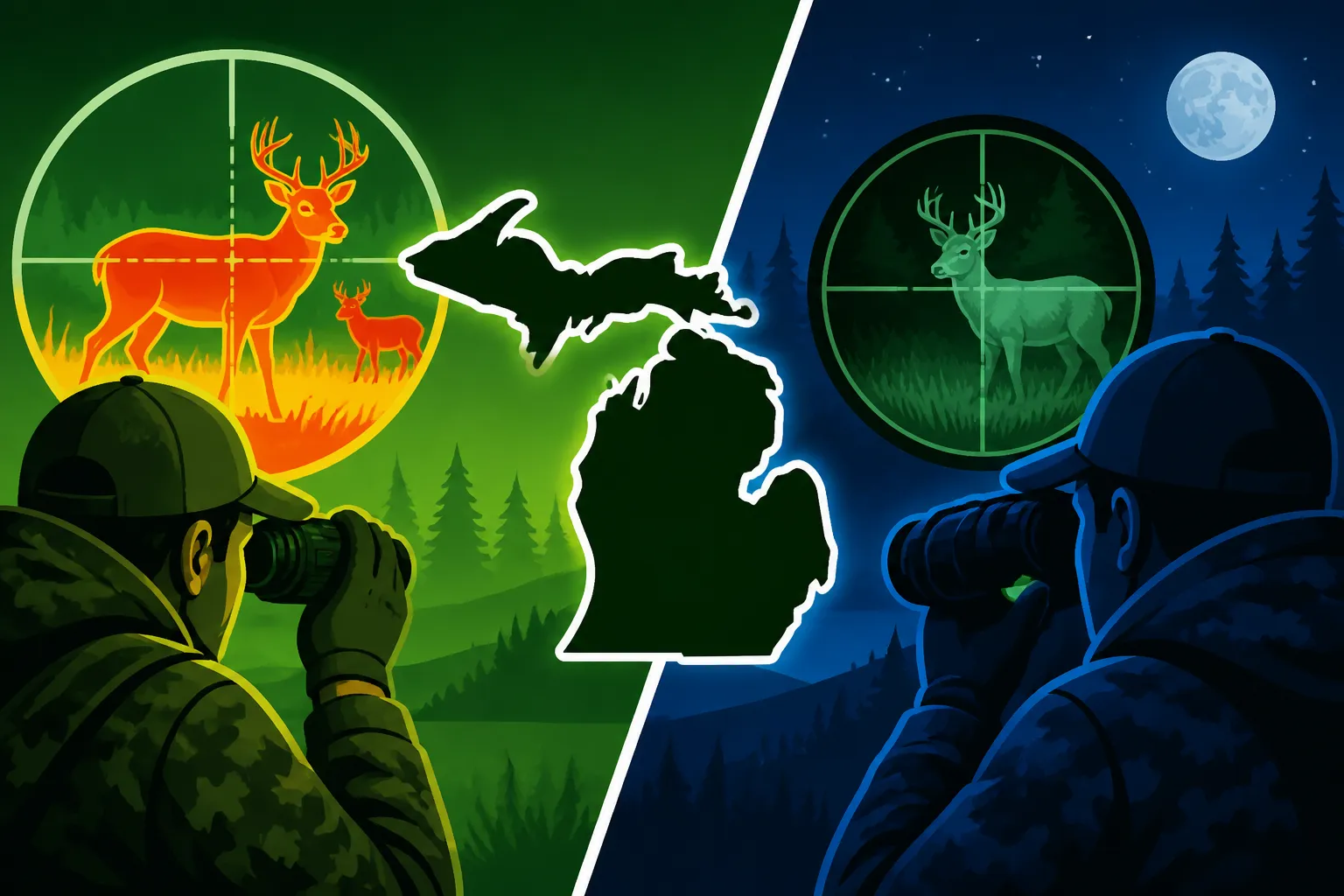
Thermal imaging devices don't rely on light at all; instead, they detect infrared radiation, which is emitted by anything that has heat. This means they can "see" the heat signatures of animals, people, or even warm rocks, regardless of ambient light conditions. Think of it like a heat map overlaying the world.
For a hunter, this can be incredibly appealing. Imagine being able to scan a dense cedar swamp at dusk and pick out the warm body of a deer even if it's perfectly camouflaged by the shadows. The allure is strong, no doubt. The images typically appear as different shades of color – often red, yellow, and blue, or sometimes just monochrome black and white – with warmer objects standing out in stark contrast. While they can be fantastic for spotting an animal, they don't offer the kind of detail you'd need for precise shot placement or antler identification in low light, which brings us to why the regulations are so tight for big game.
Understanding Night Vision Devices: Amplifying Existing Light
Night vision, on the other hand, works by amplifying the tiny bits of ambient light that are already present, even on the darkest nights. This could be moonlight, starlight, or even distant artificial light. These devices collect that faint light and intensify it thousands of times, presenting a greenish, brighter image to the user.
Generations of night vision technology exist, each offering better clarity and light amplification than the last. For a hunter, night vision can be excellent for navigating in the dark, locating game, or even performing tasks around camp without a flashlight. However, like thermal, while it makes the darkness navigable, using it for aiming a firearm at night introduces a whole host of legal and ethical questions, especially when it comes to species like deer that are typically hunted during daylight hours. The ability to see better in the dark doesn't automatically mean you can hunt better or, more importantly, legally hunt better.
Michigan's General Rules on Night Hunting and Legal Shooting Hours
This is where the rubber meets the road for most hunters considering night vision or thermal. Michigan has very specific "legal shooting hours" for nearly all game species, and these hours are the primary barrier to using these technologies for taking animals. It's not just about what equipment you can use, but when you can use it.
The Sunrise-to-Sunset Standard
For most traditional hunting, particularly for deer, Michigan law adheres to a strict "legal shooting hours" framework. This usually means from 30 minutes before sunrise to 30 minutes after sunset. This is a critical window. If you're outside these hours, even if you spot a magnificent buck with your thermal scanner, you absolutely cannot legally attempt to harvest it. This applies across the board for regulated big game and many small game species.
The rationale here is multi-faceted: it promotes fair chase, reduces the chance of misidentification in low light, and generally ensures a safer hunting environment. Hunters often get frustrated by these restrictions, especially when they know a big buck is moving at the edges of legal light, but these rules are foundational to wildlife management and public safety. Trying to skirt these rules, even with advanced optics, is a serious violation.
Species-Specific Exceptions: Where Night Hunting Is Permitted
Now, here's where it gets interesting, and where thermal and night vision devices actually do have a legal place in Michigan hunting. Certain species are designated as either nuisance animals or furbearers that can be legally hunted outside of standard daylight hours, often specifically to aid in population control or for their fur value.
The most common example for hunters is coyotes. Coyotes are often active at night, and they can have a significant impact on deer and small game populations. Because of this, Michigan allows hunting Coyote Calling in Michigan Winter both day and night, with specific rules for night hunting. This is where your thermal monocular or night vision scope can potentially come into play, if you're following all other regulations.
Similarly, some furbearers may have night hunting provisions. It's absolutely crucial to consult the current Michigan Hunting and Trapping Digest or the DNR website directly for the most up-to-date and species-specific information. Never assume; always verify. What's legal for a coyote might be highly illegal for a bobcat or a fox, so make sure you know your target species and the specific regulations that apply to it. Many hunters use resources like GoHunt to stay on top of these complex and often changing rules.
Specific Rules for Thermal and Night Vision Devices in Michigan
This is the core of what most hunters want to know: "Can I use it?" The answer, as is often the case in hunting regulations, is "it depends." It depends on the species, the season, and how you intend to use the device.
Thermal and Night Vision for Deer Hunting: Mostly No, with Nuances
Let's address the big one first: deer. In Michigan, it is generally illegal to use thermal or night vision devices to take deer. This means you cannot use them to aim your firearm or bow at a deer during legal hunting hours, nor can you use them to hunt deer outside of legal shooting hours. The spirit of the law, combined with the explicit wording, prohibits using artificial light or optical devices that intensify light for taking deer. This directly includes thermal and night vision.
This rule exists to maintain fair chase principles for a popular game animal. Imagine the advantage a hunter would have if they could effectively "see" deer in pitch black conditions, while the deer are adapted to move under cover of darkness. It simply wouldn't be fair, and it would likely lead to a huge increase in harvest numbers, impacting the overall deer population Michigan Deer Population Estimate.
However, there are nuances:
- Scouting: Can you use a thermal monocular to scout deer movement before hunting season, or to observe deer on your property outside of hunting hours, without a weapon? Generally, observing wildlife is not prohibited. But if that scouting transitions into "aiding in the taking" by providing a direct advantage during legal hunting hours, you're on very thin ice. The distinction can be tricky. Using a tool like GoHunt's mapping features can assist in scouting, and while it doesn't offer thermal views, it can help you plan legal and ethical scouting trips.
- Recovery: What if you shoot a deer during legal hours, and it's getting dark? Can you use thermal or night vision to help Blood Trailing After Dark in Michigan locate it? This is a gray area and often depends on the specific circumstances and the discretion of a DNR officer. The primary concern is using the device to hunt, not to recover. If you are actively hunting and carrying a weapon, and then try to use it for recovery, it becomes complicated. Many hunters would argue that a wounded animal should be recovered, and modern technology can assist. However, the law aims to prevent abuse. If you are ever in this situation, it is best to contact the DNR immediately to report your situation and seek guidance rather than proceeding with a device that could be misinterpreted as illegal hunting activity.
| Device Type | Deer (Taking/Hunting) | Deer (Scouting/Observation) | Coyote (Taking/Hunting) | Coyote (Scouting/Observation) |
|---|---|---|---|---|
| Thermal | Generally Illegal | Allowed (No Weapon, Non-Hunting Activity) | Generally Legal (Night Hunting Rules Apply) | Allowed |
| Night Vision | Generally Illegal | Allowed (No Weapon, Non-Hunting Activity) | Generally Legal (Night Hunting Rules Apply) | Allowed |
Note: "Generally Illegal" means for the act of taking or hunting during legal hours. "Allowed" for scouting/observation means without the intent to immediately hunt, and often without a weapon.
Thermal and Night Vision for Predator and Furbearer Hunting: Where They Shine
This is the arena where thermal and night vision really become valuable tools for Michigan hunters. As mentioned earlier, coyotes can be hunted at night, and this is where these devices are explicitly allowed and incredibly effective. If you're out Coyote Calling in Michigan Winter, being able to spot a coyote approaching through the darkness, long before it sees or scents you, is a massive advantage.
For other predators and furbearers like fox or bobcat, rules vary by season and method. For example, Bobcat Hunting in the Upper Peninsula often involves specific permits and may have restrictions on hours or methods that would preclude the use of night vision or thermal for taking. It’s absolutely vital to confirm the rules for each specific species you intend to hunt at night.
When hunting coyotes at night, you can use thermal scopes mounted on your firearm, or night vision scopes, to locate and target the animals. The key is that Michigan's regulations for these species allow for night hunting, and the use of these devices falls within the approved methods. Many hunters find that the investment in a quality thermal or night vision setup dramatically increases their success rates on these elusive nocturnal animals. Platforms like GoHunt often have forums or resources where hunters discuss legal and effective setups for these types of hunts.
Small Game and Other Species
For most small game species, like rabbits or squirrels, the same "legal shooting hours" apply as they do for deer. You cannot use thermal or night vision to hunt them outside of daylight hours. There are no general exceptions for small game to be hunted at night using these devices.
Trapping, however, is a different activity and doesn't fall under "taking" with a firearm or bow in the same way. While you might use night vision to navigate to your traps or check them in the dark, the device isn't being used to take the animal in the immediate sense. Again, always consult the current digest for specific furbearer trapping rules.
Practical Considerations and Ethical Debates
Beyond the letter of the law, there are always practical considerations and ethical discussions that arise with new technologies in hunting. Thermal and night vision are no exception.
The "Aid in Taking" Clause: A Hunter's Dilemma
Michigan's regulations often use language that prohibits using artificial lights or light-intensifying devices as an "aid in taking" game. This broad phrase is designed to cover a range of scenarios and prevent hunters from gaining an unfair advantage. It's why using a spotlight to locate deer and then shoot them is highly illegal. Thermal and night vision devices fall squarely into this category when it comes to species like deer.
The dilemma for hunters often comes down to interpreting "aid in taking." If you simply spot a deer with thermal, then put the device down and pick up your rifle with a conventional scope during legal shooting hours, have you "aided in taking"? Many would argue yes, as the thermal device gave you information you wouldn't otherwise have had. This is why the DNR tends to take a very conservative view on these devices for big game. It's about preserving the challenge and respecting the animal. This is a point of contention for some, but it’s the current framework.
Safety Concerns and Responsible Use
Hunting at night, even for legal species like coyotes, carries inherent safety risks. Target identification is paramount. While thermal and night vision can help you see in the dark, they don't always provide the same level of detail as daylight vision. It can be harder to identify exactly what's beyond your target, especially if you're not intimately familiar with the terrain.
Responsible hunters using these devices for legal night hunting should always:
- Know their backstop: Be absolutely certain of what lies beyond your target.
- Positively identify their target: Thermal might show a heat signature, but distinguishing a coyote from a domestic dog or another protected animal can be challenging. Night vision offers more detail, but still requires careful identification.
- Be aware of surroundings: Other hunters, landowners, or even curious animals could be in the area.
- Hunt with a partner: Having another set of eyes and ears, and someone to cover you, adds a layer of safety.
- Check local ordinances: Beyond state law, some local townships or counties might have additional restrictions on night hunting or firearm discharge that you need to be aware of. Using mapping tools, potentially like those offered by GoHunt, can help identify public land boundaries and potentially relevant local restrictions, though direct inquiry with local authorities is always best.
Cost vs. Benefit
Let's not forget the financial aspect. Quality thermal and night vision devices are not cheap. They represent a significant investment. For the average Michigan deer hunter, the strict regulations mean that investment wouldn't be justified solely for deer hunting, as their use is so limited.
However, for those dedicated to predator calling or furbearer hunting, or even just for general property surveillance and security, the cost can be well worth the benefit. Many hunters who invest in these tools do so with the full understanding that their primary use will be for species other than deer, or for observation rather than active hunting. It's a specialized tool for specialized situations.
Navigating the Rules: Always Verify
The most important piece of advice regarding thermal and night vision rules in Michigan, or any hunting regulation, is to always, always verify the current laws yourself. Regulations can change, and what was legal last year might not be this year.
Here's how to stay informed:
- Michigan DNR Website: The official source for all hunting and trapping regulations.
- Michigan Hunting and Trapping Digest: This annual publication is available online and at license retailers. Read it cover to cover, especially the sections pertaining to "General Hunting Rules" and the specific species you plan to hunt.
- Contact the DNR: If you have any doubt whatsoever, contact a local DNR office or conservation officer. They are the ultimate authority and can provide clarity on specific scenarios. It's always better to ask beforehand than to face a violation.
- Reputable Resources: Beyond the DNR, resources like GoHunt often compile information and provide updates, though they should always be cross-referenced with official DNR publications.
Understanding Michigan Hunting Licences and What They Cost is just the first step; knowing the specific rules for your equipment is equally important. Whether you're considering thermal for spotting coyotes or just want to know if you can use night vision to navigate to your deer stand before legal light, the answers are in the details. Always err on the side of caution and prioritize ethical, legal hunting practices. There's nothing worse than having a great hunt tarnished by a misunderstanding of the rules, or worse, facing Michigan Wildlife Violation Penalties. Enjoy the hunt, stay safe, and stay legal!
Disclaimer
This article is for general informational purposes only and does not constitute professional advice. Laws, prices and regulations vary by location and change over time. Consult a qualified professional for guidance on your specific situation.