Vehicle Rules on Michigan State Land
It can be incredibly frustrating to head out to your favorite slice of Michigan state land, whether for hunting, hiking, or just getting away, only to find yourself confused by what roads you can actually use, or worse, facing a closed gate. Michigan's public land is vast and wonderful, but the rules around vehicle access, especially for off-road vehicles (ORVs), can feel like a labyrinth. This guide will help you understand the nuances of vehicle rules on Michigan state land, ensuring you can navigate responsibly and enjoy your outdoor adventures without a headache.
The Maze of Michigan's Public Land Access
Michigan boasts millions of acres of public land, from sprawling state forests to more concentrated state game areas. While this abundance is a blessing for outdoor enthusiasts, it also means a patchwork of regulations. What's allowed in one corner of the Huron-Manistee National Forest might be strictly forbidden just a few miles away in a state game area. This complexity can leave even seasoned hunters and recreationists scratching their heads.
Why Vehicle Rules Are So Nuanced
The sheer diversity of Michigan's public lands contributes directly to the complexity of its vehicle rules. You have vast tracts of state forest land managed primarily for timber and recreation, smaller state game areas often focused on wildlife habitat and hunting, and even national forests with federal regulations overlaying state laws. Each type of land has different management objectives, which in turn dictate how and where vehicles are permitted.
Think about it: a wide, gravel forest road in the Upper Peninsula might be perfectly fine for your truck, but that narrow two-track leading into a southern Michigan marsh, while looking inviting on a map, could be off-limits to anything but foot traffic or designated ORV use. The rules are designed to protect fragile ecosystems, prevent erosion, reduce user conflicts, and maintain the quiet solitude many seek in the woods. This means that while some rules are statewide, many are specific to the type of land, the season, or even a particular parcel. It's not always intuitive, and it definitely pays to do your homework before you go.
Common Misconceptions About State Land Roads
One of the biggest misconceptions I hear from fellow hunters is, "If there's a road, I can drive on it." Unfortunately, that's often not the case. Many two-tracks, old logging roads, or even faint trails you see on an aerial map might actually be closed to motorized vehicles, or only open to certain types of vehicles. Just because a road appears to be there doesn't mean it's a legal route. Another common misunderstanding is that all ORV trails are open to all ORVs at all times. This isn't true either; some trails are seasonal, some are only for specific widths of vehicles, and some are designated for other uses entirely.
Many people also assume that if a gate is open, it means the road is open. While an open gate often indicates access, it's not a guarantee. Sometimes gates are left open temporarily for forestry operations or other management activities, but the road beyond might still be closed to general public vehicle traffic. Always look for signage, and when in doubt, default to checking official maps and walking in if you're unsure. You can find invaluable information by checking out Using the Michigan Mi-HUNT Map before you even leave your driveway.
Navigating Different Types of Vehicles
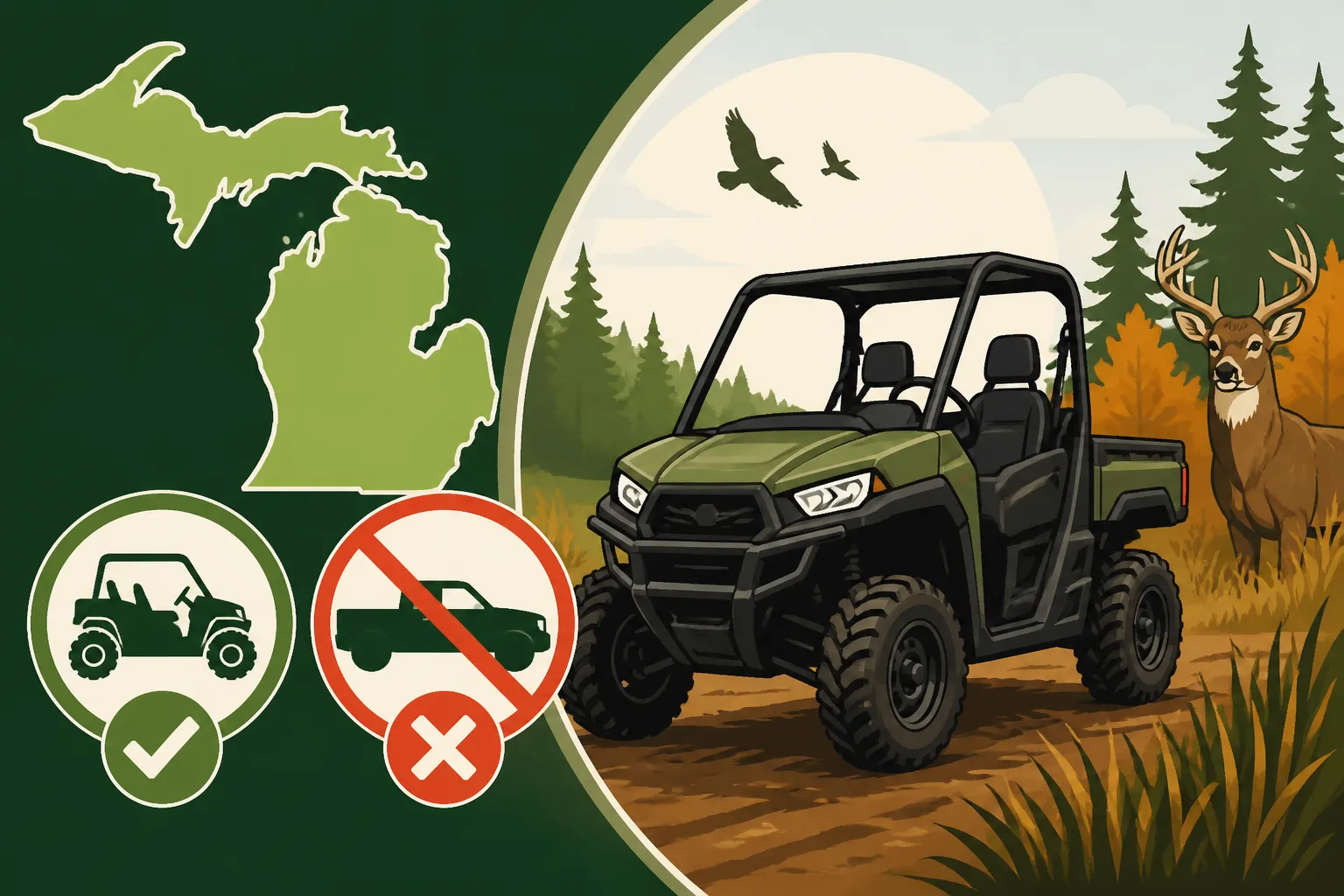
Michigan's vehicle rules differentiate significantly between standard passenger vehicles (like your truck, SUV, or car) and Off-Road Vehicles (ORVs), which include ATVs, UTVs, and dirt bikes. Understanding these distinctions is crucial for staying legal and safe on public land.
Passenger Vehicles and Designated Roads
For your everyday passenger vehicle – the truck you use to haul your deer or the SUV packed with camping gear – access on state land is generally restricted to designated public roads. These are typically county roads, state highways, or well-maintained forest roads. These roads are usually clearly marked and maintained for standard vehicle traffic. If a road is unpaved, narrow, or appears to be infrequently used, it's wise to double-check its status.
Many state forest roads are open to conventional vehicles, especially those that provide access to trailheads, campgrounds, or specific recreational sites. However, it's essential to remember that even within these areas, roads might be gated seasonally or permanently closed for various reasons, such as protecting fragile resources, preventing illegal dumping, or ensuring public safety. Always look for signs indicating whether a road is open or closed, and consult a reliable map like those found on the Mi-HUNT website or an app like onX Hunt, which often shows open/closed road designations.
ORVs and the Trail System
ORVs have their own dedicated network on Michigan state land, primarily within the vast state forest system. This system includes thousands of miles of designated ORV trails and routes. These trails are specifically designed and managed for ORV use, often marked with route numbers and signs indicating the type of vehicles allowed (e.g., motorcycles only, vehicles 50 inches or less, or all ORV types). You'll typically need a Michigan ORV license and trail permit to ride on these designated trails.
It's critical to stay on marked ORV trails and routes. Going off-trail, known as "cross-country travel," is almost universally prohibited on public land due to the severe environmental damage it can cause, including erosion, habitat destruction, and the spread of invasive species. There are some very specific exceptions, which we'll get into, but for the most part, if you're on an ORV, stick to the designated routes. Understanding ORV Rules on Michigan State Forest Roads is vital for any ORV enthusiast.
When and Where You Can Drive Off-Road
While cross-country ORV travel is generally forbidden, there are very limited circumstances where driving off designated roads or trails might be permissible for specific purposes, usually related to deer recovery. For instance, in some areas, hunters may be allowed to use an ORV to retrieve a legally harvested deer, but often only after specific conditions are met, such as obtaining permission from the managing authority or sticking to a direct, minimal-impact route. These rules are usually very specific and can vary by land type and even by individual property.
For example, on many State Forest lands, you might be able to leave a designated trail for deer retrieval, but you’re still expected to cause minimal disturbance and use the shortest practical route. This is not a blanket permission to drive anywhere you please; it's a very narrow allowance. Always check the current regulations with the Michigan Department of Natural Resources (DNR) or the specific land management unit before assuming you have permission to drive off-road for retrieval. Misinterpreting these rules can lead to significant fines and penalties.
Understanding Specific Land Designations
Michigan's public land isn't a monolith; it's a diverse collection of state forests, state game areas, and national forests, each with its own set of rules regarding vehicle use. What's permissible in one area might be strictly forbidden in another, making it crucial to know exactly where you are and what the local regulations entail.
State Forests: The Wild Card
Michigan's State Forests are the most extensive public lands, covering millions of acres, primarily in the northern Lower Peninsula and the Upper Peninsula. These areas often feel like the "wild west" for vehicle access compared to other public lands, but there are still clear rules. Generally, State Forest roads are open to conventional vehicles unless specifically closed by a gate or sign. Many of these roads are used for timber management, recreation, and providing access to remote areas for hunters and other users. This is where you'll find the bulk of the ORV trail system as well.
However, even within State Forests, some areas are more sensitive than others. Seasonal closures are common, especially on less-maintained roads that might become impassable or easily damaged during wet periods or winter thaws. Dispersed camping is often allowed, but you still need to adhere to rules regarding vehicle parking and site impact. It’s always best to use a mapping tool like GoHunt or onX Hunt to identify the specific land type you're on and check for any localized restrictions. These apps integrate state land boundaries and often indicate specific restrictions, helping you avoid accidental violations. For those considering a longer stay, familiarize yourself with Dispersed Camping on Michigan State Forest rules.
State Game Areas: Often More Restricted
State Game Areas (SGAs) are generally smaller parcels of public land managed specifically for wildlife habitat and public hunting, primarily found in the Lower Peninsula. Because of their management objectives and often higher usage, vehicle rules in SGAs tend to be much more restrictive than in State Forests. In many SGAs, motorized vehicle access is limited strictly to designated parking areas and main access roads. Driving on two-tracks or into fields is typically prohibited.
The focus in SGAs is often on walk-in access to minimize disturbance to wildlife and maintain a quieter experience for hunters. You might find numerous gates on internal two-tracks, and these are almost always closed to motorized public access. Even if you see what looks like an old trail, assume it's closed unless explicitly marked otherwise. Always check the DNR website or signs at the SGA entry points for specific regulations. The limited vehicle access is a key reason why Hunting Southern Michigan Farm Country Deer Hunting often means more legwork.
National Forests and Their Own Rules
Michigan is also home to three National Forests: the Huron-Manistee, Ottawa, and Hiawatha. While these are federal lands, they generally follow state hunting regulations. However, their specific vehicle and access rules are set by the U.S. Forest Service. Often, National Forests have a "Motor Vehicle Use Map" (MVUM) that specifically designates roads and trails open to motorized travel. If a road or trail is not on the MVUM, it is considered closed to motorized vehicles.
These maps are your best friend when hunting or recreating in National Forests. They clearly show which roads are open, which are seasonal, and which are designated for specific vehicle types (like ORVs). While the spirit of many rules aligns with state land, the specifics can differ, so always consult the relevant MVUM for the forest you're visiting. Many hunters find that utilizing mapping software on their phones, like onX Hunt, which includes layers for different land types, is indispensable for navigating these varied regulations. You can get a broader overview by reading Michigan's Three National Forests.
Staying Legal and Finding Your Way
Navigating vehicle rules on Michigan state land doesn't have to be a constant source of anxiety. With the right tools and a commitment to responsible recreation, you can confidently explore the vast opportunities Michigan offers.
Essential Tools for Navigating Public Land
The most crucial tools you can have in your arsenal are up-to-date maps and a way to access them in the field. The Michigan DNR's Mi-HUNT map is an excellent online resource that shows public land boundaries, two-tracks, and designated ORV trails. It's a fantastic starting point for planning your trip. Apps like onX Hunt or GoHunt take this a step further, offering detailed satellite imagery, private and public land boundaries, and often a wealth of information on road access, ORV trails, and even property owner data (for private land scouting). I personally rely heavily on onX Hunt on my phone for virtually all my public land excursions, as it gives me real-time location tracking on top of those critical boundary lines and road designations.
Beyond digital maps, don't underestimate the value of traditional paper maps, especially if you're heading into areas with spotty cell service. A good topographic map or a printed map from the DNR website can be a lifesaver. Always check for signs at trailheads and access points, as these provide the most current, localized information. Remember, just because a gate is open, or a trail looks inviting, doesn't mean it's legal to drive down it. Verify, verify, verify. Before heading out, make sure you've reviewed Scouting With Michigan's Mi-HUNT Map to make the most of available resources.
Here's a quick reference for general vehicle access by land type:
| Land Type | Passenger Vehicles (Cars/Trucks) | ORVs (ATVs, UTVs, Dirt Bikes) | General Rule of Thumb |
|---|---|---|---|
| State Forests | Open on designated roads unless marked closed. | Restricted to designated ORV trails/routes; license required. | Check Mi-HUNT map or onX Hunt for specific roads/trails. |
| State Game Areas | Limited to main access roads and designated parking. | Generally prohibited beyond parking areas and main roads. | Assume walk-in access, verify all roads. |
| National Forests | Open on roads listed on Motor Vehicle Use Maps (MVUMs). | Restricted to trails/routes listed on MVUMs; permit may be required. | Always consult the specific forest's MVUM. |
| Private Land | Requires landowner permission for any vehicle access. | Requires landowner permission. | Absolutely no access without explicit permission. |
Penalties for Violations
Ignoring vehicle rules on state land isn't just a minor inconvenience; it can lead to serious consequences. The DNR and other law enforcement agencies actively patrol public lands, especially during peak hunting seasons. Violations can result in hefty fines, vehicle impoundment, and even criminal charges depending on the severity and nature of the offense. Beyond monetary penalties, repeat offenses can impact your hunting privileges.
More importantly, unauthorized vehicle use causes significant damage to Michigan's precious natural resources. Driving off-trail tears up vegetation, compacts soil, destroys wildlife habitat, and contributes to erosion, especially in sensitive wetlands and hillsides. These actions can take years or even decades to recover from, harming the very environment we all enjoy. Respecting these rules is about more than just avoiding a ticket; it's about being a responsible steward of Michigan's wild places. For more on the consequences, see Michigan Wildlife Violation Penalties.
Respecting the Resource and Other Users
Ultimately, adherence to vehicle rules on Michigan state land comes down to respect. Respect for the land, its wildlife, and other outdoor enthusiasts. When you stick to designated roads and trails, you help preserve the quality of the habitat, ensure a quieter experience for hunters and hikers, and prevent unnecessary damage that burdens management agencies. Every hunter I know values the solitude and challenge of hunting public land, and by following the rules, we contribute to maintaining that experience for everyone.
Before you head out, take a few minutes to check the DNR website, consult your mapping app like onX Hunt, and understand the specific rules for the area you plan to visit. If you're unsure, err on the side of caution and choose to walk rather than risk a violation or damage to the land. Being prepared means a more enjoyable and responsible experience for everyone who loves Michigan's outdoors. It's how we ensure these amazing resources remain available and healthy for generations to come, and it helps reduce Hunting Pressure on Michigan State Land in sensitive spots.
Disclaimer
This article is for general informational purposes only and does not constitute professional advice. Laws, prices and regulations vary by location and change over time. Consult a qualified professional for guidance on your specific situation.