Dispersed Camping on Michigan State Forest
There's a special kind of freedom that comes with loading up your gear, heading deep into Michigan's state forests, and pitching a tent wherever you find a suitable spot. For many of us who love the outdoors, especially hunters, the thought of escaping the crowds and truly immersing ourselves in nature without the confines of a designated campground is incredibly appealing. However, navigating the rules and knowing where you can actually do this can feel a bit like trying to read a map in the dark. This guide aims to shine a light on the often-misunderstood world of dispersed camping on Michigan State Forest lands, helping you understand the regulations and confidently find your own slice of wilderness.
What Exactly is Dispersed Camping in Michigan State Forests?
Dispersed camping, in its simplest form, is camping outside of designated campgrounds. It means you're setting up your tent, hammock, or small RV on public land, often deep within the woods, without amenities like picnic tables, fire rings, vault toilets, or potable water. It’s the ultimate do-it-yourself camping experience, offering solitude and a genuine connection to nature that you just can't get in a bustling campground. In Michigan, this primarily applies to our vast State Forest lands, which are managed by the Department of Natural Resources (DNR).
The Allure of Unofficial Campsites
If you've ever found yourself wishing for more peace and quiet than a state park campground can offer, you've likely dreamed of dispersed camping. For hunters, it's particularly attractive because it allows you to camp right where you hunt, often cutting down on travel time and giving you a leg up on early morning starts. Imagine waking up to the sounds of the forest, rather than your neighbor's generator, and being just a short walk from your chosen treestand or tracking route. It's about flexibility, self-reliance, and feeling truly embedded in the landscape. This kind of camping fosters a deeper appreciation for the land, as you become solely responsible for your impact and experience.
The draw also comes from the opportunity for true exploration. You're not limited to a pre-defined path; you can venture off the beaten track, discover hidden creeks, remote clearings, or old-growth stands that most visitors never see. It's an adventurer's paradise, allowing for spontaneous itinerary changes and the thrill of discovery. For families, it can be a fantastic way to teach kids about self-sufficiency and the importance of respecting nature, far from the distractions of modern life.
How it Differs from Developed Campgrounds
The contrast between dispersed camping and developed campgrounds couldn't be starker. In a developed campground, you pay a fee, get a numbered site, and have access to various amenities – think paved roads, bathrooms, trash disposal, often even electrical hookups and showers. There’s usually a camp host, and rules are clearly posted. While convenient, this often means less privacy, more noise, and a feeling of being in an outdoor hotel rather than truly "roughing it."
Dispersed camping, on the other hand, is generally free. There are no reservations, no site numbers, and absolutely no amenities. You are completely self-sufficient. This means you need to pack in all your water, be prepared to dig a cathole for human waste, and pack out everything you bring in, including all trash. The rules are less about what you can't do and more about general principles of minimizing impact, ensuring safety, and respecting the land and other users. It demands a higher level of preparation and self-reliance, but the reward is unparalleled solitude and an authentic wilderness experience.
Essential Rules and Regulations for Dispersed Camping
While the freedom of dispersed camping is vast, it's not a free-for-all. Michigan has specific regulations designed to protect our natural resources and ensure everyone can enjoy these wild spaces. Understanding these rules is paramount to a legal and responsible trip. Don't let them intimidate you; they're straightforward once you know them.
Understanding the "Walk-In" Rule and Setbacks
One of the most crucial rules for dispersed camping in Michigan State Forests involves distance and access. Generally, you are allowed to camp on State Forest lands without a permit if your site is more than one mile from a designated state forest campground, and at least 150 feet from any road, trail, or body of water. This "walk-in" rule is essential for maintaining the wilderness feel and protecting fragile ecosystems near waterways and popular access points. If you plan to camp closer than one mile to a developed campground, you would need to check specific local ordinances or consider utilizing that campground instead.
The 150-foot setback from roads, trails, and water isn't just a number; it's a critical environmental protection measure. Camping too close to a water source can lead to contamination from human waste or detergents, harming aquatic life and making the water unusable for others. Being too close to a road or trail also defeats the purpose of "dispersed" camping by making your site easily visible and accessible, contributing to overcrowding and degradation of popular areas. Always carry a tape measure or practice pacing out these distances so you can be confident you're in compliance.
Vehicle Access and Designated State Forest Roads
Accessing dispersed campsites with a vehicle is a common question, especially for those bringing more gear. In Michigan State Forests, you are generally allowed to drive and park on designated state forest roads. However, driving off designated roads to access a campsite is usually prohibited to prevent habitat damage and soil erosion. If you're going to use a vehicle, plan on parking on the shoulder of an established, maintained state forest road and then carrying your gear into your desired campsite, ensuring you meet that 150-foot setback rule. Think of it as a brief portage from your car to your tent. Using mapping apps can help identify these designated roads.
It’s important to understand the difference between a designated state forest road and an unmaintained two-track or a deer trail. Only designated, usually marked, forest roads are for vehicular use. If it looks like a deer path or a long-abandoned logging trail, assume it's not meant for your truck. This is where tools like Using the Michigan Mi-HUNT Map come in handy, as they often delineate these public access points and road classifications. Ignoring these rules can lead to fines, environmental damage, and even getting your vehicle stuck in remote areas, which is a headache nobody wants.
Prohibited Areas and Specific Restrictions
While Michigan boasts millions of acres of State Forest land, not all of it is open to dispersed camping. Certain areas, like state parks, game areas (unless otherwise posted), and designated wilderness areas, may have different or stricter regulations. For instance, you generally cannot disperse camp within the boundaries of a state park. Always check with the local DNR office or review the specific regulations for the area you plan to visit. Furthermore, during high fire danger, open fires might be prohibited, or certain areas might be temporarily closed due to logging operations or other management activities.
Another important point: there might be local ordinances or specific rules for certain regions. For example, some areas might have restrictions on the length of stay at a dispersed campsite, typically limited to 14 or 21 days in a 45-day period, to prevent long-term occupation. It's always a good idea to consult the DNR's website or call the local office of the State Forest you intend to visit. While the general rules are consistent, knowing the nuances of your specific hunting grounds can save you a lot of trouble. Always remember that areas designated as state game areas might have different rules than state forests. For specific rules related to hunting, you can refer to resources like Michigan State Forest Hunting Rules.
Here’s a quick overview to help distinguish between camping styles:
| Feature | Dispersed Camping (State Forest) | Developed Campground (State Park/Forest) |
|---|---|---|
| Location | Unmarked, remote sites chosen by camper | Numbered, designated sites |
| Cost | Generally free | Requires fee (daily, nightly, or recreation pass) |
| Amenities | None (no water, toilets, tables, fire rings, trash service) | Varies (water, vault/flush toilets, fire rings, picnic tables, trash) |
| Privacy | High, often complete solitude | Low to moderate, sites are typically close together |
| Access | Park on designated road, walk 150ft+ from road/water/trail | Drive directly to site |
| Permit Req. | Not generally required for stays under 15-21 days (check local rules) | Required; reservations often recommended/necessary |
| Environmental | High responsibility on camper to follow Leave No Trace | Managed; less individual responsibility for impact (still expected) |
| Best For | Solitude, hunting camps, self-sufficient adventurers, privacy | Families, convenience, amenities, social camping |
Finding Your Ideal Dispersed Campsite
One of the biggest hurdles for newcomers to dispersed camping is figuring out where to go. It can feel like looking for a needle in a haystack, especially in Michigan's vast forests. But with the right tools and a little preparation, you can pinpoint fantastic, secluded spots.
Leveraging Mapping Tools Like onX Hunt and Mi-HUNT
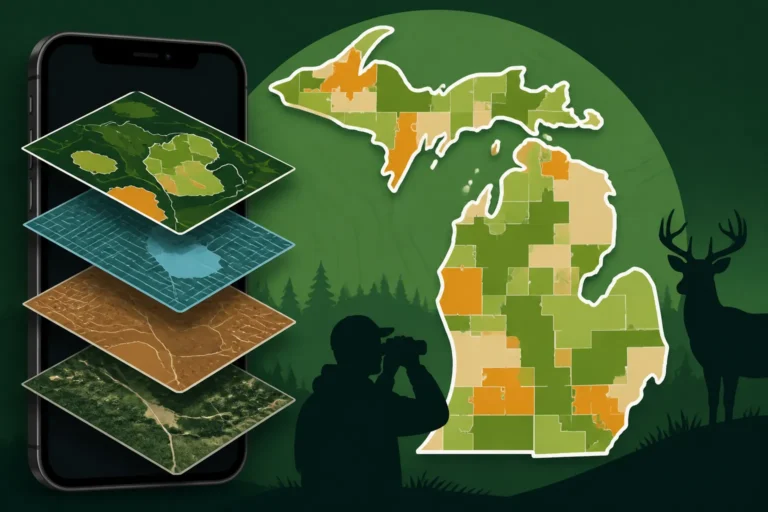
Modern technology has revolutionized how we find hunting and camping spots on public land. Tools like onX Hunt and the Michigan DNR's own Mi-HUNT map are invaluable for identifying state forest boundaries and potential camping areas. With onX Hunt, you can overlay public and private land boundaries directly on satellite imagery, helping you confirm you're on State Forest property. You can also see topographic lines, which are excellent for spotting flat areas suitable for a tent or natural high points that might offer a breeze and fewer bugs. The ability to drop waypoints for potential spots, measure distances (like that crucial 150 feet), and even track your movements is incredibly powerful. onX Hunt can be an absolute game-changer for scouting.
Similarly, the Mi-HUNT map, accessible through the DNR website, provides detailed information about state land, including different classifications and access points. While perhaps not as feature-rich as a subscription-based app for specific outdoor pursuits like hunting, it's a fantastic, free resource for verifying land ownership. Combine these digital tools by first identifying large tracts of State Forest land on Mi-HUNT, then zooming in with onX Hunt to look for specific features. Always double-check your location, especially near property lines; using tools like Finding Michigan Property Lines can help avoid any accidental trespass.
Scouting Before You Go
While mapping apps are great, nothing beats boots-on-the-ground scouting. If possible, take a day trip to the area you're considering for dispersed camping a week or two before your actual trip. Look for flat, well-drained spots away from dense underbrush. Check for signs of previous campers (though ideally, there won't be much, as a good dispersed site should look untouched). Pay attention to prevailing winds, proximity to potential water sources (even if you're filtering), and ease of access from the nearest designated road. You're looking for a spot that feels secluded, minimizes your impact, and offers good protection from the elements.
When scouting, also consider what your primary activity will be. If you're hunting, you'll want to be within reasonable walking distance of your hunting area, perhaps near a known travel corridor or a transition zone. If you're simply looking to relax, a spot near a quiet creek or with a nice view might be higher on your list. Remember to check for evidence of logging operations or recent burns, which could affect access or the immediate environment. Scouting helps you avoid unpleasant surprises and ensures your chosen spot truly lives up to your wilderness expectations. This preparation is very similar to what you'd do when Scouting Michigan Public Land Before Season.
Identifying Key Terrain Features for Good Spots
Certain terrain features lend themselves well to dispersed camping. Look for slightly elevated, flat areas within mature timber. This offers natural shade, protection from wind, and good drainage in case of rain. Avoid low-lying areas or depressions, as they tend to collect water and host more mosquitoes. Ridge tops or benches on hillsides can provide great views and breezes, but be mindful of wind exposure. Proximity to a reliable water source (like a stream or small lake, keeping that 150-foot setback in mind) is a plus, as it can be filtered for drinking and cooking.
Consider the "feel" of the spot. Does it offer a sense of privacy? Is there minimal existing impact? A good dispersed campsite should blend into the environment, not stand out. Look for natural clearings or areas where the undergrowth is sparse enough to pitch a tent without disturbing too much vegetation. If you're also hunting, consider spots near a natural funnel or a less-traveled portion of the woods, far from other hunters. Sometimes, a subtle rise in flat ground, or the edge of a small swamp, can offer a surprisingly good, dry spot. For those hunting specific game, such as deer, understanding Entry Routes on Flat Michigan Ground can help you choose a camp that works with your hunting strategy.
Practicing Leave No Trace and Ethical Dispersed Camping
The privilege of dispersed camping comes with a profound responsibility: to leave the land as you found it, or even better. Embracing Leave No Trace (LNT) principles is not just a suggestion; it’s a commitment to preserving Michigan’s wild places for future generations.
Minimizing Your Impact on the Land
The core of Leave No Trace is to minimize your impact. This starts with choosing durable surfaces for your campsite. Pitch your tent on bare soil, rock, or existing compacted areas rather than trampling vegetation. Avoid creating new trails; if you need to move off-trail, spread out to prevent forming new paths. When setting up a temporary camp, resist the urge to build elaborate structures, dig trenches, or drastically alter the environment. The goal is for someone else to barely notice you were there.
Consider the timing of your visit. Heavy rain can make certain areas more susceptible to erosion, so choosing a well-drained, higher spot becomes even more critical. Think about your gear choices; opt for items that are lightweight and don't require extensive setup. Before you leave, make sure all signs of your presence are gone. This includes removing any fire rings you built (if permitted), scattering any leftover ash, and fluffing up any flattened vegetation. The mantra is simple: "Take only pictures, leave only footprints (and make those light)."
Campfire Safety and Regulations
Few things enhance a wilderness camping experience like a crackling campfire, but they also pose the greatest risk to our forests. Michigan State Forest rules generally allow campfires for dispersed camping, unless there's a specific fire ban in effect (which you should always check before heading out). If you do have a fire, choose a spot carefully. Build a small fire in a clear area, far from overhanging branches, dry grasses, or other flammable materials. Ideally, use an existing fire ring if you find one, but if not, create a small, shallow pit that can be easily undone.
Never use rocks from a stream bed, as they can explode when heated. Collect only downed wood that is small enough to break by hand. Never cut live trees or branches. Before leaving your fire, even for a short walk, and especially before going to sleep or breaking camp, ensure it is dead out. This means dousing it with water, stirring the ashes, and then dousing and stirring again until it's cool to the touch. If it's too hot to touch, it's too hot to leave. A responsible campfire is a safe campfire, preventing devastating wildfires that could destroy the very places we seek to enjoy.
Waste Management and Packing It Out
One of the less glamorous but absolutely critical aspects of dispersed camping is proper waste management. The golden rule is simple: Pack It In, Pack It Out. This applies to all trash – food wrappers, cans, bottles, even biodegradable items like fruit peels and nut shells. While they might break down eventually, they take a long time, attract wildlife, and detract from the wilderness experience for others. Carry sturdy trash bags specifically for this purpose and ensure they are sealed to prevent spills or odors.
Human waste also needs to be managed correctly. For solid waste, the common practice is to dig a "cathole" 6-8 inches deep and at least 200 feet (about 70 paces) from water sources, trails, and campsites. After use, fill the hole with the original soil and disguise it with natural materials. Toilet paper should either be buried deeply in the cathole or, ideally, packed out with your other trash. Liquid waste can be dispersed widely, again at least 200 feet from water, to minimize impact. Proper waste disposal is a key component of ethical outdoor recreation and prevents the spread of disease and unsightly messes in our beloved forests. This is part of the broader commitment to Camping on Michigan State Land responsibly.
Disclaimer
This article is for general informational purposes only and does not constitute professional advice. Laws, prices and regulations vary by location and change over time. Consult a qualified professional for guidance on your specific situation.