Optics for Michigan Timber and Swamp
There's nothing quite like the feeling of watching the Michigan woods come alive at dawn, or holding your breath as the last light fades, hoping a big buck steps out. But if you've ever strained to identify movement in a dense cedar swamp, or wished you had just a few more precious minutes of visibility at dusk, you know the frustration. The wrong optics, or no optics at all, can mean the difference between filling your tag and going home empty-handed. This comprehensive guide will walk you through choosing and using the best binoculars, rifle scopes, and rangefinders specifically for the low light and thick cover of Michigan's diverse hunting landscapes.
The Unique Optical Challenges of Michigan's Hunting Grounds
Hunting in Michigan isn't like hunting the wide-open plains out West. Our environment, whether it's the sprawling hardwood forests of the northern Lower Peninsula, the thick cedar swamps of the Upper Peninsula, or the broken woodlots of southern farm country, presents its own set of unique challenges for a hunter's eyes and their equipment. Understanding these conditions is the first step to making smart choices about your optics.
Navigating Low-Light Conditions
Michigan hunters often find themselves in situations where the sun simply doesn't penetrate well. Think about those heavy, dark pine plantations, or the almost impenetrable canopy of a mature hardwood ridge before the leaves drop. Even during legal shooting hours, the light can be incredibly dim. Deer and other game are most active during the crepuscular hours – dawn and dusk – precisely when the light is at its poorest. You might have a clear shot at 30 yards, but if you can't positively identify your target or verify antler points, you can't take the shot.
This isn't just about sunrise and sunset; it's about the quality of light filtering through the woods. Overcast days, early mornings before the sun crests the trees, or late evenings when shadows stretch long and deep, all demand optics that can gather every available photon and deliver a bright, clear image to your eye. The "last five minutes" of shooting light can be the most productive time in the woods, but it's also the most challenging optically. If your glass isn't up to the task, those crucial minutes are effectively lost, and so are potential opportunities.
Dealing with Dense Cover and Restricted Visibility
Beyond just low light, Michigan's hunting landscapes are, by and large, incredibly dense. We're talking thick brush, heavy timber, tangled briars, and swamps choked with tag alders and cedars. You might be hunting an aspen cut for grouse, where visibility beyond 20 yards is a miracle, or trying to pick out a deer moving through the almost monolithic wall of a cedar swamp. Shots are often close, but identifying the target through all that visual clutter is the real trick.
Imagine a deer standing just inside the thicket, with only parts of its body visible through a maze of branches and leaves. Your optics need to provide such clarity and resolution that you can distinguish a deer's leg from a sapling, or confirm antler points against a busy background. A wide field of view is critical for quick target acquisition when game bursts out, but the ability to focus sharply and resolve detail in a cluttered environment is equally, if not more, important. Optics that perform poorly here will leave you second-guessing, which no hunter ever wants to do in the moment of truth.
Binoculars: Your Essential Eyes in Michigan's Wilderness
If there's one piece of optics every Michigan hunter should invest in, it's a good pair of binoculars. They are your primary scouting tool, your means of identifying game, and often your first line of defense against making a mistake. You'll spend far more time looking through your binoculars than your rifle scope, making their quality paramount.
Choosing the Right Magnification and Objective Lens
For the vast majority of Michigan hunting, a magnification of 8x or 10x is ideal. Binoculars like 8×42 or 10×42 are the sweet spot. What do those numbers mean? The first number (8x or 10x) is the magnification – how much closer an object appears. The second number (42mm) is the diameter of the objective lens, which is the lens furthest from your eye. A larger objective lens gathers more light, making the image brighter, especially in low light.
Why not higher magnification? In dense timber and swamps, anything much over 10x often makes the image too shaky to hold steady without a tripod, and it significantly narrows your field of view. When you're trying to pick apart thick cover for a deer or grouse, a wider field of view helps you scan more effectively and find game faster. For example, when you're glassing the vast, open timber ridges of the Hunting the Michigan Upper Peninsula for Deer, a 10x might give you that extra reach, but if you're working the tighter, brushy woodlots of Southern Michigan Farm Country Deer Hunting, an 8x might offer a more stable and forgiving view, letting you track movement more smoothly. The 42mm objective lens is a great balance; it gathers plenty of light without making the binoculars overly bulky or heavy, which is important for carrying them all day in our varied terrain.
Optical Quality and Construction Matters
This is where the rubber meets the road. "Good glass" isn't just a marketing buzzword; it refers to the quality of the glass elements, the coatings applied to them, and how they are assembled. High-quality binoculars will feature "ED" (Extra-low Dispersion) glass, which minimizes chromatic aberration – those annoying color fringes you sometimes see around high-contrast objects. They also boast multiple layers of anti-reflective coatings on all air-to-glass surfaces. These coatings are crucial because they reduce light loss and glare, ensuring maximum light transmission and a true-color, high-contrast image, even in the deepest shadows.
Beyond optical performance, the physical construction needs to stand up to Michigan's elements. Non-negotiable features include full waterproofing and fog-proofing. Michigan weather is notoriously fickle; you can start a hunt in sunshine and end it in a downpour or heavy snow. Your binoculars need to be sealed against moisture and purged with inert gas (like nitrogen or argon) to prevent internal fogging when you transition from a warm truck to cold outdoor air. The exterior armor should be rugged and provide a good grip, even with cold, wet hands. Finally, consider a comfortable, well-designed binocular harness. It keeps your optics secure against your chest, prevents them from flopping around, and allows for quick, silent access when that buck suddenly appears.
Practical Use in Michigan's Woods
Effective binocular use is an art form. It's not about randomly sweeping the landscape. Instead, employ a slow, deliberate grid pattern to pick apart every piece of cover. Start at the nearest likely cover, and slowly work your way out, examining every tree, stump, and shadow. Focus on areas where deer might bed, feed, or travel, like thickets, swamp edges, or creek bottoms. It’s amazing what details will emerge from the "noise" of the forest once you slow down and let your binoculars do the work.
Binoculars are indispensable for identifying game at a distance, confirming species, and, crucially, verifying antler points to ensure you're compliant with Michigan Antler Point Restrictions by DMU. There's nothing worse than making an ethical shot on what you thought was a legal buck, only to find out you miscounted points because you rushed or had poor glass. They're also incredibly useful for scouting, even during the hunt itself. You can spot subtle signs like faint trails, fresh rubs, or distant scrapes that would be invisible to the naked eye. Before you even step into the woods, a tool like GoHunt's mapping features can help you identify key terrain features, funnels, and potential bedding areas where glassing might be most effective, allowing you to pre-plan your approach and scanning strategy.
Rifle Scopes: Precision for Close to Mid-Range Shots
While binoculars help you find and identify game, your rifle scope is what allows you to place a precise shot when the moment arrives. In Michigan's timber and swamps, the requirements for a rifle scope are often very different from those needed for wide-open western hunting.
Magnification Ranges for Michigan Hunting
Forget those high-power, long-range scopes you see advertised. For Michigan's close-to-mid-range hunting, lower variable magnification is almost always king. Scopes with a power range of 1-4x, 2-7x, or 3-9x are exceptionally versatile and often ideal. The key is the ability to dial down to a very low magnification (1x, 2x, or 3x) for dense cover and quick, close shots. At 1x or 2x, your field of view is incredibly wide, making it much easier to acquire a fast-moving target in thick brush.
High magnification isn't just unnecessary; it can actually be a detriment. When a deer steps out at 40 yards in thick woods, having your scope cranked to 9x or 12x will make finding and acquiring the target incredibly difficult. You'll see nothing but fur in your scope, with no sense of the surrounding environment, which can lead to target disorientation and missed opportunities. Moreover, many of our hunting scenarios, especially in the limited firearm zone, involve cartridges like the .450 Bushmaster or shotguns with slugs, which are effective out to 150-200 yards. A 3-9x scope is more than sufficient for these ranges, perfectly complementing Rifle Setups for Michigan Deer and even specialized cartridges like Straight-Wall Cartridges Legal in Michigan.
Low-Light Performance and Reticle Choice
Just like binoculars, a rifle scope needs to excel in low light. This involves a good quality objective lens (around 40mm to 50mm is common and effective), excellent glass, and superior multi-coatings to maximize light transmission. An illuminated reticle can be a game-changer in Michigan's dim environments. Imagine aiming at a dark-colored deer against a dark background in deep shadow; a traditional black reticle can disappear. An illuminated reticle, typically a red dot or crosshair, provides a crisp aiming point that stands out without washing out the target, giving you confidence for that critical shot during the prime hunting hours of dawn and dusk.
For reticle design, simplicity often wins in thick cover. A classic duplex reticle is fast and uncluttered. While complex BDC (Bullet Drop Compensating) reticles have their place for longer shots, most Michigan deer hunting takes place within 150 yards, often much closer. A simple reticle with a precise aiming point is all you need. Focus on clear glass and an illuminated option rather than a busy reticle you might never fully utilize.
Durability and Mounting for Harsh Conditions
A rifle scope endures more abuse than many hunters realize. It's bumped against tree trunks, exposed to rain and snow, and subjected to the recoil of every shot. Consequently, durability is paramount. Look for a scope with a robust, one-piece tube construction, typically aircraft-grade aluminum. It needs to be thoroughly waterproof, fog-proof, and shock-proof to maintain its integrity and zero in the face of Michigan's unpredictable weather and rough terrain. Reliable turrets that hold their zero are essential, even if you set your zero once and rarely touch it in the field.
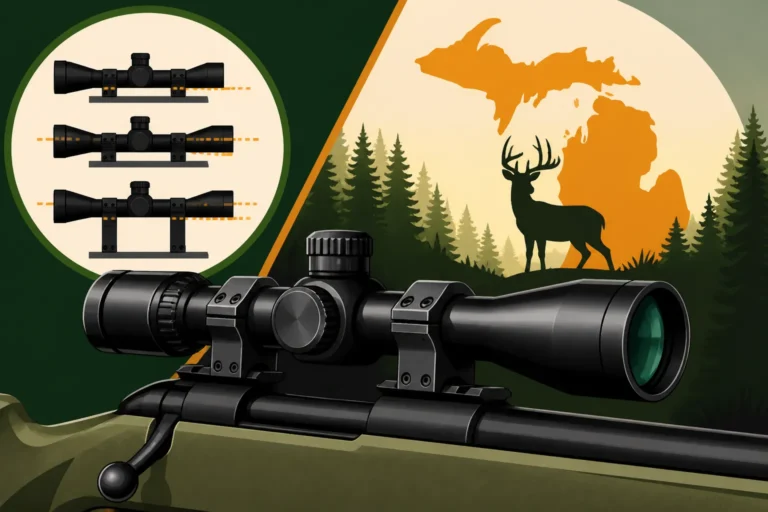
Equally important to the scope itself are the rings and bases that secure it to your rifle. Don't skimp on these components. High-quality, properly mounted rings and bases ensure that your scope remains rock-solid and maintains its point of impact, even after a long walk through the woods or an unexpected tumble. Many a hunter has chased their zero around only to find their rings were loose. Finally, consider simple flip-up scope covers. They protect your expensive lenses from rain, snow, dirt, and scratches, ensuring that when you raise your rifle, your sight picture is clean and clear.
Rangefinders: Confirming Distance in Tricky Terrain
While many Michigan hunters develop an innate ability to estimate distance, a rangefinder takes the guesswork out of crucial shot placement. In our often-confusing terrain of rolling hills, thick cover, and occasional open clearings, a rangefinder provides invaluable confidence.
When a Rangefinder is Indispensable
A good laser rangefinder is an indispensable tool for confirming ethical shot distances, especially if you're hunting with archery gear. Bowhunting success often hinges on knowing the precise yardage, as arrow trajectory drops significantly more than a bullet over even short distances. For those extending their season into colder weather with a Muzzleloader Deer Hunting in Michigan, precise rangefinding is also key due to the different ballistics of those slower projectiles. You might think you can eyeball 50 yards, but what if it's actually 65? That difference can mean a clean kill or a wounded animal.
Rangefinders are also incredibly useful for accurately judging distances across openings, clearcuts, or even over water if you're doing something like Great Lakes Waterfowl Hunting in Michigan. Eliminating guesswork in these situations not only improves your accuracy but also helps mitigate "buck fever" errors when that trophy suddenly appears. Knowing the exact range lets you focus on the fundamentals of the shot, rather than agonizing over how far away the target might be.
Limitations and Workarounds in Thick Cover
While immensely helpful, rangefinders aren't without their quirks in Michigan's dense environment. The most common frustration is "treeing out"—getting false readings from branches, leaves, or even heavy rain between you and your target. The laser simply hits the closest object, not the deer you're aiming at. To combat this, many modern rangefinders feature a "scan" mode, which continuously ranges as you move the unit. By scanning across the target, you can often pick up the further reading, which is usually the animal itself.
Another effective technique is to aim at the body of the animal, not just the edge, or to aim slightly behind it if there's a clear spot. If you're hunting from a stand, pre-ranging known landmarks around your setup—that specific tree at 25 yards, the fallen log at 40, the edge of the swamp at 70—can be a lifesaver. This way, when a deer appears, you already have an accurate reference without needing to raise your rangefinder and risk spooking it. While some units have angle compensation for steep terrain, most of Michigan is relatively flat, making this feature less critical for deer hunting but still useful in the hilliest parts of the U.P.
Integrated vs. Standalone Units
You'll encounter two main types of rangefinders: standalone units and those integrated into binoculars. Integrated rangefinding binoculars offer incredible convenience; you only have one device to carry and can range instantly while glassing. This can be a huge advantage for fast-paced hunting scenarios or for minimizing movement. GoHunt often features reviews of these integrated units, breaking down their performance and value.
However, standalone units also have their advantages. They are typically smaller, lighter, and often more powerful for the price. If you prioritize portability or already have a fantastic pair of binoculars you love, a dedicated rangefinder might be the better choice. For the typical Michigan hunter, a simple, fast, and accurate standalone unit that performs well out to 300-400 yards is usually more than sufficient, as most shots in our timber won't exceed that. The most important factor is consistency and ease of use in the field.
Other Optical Tools: Enhancing Your Michigan Hunt
While binoculars, rifle scopes, and rangefinders form the core of most Michigan hunters' optical arsenals, there are a few other specialized tools that can prove useful in specific situations. Knowing what they are and when they're legal to use is key.
Red Dot Sights for Fast, Close Action
For hunting in Michigan's limited firearm zone, especially with shotguns or straight-wall cartridge rifles, a red dot sight can be a fantastic option. They are also highly effective for Spring Turkey Hunting in Michigan where shots are typically close and fast. A red dot sight provides an uncluttered, illuminated aiming point that's incredibly quick to acquire, even with both eyes open. This translates to rapid target acquisition, which is invaluable when a deer bursts from cover or a gobbler finally steps into range.
The wide field of view and lack of magnification make red dots excellent for close-quarters hunting where targets might appear suddenly and move quickly. They are typically very durable, designed to withstand heavy recoil and harsh weather, and many boast impressive battery life. While they don't offer the precision of a magnified rifle scope at longer distances, for shots within 100-125 yards in thick cover, a red dot can be an extremely effective and user-friendly aiming system.
Thermal and Night Vision: Know the Rules
Thermal and night vision devices are powerful tools, but their use for hunting in Michigan comes with very strict regulations. For species like deer, bear, and turkey, using any artificial light, night vision, or thermal imaging device to locate or aid in the taking of game during legal hunting hours is generally illegal. This is a critical distinction to understand.
However, some species, particularly predators like coyotes, can be hunted at night under specific conditions, and thermal or night vision may be permissible then. If you're interested in Coyote Calling in Michigan Winter after dark, for instance, you'll need to thoroughly research the most current regulations regarding these devices. They are incredibly effective at detecting heat signatures or amplifying ambient light, which can be a huge advantage for spotting elusive nocturnal animals. But never assume they are legal for all hunting; always consult the Michigan DNR regulations before you even consider purchasing or using such equipment for game animals.
Spotting Scopes for Long-Range Observation (Limited Use)
For the typical timber and swamp hunter, a spotting scope might seem like overkill, and for much of Michigan, it genuinely is. Its primary purpose is high-magnification, long-range observation, usually from a stationary position. This makes it less practical for still-hunting dense cover where shots are short and opportunities are fleeting.
However, there are niche scenarios where a spotting scope shines. If you're fortunate enough to draw a tag for Michigan's Limited Elk Hunt, and you find yourself glassing vast clearings or distant ridges in the Pigeon River Country, a spotting scope becomes an invaluable tool for identifying elk and assessing their antlers from afar. Similarly, if you're scouting expansive open agricultural fields in southern Michigan from a distance, or observing waterfowl on large bodies of water before a hunt, a compact spotting scope can reveal details that even 10x binoculars can't resolve. When choosing one, prioritize image quality, a steady tripod system, and robust weatherproofing, as they will often be used in exposed conditions.
Protecting Your Investment: Optics Care in Michigan Weather
You've invested your hard-earned money in quality optics, so it makes sense to protect them. Michigan's diverse and often unpredictable weather—from driving rain and heavy snow to pervasive humidity and freezing temperatures—can be tough on delicate optical equipment. Proper care isn't just about extending the life of your gear; it's about ensuring it performs flawlessly when it matters most.
Weatherproofing and Moisture Management
Even the most "waterproof" optics can benefit from extra precautions. Always use your lens caps and scope covers when your optics aren't actively in use. A simple rain guard for your binoculars can prevent water from pooling on the objective lenses, obscuring your view. If you find yourself in a downpour, try to keep your optics tucked inside your jacket or pack whenever possible. Remember that "waterproof" doesn't mean "submersible for hours," it means sealed against typical rain and splashes.
After a wet hunt, never put your optics away wet. Moisture can lead to corrosion, fungal growth, and internal fogging over time. Wipe them down thoroughly with a soft cloth. If they've gotten truly soaked, allowing them to air dry in a well-ventilated area for a day or two is crucial. For scopes that might have taken on a little moisture internally (despite being sealed), placing them in a sealed container with desiccant packs or even uncooked rice for a few days can help draw out any trapped humidity. Avoid rapid temperature changes, like bringing a freezing cold scope directly into a warm, humid cabin, as this is a prime recipe for internal fogging.
Cleaning Lenses in the Field and at Home
One of the most common mistakes hunters make is trying to clean a dusty or dirty lens with their shirt or a rough cloth. This is a surefire way to scratch delicate lens coatings, permanently degrading optical performance. In the field, always start by gently blowing any loose dust or debris off the lenses. If that doesn't work, use a soft lens brush. For smudges or water spots, apply a drop of a reputable optical cleaning solution to a clean, soft microfiber lens cloth and gently wipe in a circular motion, working from the center outwards.
At home, a more thorough cleaning can be done with the same method. Pay attention to the housing and eyecups as well, wiping away any mud or grime. Regular, gentle cleaning not only ensures a clear sight picture but also prevents abrasive particles from accumulating and causing damage. Treat your lenses like they are made of glass, because they are, and those coatings are exceptionally vulnerable to rough treatment.
Storage and Transport
When transporting your rifle or binoculars to and from your hunting spot, always use appropriate protection. A padded rifle case will protect your scope from impacts and vibrations that could knock it out of zero. For binoculars, a good padded case or a binocular harness that keeps them snug against your body will prevent them from swinging wildly and banging into things.
When not in use for extended periods, store your optics in a dry, temperate environment. Avoid attics, basements, or unheated garages where temperature and humidity fluctuations are extreme, as these can be detrimental to seals and coatings. Periodically, especially after a rough hunt or if you notice any accuracy issues, check your scope mount screws to ensure they are still tight. A loose scope mount is a common culprit for accuracy problems and can be easily remedied with a quick check.
Finding Your Ideal Optics: Performance, Budget, and Practicality
Choosing the right optics for Michigan hunting can feel overwhelming with the sheer number of options available. But by focusing on what truly matters for our unique hunting environment, and balancing that with your budget and personal preferences, you can make an informed decision.
Prioritizing Features for Michigan's Environment
When you're sifting through specifications, remember the core challenges of Michigan's timber and swamps: low light, dense cover, and often unpredictable weather. This means certain features should take priority. Low-light performance, driven by excellent glass and coatings, should be at the top of your list for both binoculars and rifle scopes. Durability, including waterproofing and fog-proofing, is not a luxury but a necessity here. And a wide field of view, particularly at lower magnifications, will help you acquire and track game more effectively in tight spaces.
High magnification, while impressive on paper, is often less important than clarity and brightness in our typical hunting scenarios. A 3-9x scope with superb glass will outperform a 6-24x scope with mediocre glass in the dim Michigan woods, every time. Think about the average shot distance for your preferred hunting method and location, and choose optics that optimize for that range, rather than for extreme long shots you might never take.
The Value Equation: When to Spend More, When to Save
Optics represent an investment, and like most things, you generally get what you pay for. Quality glass is expensive to produce, and it makes a noticeable difference in low-light performance and image clarity. While it's tempting to save money, don't skimp on your primary binoculars. They are your most-used optical tool, and a good pair will serve you reliably for decades. Consider them an investment in your hunting success and enjoyment.
For rifle scopes, aim for a balance. You don't necessarily need the absolute top-tier model, but stepping up from the cheapest options to a mid-range scope from a reputable brand will provide a significant leap in performance, especially in crucial low-light situations. There are diminishing returns at the very highest end of the market for most hunters. However, there are many excellent brands that offer outstanding value without breaking the bank. Resources like GoHunt often provide in-depth reviews and comparisons of optics across various price points, helping you understand where your money makes the biggest impact on performance.
Hands-On Experience and Research
Finally, there's no substitute for getting your hands on optics before you buy. Visit a local sporting goods store or a gun range that has demo models. Look through different binoculars and scopes, even outside if possible, to get a feel for their ergonomics, brightness, and clarity. Compare an 8x to a 10x binocular, or a 3-9x to a 4-16x scope, to see what feels most natural to your eyes and handles best for you.
Supplement your hands-on experience with thorough research. Read reviews from other hunters, particularly those who hunt similar terrain to Michigan. Talk to experienced hunters you know about what brands and models have worked for them over the years. Ultimately, the "best" optic is highly personal. It's the one you're comfortable carrying, confident using, and that consistently delivers a clear, bright image when that Michigan whitetail, bear, or turkey finally steps into your shooting lane.
Disclaimer
This article is for general informational purposes only and does not constitute professional advice. Laws, prices and regulations vary by location and change over time. Consult a qualified professional for guidance on your specific situation.