Counting Antler Points Under Michigan APRs
The moment of truth arrives quickly in the deer woods. A buck steps out, and your heart races. But before you can even think about drawing your bow or raising your rifle, a different kind of challenge sets in: the mental math and visual assessment required by Michigan’s Antler Point Restrictions (APRs). This often creates a stressful dilemma for hunters, forcing split-second decisions under pressure. This comprehensive guide is here to walk you through the intricacies of counting antler points accurately under Michigan's APRs, ensuring you can make confident, legal decisions in the field.
Understanding Michigan's Antler Point Restrictions APRs
Michigan's deer hunting landscape is diverse, and so are its regulations. Antler Point Restrictions are a prime example of this, designed with specific goals in mind but often leading to confusion for hunters trying to do the right thing. It's not just about bigger antlers; it's about smarter deer management.
Why APRs Exist in Michigan
The introduction of Antler Point Restrictions in Michigan wasn't a random decision; it was a strategic move by the Michigan Department of Natural Resources (DNR) to address specific concerns within the deer herd. Primarily, APRs aim to shift the age structure of the buck population. In areas without APRs, young bucks, particularly yearlings, are often the most vulnerable to harvest. This can lead to a buck population dominated by very young deer, with fewer older, more mature bucks available. By requiring bucks to have a certain number of antler points on one side to be legal, APRs effectively give younger bucks a pass, allowing them to survive another year or two.
This strategy has several intended benefits. First, it can lead to more mature bucks in the population, which many hunters find desirable for the challenge and satisfaction of harvesting a larger animal. Second, a more balanced buck age structure can improve herd health and breeding dynamics, as older, more experienced bucks participate in the rut. Finally, while not always universally popular, many hunters report increased satisfaction with their hunting experience in APR-regulated areas, even if it means passing up more deer. The frustration, of course, comes from the added complexity, especially when a buck steps out quickly, and you have mere seconds to count accurately. It's a mental game as much as it is a hunting skill.
Where APRs Apply
One of the most crucial things to understand about Michigan's APRs is that they are not a statewide mandate. Instead, they are applied on a specific geographical basis, broken down by what the DNR calls Deer Management Units (DMUs). These DMUs are essentially regions or groups of counties where particular regulations, including APRs, are in effect based on local herd conditions, habitat, and management goals. This means that a buck that's legal in one DMU might be illegal just a few miles down the road in an adjacent DMU.
Before you even step foot in the woods, it is absolutely essential to know which DMU you'll be hunting in and to check the current regulations for that specific unit. The DNR's hunting digest and online resources are your best friends here. For example, some DMUs in the southern Lower Peninsula might have a "3-points on one side" rule, while others could require "4-points on one side," or even have no APRs at all. Moreover, some specific areas, particularly in the historically "shotgun zone" (now referred to as the limited firearm zone), might have additional restrictions or different legal firearm requirements that interplay with antler regulations. Navigating these regional differences can be a headache, but understanding your specific Michigan Deer Management Units is the first step to staying compliant. Tools like the Michigan DNR's Mi-HUNT map and platforms like GoHunt can be invaluable resources for identifying your DMU and quickly accessing the most current regulations for your hunting location.
The Official Method for Counting Antler Points
This is where the rubber meets the road. Michigan's APRs hinge on a very specific definition of what constitutes an "antler point." Misunderstanding this definition can lead to an illegal harvest, which nobody wants.
What Qualifies as a Point
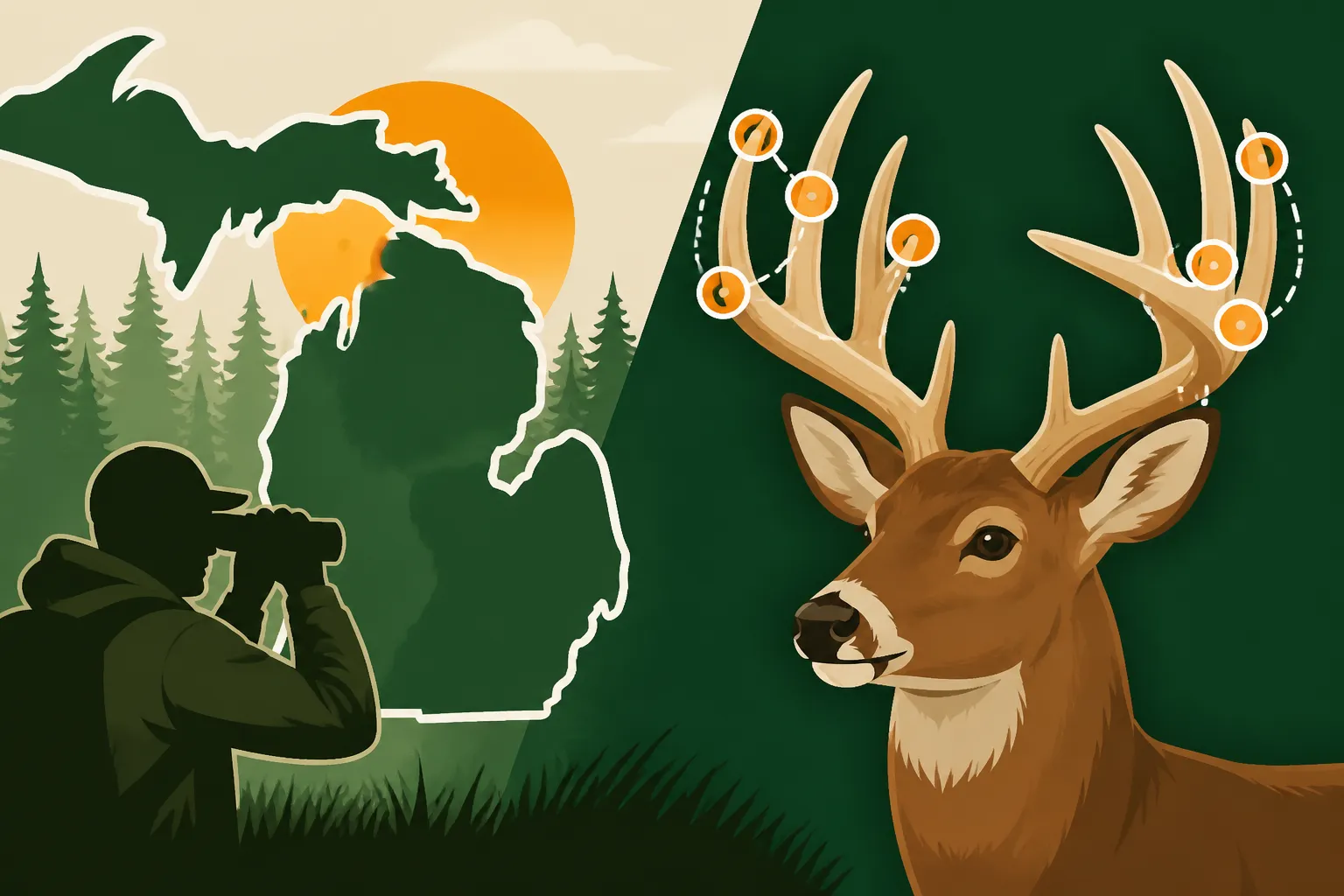
According to Michigan DNR regulations, a point is defined as a projection on an antler that is at least one inch long and extends beyond the edge of the main beam or another point. This "one-inch rule" is absolutely critical. It doesn't matter how sharp, how blunt, or how thick a projection is; if it doesn't measure at least an inch from its base on the main beam or another point, it simply doesn't count towards the APRs. This is probably the single biggest point of confusion and frustration for hunters.
Imagine a small knob or a slight bump on an antler. To the naked eye, especially at a distance or in low light, it might look like a point. However, if you were to measure it and find it's only three-quarters of an inch long, it's not a legal point. This can be agonizing when you're trying to quickly assess a buck in the field. Burr points, which are those bony projections right above the pedicle where the antler meets the skull, never count. These are part of the base structure, not true points. Similarly, broken points, even if they were clearly over an inch before they snapped off, typically do not count as a legal point unless there is still at least one inch of material extending from the main beam. Always err on the side of caution; if you can't definitively determine it's an inch, it's safer to consider it not a point.
Main Beam vs. Abnormal Points
When it comes to counting points, Michigan's APRs focus on what is commonly referred to as "legal antlers." Generally, this refers to points that extend from the main beam of the antler. For example, a typical 8-point buck would have four points on each main beam, consisting of brow tines (G1s), bez tines (G2s), trez tines (G3s), and maybe G4s or G5s, all originating from the main beam. Each of these must meet the one-inch rule to be counted.
The rules around abnormal points, sometimes called non-typical points or stickers, can vary slightly but are generally straightforward: if they meet the one-inch length requirement and extend from the main beam or another point, they do count towards the total number of points on that side. So, if a buck has a sticker point growing off its G2 tine that's over an inch long, that counts as an additional point for that side's total. This is important to remember because a buck that looks like a 3-point on one side might actually be a 4-point if it has a legal sticker point. The key is always that one-inch threshold. Understanding What Counts as an Antler Point in Michigan is paramount to avoiding any accidental violations. The DNR's emphasis is on the actual projection, not just its location on the antler.
Here's a quick summary of point counting:
| Antler Feature | Counts as a Point (if ≥ 1 inch) | Does NOT Count as a Point | Notes |
|---|---|---|---|
| Tines (G1, G2, G3, etc.) | Yes | Must extend from the main beam. | |
| Sticker Points | Yes | Must extend from main beam or another tine. | |
| Main Beam Tip | Yes | If it forms a distinct, measurable point. | |
| Burr Points | Yes | Part of the base, not a true point. | |
| Broken Tines | Yes (usually) | Only if at least 1 inch still extends. | |
| Bumps/Nubs | Yes | If less than 1 inch. |
Real-World Scenarios and Challenges in the Field
Counting antler points in a static photo or with a shed antler in your hand is one thing. Doing it when a wary buck is skirting a treeline at last light, or when it's pouring rain, is an entirely different beast. This is where the mental game truly comes into play.
The "Split G2" and Other Tricky Situations
Michigan's deer woods are full of character, and so are the antlers of its whitetails. You'll encounter bucks with all sorts of unique racks, and some configurations are notorious for causing counting dilemmas. The "split G2" is a classic example. This is when the second tine (the G2) forks or splits near the tip. Does each fork count as a separate point? According to the one-inch rule, if both forks are at least one inch long and extend beyond the main beam or the base of the G2, then yes, they would both count. If one of the forks is only half an inch, then it doesn't. This requires careful observation.
Another tricky situation arises with very short brow tines or G1s, which might just barely clear the one-inch mark, or appear to be rounded bumps rather than distinct points. What about a non-typical projection that grows straight up from the main beam but is very thick and blunt? Again, it always comes back to that one-inch measurement. If you're unsure, it's best to lean conservative. Hunters often discuss these "what if" scenarios around the deer camp fire because they are genuinely hard calls in the moment. The key is to train your eye to focus on that critical length requirement.
Counting Under Pressure: Ethical Considerations
The adrenaline surge, the rapidly fading light, the buck that’s about to disappear into the thick cover – these factors compound the difficulty of accurately counting points in the field. It’s easy to misjudge distances, overlook a small point, or imagine one that isn't quite an inch long. Many seasoned hunters will tell you that they've passed up bucks they thought were legal but simply couldn't get a clear enough view to confirm the point count. This decision to Passing a Buck You Cannot Count is an ethical one, rooted in respect for the regulations and the resource.
Making a rushed decision and harvesting a buck that turns out to be illegal can lead to serious consequences, including fines, loss of hunting privileges, and forfeiture of the animal. Beyond the legal ramifications, there's the personal disappointment and ethical burden. It’s far better to let a buck walk and live to hunt another day than to harvest an illegal animal. This ethical dilemma underscores the importance of thorough preparation and a commitment to patience in the field. Practice your quick assessment skills before the season, and if doubt creeps in during a real encounter, let that doubt guide your decision to wait for a better, clearer opportunity.
Tools and Strategies for Better Antler Assessment
While field experience is invaluable, there are practical tools and strategies you can employ to improve your ability to assess a buck's antlers quickly and accurately. These aren't just for seasoned pros; every Michigan hunter can benefit.
Optics for Clearer Views
In Michigan's varied terrain, from dense cedar swamps to open agricultural fields, reliable optics are your best friend when it comes to assessing antlers. High-quality binoculars are non-negotiable. An 8×42 or 10×42 pair provides an excellent balance of magnification and field of view, allowing you to quickly find and scrutinize a buck's rack. The clarity and light-gathering capabilities of good optics, especially in low light conditions common at dawn and dusk, can make all the difference in definitively identifying those critical one-inch points.
Don't just scan; when you spot a buck, focus on the antlers. Systematically scan each main beam from base to tip, looking for every projection and mentally applying the one-inch rule. Practice this scanning technique even on legal bucks you don't intend to shoot. A spotting scope can be a tremendous asset if you're hunting more open areas or scouting from a distance, allowing you to examine antlers in minute detail. While not always practical for every hunting situation, a good rangefinder can also help you understand the distance, which can influence how well you can assess points. Clear optics reduce eye strain and give you the confidence needed to make a sound judgment.
Using Trail Cameras for Pre-Season Scouting
Trail cameras have become an indispensable scouting tool for modern hunters, and they are particularly valuable for understanding the bucks in your area, especially concerning APRs. By strategically placing trail cameras on travel corridors, food sources, or rub lines, you can capture numerous images and videos of individual bucks throughout the pre-season and early hunting periods. This allows you to study their antler development, count points at your leisure, and even nickname specific bucks based on their unique rack characteristics. GoHunt's mapping tools, integrated with trail camera intel, can further enhance your scouting by showing you exactly where specific bucks are frequenting relative to your stand locations and DMU boundaries.
Instead of making a hurried decision in the field, you can review camera footage from the comfort of your home, scrutinizing every angle and ensuring each potential point meets the one-inch criterion. This practice helps you develop a mental database of the bucks in your hunting area, so when you see one in person, you might already know if it’s legal. Moreover, trail cameras help you understand Michigan Deer Population Estimate and behavior patterns, informing your overall hunting strategy. They take some of the guesswork out of the APR equation, letting you focus on the hunt itself rather than being caught off guard by an unfamiliar rack.
Practice and Preparation
Like any skill, accurately counting antler points under various field conditions improves with practice. Don't wait until opening day to try and perfect this. Start long before the season begins. A fantastic way to practice is by examining shed antlers. Pick up sheds and, using a ruler, actually measure every projection to see if it qualifies as an inch. This tactile experience helps cement the one-inch rule in your mind.
Another excellent method is to use photos and videos of deer. Many hunters post pictures of bucks online or in hunting magazines. Take these images and practice counting the points, discussing your assessment with hunting buddies. Try to do it quickly, simulating the pressure of a real encounter. If you visit deer exhibits or even local taxidermy shops, take the opportunity to count points on mounted deer. The more you consciously practice this skill, the more ingrained it becomes, and the less likely you are to make a mistake when it truly matters. Being prepared with knowledge of Michigan Antler Point Restrictions by DMU and actively practicing point counting are two of the best ways to ensure a confident and compliant hunt.
Navigating APRs with Different Licences and Seasons
Michigan's hunting regulations can feel like a tangled web, especially when you factor in different types of licenses and seasons. It's crucial to understand how APRs interact with these various aspects of your hunt.
APRs and the Universal Antlerless Tag
It's important to remember that Antler Point Restrictions in Michigan are typically applied exclusively to antlered deer, meaning male deer with antlers. They generally do not apply to antlerless deer, which includes female deer (does) and fawn deer of either sex. If you possess a valid antlerless deer license, the specific APRs of your DMU usually won't affect your decision to harvest an antlerless deer. However, you'll still need to be absolutely certain you're identifying a truly antlerless deer, as small button bucks can sometimes be mistaken for does, especially from a distance.
The universal antlerless license allows you to harvest an antlerless deer in any county open for antlerless hunting, provided you have a valid tag for the public or private land you're hunting on. These tags are critical for population management, helping to control deer numbers and balance the herd sex ratio. While APRs are a significant part of the buck hunting experience, they don't add complexity to your antlerless harvest strategy beyond proper identification. For the specifics on how many antlerless tags you can buy and where, always refer to the current Michigan DNR hunting guide or use resources like GoHunt to stay informed.
APRs in Archery vs. Firearm Seasons
For the most part, the definition of a legal antler point and the specific APRs for a given DMU remain consistent across all deer hunting seasons – archery, firearm, and muzzleloader. So, if your DMU requires a buck to have 3 points on one side during the Michigan's November Firearm Deer Season, that same rule applies during the archery season and the late muzzleloader season. The buck that was legal (or illegal) during the early archery hunt will still be legal (or illegal) later in the fall.
However, the conditions under which you are hunting during these different seasons can significantly impact your ability to accurately count points. The early archery season often presents challenges like dense foliage that can obscure antlers, or the low light of early morning and late evening draws. During the firearm season, you might have greater visibility in more open areas, but the speed of encounters or the distraction of other hunters could still lead to errors. Muzzleloader season, often in late December, can bring snow and extreme cold, affecting visibility and your comfort level for extended observation. Understanding the nuances of each season and how to prepare for them, such as Michigan Muzzleloader Season Tactics in December cold, can help you navigate these challenges regardless of the APRs in place. The core rules for counting points, however, remain constant, simplifying one aspect of an otherwise complex set of regulations.
Disclaimer
Always consult the current Michigan Department of Natural Resources hunting digest or official website for the most up-to-date and complete hunting regulations. Laws and rules can change, and it is the hunter's responsibility to know and follow all applicable regulations.