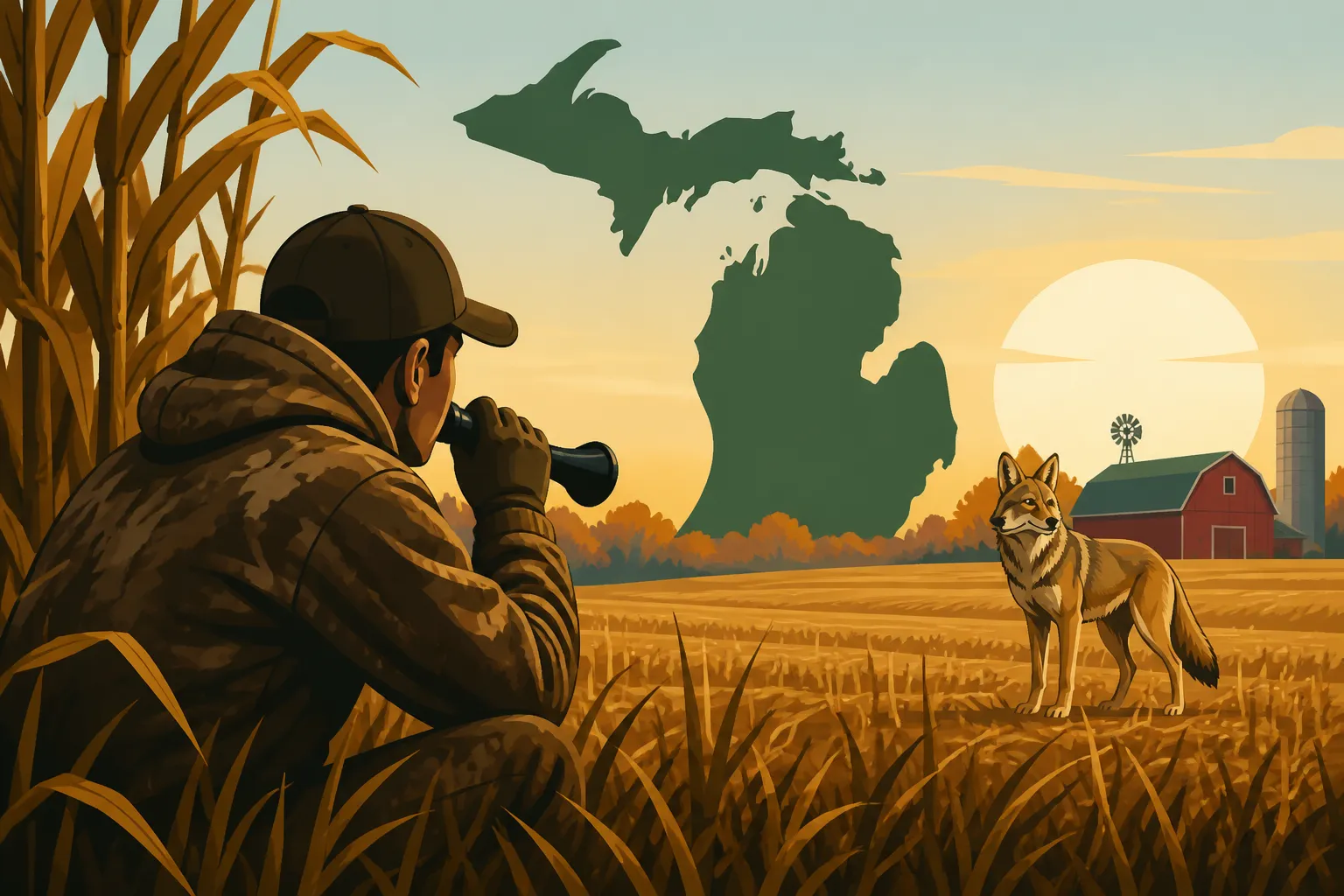
Coyote Calling in Michigan Farm Country
There's nothing quite like the frustration of hearing coyotes yipping and howling on your property, or worse, knowing they're impacting local deer and small game populations. For Michigan hunters in the vast agricultural lands, calling coyotes can feel like an impossible puzzle with all the open space and wary animals. This guide is here to unravel the mysteries of coyote calling in Michigan's farm country, providing you with practical strategies, gear advice, and setup insights to bring these elusive predators into range.
Understanding Coyotes in Michigan's Agricultural Landscape
Hunting coyotes in Michigan's farm country presents a unique set of challenges and opportunities. Unlike the dense forests of the Upper Peninsula or even the mixed hardwoods further north in the Lower, farm country is a patchwork of open fields, woodlots, creek bottoms, and hedgerows. This environment shapes how coyotes live, hunt, and respond to calls. They're often smarter, more cautious, and have a keen understanding of the terrain.
Coyote Behavior and Movement in Open Country
Coyotes are incredibly adaptable animals, and their behavior shifts dramatically based on their environment. In farm country, their home ranges often encompass vast expanses of open fields, broken up by smaller blocks of cover. They travel these open areas, often using field edges, ditches, and sparse hedgerows for concealment as they move between bedding areas in woodlots and hunting grounds in the fields. You'll often find them working the edges of standing corn, soybean fields, or winter wheat, where prey like mice, voles, and rabbits are abundant.
Their movements are often dictated by wind direction and thermal currents, especially in areas with subtle elevation changes. They'll use any available cover to remain unseen, often skirting around the backside of a small rise or using a drainage ditch as a highway. These animals also learn quickly. If they've been called to previously and had a negative experience, they become incredibly "call-shy." They might approach with extreme caution, circling downwind far out, or simply ignore the call altogether. Understanding this innate wariness is key to successful hunting. You're not just calling a coyote; you're trying to outwit a highly intelligent and pressured predator.
Identifying Prime Farm Country Habitat
While the "farm country" might seem like one big, open canvas, successful coyote calling hinges on identifying specific microhabitats and travel corridors. Look for fingers of timber extending into fields, isolated woodlots, brushy creek bottoms, old abandoned farmsteads, and overgrown fence lines. These are the places coyotes use for bedding, travel, and ambushing prey. Even a small clump of brush in the middle of a large field can be a key piece of cover.
Focus on areas where different habitat types converge, like where a cornfield meets a thick CRP field, or where a woodlot transitions into a marshy lowland. These "transition zones" are natural funnels for wildlife, including coyotes. Don't overlook low-lying areas or drainage ditches that cut through fields; these often offer the only cover for a coyote to travel unseen. For a better understanding of how animals move through flat terrain, you might find insight in our guide on Entry Routes on Flat Michigan Ground. Early scouting, either physically or using tools like aerial photos on platforms such as GoHunt, can reveal these critical areas. Checking for tracks, scat, and even old deer carcasses can give you clues to their presence and travel patterns.
The Pressure Cooker: Hunting Pressured Coyotes
Michigan's farm country coyotes are often highly pressured. They've heard it all: electronic calls blaring, mouth calls squeaking, and perhaps even been shot at. This makes them incredibly wary and requires a different approach than hunting naive coyotes in remote wilderness. They are masters of using the wind to their advantage, often circling far downwind to scent-check the source of a call before committing to an approach. This behavior is precisely why understanding wind direction and setting up carefully is paramount.
To combat this pressure, vary your calling sequences, use more subtle calls, and don't overcall. Sometimes, less is more. Short, intermittent bursts of distress calls, followed by long periods of silence, can be more effective than continuous calling. Also, consider the timing of your hunts. Midday, when other hunters might be less active, or during inclement weather when coyotes might be more inclined to move, can offer better opportunities. Furthermore, understanding Michigan's various hunting seasons, including Michigan Small Game and Furbearer Seasons, can help you identify periods of lower hunting pressure.
Essential Gear and Setup for Farm Country Calling
Successful coyote calling in Michigan's agricultural areas demands the right gear and a thoughtful approach to your setup. The open nature of the landscape means you'll need to think about long-range observation, effective concealment, and versatile calling tools.
Choosing the Right Calls for Open Land
When it comes to calls, a diverse arsenal is your best friend in farm country. Electronic calls offer volume and a wide array of sounds, from rabbit and fawn distress to coyote howls and barks. Brands like Foxpro or Primos Alpha Dogg are popular choices among serious coyote hunters. Their ability to project sound across large open fields is invaluable. However, don't underestimate the power of mouth calls. They offer nuance, can be used quietly, and are perfect for those subtle adjustments based on a coyote's response. A good quality open-reed distress call and a closed-reed howler are staples.
| Call Type | Pros | Cons | Best Use Case in Farm Country |
|---|---|---|---|
| Electronic | High volume, diverse sounds, remote operation | Requires batteries, can sound less natural | Long-range calling, covering large fields |
| Open-Reed | Versatile distress calls, natural sound | Requires practice, can be difficult in cold | Close-range, subtle distress, adaptable |
| Closed-Reed | Easier to learn, good for howls and yips | Fewer sound options, less versatile | Howling, challenge calls, locating coyotes |
| Lip Squeaks | Extremely subtle, no equipment needed | Very short range, limited volume | Finishing a wary coyote, close encounters |
The key is to use calls that mimic common prey species in agricultural areas: cottontail rabbits, jackrabbits, pheasants, and even rodent squeaks. For more aggressive calling, especially during the breeding season or when trying to draw in a dominant male, a variety of coyote howls and challenge barks can be incredibly effective. Consider practicing Coyote Calling in Michigan Winter as the cooler temperatures and snow often make for optimal sound travel and tracking conditions.
Optics for Long-Range Observation and Shot Placement
Given the open nature of Michigan's farm country, quality optics are non-negotiable. A good pair of binoculars, at least 10×42, is crucial for scanning vast fields, identifying distant coyotes, and watching their approach. You'll often spot a coyote working its way across a half-mile field long before it hears your call. Having that early warning allows you to adjust your setup or calling strategy.
For your firearm, a reliable rifle scope with variable magnification (e.g., 3-9x or 4-12x) is ideal. It allows for wide field-of-view scanning at lower power and precise shot placement at higher magnification for those longer shots that are common in open country. A rangefinder is also an invaluable tool. Knowing the exact distance to a fence line, a clump of brush, or a distant tree can help you make an ethical shot when a coyote finally presents itself. The GoHunt platform often provides mapping tools that integrate with rangefinding capabilities, which can be a huge asset for planning shot distances and visualizing terrain.
Concealment Strategies in Sparse Cover
Effective concealment is paramount when hunting coyotes in farm country. They have incredible eyesight and will quickly pick out any movement or unnatural silhouette. Ground blinds are often the most practical solution. A hub-style ground blind, well brushed in with local vegetation, can provide excellent cover. You can find detailed advice on Using a Ground Blind on Michigan State Land and Brushing In a Blind on a Field Edge which are crucial skills here.
When a blind isn't feasible, natural cover like hedgerows, fence lines, or the base of a large tree can work, but you'll need to be extra vigilant about breaking up your outline. Wear full camouflage, including a face mask and gloves. Avoid shiny objects. Position yourself so that you're not silhouetted against the sky. Sometimes, lying prone in a ditch or behind a small rise, if the terrain allows, can offer surprisingly good concealment. Remember, the coyotes will often circle downwind, so having a 360-degree view, or at least a clear shooting lane downwind, is important.
Proven Calling Techniques for Michigan Farmlands
Now that you've got your gear sorted and a handle on coyote behavior, it's time to talk about what to say to these clever canines. Calling coyotes in Michigan farm country requires a blend of distress, curiosity, and sometimes, pure aggression.
Mastering the Distress Call Sequence
The distress call is the bread and butter of coyote calling. Mimicking a rabbit, bird, or fawn in distress triggers a coyote's innate hunting instinct. However, in pressured farm country, simple, continuous distress calls often don't cut it. Start with short, low-volume bursts of a rabbit distress call, gradually increasing the volume and intensity. Use your electronic call to project sound across the fields, but keep your mouth call ready for more subtle, close-range finishing sounds.
A typical sequence might look like this:
- Initial Burst (15-30 seconds): A moderate volume rabbit distress.
- Silence (1-2 minutes): Scan the fields intently for any movement.
- Second Burst (30-45 seconds): Slightly louder, more frantic distress.
- Silence (2-3 minutes): Continue scanning.
- Subtle Sounds: If nothing appears, switch to bird distress, rodent squeaks, or even pup distress to pique curiosity.
Vary the rhythm; don't make it sound too robotic. Real prey animals don't call perfectly. Don't be afraid to sit in silence for extended periods. Sometimes, a coyote might be approaching very cautiously, and any additional calling might cause it to hang up or circle wide.
Incorporating Howls and Challenge Calls
While distress calls bring coyotes in looking for a meal, howls and challenge calls can bring them in looking for a fight or to defend their territory. These are particularly effective during the breeding season (late winter through early spring) or when trying to locate coyotes at first light or dusk. Learning Night Hunting Rules for Michigan Coyotes can also open up opportunities for vocalizations outside of daylight hours.
- Lone Howl: A single, drawn-out howl can serve as a locator call or a general invitation. If a coyote responds, you know roughly where it is.
- Interrogation Howl: A series of shorter, questioning howls. Often used after a lone howl receives a response.
- Challenge Howl/Bark: A more aggressive series of howls and barks, often used to challenge other coyotes in their territory. This can work wonders on dominant males.
When using howls, listen intently for responses. If a coyote howls back, try to mimic its cadence and volume. Sometimes, a subtle howl, followed by silence, can make a curious coyote come looking for the source. For effective calling in these open, often windy conditions, consider how Wind and Thermals on Michigan Ridges can influence sound travel, even in relatively flat farm country.
Adaptability: Reading the Response and Adjusting
The most crucial skill for any coyote caller is adaptability. No two hunts are exactly alike, and no two coyotes react the same way. You need to constantly read the situation and adjust your calling.
- The Hang-Up: If a coyote approaches to a certain distance, then stops and won't come closer, try switching to a different, softer distress call or a subtle lip squeak. Sometimes, turning your electronic call off completely for a few minutes can make the coyote think the "prey" has stopped moving, and it might commit.
- The Wide Circle: If a coyote is circling far downwind, it's scent-checking. Your setup needs to account for this. Don't call more loudly; instead, try to anticipate where it will cross a shooting lane.
- No Response: If your initial calls yield no response after 10-15 minutes, consider moving to a new location. Don't sit in a dead area for too long.
- Aggressive Approach: If a coyote comes charging in, be ready! Stop calling immediately and prepare for the shot.
Practicing your calling in varying conditions and with different calls will build your confidence and help you react instinctively when a coyote shows up. Tools like the GoHunt app can help you mark your calling locations and note coyote responses, allowing you to refine your tactics over time.
Strategic Setups and Safety Considerations
A great calling sequence is wasted if your setup is poor or you compromise safety. In Michigan's farm country, where visibility can be extreme and private land is abundant, strategic positioning and adherence to regulations are critical.
Optimal Setups for Wind and Visibility
When selecting a setup location, the wind is your absolute number one consideration. Coyotes almost always approach downwind to scent-check the source of a call. This means you need to position yourself so the wind is blowing from your setup towards where you expect the coyote to come from. This way, any approaching coyote will have to expose itself to you before it smells you.
Always aim to have your back to some form of cover – a hedgerow, a woodlot edge, a barn, or even a vehicle if hunting from one (where legal). This breaks up your silhouette. Secondly, pick a spot that offers maximum visibility in the directions you anticipate coyotes will approach, especially downwind. Elevated positions, like the edge of a slight rise, can give you an advantage for spotting incoming coyotes. A typical setup might place you 50-100 yards into a woodlot that borders a large field, with your electronic call placed 30-50 yards out into the field, forcing coyotes to pass your shooting lanes before getting to the call.
Navigating Public and Private Land Challenges
Michigan's farm country is predominantly private land, making access a primary concern for coyote hunters. You absolutely must have permission to hunt private property. Ignoring this can lead to serious legal trouble under Michigan Trespass and Permission Law. Don't be afraid to knock on doors and ask landowners for permission. Our guide on Knocking on Doors in Michigan Farm Country offers practical advice for this often daunting task. Emphasize that you're trying to help control coyote populations that might be preying on their livestock or fawns. Many landowners welcome responsible coyote hunters.
While harder to find, there are pockets of public land, often in the form of State Game Areas or smaller state forest parcels, even in southern Michigan. Using resources like Michigan's Mi-HUNT map or hunting apps like GoHunt can help you identify these valuable areas. When hunting public land in farm country, expect competition and plan your approach carefully. Our article Hunting Small Private Tracts in Michigan offers further advice on maximizing limited access.
Important Safety and Ethical Practices
Safety is always paramount. When hunting in agricultural areas, you're often near homes, barns, and potentially other people or animals. Always be aware of your surroundings and your backdrop. You must adhere to Michigan Safety Zone Rules, which generally prohibit discharge of a firearm within 150 yards of an occupied dwelling, building, or barn without the owner's permission.
- Positive Identification: Never shoot at movement or sound. Always positively identify your target as a coyote before taking a shot.
- Backdrop: Ensure you have a safe backdrop beyond your target. Remember, bullets can travel a long way, especially in open country.
- Hunter Orange: While not always required for coyote hunting, wearing hunter orange, especially when moving between setups, is a good safety practice, particularly during deer seasons. Check regulations for specific requirements.
- Respect Landowners: If you gain private land access, always be courteous, clean up any spent casings, and report back to the landowner. Building good relationships is key to long-term access.
Coyote calling in Michigan's farm country can be incredibly rewarding. With patience, persistence, and a solid understanding of these animals and their habitat, you can significantly increase your success rates and help manage predator populations in your local area.
Disclaimer
Please note: Hunting regulations and laws can change. Always consult the latest Michigan Department of Natural Resources (DNR) regulations and local ordinances before engaging in any hunting activity. This guide is for informational purposes only and does not supersede official DNR guidelines.