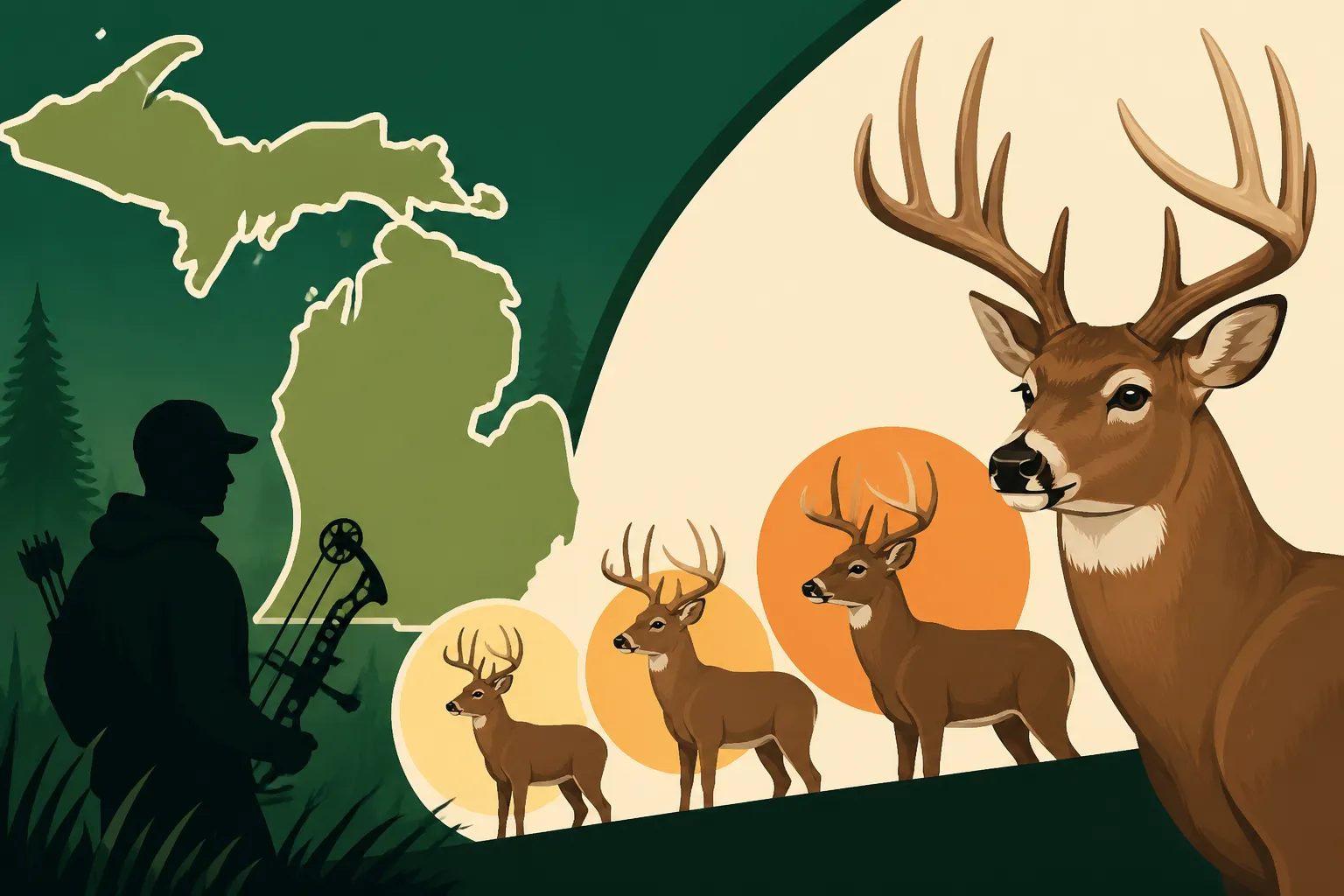
Buck Age Structure Under Michigan APRs
For many Michigan deer hunters, there's a constant quest for that elusive older, bigger-racked buck. It can be frustrating to put in countless hours in the woods, only to feel like you're seeing nothing but young spikes and fork horns, making you wonder if the "good old days" of deer hunting are long gone. You might even question if the current regulations are truly helping. This guide is here to shed light on how Michigan's Antler Point Restrictions (APRs) are specifically designed to influence the buck age structure within our deer herds, offering a deeper understanding of what you're seeing in the woods and how to adapt your hunting strategy.
The Foundation of Antler Point Restrictions in Michigan
Michigan's deer management strategies are always evolving, and few topics spark as much discussion among hunters as Antler Point Restrictions, or APRs. These rules dictate the minimum number of antler points a buck must possess to be considered a legal harvest in certain areas, and they weren't put in place on a whim. They represent a significant shift in how we approach deer management, aiming for specific outcomes in the deer woods that many hunters expressed a strong desire for.
What Are Antler Point Restrictions?
At their core, Antler Point Restrictions are regulations that require a buck to have a certain number of antler points on at least one side to be legally harvested. For example, in many APR zones, a buck must have at least three points on one antler. This "three-point rule" is quite common, but it's crucial to remember that the specific number of points can vary depending on the Deer Management Unit (DMU) you're hunting in. The idea behind these rules is simple: by making young bucks with fewer points illegal to harvest, we allow a greater number of them to survive for at least another year. This gives those bucks the chance to grow older, develop larger antlers, and contribute to a more diverse age structure in the herd. It's about letting those smaller bucks walk today for the potential of a bigger buck tomorrow.
Why Were APRs Implemented?
The implementation of APRs in Michigan wasn't solely a biological decision; it was heavily influenced by hunter feedback and a shared vision for the future of deer hunting in our state. Historically, many areas saw a disproportionate harvest of yearling (1.5-year-old) bucks. While perfectly legal, this often meant that many hunters rarely saw or had the opportunity to harvest older, more mature deer. There was a growing desire among hunters to see more mature bucks with larger antlers, not just for "trophy" reasons, but for a more challenging and rewarding hunting experience overall.
The Michigan Department of Natural Resources (DNR) responded to this desire by piloting and eventually expanding APRs in various DMUs. The primary biological goal was to allow a higher percentage of bucks to reach older age classes. This, in turn, can lead to a more balanced buck-to-doe ratio, and potentially, a more pronounced rut as older bucks are present to compete for breeding. While the science on genetics and herd health specifically linked to antler points is complex and debated, the overwhelming driver for APRs was the social desire to experience hunting in an environment where mature bucks were more common. It's a key part of how Michigan manages its White-Tailed Deer Across Michigan population, trying to balance biological health with hunter satisfaction.
How APRs Reshape Michigan's Buck Age Structure
The most direct and observable impact of Antler Point Restrictions is on the demographic profile of the buck herd. Before APRs, it wasn't uncommon for the vast majority of harvested bucks to be 1.5 years old. These are the "new recruits" to the antlered class, often sporting spike antlers or small forks. APRs act as a protective shield for these younger animals, fundamentally altering who survives and, consequently, who is available for hunters in subsequent seasons.
Protecting Yearling Bucks
This is the cornerstone of APR efficacy. In many APR-mandated areas, a 1.5-year-old buck, which often carries fewer than the required number of points (say, three points on one side for The Three-Point Rule in Michigan), becomes off-limits to hunters. This isn't about making hunting harder; it's about shifting the focus. Instead of being the most vulnerable age class, yearlings gain a significant reprieve. They get to live through their first hunting season, forage through the winter, and return the following year as 2.5-year-old bucks.
This protection is absolutely critical. Imagine a scenario where 70% of bucks harvested were yearlings. With APRs, that number can drop dramatically, sometimes to 20-30% or even lower in well-established APR units. All those bucks that would have been harvested now get an additional year to grow their bodies and, importantly, their antlers. This single mechanism is what drives the profound changes in the Buck Age Structure Under Michigan APRs that hunters observe over time. It creates a domino effect, leading to more mature animals throughout the herd.
Shifting the Age Class Distribution
When APRs effectively protect yearling bucks, the result is a measurable shift in the age distribution of the buck harvest. Before APRs, a typical harvest might look like a pyramid, with a very wide base of 1.5-year-old bucks and very few older animals. After a few years under APRs, that pyramid starts to bulge in the middle.
You'll start to see a significantly higher percentage of 2.5-year-old bucks in the harvest. These bucks are often legal under APRs, having developed enough points to meet the criteria. While a 2.5-year-old buck isn't necessarily a "trophy" in the traditional sense, it's a much more mature animal than a yearling. It's bigger, wiser, and more challenging to hunt. Furthermore, while less dramatic, there's often a slight increase in the proportion of bucks 3.5 years old and older making it into the harvest. This indicates that APRs are successful in allowing a greater number of bucks to reach those older age classes, even if getting them past 3.5 years old still presents a challenge due to natural mortality and continued hunting pressure on legal bucks.
Here’s a simplified look at how APRs can alter the typical buck harvest distribution by age class:
| Buck Age Class | Typical Harvest % (Before APRs) | Typical Harvest % (After APRs) |
|---|---|---|
| 1.5 years old | 60-70% | 20-30% |
| 2.5 years old | 15-20% | 40-50% |
| 3.5+ years old | 5-10% | 15-25% |
This table clearly illustrates the intended shift: fewer young bucks harvested, and more 2.5-year-olds (and some older) taking their place.
Real-World Impacts and the Hunter's Perspective
While the biological data often supports the idea that APRs lead to an older buck age structure, the hunter's experience on the ground can be a nuanced thing. It’s easy to look at data and graphs, but it’s another entirely to be sitting in a treestand, watching deer, and trying to make sense of what you’re seeing through the lens of APRs. The perception versus the reality can sometimes feel at odds, especially for those hoping to see truly giant deer emerge quickly.
More Mature Bucks, or Just More Two-Year-Olds?
This is a common question, and a very valid one. After a few years of APRs, many hunters do report seeing more bucks. However, the feeling often is, "Yes, I'm seeing more bucks, but they're still not big bucks." And this observation is largely accurate. The biggest impact of APRs is usually the significant increase in 2.5-year-old bucks. These deer are certainly larger than yearlings, with bigger body frames and more developed antlers, but they are still far from reaching their full genetic potential in terms of antler size. A 2.5-year-old buck, while legal and a fine animal, might still only be a decent 8-point, not the sprawling 10 or 12-point that many hunters dream of.
The challenge of getting bucks to 3.5, 4.5, and beyond is immense. Michigan’s diverse habitats, from the vast timber of the Upper Peninsula to the farm country of the Lower Peninsula, present different challenges. Factors like habitat quality, nutrition, and especially hunter density and pressure, all play significant roles. Even with APRs, if an area has high hunter numbers, a 2.5-year-old buck, now legal, might be harvested before it ever gets to see its third or fourth birthday. So, while APRs undeniably shift the age structure upward, the degree to which truly old bucks become common still depends heavily on local conditions and hunter choices.
Hunter Choices and Perceptions
APRs undoubtedly force hunters to become more selective, and this selectivity itself fosters a culture of evaluating antler size and number of points. It’s no longer just about seeing a buck, but about seeing a legal buck. This can lead to some tense moments in the stand, trying to count points, especially if a buck is moving quickly or cover is thick. Many hunters, even in APR units, adopt a "Gohunt" mentality, choosing to pass even legal 2.5-year-old bucks in hopes of seeing something even older. This self-imposed restraint can further enhance the effects of APRs, but it also adds another layer of mental challenge to the hunt.
There can be frustration when a hunter consistently passes smaller, legal bucks but never sees a truly mature one, leading to empty tags and sometimes, disillusionment. On the flip side, many hunters appreciate the increased sightings of antlered deer and the greater challenge of identifying a legal buck. The process of Counting Antler Points Under Michigan APRs can become a key skill, and the satisfaction of letting a younger buck walk, knowing he has a better chance to grow, is a reward in itself. For some, the positive experience of having more buck encounters outweighs the difficulty of filling a tag, while for others, the goal remains solely that mature, older buck. It's a balance, and understanding your DMU's specific rules is paramount; never assume. If you're unsure if a buck is legal, it's always best to err on the side of caution and let it walk, especially if you're like me and struggle with Passing a Buck You Cannot Count.
Strategies for Hunting Under Michigan's APRs
Hunting in areas with Antler Point Restrictions requires a slightly different mindset and often, an adjusted strategy. It's not just about finding deer; it's about finding legal deer, and ideally, those older age class bucks that APRs are designed to promote. To be consistently successful, you need to be informed and adapt your approach.
Understanding Your Specific DMU
The first and most critical step is knowing the exact rules for the specific area you plan to hunt. APRs are not uniform across Michigan. They are implemented in specific Michigan Deer Management Units, and the requirements (e.g., 3 points on one side, 4 points on one side, or no APRs at all) can vary. You simply cannot assume. Before you head out, you need to check the current Michigan Hunting Digest, consult the Michigan DNR website, or use helpful resources like the Michigan Antler Point Restrictions by DMU map. For example, some areas in the Lower Peninsula’s restricted firearm zone might have APRs, while others won't. Being caught unaware of the regulations can lead to a costly mistake, so make it a habit to confirm the rules for your hunting spot every season. Modern tools like The Michigan DNR Hunt Fish App can be incredibly useful for this, providing up-to-date regulations right in your pocket.
Adapting Your Hunting Approach
Since APRs are designed to protect younger bucks, your focus as a hunter should shift towards identifying and targeting those older age classes that are legal. This means your scouting, stand placement, and even your in-field tactics might need an adjustment:
- Scout for Older Buck Sign: Mature bucks behave differently than yearlings. They often leave bigger rubs, larger tracks, and more pronounced scrapes. Instead of just looking for any deer sign, start keying in on sign that indicates an older, heavier deer is using the area. Focus your scouting on thicker cover, transition areas, and food sources that might appeal to more cautious animals.
- Patience is a Virtue: You will likely pass more deer than you did before APRs were in place. Embrace it. The goal is to let those young bucks grow. This requires discipline and patience, but it also means that when a legal buck does step out, you’ve earned that shot.
- Target Mature Buck Habitat: Older bucks are often found in areas that offer good cover, consistent food, and low human intrusion. If you're hunting public land, this might mean walking further off the beaten path or exploring overlooked corners. For example, learning to read aerial photos to find areas like Where Big Woods Bucks Bed in Michigan or identifying prime locations for Hunting Michigan Swamp Edges for Deer can put you in front of older deer.
- Employ Calling Tactics: As bucks age, they become more dominant and territorial. This can make them more responsive to calling. During the rut, rattling antlers or using a grunt tube can be highly effective for drawing out an older buck that might be reluctant to step into the open. Understanding Rattling and Grunting in Michigan techniques and when to deploy them can greatly increase your odds. GoHunt, with its detailed mapping and historical data tools, can also aid in pinpointing areas known for higher deer densities or less pressure, which might be more conducive to finding those older bucks. This helps you refine your focus from just finding "deer" to finding areas with the potential for legal, older bucks.
- Manage Expectations: While APRs are effective at shifting the buck age structure, they don’t guarantee a Boone and Crockett buck behind every tree. Celebrate the process, the learning, and the opportunities you have to be in the woods. The shift to a more mature buck population is a long-term endeavor, and every hunter who participates by adhering to APRs contributes to that goal.
By understanding the "why" behind APRs and adapting your hunting style, you can increase your chances of encountering and ultimately harvesting the kind of mature buck that these regulations are designed to foster.
Disclaimer
This article is for general informational purposes only and does not constitute professional advice. Laws, prices and regulations vary by location and change over time. Consult a qualified professional for guidance on your specific situation.