Decoy Spreads for Great Lakes Divers
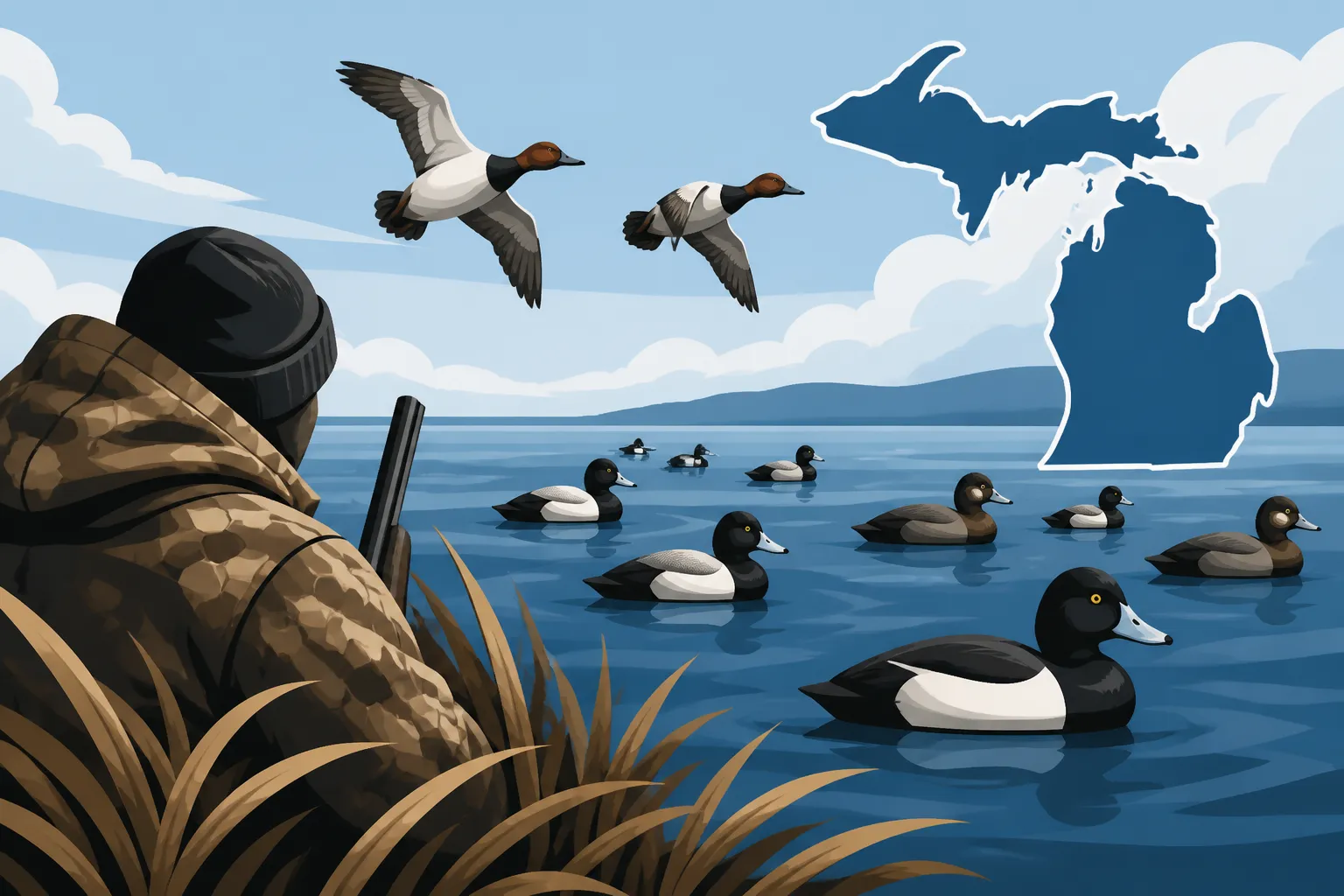
Hunting diver ducks on Michigan's vast Great Lakes is a truly unique challenge, one that often leaves hunters scratching their heads as rafts of birds land miles offshore, seemingly oblivious to their efforts. The sheer scale of the water, coupled with ever-changing winds and strong currents, makes traditional decoy strategies fall flat. This guide aims to pull back the curtain on effective decoy spreads specifically designed to entice those fast-flying bluebills, redheads, and canvasbacks into shooting range on Michigan's challenging big water.
Understanding Diver Duck Behavior on the Great Lakes
Diver ducks are a different breed from the puddle ducks many of us grew up hunting in local marshes. Their habits, feeding preferences, and flight patterns are fundamentally shaped by the open water environment of the Great Lakes, and understanding these differences is the first step to successful decoying.
Why Divers are Different
Unlike their puddle duck cousins, which "tip up" to feed in shallow water, diver ducks like bluebills, redheads, and canvasbacks propel themselves underwater, often to considerable depths, to find their meals. This means they are inherently drawn to deeper, open water habitats rather than the shallow, vegetated margins that attract mallards and wood ducks. They also tend to congregate in massive rafts, sometimes numbering in the thousands, providing them with a sense of security on the vast expanses of the Great Lakes. It's easy to get discouraged when you see huge rafts of bluebills and redheads sitting miles out, seemingly unreachable, but understanding their preference for open water is key. These birds often fly much faster and lower over the water than puddle ducks, hugging the waves, which means your spread needs to be highly visible and positioned correctly to grab their attention.
Their social nature also plays a huge role in how they respond to decoys. A small handful of blocks that might fool a couple of mallards will likely be ignored by a flock of divers accustomed to seeing hundreds or thousands of their kind. They often circle high, assessing the situation, before committing to a landing, demanding a convincing and welcoming spread. Moreover, they are incredibly powerful fliers, capable of covering vast distances quickly, so your spread needs to intercept them effectively in their travel lanes rather than hoping they stumble upon your setup.
Key Species and Their Habits
Michigan's Great Lakes host a variety of diver species, each with subtle differences in behavior that can influence your decoy strategy. Knowing your quarry helps immensely in fine-tuning your spread.
- Bluebills (Scaup): Often seen in enormous rafts, both greater and lesser scaup are widespread. They are generally shyer than some other divers and respond best to very large spreads that mimic the safety of a big flock. They tend to stick to open water, feeding on mussels and other invertebrates. Trying to figure out what each species wants on a given day can feel like a guessing game, but for bluebills, sheer numbers in your spread are often a good starting point.
- Redheads: These striking divers are also highly social and frequently mix with bluebills. They're a bit more responsive to decoys than scaup and will often work a spread well, especially if it's positioned near natural feeding grounds or travel corridors. Redheads are known to feed on submerged vegetation and mollusks in slightly shallower open water areas than some other divers.
- Canvasbacks: The "king" of divers, canvasbacks are highly prized for their speed and wariness. They often fly in distinctive V-formations, much like geese, and can be incredibly difficult to decoy. They prefer to feed on wild celery and other aquatic plants, often in specific bays or areas known for these food sources. A dedicated canvasback spread might need to be even larger and more realistic, perhaps even isolated from other diver species, to truly convince these birds.
- Goldeneyes and Buffleheads: These smaller, faster divers are often found closer to shore, in protected bays, or around rock outcroppings. While they still prefer open water, they are often less wary than the big raft birds and may decoy more readily to smaller, active spreads. They're quick fliers and often respond well to motion in the water.
- Long-tailed Ducks (Oldsquaws): While more associated with Arctic waters, long-tailed ducks are regular visitors to the Great Lakes, particularly during colder months. They are incredibly hardy, often found in very rough, icy water, and have distinctive, musical calls. Hunting them requires specialized gear and an even greater emphasis on safety due to the extreme conditions they inhabit.
Understanding these species-specific preferences, from their preferred feeding depths to their general wariness, allows you to tailor your decoy setup for the best possible results. You can find more insights into migration patterns and species distribution in resources like Michigan Waterfowl Migration Timing or specific locations like Diver Ducks on Saginaw Bay and Canvasbacks on Lake St. Clair.
Essential Gear for Great Lakes Diver Spreads
Hunting divers on the Great Lakes isn't just about throwing out a few plastic ducks; it demands specialized gear designed to withstand the harsh conditions and effectively attract these open-water birds. From the decoys themselves to the rigging that holds them, every piece plays a crucial role.
Decoy Selection and Quantity
When it comes to diver hunting on the Great Lakes, the mantra "quantity is king" truly applies. These birds are accustomed to seeing massive rafts of their kind, so a small spread of a dozen decoys might be completely overlooked on the vastness of Lake Michigan or Saginaw Bay. Successful diver hunters often deploy spreads ranging from 50 to 200 or even more blocks to create a convincing illusion of a large, safe haven. The bigger the water, the bigger your spread often needs to be to grab their attention from a distance.
While a mix of species in your spread can be effective, it's often wise to lean heavily on the dominant species you expect to encounter. If you're seeing huge numbers of bluebills, make them the bulk of your spread. However, a few redheads mixed in, or a separate cluster of canvasbacks if you're targeting them, can add realism. Decoy size and visibility are equally crucial. Standard-sized decoys can get lost in the chop and waves of the Great Lakes. Magnum and super-magnum decoys are highly recommended as their larger profiles stand out better, increasing your spread's effective range. Paint schemes that offer high contrast and realism, especially in varying light conditions and choppy water, are also paramount. Many hunters rely on robust, high-visibility decoys, and resources like GoHunt can help you research the best options for durability and realism, ensuring your investment pays off on the water.
Rigging for Big Water
The Great Lakes are not forgiving, and their strong currents, powerful waves, and significant depths demand rigging that is up to the task. Flimsy lines and light weights are a recipe for disaster, and there's nothing worse than watching a thousand-dollar spread of decoys drift away with the current because of flimsy rigging.
-
Texas Rigs vs. Longlines: These are the two primary rigging methods for diver hunting.
- Texas Rigs: These consist of individual decoys with a loop of line, a weight on one end, and a clip on the other. They are fast to deploy and retrieve, making them excellent for smaller groups of decoys, actively moving your spread, or hunting in areas where you might need to pick up quickly. The weights keep the decoy upright, and the clip makes attachment to a main line or individual retrieval easy.
- Longlines: Longlines are the workhorse for large, organized diver spreads. They consist of a heavy main line (often tarred trotline or heavy mono) with multiple decoy drops spaced along its length. Each drop has a clip to attach a decoy. Longlines allow you to deploy many decoys at once in a consistent pattern, creating a more uniform and realistic raft effect. While they take more initial time to set and retrieve, they make managing a massive spread much more efficient.
-
Heavy Weights and Durable Line: Great Lakes currents and waves will make short work of inadequate rigging. For longlines, you'll need substantial anchor weights (e.g., 2-4 pounds) at each end to hold the line in place. For Texas rigs, individual decoy weights should be heavier than you'd use in a marsh, often 16-24 ounces in rough conditions, to prevent them from drifting. The line itself needs to be incredibly strong and abrasion-resistant. Heavy monofilament, tarred trotline, or even paracord can be used, with swivels and heavy-duty clips at all connection points to prevent tangles and breakages.
-
Deep Water Considerations: You'll frequently be setting decoys in water much deeper than what you'd encounter in a typical marsh—sometimes 10, 20, or even 30+ feet deep. Ensure that your decoy drops on longlines are long enough to reach the bottom with some slack, and that your Texas rigs have sufficient line for the depths you'll be hunting. Trying to hunt deep water with shallow-water rigging will only lead to frustration and lost decoys.
Here's a quick comparison of the two main rigging types:
| Feature | Longlines | Texas Rigs |
|---|---|---|
| Decoy Quantity | Excellent for large spreads (25+ per line) | Better for smaller groups or active movement (1-15) |
| Deployment Time | Longer initial setup, faster for many decoys | Quick and easy for individual decoys |
| Retrieval Time | Longer, especially if tangled | Fast, less tangling |
| Management | Organized, easy to adjust a line of decoys | Individual decoys, can drift if not weighted properly |
| Water Depth | Best for deeper water, less prone to tangling | Adaptable, but can tangle in shallow brush |
| Cost | Initial cost for line, weights, crimps | Weights and loops for each decoy |
| Durability | Very durable with heavy line and swivels | Good, but individual rigs can snag |
| Visibility | Creates a clear, continuous line of birds | More scattered, but can be pulled close for action |
Classic Diver Decoy Spreads and Their Applications
Once you have your gear sorted, the next step is understanding how to arrange your decoys to maximize their appeal. Diver hunters have developed several classic spread configurations, each with its own advantages for different conditions and bird behaviors.
The "J" Hook or Fish Hook Spread
The "J" hook, or fish hook, spread is a tried-and-true layout for diver hunting. Imagine a capital "J" laid on its side. The main body of your decoys forms the curved part of the "J," creating a large, inviting mass of birds. A longer, thinner "tail" then extends out from this mass, typically into the prevailing wind or towards deeper water and a known travel lane. The purpose of this tail is to act as a highly visible "runway" or attractant, drawing the attention of distant birds and guiding them towards the main body of the spread.
Divers almost always land into the wind, much like an airplane landing on a runway. Therefore, the bend of the "J" is precisely where you want birds to commit and land. Your boat or blind is strategically positioned on the inside curve of the hook, allowing you to remain concealed while having incoming birds finish right in front of you. This spread excels at funneling birds into a prime shooting zone, offering a clear landing strip while making your setup appear as a natural, unpressured flock. It's particularly effective when hunting a point or a subtle current seam where birds naturally gravitate.
The "V" or "Wedge" Spread
Another highly effective spread for divers is the "V" or "wedge" formation. This setup mimics a natural raft of ducks resting on the water, with a clear, open landing strip right in the middle. The decoys are arranged in a V-shape, with the open end of the "V" facing the direction from which you expect birds to approach—which is typically directly into the wind. This open "mouth" of the V acts as a natural invitation for incoming birds to cup their wings and settle down right where you want them.
The V-spread offers a distinct shooting pocket directly within its opening, providing excellent shot opportunities. You can vary the size and tightness of the V depending on the number of decoys you have and the conditions. A single, wide V might be ideal for a larger spread, while a tighter V or even a "Wedge" (essentially a double V) can create an even more pronounced landing zone. This spread is fantastic for drawing birds straight in, giving them a clear path and making them feel secure enough to commit. It's a fundamental spread that works well across many diver species and conditions on Michigan's open waters.
The "X" Spread or "Monster Rig"
For those truly committed to diver hunting on the vast Great Lakes, the "X" spread, sometimes called a "Monster Rig," represents the pinnacle of visibility and attraction. As the name suggests, this spread consists of two longlines that cross each other, forming an "X" pattern on the water. Decoys are attached along the arms of the "X," with often denser clusters at the intersection and ends of the lines. The sheer size and distinct shape of an X-spread make it incredibly visible from a great distance, allowing you to pull birds from further out on the lake than smaller, more conventional spreads.
The primary purpose of the X-spread is to create multiple potential landing zones and a massive visual footprint. Incoming birds can pick any of the four "arms" or the central intersection to commit, giving you flexibility and increasing your chances of success. While it's a more involved setup, requiring more time, decoys, and robust rigging, the payoff can be significant, especially on huge bodies of water where getting noticed is half the battle. This spread is often employed by seasoned diver hunters who brave the biggest waters. For those truly dedicating themselves to diver hunting, exploring advanced setups like the "Monster Rig" might require research into specialized gear, which can often be found through hunting communities and databases like those accessible via GoHunt, helping you find the right equipment for these demanding setups.
Advanced Tactics and Considerations for Divers
Beyond the basic spreads, a few advanced tactics and keen observations can significantly elevate your diver hunting success on the Great Lakes. These often come down to subtle details that make your spread more realistic and responsive to the conditions.
Motion Decoys and Confidence Birds
In the vast, often monochromatic environment of the Great Lakes, static decoys can sometimes disappear, especially on calm days. Adding movement to your spread can be a game-changer. Motion decoys, such as battery-operated swimmers, flappers, or even simple jerk strings operated from your blind, can simulate active feeding or preening, which is a huge draw for wary divers. That subtle ripple or splash can be the final convincing element that turns a circling flock into committed callers. However, it's crucial to always check current Michigan hunting regulations regarding motorized decoys, as rules can vary.
Beyond mechanical motion, incorporating "confidence birds" can add another layer of realism. A few full-body Canada goose decoys strategically placed on the edge of your diver spread, or even a legal swan decoy, can signal to incoming ducks that the area is safe. Geese are often seen resting on big water, and their presence suggests a peaceful, undisturbed environment. Don't be afraid to mix in a few coot or even gull decoys on the outer edges of your spread; divers often associate with these non-game birds, and their inclusion can make your setup appear even more natural. These small details can often mean the difference between birds flaring off and cupping their wings for a landing.
Reading the Water and Adjusting Your Spread
The Great Lakes are dynamic, and what worked yesterday might not work today. Successfully hunting divers often boils down to your ability to "read the water" and adjust your spread in real-time.
- Wind and Current: Always, always consider wind direction and strong currents. Birds land into the wind, so your spread needs to be oriented to provide a clear landing strip from that direction. Strong currents can quickly pull your carefully set spread out of shape, collapsing your intended V or J. You might need to use heavier weights, longer lines, or adjust the angle of your spread to compensate. It’s maddening to meticulously set a spread only to have the wind shift, rendering your carefully planned setup completely ineffective. Just like adapting to deer movement during Hunting the Michigan Rut in November, you have to be ready to change your tactics for diver ducks.
- Bottom Structure: If you have access to a good depth finder or nautical charts, pay attention to bottom structure. Divers often feed over shoals, drop-offs, or areas with specific aquatic vegetation. Positioning your spread near these natural feeding grounds, even if they are subtly marked on the surface, can put you right where the birds want to be. Understanding where the food is located is paramount.
- Bird Movement: Watch how birds are flying. Are they hugging a shoreline or breaking point? Are they crossing a specific channel or flying down the middle of a bay? Pay attention to their natural flight paths and adjust your setup to intercept these lanes. Sometimes, moving your entire spread just 50 yards can make all the difference. Don't be afraid to pick up and reposition if the birds aren't working your decoys as intended; a stubborn attachment to a "perfect" but unproductive spot is a common mistake.
Boat Blinds and Concealment
You can have the perfect spread, but if you're sky-busting or silhouetted against the horizon, those smart diver ducks will flare every time. Effective concealment is non-negotiable for diver hunting.
- Layout Boats: For open-water hunting, a layout boat is the ultimate in concealment. These low-profile craft allow you to lie down within your decoy spread, making you virtually invisible on the water. They are incredibly effective but require a tender boat for transport, deployment, and safety. Layout Hunting Michigan Big Water provides an excellent deep dive into this specialized method.
- Shore Blinds/Pop-ups: If you're hunting from a point, island, or subtle shoreline feature, a well-built shore blind or pop-up blind is essential. It must blend in seamlessly with the natural surroundings. Use local vegetation like cattails, dogwood branches, or even sand and rocks to break up your silhouette. Avoid anything that stands out unnaturally against the horizon.
- Natural Cover: Sometimes, the best blind is simply good use of natural cover. A small rise of land, a thick clump of brush, or even a large boulder can provide enough concealment if used correctly. Always position yourself with the sun at your back and the wind in your face to optimize concealment and give you the best shot angle at incoming birds. Remember, a camouflaged face and hands are just as important as your blind material when those keen-eyed divers are scrutinizing your setup.
Safety First on Michigan's Great Lakes
Hunting on Michigan's Great Lakes is an exhilarating experience, but the sheer power and unpredictable nature of these waters demand an unwavering commitment to safety. Disregarding safety protocols can turn a fantastic hunt into a life-threatening situation in an instant.
Weather and Water Conditions
The Great Lakes are notorious for rapidly changing weather. A calm, glassy morning can transform into a white-capping gale in a matter of minutes, leaving hunters stranded or in peril. Always check multiple reliable weather sources before you even leave home and continue to monitor conditions throughout the day. Pay close attention to wind forecasts, wave heights, and temperature changes. The GoHunt platform often integrates weather data, which can be a lifesaver in planning your trip, allowing you to make informed decisions about whether to even launch. I've seen more than one hunter get caught out when a calm November morning suddenly turned into a white-capping nightmare, and it's a terrifying experience no one should have to endure.
Beyond the wind and waves, cold water and air temperatures are a constant and deadly threat, especially during the prime diver hunting months of late fall and early winter. Hypothermia can set in quickly, even on relatively mild days, if you become wet. Dress in multiple layers of warm, synthetic or wool clothing that retains insulating properties when wet. Always wear a personal flotation device (PFD), and have emergency dry clothes stored in a waterproof bag. Never underestimate the power of these vast bodies of water; respect them, and they might just allow you to enjoy your hunt safely.
Essential Safety Gear
Having the right safety gear isn't just a recommendation; it's a lifeline. Always ensure your boat is properly maintained and equipped before hitting the water for Great Lakes Waterfowl Hunting in Michigan.
- PFDs (Personal Flotation Devices): This is non-negotiable. Everyone in the boat should wear a PFD at all times, especially in cold water or rough conditions. Modern PFDs are comfortable and don't impede movement.
- VHF Radio/Cell Phone: While cell phones can work near shore, a marine VHF radio is often more reliable on open water. It allows you to communicate with the Coast Guard and other boats. Ensure your battery is charged, or have extra power sources.
- Anchor and Rope: A robust anchor system with enough rope for the depths you'll be hunting is crucial. It can keep you from drifting into dangerous situations or allow you to ride out unexpected squalls.
- Flare Gun/Whistle: Essential signaling devices to attract attention in an emergency. Make sure your flares are current and not expired.
- First Aid Kit: A well-stocked first aid kit can handle minor injuries and stabilize more serious ones until help arrives.
- Emergency Blanket/Dry Clothes: Stored in a waterproof dry bag, these can be critical if someone gets wet or succumbs to the cold.
- Paddle/Oars: Even if you have a motor, a backup form of propulsion can save your skin if your engine fails.
For more detailed information on staying safe in a layout boat specifically, refer to Big Water Safety in a Layout Boat.
Navigational Awareness
On the expansive and often featureless Great Lakes, it's incredibly easy to become disoriented, especially in fog, low light, or during a white-out. Strong currents can also carry you far from your intended position without you realizing it.
- GPS/Charts: A reliable GPS unit (dedicated or on a marine-grade chart plotter) loaded with up-to-date nautical charts is essential. Know your location at all times, identify submerged hazards like shoals or old cribs, and be aware of any restricted zones. Modern phone apps can be good backups but shouldn't be your primary navigation tool on big water.
- Knowledge of the Area: Familiarize yourself with your chosen hunting area well before the season. Understand local currents, depths, and potential obstacles. Knowing where you are and what's around you, even if obscured by weather, is a critical safety measure.
- Tell Someone Your Plan: This is perhaps the simplest yet most vital safety precaution. Always inform a reliable person—a spouse, friend, or family member—of your hunting location, your expected departure and return times, and who is with you. Give them a copy of your float plan. If you don't check in, they'll know something is wrong and can initiate a search. Never go out on the Great Lakes alone without someone knowing your precise plans.
Disclaimer
This article is for general informational purposes only and does not constitute professional advice. Laws, prices and regulations vary by location and change over time. Consult a qualified professional for guidance on your specific situation.