Shot Size for Grouse and Woodcock
Trying to figure out the perfect shot size for Michigan's ruffed grouse and timberdoodles can feel like a never-ending debate around the campfire. Every hunter has an opinion, and the dense cover we often navigate here adds another layer of complexity. This guide will cut through the noise, helping you understand the nuances of shot size so you can make an informed choice for more successful and ethical hunts for these incredible upland birds.
Understanding the Game: Grouse and Woodcock Anatomy & Habitat
Before we even talk about pellets, it's vital to understand the targets themselves. Grouse and woodcock, while both upland birds, present very different challenges, largely due to their size, feathering, and the specific habitats they call home in Michigan.
Ruffed Grouse: Tough Birds in Thick Cover
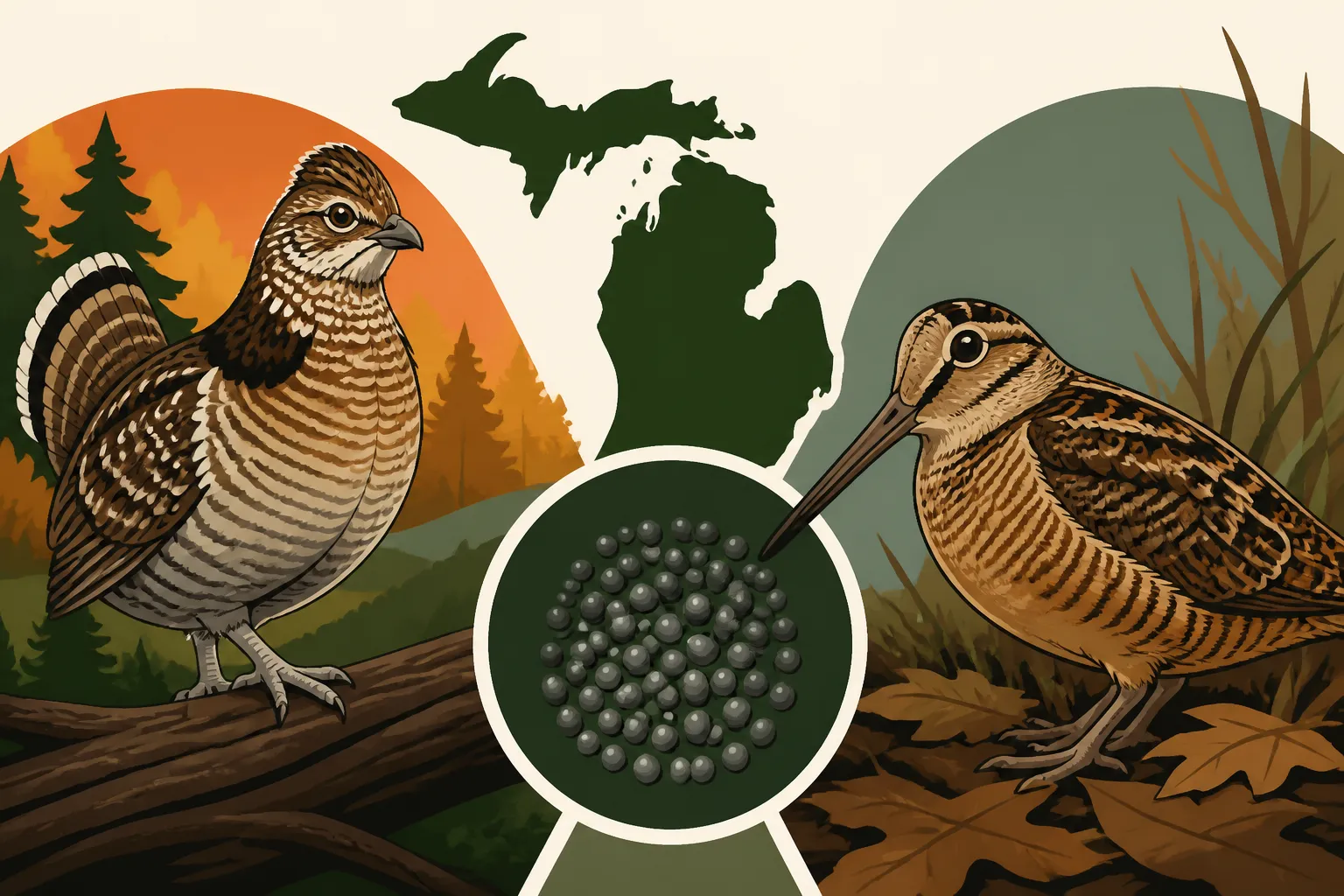
Michigan's ruffed grouse are hardy, robust birds. If you've ever had one thunder out of an aspen thicket, you know they're built for speed and resilience. Their dense feathering acts like armor, and their bone structure is surprisingly tough, especially around the body. This means you need sufficient kinetic energy from your shot to penetrate effectively and deliver a clean kill.
These birds love thick cover – regenerating aspen stands, forgotten apple orchards, dense pine plantations, and young hardwood forests are prime habitat. When they flush, they burst out explosarily, often weaving through branches at incredible speeds. Most shots you get on grouse in Michigan will be close-range, fast, and fleeting, usually within 20-30 yards, sometimes even closer. This close proximity and their ability to quickly disappear behind timber demand a pattern dense enough to catch them but with enough punch to anchor them. Grouse Hunting Michigan Aspen Cover is a classic scenario where shot size really matters for penetration.
American Woodcock: Small Target, Vulnerable in Alder
In stark contrast to the grouse, the American woodcock, often affectionately called a "timberdoodle," is a much smaller, more delicate bird. Their feathers aren't as dense, and their bone structure is much finer. When they flush, especially in the tangled mess of an alder run or a tag alder swamp, they typically ascend vertically for a few yards before leveling off into a somewhat slower, erratic flight path.
Woodcock prefer damp, boggy areas, often found along stream bottoms, near beaver ponds, or in dense alder and willow thickets. Their smaller size and less robust build mean you don't need heavy-hitting pellets for penetration. Instead, the challenge is hitting such a small, erratic target amidst thick cover. A wider, denser pattern is often more critical than individual pellet energy. Woodcock Hunting Michigan Alder Runs is the textbook habitat for these fascinating migrants.
The Science of Shot: Pellet Count, Energy, and Patterning
Choosing the right shot size isn't just about what "feels right" or what your grandpa always used. There's a science to it, balancing the number of pellets in your pattern with the energy each pellet carries.
Pellet Count vs. Pellet Energy
This is the core trade-off when selecting shot size.
- Smaller shot sizes (higher numbers like 8 or 9): These loads contain a greater number of pellets. A 12-gauge shell loaded with #8 shot will have significantly more pellets than one loaded with #6 shot. More pellets mean a denser pattern, increasing your probability of hitting a fast-moving, small target like a woodcock. However, each individual #8 pellet carries less kinetic energy, reducing its penetration and knockdown power on a tougher bird like a grouse at longer ranges.
- Larger shot sizes (lower numbers like 6 or 7.5): These loads contain fewer pellets. A 12-gauge shell with #6 shot will have fewer pellets than one with #7.5 shot. Fewer pellets mean a slightly less dense pattern. However, each #6 pellet is heavier and carries more kinetic energy, improving its ability to penetrate dense feathers and bone, making it more effective for larger, tougher birds like grouse, especially if the shot is a bit further out.
The goal is to find the sweet spot where you have enough pellets to ensure a hit within your effective range, and each pellet carries enough energy to cleanly dispatch the bird.
Patterning Your Shotgun
Understanding the science is one thing, but seeing how your specific shotgun and choke combination performs with different loads is another. Patterning is essentially shooting at a large paper target (like a 40-inch square) at various distances (e.g., 20, 30, and 40 yards) to see how your pellets spread.
For grouse and woodcock in Michigan, most shots are within 30 yards. You'll want to see a consistent, even distribution of pellets across the target with no major "holes" that a bird could fly through unscathed. A sparse pattern, or one with an inconsistent distribution, means you're leaving too much to chance. Many hunters underestimate the importance of patterning, but it's crucial for understanding your effective range with a particular load. Resources like GoHunt can be invaluable for researching and comparing various shotgun loads and choke tubes, giving you a better idea of what combinations might work well for upland hunting before you even head to the range.
Choke Selection and Shot Size Synergy
Your choke tube plays a huge role in how your shot spreads. It's the constriction at the end of your barrel that controls the pellet spread.
- Open chokes (Cylinder, Skeet, Improved Cylinder): These allow the shot pattern to spread out more quickly. They are excellent for the very close-range shots typical of Michigan upland hunting, especially in dense cover where birds flush tight. An Improved Cylinder is a common starting point for grouse and woodcock.
- Tighter chokes (Modified, Full): These keep the shot pattern denser for longer distances. While useful for waterfowl or pheasants in open fields, a Full choke with small shot at 15 yards can result in a pattern so tight it might entirely miss the bird, or be so dense it destroys the meat.
The synergy between choke and shot size is important. Using too tight a choke with very small shot (#8 or #9) at close range can lead to blown patterns or insufficient spread. Conversely, an overly open choke with large shot (#6) might spread too quickly, leaving too few pellets in the pattern to guarantee a hit at a reasonable distance. Most Michigan upland hunters find a sweet spot with Improved Cylinder or Light Modified chokes for grouse and woodcock. Upland Guns for Aspen and Alder often discusses this very combination.
Recommended Shot Sizes for Michigan Grouse and Woodcock
Let's get down to the brass tacks: what shot sizes are generally recommended for these two unique birds in Michigan's cover?
Dedicated Grouse Loads
For ruffed grouse, most experienced Michigan upland hunters gravitate towards #7.5 shot or #6 shot.
- #7.5 shot: This is arguably the most popular all-around upland load. It offers a fantastic balance of pellet count and individual pellet energy. You get a dense enough pattern for those quick, close-range flushes in thick aspen, and each pellet carries enough energy to reliably penetrate a grouse's dense feathers and anchor the bird for a clean kill. It's often the go-to for hunters navigating Michigan's varied grouse cover.
- #6 shot: Some hunters prefer #6 shot, especially if they anticipate slightly longer shots or hunt in more open cover where birds might get out a bit further before being engaged. The larger pellets of #6 shot carry more energy, which can be beneficial for penetration. The trade-off is a slightly lower pellet count, meaning a marginally less dense pattern. If you're consistently shooting beyond 30 yards on grouse (which isn't common in Michigan's typical grouse haunts), #6 might give you a bit more confidence. However, for most tight cover hunting, #7.5 generally suffices.
These recommendations hold true across common gauges like 12, 20, and 28 gauge. A 20-gauge with #7.5 shot is a phenomenal combination for a day of walking Michigan's grouse woods.
Dedicated Woodcock Loads
When targeting only American woodcock, a different approach is often warranted due to their smaller size and more delicate build. Here, maximizing pellet count for a wider, denser pattern is usually the priority.
- #8 shot: This is an excellent choice for dedicated woodcock hunting. The sheer number of pellets in a #8 load significantly increases the chances of hitting the small, erratic target. While individual #8 pellets carry less energy than #7.5 or #6, it's more than sufficient to dispatch a woodcock cleanly. Most woodcock shots are very close, often under 20 yards, making the dense pattern of #8 shot incredibly effective.
- #9 shot: Some hunters go even smaller with #9 shot, particularly in very dense cover where shots are almost always under 15 yards. This provides the ultimate in pellet count and pattern density. However, beyond very close ranges, the energy of #9 shot can drop off, making #8 generally a more versatile choice for woodcock.
For woodcock, open chokes like Improved Cylinder are almost always preferred to allow the pattern to open quickly, maximizing the chances of connecting with the bird in the tight confines of an alder run.
All-Around Upland Loads for Mixed Bags
The reality for many Michigan upland hunters is that you'll often encounter both grouse and woodcock in the same areas. It's not uncommon to flush a grouse from an aspen thicket only to find a woodcock in a damp depression just a few yards away. This presents the classic "mixed bag" dilemma.
For this common scenario, #7.5 shot often emerges as the best compromise. It strikes a good balance:
- For grouse: #7.5 provides enough energy and pattern density to effectively take grouse at typical ranges.
- For woodcock: While not as many pellets as #8 or #9, #7.5 still delivers a dense enough pattern to hit woodcock, and the pellets carry ample energy for a clean kill.
If you know you're entering prime woodcock territory (like a dense alder swamp) after hunting grouse, you could consider carrying a few shells of #8 shot in your vest and swapping them in. This versatility allows you to optimize for the birds you're most likely to encounter. Exploring different manufacturers and their upland-specific loads is where a tool like GoHunt can really shine, helping you find those perfect compromise loads or even specific shells designed for mixed bags. Grouse and Woodcock Hunting in Michigan often involves this kind of flexibility.
| Shot Size | Pellet Count (Approx. per oz.) | Typical Use | Target Bird in Michigan | Advantages | Disadvantages |
|---|---|---|---|---|---|
| #9 | 585 | Very Light | Small Birds, Very Close | Max pellet count, very dense patterns at close range | Low individual pellet energy, limited effective range, less penetration |
| #8 | 410 | Light Upland | Woodcock, Quail, Doves | High pellet count, great for small, fast targets | Reduced energy for tougher birds or longer shots |
| #7.5 | 350 | Standard Upland | Grouse, Pheasant, Doves, Woodcock | Excellent balance of pellet count and energy, good all-rounder | Not specialized for either extreme (super small/close vs. super tough/far) |
| #6 | 225 | Heavy Upland | Grouse, Pheasant, Rabbits | More individual pellet energy, better penetration | Lower pellet count, less dense pattern at close range |
Note: Pellet counts are approximate and can vary slightly by manufacturer and load.
Practical Considerations and Personal Preference
Beyond the technical specifications, there are several practical factors that influence your shot size choice when hunting Michigan's uplands.
Shotgun Gauge and Recoil
The gauge of your shotgun (12, 20, 28, .410) certainly influences load availability and how much recoil you'll experience. For Michigan upland hunting, where you might walk miles through dense cover, a lighter-recoiling 20-gauge or 28-gauge is often preferred. They are easier to carry, quicker to swing in tight quarters, and reduce fatigue over a long day. A 20-gauge firing #7.5 shot is incredibly effective for both grouse and woodcock and offers a pleasant shooting experience. The key is to match the shot size to the gauge for optimal patterning and energy.
Ammunition Type and Cost
Most upland loads for grouse and woodcock in Michigan will be lead shot, as non-toxic shot is generally only required for waterfowl hunting or on specific managed areas where lead is prohibited. Lead shot offers excellent ballistic performance and is typically more affordable. Always check local regulations for any specific non-toxic shot requirements in your hunting area, though for general state land upland hunting, lead is almost always permissible. Michigan Small Game and Furbearer Seasons provides more details on regulations.
Ammunition cost can be a factor, especially if you're doing a lot of patterning or shooting hundreds of rounds a season. Standard game loads are usually quite economical, but specialty loads with unique shot compositions can be more expensive. It's worth trying a few different brands and loads with your shotgun to see what patterns best without breaking the bank.
Ethical Considerations and Clean Kills
Ultimately, the goal of any hunter is to achieve a swift, humane, and clean kill. This isn't just about bagging a bird; it's about respect for the game. Using the correct shot size, combined with proper choke selection and patterning, dramatically increases your chances of doing just that.
A load that's too light or too sparse can wound a bird, leading to unnecessary suffering and lost game. Conversely, a pattern that's too tight with too much power for a delicate bird like a woodcock can damage the meat excessively. Understanding the balance and practicing your shooting ensures you're making the most ethical choice in the field. Every shot counts, and making it count in the right way is paramount. Flushing Grouse Without a Dog and Hunting Woodcock in Alder Runs both emphasize the need for quick, accurate shots.
Disclaimer
This article is for general informational purposes only and does not constitute professional advice. Laws, prices and regulations vary by location and change over time. Consult a qualified professional for guidance on your specific situation.